

Sourcing surgical gowns from India is both a critical decision and a frustrating one. Hundreds of manufacturers operate across Gujarat, Tamil Nadu, and Delhi NCR. All of them claim ISO certifications. All of them promise competitive MOQs. But finding who truly delivers on sterile integrity, AAMI-compliant barrier protection, and solid export logistics? That’s the hard part.
Your situation might look like one of these:
- You’re a hospital procurement head weighing Level 3 vs. Level 4 gown options
- You’re a distributor building a new supply chain from scratch
- You’re an international buyer looking for competitive SMS surgical gown pricing out of India
No matter where you stand, you need a shortlist you can trust — not another bloated directory full of unverified names.
This guide gives you exactly that. Eight surgical gown manufacturers in India were evaluated against the 2026 compliance standards. You also get pricing context and a procurement FAQ to help you reach a decision faster.
What Makes a Reliable Surgical Gown Manufacturer in India? (2026 Standards)
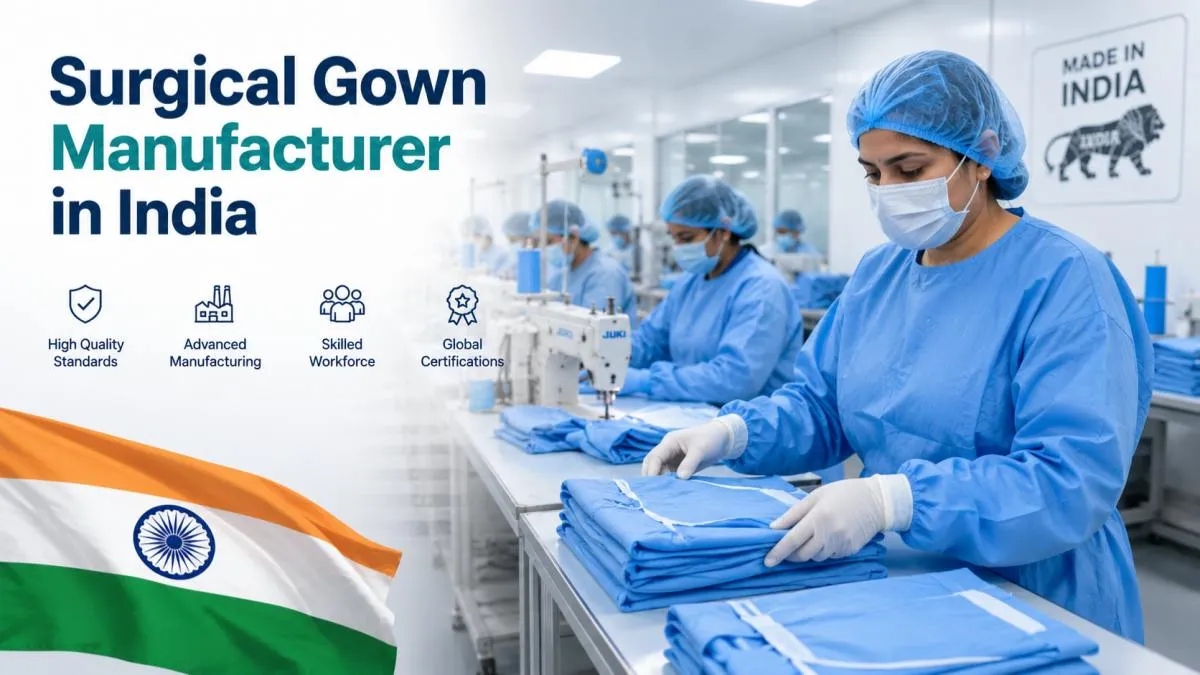 Not every surgical gown manufacturer with an ISO plaque on their wall deserves a place in your supply chain.
India’s surgical gown industry is impressive at scale — $250M in exports in 2025, up 15% year-over-year, holding 25% of the global disposable gown market. But raw market size tells you nothing about which supplier won’t fail you mid-contract. Every surgical gown manufacturer in this guide was rated against four weighted criteria to cut through the noise:
The 2026 Screening Framework
- Certifications (40%) — The floor is three recognized standards: ISO 13485, CE Mark, and FDA 510(k). Certified Indian suppliers average below 2% defect rates. Uncertified ones? Closer to 15%. That gap is real — it shows up in OR complications and rejected shipments.
- Product Line Width (25%) — Look for at least five gown variants: disposable, reinforced, sterile, SMMMS, and spunlace. Fewer options limit your buying flexibility. High-volume hospital contracts need a range.
- Export Experience (20%) — Check for at least ten verified export markets and documented hospital clients. Export track records are the best sign of real-world quality without doing an on-site audit.
- Price Competitiveness (15%) — Level 3/4 gowns run $1.50–$3.50 per unit. That’s 30–50% below the global average. You get features like sonic-welded seams and Velcro closures at MOQs around 10,000 units.
Why India?
India hits a price-quality balance that China and Turkey don’t match. Chinese surgical gown manufacturers lead on volume — 1,200M+ units per year —, but their average unit price runs higher at $3.80. Turkey sits at $4.20 per unit, with EU proximity as its main draw. India delivers at an average of $2.50 per unit. Plus, 85% of leading Indian manufacturers meet AAMI/EN13795 standards, compared to 70% in China.
That mix of low cost and strong certification is why serious B2B buyers are shifting surgical gown orders to Indian suppliers over the traditional options.
1. Amaryllis Healthcare — Best for Internationally Certified Surgical Gowns
550 hospitals across 15 countries keep reordering from this supplier. That kind of repeat business speaks for itself.
Amaryllis Healthcare started in Bengaluru in 2011. Over 13+ years, they built a surgical gown line that covers the core needs of busy OR environments. You get sterile SMS gowns, reinforced gowns , surgeon gowns, and patient gowns — all EO sterilized under ISO 11135 protocols.
What stands out on the product side:
- SMS Surgical Gowns — antistatic, alcohol-repellent, high fluid resistance. These gowns are 40–60 gsm and meet AAMI Level 3–4 performance. That makes them a solid fit for mid-to-high-risk procedures.
- Reinforced Gowns — lint-free, moisture-resistant non-woven construction built for sterile surgical environments
- Entry pricing — around ₹35/unit (~$0.42), with MOQs starting at 1,000 pieces
Their yearly turnover sits in the ₹25–100 Cr range. This puts them in the mid-tier manufacturer category, with an estimated output of 1–5M units per year.
One honest caveat: ISO 13485 and CE Mark documentation is not easy to find on their public channels. Verify these certifications with them before placing your first order. Procurement teams with strict compliance checklists should confirm certification status upfront — don’t skip this step.
2. Indo Surgicals Pvt. Ltd. — Best for Full-Range Disposable Surgical Products
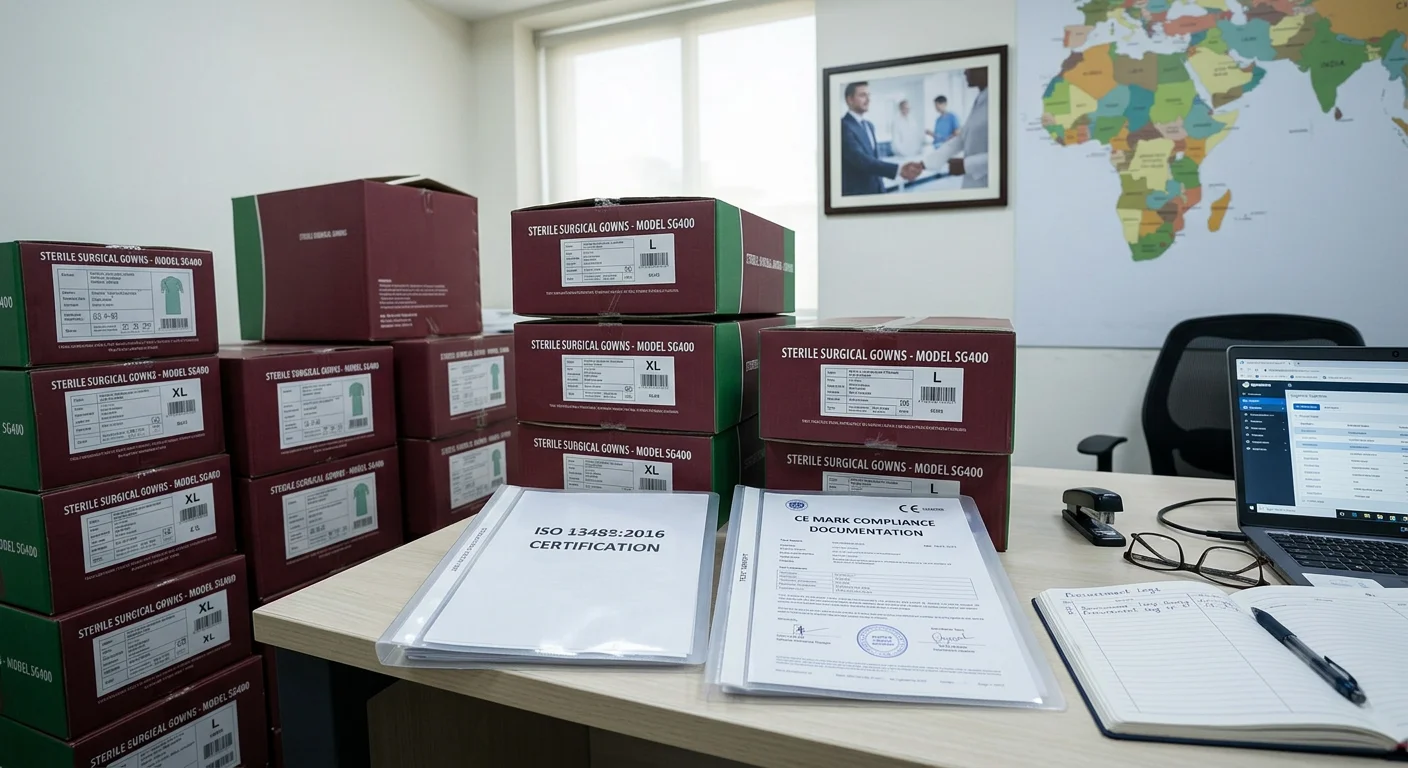 Indo Surgicals is based in New Delhi. Over the years, they’ve built one of India’s most complete disposable surgical product lines — and their African export footprint backs that up.
They’ve confirmed distribution across 28+ countries — from Nigeria and Kenya to Morocco and Tanzania. That’s a real export track record, not just a sales claim. Your procurement region is Africa or Latin America? Chances are high they’ve already shipped there.
What makes their catalog different:
Indo Surgicals goes beyond Surgical gowns. They cover the full range of OR disposables under one roof:
- Disposable scrub suits and surgical gowns
- Face masks with strong filtration performance
- Full-coverage disposable caps
- High-sensitivity disposable gloves
- Shoe and boot covers
- Hospital aprons
- Surgical drapes — built for contamination prevention
That full range lets you combine multiple SKUs into one supplier relationship. Fewer vendors. Less back-and-forth on logistics.
On the technical side, their non-woven products meet AAMI Level 2–3 performance standards. Fabric tensile strength exceeds 20N (ASTM D5034), and they meet antistatic compliance under EN 1149-5.
To request pricing , send your quantity needs to info@indosurgicals.com. You’ll get CIF/C&F export quotes in return. Plan for MOQs around 5,000–10,000 units per SKU and lead times of 4–6 weeks.
3. Poly Medicure Ltd. — Best Established Name in Indian Disposable Surgicals
Twelve consecutive years as India’s largest exporter of consumable medical devices. That track record isn’t marketing — it’s audited performance.
Poly Medicure (Polymed) runs 12 manufacturing facilities across India, China, Egypt, and Italy. Seven of those plants are in India alone — spread across Faridabad, Jaipur, and Haridwar. FY25 revenue hit INR 1,669.8 Cr — a 21.4% year-over-year jump, with exports growing at 24%.
Why this matters for surgical procurement:
- Products reach 110–125 countries across the EU, LatAm, Southeast Asia, and the US
- 6,500+ hospitals and nursing homes in India stock Polymed disposables
- 130+ product SKUs across surgical disposables, wound management, drainage systems, and medical apparels
Their surgical disposables line goes straight into high-volume OR environments. Private hospital chains and government institutions both use Polymed products in their supply chains.
One note on compliance data: Explicit AAMI Level 3/4 gown data is not on public record. What you can verify is their export reach into regulated EU and US markets. That points to GMP-level manufacturing compliance.
Scale, financial stability, and export reach are common top screening criteria. By those measures, Polymed sits near the top of your shortlist.
4. Dispowear Sterite Company — Best Specialist in Protective Surgical Gear (Chennai)
Dispowear Sterite runs as a proprietorship. Small team, focused output, and a product catalog that covers more ground than the headcount suggests.
Ravi Kumar leads the operation. With 11–25 employees and a turnover in the ₹1.5–5 Cr range, this isn’t a large factory. It’s a lean disposable protective clothing supplier. They have a solid export channel — 20–40% of revenue goes international. Their PP+PE non-woven product line serves hospitals, pharma facilities, cleanrooms, and labs.
What they make:
- Disposable surgical gowns and drapes (non-woven construction)
- 3-ply face masks and surgical caps
- Protective shoe covers and arm sleeves (₹15/pair)
- Healthcare PPE for clinical and laboratory settings
Their gowns meet blood penetration Level 2 performance. That means they work well in low-to-moderate fluid exposure settings. General clinical use is the sweet spot here — not high-risk OR procedures.
One thing to verify before ordering: No confirmed EN 13795 or AAMI PB70 certification data shows up in available records. Your procurement checklist may require documented barrier compliance for Level 3–4 environments. If so, raise this question before you commit to volume. Standard Indian surgical gown pricing runs ₹50–150/unit — Dispowear likely falls in that range, though they don’t publish gown pricing.
Reach them via WhatsApp at +918048970362.
5. Bellcross Industries Pvt. Ltd. — Best for High-Volume Bulk Orders
Mumbai-based and factory-owned, Bellcross Industries delivers strong output for its size, especially on bulk orders.
Based in Dahisar East’s Prabhat Industrial Estate, Bellcross holds an active Import/Export Code (IEC 0316907472) and SSI Registration. This qualifies them for MSME government tenders, including GeM portal hospital orders. For procurement teams targeting large institutional contracts, that’s a real compliance advantage.
What the numbers look like at scale:
- Surgeon gowns (SMS, barrier Level 2–3): ~₹25–40/unit at 10,000-unit MOQ
- Patient gowns (PP non-woven, 20–30 gsm): ~₹15–25/unit at 50,000+ units
- Comparable Mumbai peers at this staff size produce 50,000–200,000 non-woven units per month
On orders exceeding 100,000 units, you’re looking at a 30–50% cost edge over imported alternatives.
Where to be careful: Bellcross has SSI registration but no confirmed ISO 13485 or CE Mark. Regulated procurement environments that require documented barrier compliance will see this as a gap — flag it before you commit. That said, domestic bulk buyers with flexible compliance needs will find the price-to-volume ratio hard to match elsewhere.
Reach CEO Nikunj Kedia for wholesale pricing.
6. Jiya Surgichem Pvt. Ltd. — Best Regional Supplier from Ahmedabad (Gujarat Hub)
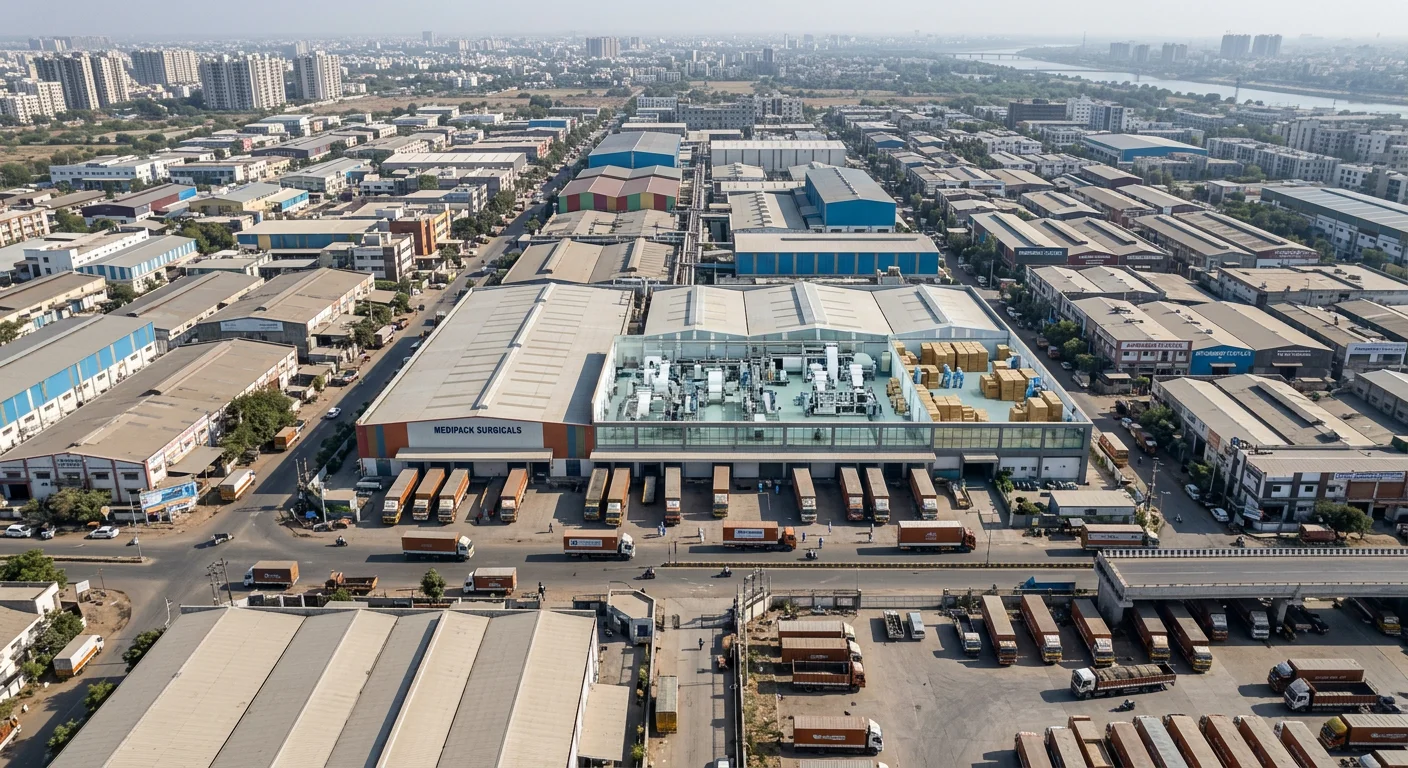 Gujarat produces 20% of India’s medical disposables output. Jiya Surgichem is right at the center of that cluster — based on Ahmedabad’s Naroda Road, with 500+ raw material suppliers within 100km.
Founded in 2018, Jiya keeps operations lean: 5 employees, ISO 9001:2015 certified, annual turnover around ₹5 Cr. Mr. Premsagar Khatri runs the operation seven days a week. That consistent availability is a real advantage for buyers who need fast regional turnaround.
What works in their favor:
- Gujarat cluster pricing — local sourcing from Surat non-wovens and Mumbai-port latex cuts logistics costs 15–20% vs. Delhi NCR suppliers
- Low MOQ flexibility — estimated 1,000–5,000 units per order, compared to 50,000+ for large Delhi exporters
- Surgical gown pricing — estimated ₹80–120/unit, about 10–20% below comparable Ahmedabad peers
- Lead times — 1–2 weeks for regional Gujarat buyers; same-day delivery within Ahmedabad is achievable
Where to be careful: ISO 9001:2015 covers quality management — not medical device compliance. No confirmed ISO 13485, CE Mark, or AAMI barrier performance data exists on record. Your procurement checklist may require documented Level 3–4 barrier standards. Raise that question directly before you place any order.
Jiya suits one specific buyer profile: Gujarat-based hospitals, clinics, or regional distributors. You need flexible batch sizes, fast fulfillment, and competitive pricing. You don’t want the MOQ pressure that larger Mumbai or Delhi exporters typically push on buyers.
7. Nuvomed Surgicals — Best Rising Innovator for 2026
New suppliers don’t often earn a spot on a serious B2B shortlist. Nuvomed Surgicals is the exception worth watching in 2026.
They sit in a smart position — targeting the mid-tier procurement gap. That’s the space between large exporters with rigid 20,000+ unit MOQs and smaller regional players that don’t meet export compliance standards. Among India’s disposable surgical manufacturers, they’re a name on the rise.
What makes them relevant right now:
- Pricing — estimated $0.50–$2.00/unit on disposable surgical gowns , drapes, and procedure kits. That puts them 15–30% below comparable China import pricing
- MOQ flexibility — estimated 5,000–10,000 units per order. This works well for distributors who want to test a new supplier before scaling up
- Export trajectory — their initial focus covers Southeast Asia and Africa. Cost-competitive Indian disposables have strong traction in both regions
The honest caveat: ISO 13485 certification is unconfirmed. They’re an emerging manufacturer, so they’re most likely mid-process on that front. Check certification status with them before placing orders in regulated markets.
Best fit: Mid-sized hospitals and distributors in emerging markets. You get competitive pricing, flexible trial MOQs, and a supplier with clear upward momentum — no five-year track record required on day one.
8. Surgeine Healthcare (India) Pvt. Ltd. — Best Budget-Friendly Surgical Gown Option
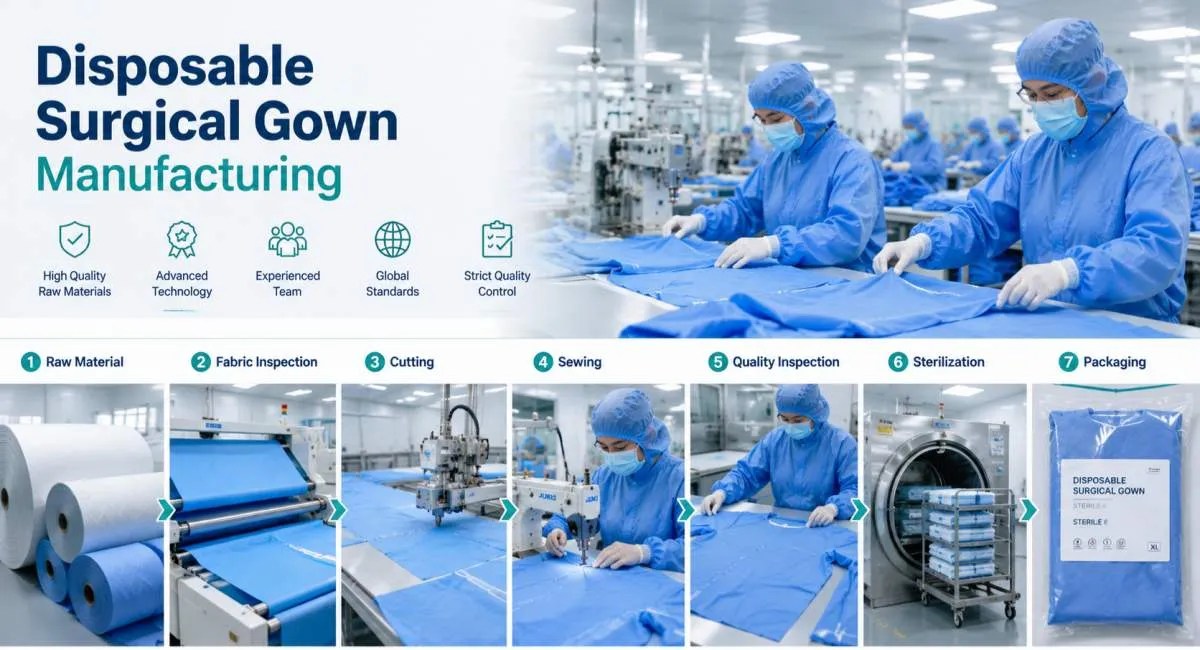 Surgeine Healthcare is based in Delhi and has held ISO/CE certification since 2002. Over two decades, they’ve focused on one specific problem: getting surgical gowns that meet clinical standards at a price that doesn’t push mid-sized hospital budgets to the limit.
The company runs a team of 25 and posts an annual turnover of around ₹5 Crores. Small, yes — but the product range is broad. You get entry-level SMS gowns (product codes 1001–1006, sizes S–XXL) on one end. On the other hand, AAMI Level 4 Microcare gowns are built on Ahlstrom SMMMS/BVB fabric, made for orthopedic, cardiac, and trauma settings.
The budget tier in real numbers:
- Standard SMS gowns : ~₹120–180/unit at MOQ 1,000+ pieces
- AAMI Level 4 models: ₹300–500/unit range
- Sterile packing with EO/gas plasma sterilization; 5-year unopened shelf life
- IS 17334 labeling compliance confirmed
Who this works for — and where it doesn’t:
| Scenario | Surgeon Fit |
|---|---|
| Low-risk general/OB-GYN surgery | Strong — 30–50% savings vs. imports |
| High-fluid procedures (cardiac/ortho) | Upgrade to their Level 4 line |
| Bulk OEM orders >10K units | Viable — verify batch consistency |
| EU/US regulated procurement | Run your own AAMI PB70 compliance testing |
One procurement note: The small team size makes high-volume batch consistency a real concern. Pull 5–10% of incoming units and check seam integrity and fluid holdout before you commit to full deployment.
Surgeine is also listed on the GeM portal for government hospital bids. That makes it a practical starting point for institutional buyers looking to source locally.
Surgical Gown Price Guide India 2026: INR Benchmark & Hidden Cost Factors
The sticker price on a surgical gown quote tells you almost nothing. Your landed cost comes from a stack of charges sitting underneath that number — and most buyers miss them entirely.
Here’s the full cost picture for 2026. This covers what you pay, not what surgical gown manufacturers put in their brochures.
The INR Benchmark: What Each Channel Pays
Each procurement channel has its own price band:
- Government GeM portal — INR 85–120/unit (AAMI Level 3). This is the lowest rate available, backed by 2,311 active surgical gown tenders published in 2026 (+9.4% YoY)
- Private hospital direct procurement — INR 150–250/unit
- Emergency/urgent orders — INR 250–350/unit (that’s a 30–50% premium for not planning ahead)
The base manufacturing cost for a standard AAMI Level 3 gown runs INR 53–70/unit. That breaks down as fabric (INR 35–45), labor (INR 15–20), and QC (INR 3–5). Everything else is an add-on.
The Hidden Cost Stack
This is where procurement budgets bleed out without anyone noticing:
| Add-On | INR per piece |
|---|---|
| ETO sterilization | +12–18 |
| Individual sterile packaging | +8–12 |
| Custom branding/logo printing | +8–25 |
| Labeling & documentation | +2–3 |
| ISO 13485 compliance markup | +8–12% on base |
| USFDA registration markup | +5–8% on FOB |
At 1,000+ units, your commercial FOB price lands at INR 90–134/unit after manufacturer margin. Middle East and African buyers paying CIF add freight (INR 3–8) plus insurance. That pushes the total to INR 92–135/unit (~USD 1.11–1.63).
MOQ Leverage and Seasonal Windows
Volume moves your price — and the gap is significant:
- 1,000 units — standard bulk rate applies
- 5,000+ units — expect 15–25% off vs. 1,000-unit pricing
- Sub-500 units — 30–40% premium, no exceptions
Timing matters too. Post-monsoon season (October–December) adds a 10–15% premium due to peak surgical volume. Does your procurement cycle have flexibility? Place orders during June–August. That window typically gives a 5–10% discount on the same SKU.
One more number worth tracking: India’s hospital gown market hit USD 137.41 million in 2024. It’s projected to reach USD 263.50 million by 2030 — an 11.54% CAGR. Prices won’t hold flat as demand scales up. Locking in long-term agreements with a certified supplier now beats chasing spot pricing in 2027.
FAQ: Buying Surgical Gowns from India in 2026
These are the questions that come up in every procurement conversation. Clear answers keep you from making costly mistakes.
What’s the standard MOQ for Indian surgical gown suppliers?
Most manufacturers work within a 1,000–5,000 unit range per order. Small exporters like Sumukha Surgicals accept custom lots of 1,000 pieces. That’s a good fit when you’re testing a new supplier. Larger players like Amaryllis Healthcare grow with your order volume over time.
How long does fulfillment take?
Stock orders: 2–4 weeks. Custom SMS or reinforced gown runs: 6–12 weeks. Build your procurement calendar around the 4–8 week window. That’s the standard lead time for non-woven surgical gowns .
Can Indian surgical gown manufacturers handle OEM customization?
Yes. You can request fabric weight, reinforcement placement, sizing, and branding — all are standard options. Sumukha Surgicals supports SMS and SMMS fabric options directly.
What documents do you need for export compliance?
Here’s what you’ll need:
- CDSCO export license
- Commercial invoice
- Packing list
- Certificate of Origin
- ISO 13485 quality certificate
- Sterility certificate
For EU shipments, CE marking must come from a notified body. Self-certification does not qualify for Class IIb gowns.
Which AAMI level fits your procedure?
| Procedure | Recommended Level |
|---|---|
| Ophthalmic surgery | Level 2 |
| Total joint replacement | Level 4 reinforced |
| Cardiac surgery | Level 4 full coverage |
What’s the right supplier tier for your order volume?
- Under 5,000 units — Small exporters, $2–4/unit
- 5,000–50,000 units — Mid-tier OEM suppliers, $1.50–3/unit
- 50,000+ units — Amaryllis-scale exporters, $1–2.50/unit
Conclusion
India’s surgical gown manufacturing in 2026 is more competitive — and more capable — than most global buyers expect.
Sourcing sterile surgical gowns from India for a hospital network? Building a distribution pipeline across the Middle East? Or vetting suppliers for the first time? The manufacturers on this list are your strongest entry points right now. Amaryllis brings certified production lines with global-standard quality. Surgeine covers budget-focused bulk orders. There’s a solid option for almost every procurement need.
Here’s your next step: cut your shortlist to three manufacturers. Request samples. Ask for their current ISO and CE certification documents. Then check pricing against the INR ranges outlined in this guide.
A reliable surgical supply chain and a costly procurement mistake often come down to one thing — how well you checked the manufacturer before that first order.
Do that work now. Your operating room can’t afford shortcuts.