

Surgical gowns don’t get much attention in procurement meetings — until a contamination incident hits. Suddenly, “good enough” doesn’t feel good enough anymore.
Molnlycke Health Care built its name on refusing that standard. Their BARRIER line of sterile surgical gowns comes at a premium price, and that price reflects the quality behind the product.
But here’s the real question OR managers and surgeons face: is the quality gap wide enough to justify the extra cost? Budget pressure is real. So is the fact that surgeons wear these gowns for hours at a time.
This review skips the spec sheets and marketing talk. You’ll get a straight, hands-on look at:
- Protection — how well it holds up against contamination
- Comfort — what it actually feels like over a long procedure
- Mobility — whether it limits or supports movement in the OR
- Real-world performance — how it holds up when it counts
By the end, you’ll have what you need to make a sharper purchasing call.
Molnlycke BARRIER Surgical Gown Material & Construction: What It Feels Like in Real Wear
 The Molnlycke BARRIER surgical gown’s material story starts well before you scrub in. It starts at the seam level.
Molnlycke BARRIER gowns use SMS (spunbond-meltblown-spunbond) nonwoven fabric. This layered build does two things at once: blocks fluid and lets skin breathe. That balance is hard to get right. Most disposable surgical gowns give up one to gain the other.
What sets BARRIER apart from lower-cost options comes down to build quality:
- Reinforced critical zones — The chest and forearms get extra laminated reinforcement. These are the exact areas most exposed during open procedures.
- Seam integrity — Stress points are sealed, not just stitched. That matters when a gown stretches across a surgeon’s shoulders for three hours straight.
- Closure design — The back tie and wrist cuffs hold a secure fit without cutting off circulation or limiting movement.
Surgeons who wear BARRIER gowns through long procedures report that the shape holds. The fabric doesn’t bunch, stiffen, or develop that uncomfortable plasticky film-against-skin feeling you often find in lower-grade disposable surgical gowns.
For a fluid-resistant surgical gown worn through high-volume cases, that build quality isn’t a bonus. It’s the baseline for doing the job right.
Molnlycke BARRIER Surgical Gown Protection Level: Do I Feel Safe Enough During Surgery?
Numbers cut through opinion fast. Patients rated their sense of safety during surgery on a 7-point scale. The average score came back at 6.53 out of 7. That’s not luck. It’s the result of systems, equipment, and materials that hold up under real pressure.
A surgical gown sits right at the center of that performance equation.
What “Protection Level” Means in the OR
The Molnlycke BARRIER surgical gowns carry an AAMI Level 4 rating — the highest tier in the AAMI PB70 standard for surgical gown protection. That rating doesn’t come from a marketing team. It comes from lab tests that simulate high-pressure fluid exposure. The kind of exposure that happens in open abdominal or cardiac procedures.
Here’s what that rating means on the ground:
- Fluid barrier integrity — BARRIER gowns block blood and body fluid penetration, even under sustained pressure
- Critical zone reinforcement — The chest and forearm panels use laminated construction. They handle heavy splash moments without giving way
- Pathogen blocking — The SMS nonwoven builds filters that block particles at a level that standard fluid-resistant surgical gowns can’t reach
For surgeons running high-risk, high-volume cases, AAMI Level 4 isn’t an upgrade. It’s the right starting point.
Protection That Works With You, Not Against You
There’s one detail most operating room gown evaluations miss. A gown that shifts, gaps, or bunches mid-procedure breaks protection — regardless of its rating on paper. A gown sliding off the shoulder creates real exposure. No rating covers that.
Molnlycke BARRIER’s secure fit design keeps the sterile surgical gown in place through long procedures. Coverage holds. Critical zones stay put.
Protection isn’t a one-variable problem. The WHO Surgical Safety Checklist, used as designed, cuts surgical complications by more than 30%. Your gown is one part of that system. It needs to be a part you can count on.
Molnlycke BARRIER keeps that reliability consistent — procedure after procedure.
Molnlycke BARRIER Surgical Gown Comfort & Mobility in the OR: Can I Move and Work Freely?
 Surgeons are athletes who never get to sit down.
A meta-analysis of more than 5,000 surgeons found that 68% experience generalized pain and 71% experience fatigue during or after operating. A separate study found that 87% of surgeons report discomfort at least “sometimes” while working. These aren’t anomalies. Standing, reaching, and holding precise positions for hours — that’s just the baseline reality of OR work.
What you wear is part of the ergonomic equation. Not the whole story, but a real piece of it.
What Physical Strain Looks Like in the OR?
The data is specific — and uncomfortable. Back pain affects 64% of surgeons. Neck and shoulder issues hit more than 33%. Surgeons at height extremes — under 160 cm or over 185 cm — report discomfort at rates above 90%. Much of that comes from fit and reach mismatches that build up over time.
Fit matters at every level. A sterile surgical gown that pulls across the shoulders, bunches at the elbows, or limits lateral reach doesn’t just annoy you. It adds physical load to a posture that’s already demanding.
Where Molnlycke BARRIER Surgical Gowns’ Design Helps?
The Molnlycke BARRIER disposable surgical gown handles mobility through proportional sizing and a construction that moves with your body. The back closure system gives you full shoulder rotation. The wrist cuffs stay secure without blocking wrist extension — a detail that matters, since ACS ergonomic guidelines call out wrist neutrality as a key injury-prevention principle.
In longer procedures, small details add up. Right now, specialized clothing is used by 33% of OR staff as an ergonomic tool — yet 80–90% of staff see ergonomic interventions as beneficial. The gap between knowing and doing is real.
A well-fitted breathable surgical gown won’t fix table height or instrument reach problems. But it removes one friction point from a body that’s already managing many. In a long case, that matters. It’s the difference between finishing sharp and finishing spent.
OR Workflow Experience: What It’s Like for Surgeons and Nurses
 The operating room runs on invisible choreography — and every person in it has a part to memorize cold.
Two roles anchor every case.
The circulating nurse works outside the sterile field. She tracks supplies, checks equipment, coordinates with pathology, radiology, and recovery, and documents everything in real time.
The scrub nurse or technician works inside the sterile field. She passes instruments with precision and reads the surgeon’s next move before it’s asked.
That anticipation is the job. A scrub nurse who hesitates — or hands off the wrong instrument at a critical moment — breaks the flow. That break ripples across the whole procedure.
Here’s where the gown enters the picture in a way most people overlook.
A sterile surgical gown that fits badly becomes a distraction. A sleeve bunches during instrument handoff. A back closure shifts as the circulating nurse reaches for documentation supplies. These are small interruptions — but the margin for friction is already thin. 86% of perioperative nurses now use real-time alpha messaging to coordinate between surgeons and anesthesia. Every extra disruption adds up.
A reinforced surgical gown that stays secure and moves with the body does more than protect. It maintains sterile integrity through each turnover. It doesn’t pull attention. It doesn’t create friction. It just disappears into the workflow — which is where it belongs.
Molnlycke BARRIER Surgical Gowns vs Other Surgical Gowns I Have Used
Three brands sat in our supply room at the same time last year. Real comparisons work that way — not in spreadsheets, but in side-by-side daily use. That’s where the differences become real.
Here’s what I found.
The SMS Question
Most disposable surgical gowns on the market use SMS nonwoven fabric. That part isn’t unique to Molnlycke. What varies is what manufacturers do with it — and the gap can be wide.
The BARRIER line covers three distinct material types. Each one fits a different procedure:
- SMS Gowns — The Primary and Primary Plus handle standard dry procedures well. Comfortable, functional, no surprises. The BARRIER Ultimate goes a step further. It delivers better softness, breathability, and overall performance than competitors’ standard SMS gowns at the same price tier.
- Spunlace Gowns — These use 50%+ bio-based material — pulp and polyester nonwoven fibers. The two-layer build puts a tissue layer on the outside for comfort and polyester on the inside for strength. The Classic Urology version adds full fluid impermeability. Also worth noting: FSC-certified construction, which matters if sustainability is part of your procurement criteria.
- Laminate Gowns — The FPP runs a microporous polyethylene film across the full surface. The VPP adds a three-layer build engineered for virus protection. These aren’t general-purpose gowns. They’re built for cases where a barrier failure is not something you recover from.
Where Other Brands Tend to Fall Short
Standard SMS surgical gowns from other brands often push you into a tradeoff: better fluid resistance comes at the cost of breathability, and the reverse is true, too. BARRIER’s construction — the Ultimate in particular — handles that tradeoff better than most gowns I’ve worn.
One compliance point worth knowing: the Primary range meets EN13795. Every other Molnlycke BARRIER surgical gown meets both EN13795 and AAMI standards — dual-standard compliance that many lower-cost competitors skip.
That’s not a marketing distinction. In cross-border procurement, it’s a practical one.
Molnlycke Classic SP vs Ultimate: Do I Need to Upgrade?
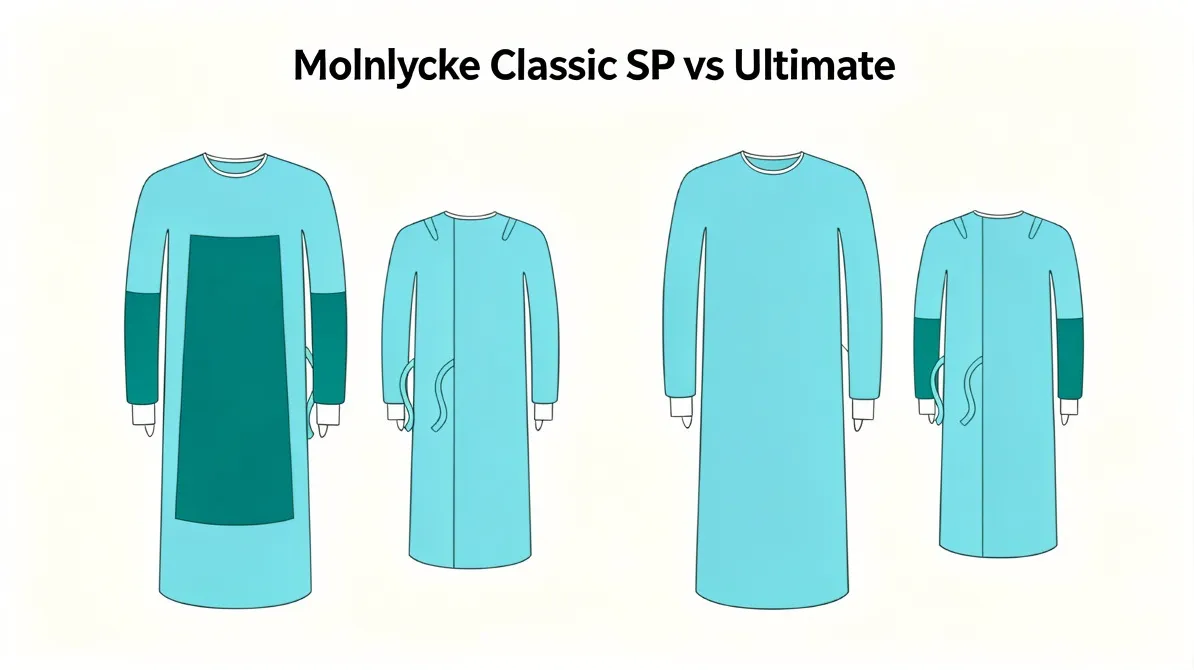 The short answer: it depends on what’s happening on the other side of the drape.
The Molnlycke BARRIER line doesn’t ask you to pick one gown and call it done. The Classic SP and the Ultimate are built for different case profiles. The real question is which one fits your work.
The Classic SP is a solid, dependable performer. It meets EN13795 and AAMI standards. It handles routine surgical cases well. You get the fluid resistance and breathability you’d expect from a quality SMS surgical gown. For lower-risk, drier procedures, it covers everything it needs to.
The Molnlycke BARRIER Ultimate is built for something different.
The Molnlycke Classic SP holds the line. The Ultimate raises it. You get noticeably better softness, a more breathable feel, and a build that holds up through longer, harder procedures. Surgeons spending three-plus hours in a sterile surgical gown will feel that difference. Not as a luxury, but as less fatigue and fewer distractions during the stretch where precision matters most.
A straight framework for this decision:
- High-volume, high-risk, high-fluid cases — the Ultimate earns its cost
- Standard, lower-complexity procedures — the Classic SP is the smarter spend
- Mixed-case ORs — consider stocking both, matched by procedure type
One gown doesn’t need to cover every situation. So skip the question of which is best . Ask instead: Which is right for this case?
Molnlycke BARRIER Surgical Gown Price vs Value: Is It Worth the Cost?
Let’s talk about the price tag. Molnlycke BARRIER surgical gowns cost more at first than budget brands. But think about a cheap gown failing. What does that cost your facility?
One barrier break creates major safety risks. It disrupts the daily workflow. You also face heavy costs to manage the incident. Taking on that risk costs far more than buying a reliable gown.
The BARRIER AAMI Level 4 gown justifies its premium price. It delivers solid protection for critical moments. You get dual-standard compliance (EN13795 and AAMI). The design features reinforced critical zones. Plus, the comfortable fit moves with the surgeon.
My final takeaway:
- Handling high-risk, high-fluid procedures? BARRIER proves worth every extra dollar.
- Running standard dry cases? The Classic SP model makes a smart, affordable choice.
The operating room tolerates no shortcuts. Your procurement checklist needs that same strict standard. Still unsure? Request a sample kit. Let your surgical team test it during a live shift. Their direct feedback tells you everything you need to know.