

You’re stacking gloves in your kitchen drawer. Or maybe you’re sourcing them for a food service operation. Either way, someone drops the name MedPride.
These gloves are everywhere — bulk boxes on Amazon, popping up in medical supply lists, showing up in restaurant supply hauls. So the real question is: are these food safe, or are they just medical gloves dressed up for the kitchen?
There’s a difference. And it matters more than most people think.
This is a hands-on look at MedPride nitrile gloves for food handling. We’ll cover the feel, the fit, and the certifications that count. Plus, you’ll get a straight verdict on whether these belong in your kitchen — or just your first aid cabinet.
What Are MedPride Gloves? Brand Background & What They Feel Like in Real Use
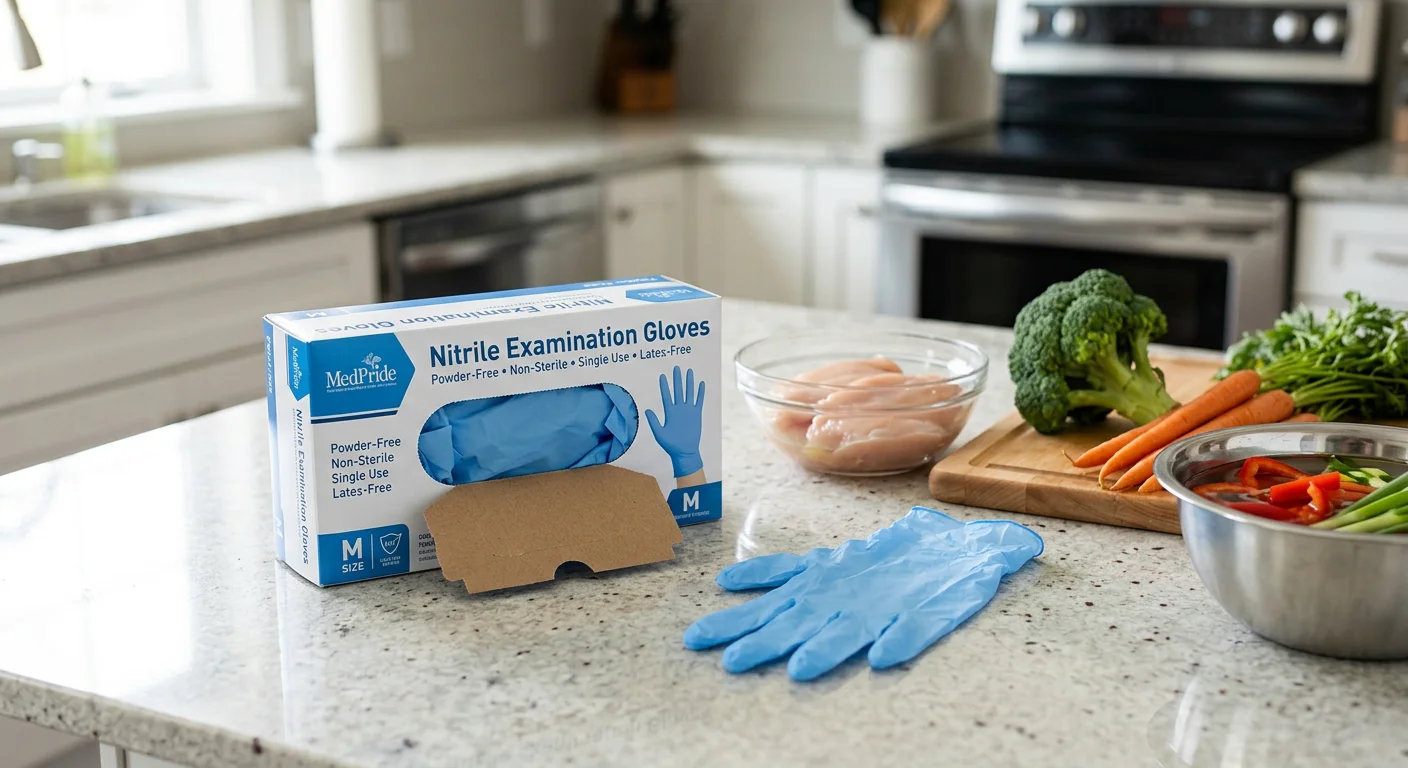 MedPride built its name without flashy marketing. You’ll find these gloves in hospital supply rooms, commercial kitchens, and laboratory counters — places where reliability is non-negotiable.
MedPride makes both nitrile and vinyl disposable gloves . All gloves come from CGMP-compliant environments — the same manufacturing standard used in pharmaceutical production. That’s a big deal. Quality control isn’t a checkbox here; it’s built into every step of the process.
What You’re Getting?
Every pair is:
- Powder-free — no starch residue left on food surfaces
- Latex-free — safe for anyone with latex sensitivities
- Ambidextrous — fits either hand, so you don’t slow down in a busy kitchen
- Single-use and disposable — no cross-contamination risk between tasks
The nitrile build is where MedPride earns real credibility. Nitrile outperforms latex in puncture resistance and chemical barrier protection. For food prep, that matters. The glove holds up through repetitive cutting, seasoning, and handling. You won’t get hidden micro-tears building up without you knowing.
How They Feel About Wearing
Snug, but not tight. The fit gives you solid tactile sensitivity — you can feel texture, grip wet surfaces, and handle food with precision. They don’t bunch at the fingers or slip loose at the wrist.
MedPride comes in multiple sizes, including Medium and Large, sold in 100-count boxes. You get high-standard protection without paying a premium price for it.
Can You Use MedPride Gloves for Food Prep? Real Kitchen Use Experience
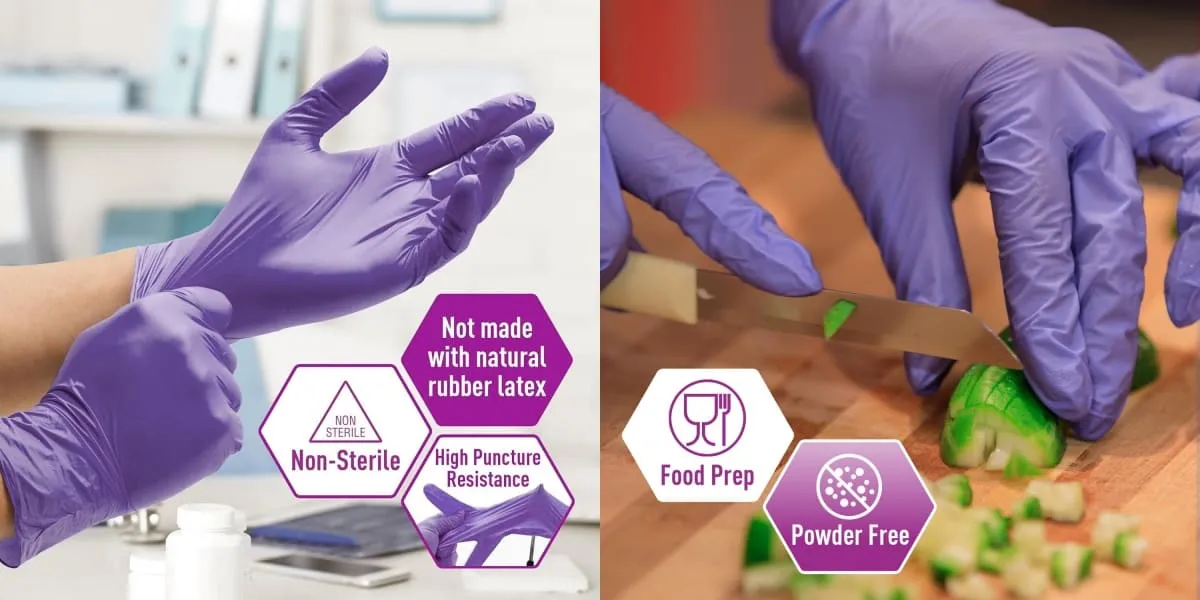 The short answer is yes — but the details are where it gets useful.
MedPride’s vinyl and poly gloves meet FDA 21 CFR 170-199 standards for food contact materials. That’s the federal framework that governs what can touch your food. These gloves clear it. So dicing raw chicken at home or assembling sandwiches during a lunch rush — you’re working within compliance, not around it.
Powder-free matters more than most people realize. The FDA banned powdered gloves from food environments outright. Starch residue on food surfaces isn’t a small annoyance — it’s a contamination risk. Every MedPride glove ships powder-free. That’s not a marketing claim they added; it’s a requirement they already meet.
What MedPride Gloves Handle Well?
In a real kitchen, these gloves hold up across a wide range of tasks:
- Raw meats — chicken, beef, fish. The vinyl builds up resistance to oils and fats. The glove stays intact and easy to grip, even on slick surfaces.
- Fruits and vegetables — you get enough feel and feedback to peel, slice, and handle without fumbling.
- Ready-to-eat foods — sandwiches, pizza toppings, and plated appetizers. No latex allergen transfer. No powder residue. Clean contact.
- Oils and marinades — synthetic vinyl holds up to short exposure. Thinner materials tend to break down faster.
For lighter work — portioning snacks, handling packaged ingredients, quick service line tasks — the poly gloves are a solid pick. They’re the lowest-cost option in the MedPride range and work well for minimal-contact situations.
Where Are the Limits?
No glove covers every job. MedPride’s food-prep gloves aren’t rated for long exposure to high heat. They’re also not built for heavy chemical handling beyond standard kitchen substances. Your prep work involves industrial cleaning agents or tasks right next to an oven? These aren’t the right gloves for that.
There’s also a latex point worth knowing. MedPride is latex-free across the board. That matters because 1% of the general population has a latex allergy. Among healthcare workers, that number rises to 8–12%. Nine US states — including California, Illinois, and Massachusetts — have banned latex gloves in food service. Vinyl avoids that problem completely.
How to Use Them Right?
Getting full value from any disposable glove for food handling comes down to discipline, not just the glove itself:
- Wash and dry your hands before putting on gloves. Gloves over dirty hands don’t fix the contamination problem.
- Change between tasks. Going from raw meat to ready-to-eat food means a new pair — no exceptions.
- Sanitize work surfaces at the same time. The glove isn’t doing the whole job on its own.
- Clear debris often. Food scraps and packaging waste speed up cross-contamination risk.
Material Comparison at a Glance
| Material | Food Suitability | Strength | Limitation |
|---|---|---|---|
| Nitrile | High — raw food, oils | Best chemical and puncture resistance | Higher cost per glove |
| Vinyl (MedPride) | High — general handling | Latex-free, versatile, cost-effective | Less durable under stress |
| Poly (MedPride) | Light-duty tasks | Lowest cost | Minimal protective barrier |
| Latex | Use with caution | Excellent stretch and fit | Allergy risk across 1–12% of users |
For most home kitchens and food service setups, MedPride vinyl gloves hit the right balance — compliant, affordable, and dependable across the tasks that come up daily. Need more protection for heavier prep work? The nitrile option steps up there. Either way, you’re not trading food safety to save money.
What It Feels Like After Wearing Them for a While in the Kitchen?
An hour into a prep shift, you stop thinking about your gloves. That’s the point.
The real test of any disposable glove for food handling isn’t the first five minutes — it’s the forty-fifth. Your hands are damp from washing produce. They’re warm from working near the stove. You’ve already changed pairs twice. That’s where the MedPride nitrile gloves prove their case.
The Fit Holds — Even When Your Hands Don’t
Heat builds up inside any glove over time. Thinner or bad-fitting gloves turn that warmth into sweat. Sweat turns into slippage. The glove starts moving against your palm instead of with it. You lose grip. You lose precision. You start compensating — gripping harder, moving slower.
MedPride’s nitrile construction handles this better than you’d expect at this price point. The material stays breathable through moderate-duration tasks. The snug fit doesn’t loosen as your hands warm up. You keep tactile sensitivity through repetitive work — dicing, portioning, plating — the kind that breaks down lesser gloves from the inside out.
Extended Wear Has a Real Ceiling
There’s an honest ceiling here. These are single-use powder-free disposable gloves , not extended-wear gloves built for multi-hour continuous use. Past 30 to 45 minutes of active work — tasks with water, oils, or frequent hand movement — moisture starts building inside. That’s the right time for a glove change, both for comfort and for food prep safety standards.
Changing pairs often isn’t a flaw in the glove. It’s the protocol. MedPride’s 100-count boxes make that easy to stick to. You’re not rationing pairs to save cost. Pull a new glove, keep the work moving.
What Sustained Kitchen Use Reveals?
- Grip stays consistent on wet and oily surfaces through moderate tasks
- No bunching or rolling at the fingers, even during fine motor work
- Wrist seal holds without cutting off circulation or riding down during movement
- Latex-free nitrile means no mid-shift allergic reactions for sensitive users
The gloves don’t ask for your attention. In a busy kitchen, that’s what you need from them.
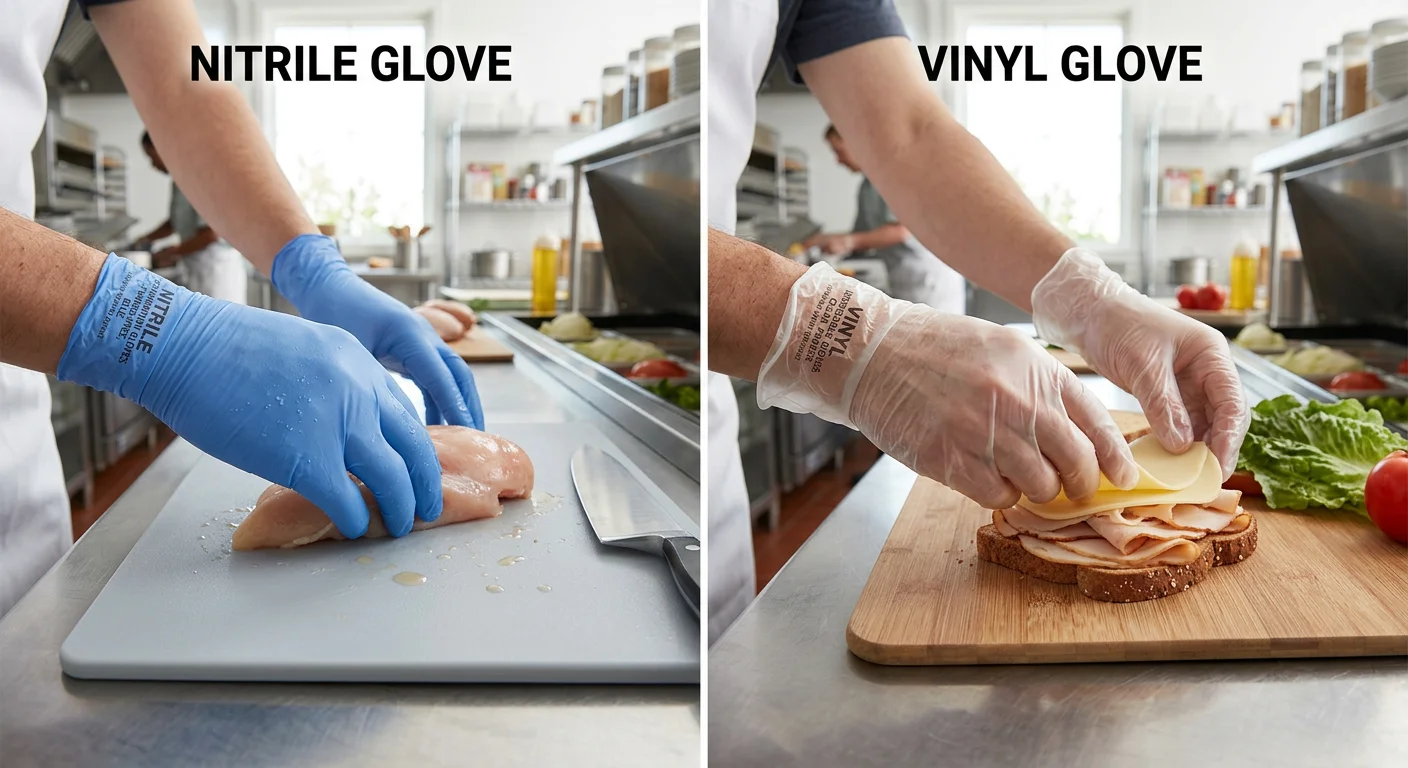
Nitrile vs Vinyl in MedPride Gloves: What Matters in the Kitchen
The difference between nitrile and vinyl isn’t a minor spec detail. In a working kitchen, it’s the difference between a glove that holds and one that doesn’t.
MedPride offers both. Pick the wrong one for the wrong task, and you don’t just lose a pair of gloves. You lose control over what touches your food.
The Numbers Are Stark
Across testing of more than 5,000 gloves , nitrile failed 1.3% of the time. Vinyl? 8.2%. Peer-reviewed studies push that gap even wider. Vinyl failure rates in clinical settings range from 12% to 61%. Nitrile holds steady at 1–3%.
That’s not a marginal improvement. That’s a completely different level of reliability.
Raw meat, oily fish, anything that needs a consistent barrier over 20 minutes of active work — vinyl isn’t built for that. It’s prone to micro-tears you won’t spot until the glove is already compromised.
Where Each Material Belongs?
MedPride nitrile gloves are the right call for heavier tasks:
- Raw protein handling — chicken, beef, fish. Nitrile earns a 5-star rating for protection against animal fats and oils. Vinyl scores a 3.
- Extended prep sessions — vinyl needs swapping every 15–20 minutes under real kitchen load. Nitrile lasts longer before it breaks down.
- Chemical contact — nitrile blocks kitchen cleaning agents 3.7 to 9 times longer than vinyl. Your prep overlaps with surface sanitation? That gap matters.
- Pathogen barrier — nitrile rates 5-star for virus and bacteria protection. Vinyl rates 2-star. Cross-contamination risk drops sharply with nitrile.
MedPride vinyl gloves hold up well in lower-stakes situations:
- Sandwich assembly and cold deli work
- Quick-service portioning with minimal contact
- Short tasks where cost-per-use is the main factor
The Cost Argument, Straight Up
Vinyl costs less per box. That’s real. But in a busy prep environment, frequent replacements close that gap fast. A glove you swap every 15 minutes isn’t saving money. You’re just spending it on more gloves, with less protection between each change.
Nitrile costs more upfront. Over a full prep shift, you often use fewer pairs total — and get a stronger barrier the whole way through.
One Thing Both Share
Both MedPride nitrile and vinyl gloves are latex-free. No allergy risk on either side. That’s a baseline worth confirming before you stock either option in a commercial kitchen — not a selling point, just a fact you want locked in before ordering.
The bottom line: reach for nitrile with raw, oily food or anything that needs steady handling over time. Vinyl fits the quick, light tasks where you need a barrier, but the work is short and low-contact. MedPride gives you both — knowing which one fits your prep is what makes either worth buying.
Where MedPride Gloves Work Well—and Where They Don’t
MedPride gloves are versatile — but versatile doesn’t mean universal.
These gloves fit a wide range of environments. Hospitals use them for examinations. Labs reach for them when powder contamination is a concern. Dental offices stock them because latex allergies in patients are common, not rare. Food service operations use them on the line, in prep areas, and behind counters where speed and compliance both matter.
That range isn’t accidental. The powder-free, latex-free build removes two of the most common barriers to cross-setting use. No need to reorganize your supply chain for different work environments. One glove line covers most of what you need.
Where do they hold up?
- Food prep and service — FDA-compliant material, no powder residue, no latex allergen transfer. These cover raw protein handling, deli assembly, and most tasks in between. The right material choice depends on the job.
- Medical and clinical use — hospital exams, dental procedures, and lab work. The powder-free build meets the standard for sensitive clinical environments. No exceptions needed.
- Janitorial and industrial tasks — general-purpose handling, first aid, surface cleaning. Chemical resistance holds up for standard-use conditions.
- Fine motor work — the fit is snug without being tight. You can handle small objects, work with precision, and keep your grip on wet or greasy surfaces.
Where the Limits Show Up?
Fingertip ripping does happen on occasion. Worth stating directly. This isn’t a MedPride-specific issue — it’s a known trait of disposable exam gloves under repeated stress. That said, does your work involve sustained sharp-edge contact or high-friction tasks? Check your gloves often and swap them out as needed.
Past that, these gloves aren’t rated for prolonged heat exposure or heavy industrial chemicals outside standard kitchen and cleaning agents. Match the glove to the task. That habit matters more than the brand.
Conclusion
Tested on raw chicken, sticky marinades, and everything in between—MedPride gloves hold up. They’re powder-free and puncture-resistant enough for real kitchen work. The nitrile options meet FDA food-contact standards. No latex allergy risk either, which removes a real concern with other brands.
Are they perfect? No glove is. But home cooks, restaurant prep stations, and food processing environments all need something reliable and affordable. MedPride delivers that. You get more than expected at this price point.
Safe for food handling? Yes—with the right variant. Go with the nitrile, powder-free disposable glove s. That’s the one that checks all the boxes.
Ready to order? Check current pricing and available sizes before the bulk packs sell out. A glove that fits well changes how you work in the kitchen. You won’t want to go back to the flimsy ones.