

Six hours into a complex spinal procedure, a surgeon shouldn’t be thinking about their gown. But discomfort has a way of forcing itself into focus — the slow build of heat, restricted movement, or fabric that chafes under a lead apron. It pulls attention at the worst possible time.
McKesson surgical gowns have built a quiet reputation in operating rooms for solving this exact problem. They pair surgical gown comfort features with fluid resistance and sterile barrier protection that long procedures demand.
This breakdown is for you — whether you’re a surgeon choosing your next gown, a scrub nurse speaking up for your team, or a supply manager sorting through OR options. It covers fit, breathability, AAMI protection levels, and real-world performance. So you can make a decision based on facts, not guesswork.
What Makes a Surgical Gown “Comfortable” for Long Procedures?
 Comfort in a surgical gown is not a luxury. It is a performance requirement.
For the past four hours, the gown has become part of the physical load a surgeon carries — alongside concentration, precision, and responsibility. A gown that fails on comfort doesn’t fail in one obvious way. It builds up: heat here, a sleeve pulling there, fabric noise at the wrong moment.
Four factors define whether a surgical gown holds up through a long procedure:
- Thermal regulation — Operating rooms sit between 15–18°C, but body heat under a gown builds fast. You need breathable back panels and a moisture management index above 0.4. That’s the line between manageable and miserable. Fabrics like Coolmax and microfibre polyester outperform standard nonwovens in extended wear — the test data backs this up.
- Freedom of movement — Raglan sleeves open up the armpit area and remove binding across the shoulder. In microsurgery, articulated stretch zones are non-negotiable. Precision work has zero room for fabric that pushes back.
- Weight — Lighter knitted structures cut down on fatigue over time. Three-layer laminated knit gowns give you full-body barrier protection at a fraction of the bulk. They also hold a barrier index of 6 after 70 wash cycles — protection that doesn’t fade with use.
- Back ventilation — A breathable back panel is not optional for long procedures. It’s the main exit point for body heat. No ventilation means heat stays trapped.
AAMI Level 3 surgical gowns suit most extended surgeries — joint replacements, complex abdominal cases. They cover moderate fluid risk while giving you reinforced zones and enough breathability to last. Level 4 delivers maximum protection for high-exposure work like cardiac surgery. But breathability needs to be a design priority at that spec, not an afterthought. Skip it, and surgeon endurance takes the hit.
My Doctor Cousin’s Experience Wearing a McKesson Surgical Gown
 Honest reviews are hard to come by, so I asked my cousin—an orthopedic surgeon who regularly pulls six-hour complex spinal procedures—about his actual experience with McKesson gowns . He wasn’t giving a sterile sales pitch; he told me exactly how it felt on the floor when things get complicated.
“The first thing you notice,” he told me, “is the quiet.” Operating rooms are never truly silent, but there’s a specific, annoying rustle that cheaper nonwovens make every time you reach across a surgical tray. The McKesson SMS fabric moves without that crinkle. It sounds like a minor detail, but when you’re deeply focused, the absence of friction noise is a weirdly huge relief.
But the real test is how the Mckesson surgical gown handles time and physical stress. He broke down the feeling for me, hour by hour.
Hour One: Unnoticed Weight and Clean Wrists
By the time the first hour passes, what you appreciate most is what you don’t feel. The triple-density material is surprisingly light. “You usually brace yourself for the heavy, plastic feel of Level 3 gowns ,” he said. But there was no dragging on his shoulders. Even better, the knit cuffs sat completely flat under his double sterile gloves. If you’ve ever dealt with cheap cuffs bunching up and digging a painful friction ridge into your wrist while twisting a driver, you know how distracting that gets. Here? Nothing. Just a smooth fit.
Hour Four: The Heat Trap Avoided
This is the breaking point for most operating room apparel. Around hour four, the OR lights feel hotter, and physical tension is high. Usually, your lower back feels like it’s trapped in a plastic greenhouse. My cousin specifically pointed out how the gown’s cool-back panel handled this. “My back definitely got warm—that’s unavoidable—but the heat actually had somewhere to go,” he explained. Instead of sweat pooling and eventually turning into a miserable, clammy chill against his scrubs, the fabric breathed. The thermal regulation kept him focused on the spine in front of him, not his own discomfort.
Hour Six and The Finish Line: Freedom of Movement
Closing a complex case requires precision when your body is already exhausted. This is where the gown’s generous cut really proved its worth. When leaning aggressively over the table or reaching for instruments, the set-in sleeves and rear pleats opened up perfectly. “There was zero resistance,” he noted. The fabric didn’t pull tightly across his shoulder blades or bind under his armpits. It moved exactly as he did.
When he finally broke scrub and stripped the Mckesson surgical gown off, his scrub top was remarkably dry for a multi-hour case. The hook-and-loop neckline had stayed secure the entire time without needing a circulating nurse to fix it mid-surgery.
At $161–$213 per case, depending on size, the per-unit cost makes total sense for hospital budgets. But more importantly for the people wearing them, you’re getting AAMI Level 3 protection that doesn’t feel like a physical punishment during long shifts. Fluid resistance and breathability actually work together here.
McKesson Surgical Gown Core Comfort Features for Extended OR Use
 The engineering behind a surgical gown rarely gets credit. Surgeons do. Teams do. But the gown that holds together across an eight-hour reconstruction — staying breathable, quiet, and protective from the first incision to the last suture — that’s doing serious work. It just does it without anyone noticing.
McKesson builds that work into the material itself.
Material That Carries Its Weight — Without Feeling Like It
The triple-density SMS nonwoven — spunbond, meltblown, spunbond — does two things that tend to trade off against each other: it blocks fluid and lets heat escape. In the critical zones (A, B, and C), two reinforced layers add barrier strength for invasive procedures where fluid exposure is highest. The rest of the gown stays lighter. That matters at hour five of a complex case, when the weight of everything starts to add up.
Fine fiber construction adds something specs don’t quite capture: the Mckesson surgical gown doesn’t fight you. No crinkle against your forearm mid-suture. No friction noise cuts through the room as you shift position. It moves without sound. That’s a small detail — until you’re working in concentrated silence and every noise registers.
Where the Design Earns Its Keep?
Three structural features set these disposable surgical gowns apart in extended OR use:
- Cool-back panel — This is the thermal management system. Body heat builds fastest through the back surface under full operating room apparel. The ventilated back panel gives that heat a direct exit. It cuts the slow buildup that wears down focus and comfort over time. AAMI Level 3 protection holds across the critical zones while the back breathes.
- Generous cut with intuitive rear pleats — Reach forward, reach across, rotate at the shoulder — the rear pleats open to give you the range you need without pulling back. Available in lengths from 50 to 53 inches (Large through 2X-Large), you get genuine full coverage without losing movement.
- Extended surgical-fit knit cuffs — These run longer than standard. The construction holds flat under sterile gloves. No rolling. No pressure ridge. No gap opening at the wrist as your arm extends.
Compliance Built Into Every Layer
The McKesson surgical gown meets the standards that procurement and clinical teams need to be confirmed:
| Standard | What It Covers |
|---|---|
| AAMI Level 3 (ANSI/AAMI PB70) | Fluid barrier protection — critical zones |
| Class 1 Flammability (16 CFR Part 1613) | Flame resistance |
| ASTM D5034-2009 | Breaking strength and elongation |
| ISO 9073-10-2003 | Lint resistance |
| ISO 10993 | Biocompatibility — cytotoxicity, irritation, sensitization |
| ISO 12945-2 | Abrasion resistance |
That’s not a checkbox exercise. A sterile surgical gown sits in direct contact with the surgical team for hours of close work. Biocompatibility and abrasion resistance aren’t optional — they’re clinical requirements. The lint-resistance rating carries weight, too. Low-lint construction protects the sterile field, not just the person wearing the gown.
The extra-long hook-and-loop neck closure and adjustable waist ties finish the fit: donning is fast, the fit adjusts to each wearer, and nothing shifts through a long procedure. Surgical protective wear at this level should work without asking for attention. These gowns do.
McKesson Surgical Gown Sizing Guide: Finding the Right Fit for OR Performance
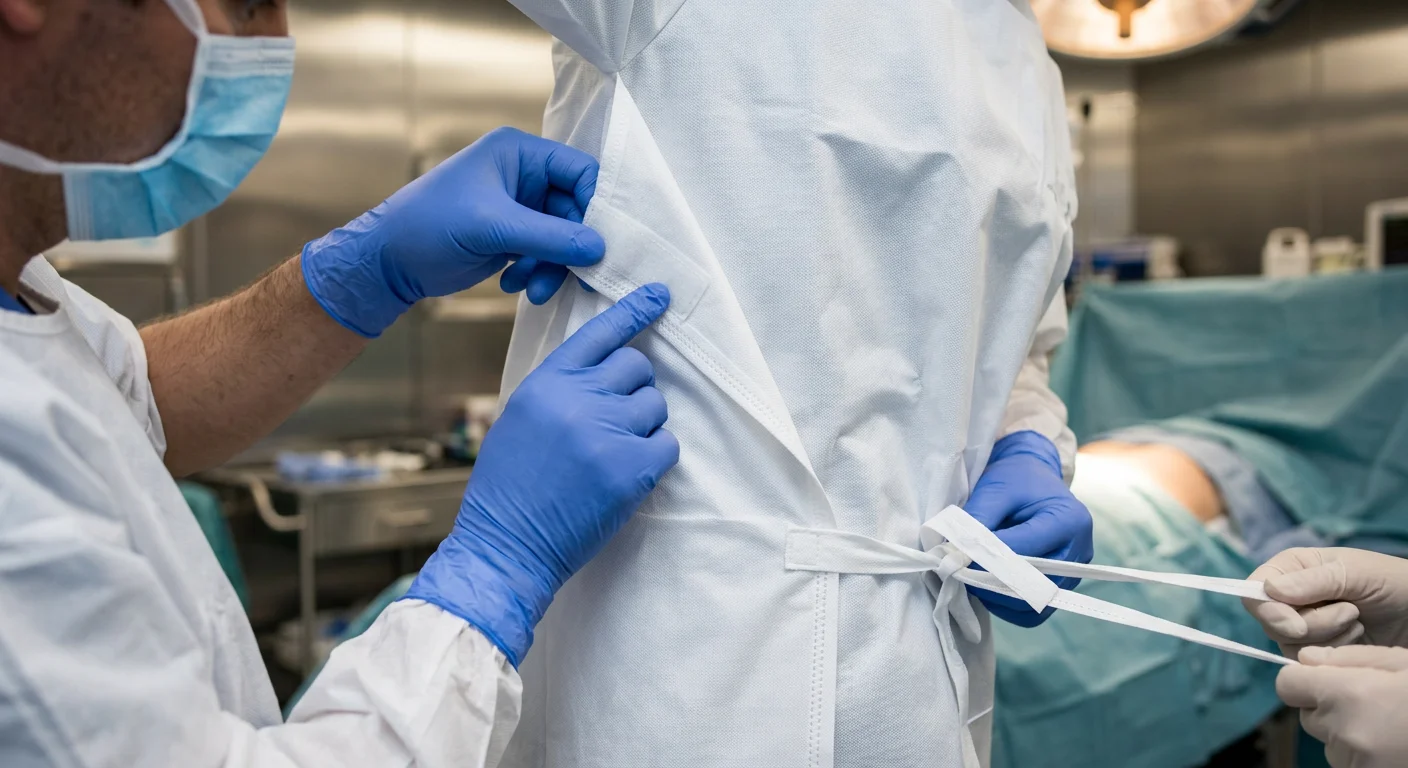 Size is where comfort either starts or collapses.
A medical surgical gown that’s too short rides up during extended reach. One that’s too narrow pulls across the shoulders at the moment precision matters most. McKesson builds its size range around this reality — length and cut are calibrated together, not length alone.
Available sizes across the standard non-reinforced line:
| Size | Gown Length |
|---|---|
| Medium | 45 inches |
| Large | 50 inches |
| X-Large | 52 inches |
| 2X-Large | 53 inches |
| 3X-Large | 61 inches |
Fabric-reinforced variants run Large through 2X-Large (50–53 inches). That range covers most OR teams.
Matching size to body type matters more than it sounds:
- Taller surgeons — go up to X-Large or 2X-Large for the length, even if your build doesn’t demand it. Those extra inches keep coverage in place during forward reach and table-side positioning.
- Larger-build surgeons — XL and 2XL give you a generous cut with rear pleats. You get full shoulder rotation without fabric pulling tighter as the hours add up.
- Undersizing is the most common fit mistake. A gown that fits while standing will bind the moment you lean in. AAMI Level 3 protection covers zones A, B, and C across every size, but the gown has to stay in the right position throughout the case for that protection to hold.
The hook-and-loop neck closure and waist ties take care of individual variation within a size. One-handed adjustment, no help needed.
McKesson Non-Reinforced vs. Reinforced Surgical Gown: Which Is Right for Long Surgeries?
 The choice isn’t complicated — but getting it wrong costs you more than comfort.
McKesson offers two gown types: the standard non-reinforced surgical gown and the fabric-reinforced surgical gown with a towel. Both carry AAMI protection. Both are sterile surgical gowns built for the OR. They serve different exposure profiles, though. That difference matters a lot across a long case.
Non-Reinforced McKesson Surgical Gowns: The Long-Surgery Default
General surgery, laparoscopic work, complex abdominal cases — the non-reinforced line fits most of these well. AAMI Level 3 protection covers critical zones A, B, and C with tested fluid resistance. The triple-density SMS nonwoven keeps the gown light from top to bottom. Sizes run from 45 inches at Medium up to 61 inches at 3X-Large.
That lightness serves a real purpose. For the past four hours, extra gown weight has started showing up in your shoulders and your concentration. The cool-back panel moves heat away from your body. Reinforced layers would trap that heat exactly where you need airflow most.
For moderate fluid exposure — which covers most long orthopedic and general cases — non-reinforced disposable surgical gowns give you solid protection without the added weight.
Reinforced McKesson Surgical Gowns: Fluid Exposure Changes the Math
McKesson’s reinforced surgical gown steps in for higher-demand procedures. Think cardiac surgery, major vascular work, and high-volume irrigation cases. These involve bigger fluid volumes, direct splash zones, and real saturation risk. That’s a different protection need.
The reinforced build adds stronger barrier coverage in the highest-exposure areas. The tradeoff is breathability. Extra layers reduce airflow at every point they’re applied. So thermal comfort takes a hit.
The Decision Framework
| Factor | Non-Reinforced | Reinforced |
|---|---|---|
| Fluid exposure level | Low to moderate | Moderate to high |
| Procedure duration | Extended (4–8+ hrs) | Any duration |
| Thermal comfort priority | Higher | Lower |
| AAMI protection level | Level 3 | Level 3+ |
| Best-fit procedures | General, orthopedic, laparoscopic | Cardiac, vascular, high-irrigation |
For long surgeries, heat control and freedom of movement matter more as hours pile up. The non-reinforced line handles better in most cases. Go with reinforced when fluid volume — not procedure length — is your main risk factor.
McKesson Surgical Gown vs. Competing Brands: Comfort Comparison for Prolonged Procedures
According to MarketsandMarket , the global surgical gowns and drapes market was valued at US$4.69 billion in 2025. That number tells you something: this is a crowded field, and every major brand claims comfort. The harder question is which claims hold up past hour four.
Five names dominate operating room apparel for prolonged procedures: McKesson, Halyard (Owens & Minor), Medline, Cardinal Health, and Mölnlycke. Each takes a distinct position. The differences are real — and they matter most for teams running complex, multi-hour cases.
What Each Brand Claims?
| Brand | Comfort Positioning |
|---|---|
| McKesson | Cost-effective AAMI-rated protection; rear pleats and a generous cut for mobility |
| Halyard | High-performance nonwovens; target breathability in long surgeries |
| Medline | Ergonomic design for ease of use across surgical teams |
| Cardinal Health | Broad portfolio with packaging convenience; limited breathability-specific claims |
| Mölnlycke | Advanced nonwovens for breathability; specialty procedure sets |
Halyard leads on breathability language. Mölnlycke runs close behind on material innovation. McKesson competes on something different: consistent, well-documented AAMI surgical gown levels at a price point that holds up across high-volume purchasing.
Where McKesson Surgical Gowns Stand Apart?
The honest gap in this comparison is data. No brand — McKesson included — publishes breathability metrics like MVTR scores (g/m²/24h) or fabric weight in gsm for side-by-side comparison. What you get are claims, material disclosures, and design specs.
On mobility design, McKesson’s rear pleats and generous cut are concrete, documented features. Medline talks about ergonomics in broad terms. Cardinal Health centers its pitch on procurement convenience, not wear performance. That distinction hits differently for a surgeon six hours into a reconstruction.
On fluid resistance, Halyard has an edge for high-risk, high-exposure procedures. Their fluid-resistant surgical gown line is built around those cases. For routine extended surgeries — orthopedic, general, and laparoscopic — McKesson’s reinforced surgical gown and non-reinforced lines cover the protection requirements. You get that without paying the premium cost.
The Procurement Reality
For hospitals and ASCs running high procedure volumes, McKesson’s value is structural. Consider what you actually need at scale:
- Strong distributor networks that keep supply flowing
- Reliable sterile packaging that meets consistent sterile surgical gown standards
- Supply chain predictability that matches per-unit performance in importance
Halyard is the right call where fluid risk is the main concern for a procedure. McKesson is the right call where procedure volume, cost control, and solid comfort across a broad surgical team drive the decision. Those are different problems. Both brands solve theirs.
Buying Guide: Selecting the Right McKesson Surgical Gown for Your OR Team
Four variables determine the right McKesson surgical gown for your team. Get them right, and the gown disappears into the background of the procedure. Get them wrong, and you’ll notice.
Surgery type comes first. High-fluid invasive procedures — cardiac, vascular, major joint work — need the fabric-reinforced line. The reinforced SMS construction adds barrier strength at the spots where splash and saturation risk run highest. For general surgery, laparoscopic cases, and moderate-fluid procedures, the non-reinforced line is the better pick. It’s lighter, cooler, and still rated AAMI Level 3 across critical zones A, B, and C.
Procedure duration shapes the second decision. Extended cases — anything past four hours — work better with non-reinforced construction. The reason is simple: the cool-back panel can breathe. Add reinforced layers to the back surface, and you lose your main heat-exit point. That’s a trade-off most long cases don’t require.
Team sizing gets overlooked on most procurement checklists. It shouldn’t. Here’s the SKU breakdown:
| SKU | Type | Size | Length | Best For |
|---|---|---|---|---|
| #1104452 | Fabric-Reinforced | Large | 50″ | High-fluid, manipulation-intensive cases |
| #183-I90-8030-S1 | Non-Reinforced | X-Large | 52–53″ | Standard procedures, larger team members |
| #183-I90-8040-S1 | Non-Reinforced | 2X-Large | 53–61″ | Extended coverage, tall or broad builds |
Budget and volume close the loop. Non-reinforced cases pack 32 units. Fabric-reinforced packs 24. Both lines use individual sterile packaging. This keeps sterility intact and supports FIFO inventory rotation. For high-turnover ORs, that’s a practical win — no added storage complexity required.
One certification worth noting for specialty teams: every McKesson disposable surgical gown is latex-free and ISO 10993 biocompatibility-rated. For immunocompromised patients or implant procedures, that’s not a footnote — it’s a clinical requirement.
Conclusion
After hours on your feet, the last thing you need is a gown fighting against you.
McKesson surgical gowns belong in the OR for good reason. The materials are breathable and manage heat buildup during long procedures. Coverage is reinforced where fluid exposure risk runs highest. Sizing fits how surgeons move — not just how they stand.
Choosing between non-reinforced and reinforced options is straightforward. Map it to your case load:
- High fluid exposure? Go with AAMI Level 3 or 4 protection.
- Routine procedures? A lighter, breathable gown cuts fatigue across a full day.
Evaluating McKesson medical products for your OR team? Start with the procedure profile, not the price tag. Get the fit right. Match the protection level to the risk. Comfort follows from there.
Your focus belongs to the patient. Your gown should never compete with it.