

By hour four of your shift, something shifts — and not in a good way. That bouffant cap felt fine at the start. Now it’s pressing into your temples. It’s trapping heat against your scalp. It’s leaving a red elastic band imprint across your forehead.
You’re not imagining it. You’re not alone either. Bouffant cap discomfort is a real workplace frustration — one that doesn’t get talked about much. Yet it affects your focus, your comfort, and even your safety. Every time you stop to adjust your head covering mid-task, it breaks your concentration and slows you down.
The good news? Most of it comes down to fixable factors:
-
Wrong size
-
Wrong material
-
A small fit mistake that adds up fast
So what’s causing the problem? And how do you pick and wear a cap that stops fighting you before lunch? That’s what we’re getting into here.
Why Does Your Bouffant Cap Feel Uncomfortable After Just a Few Hours?

Several things happen to your head at once — and they make each other worse.
Heat is the first culprit. Non-woven polypropylene is the material in most standard bouffant caps . It’s lightweight and does its job well at the start of a shift. But it doesn’t breathe. Moisture has nowhere to go. By hour two or three, your head is trapped under a layer of heat and sweat. Surgeons in long procedures report that this heat buildup hurts their concentration — not just their comfort.
Fit problems make everything worse. A cap that’s even a little too tight cuts off circulation around your scalp and temples. Over a four-to-eight-hour shift, that small pressure turns into a real headache — literally. Too loose, and you’re nudging it back into place all day. That constant friction builds its own frustration fast.
The elastic band is its own problem. That single band carries all the work of keeping the cap on your head. After hours of wear, it digs into your forehead. It leaves red marks. It causes itching that’s hard to ignore — especially when your hands need to stay sterile and away from your face.
One issue that gets missed often: the wrong size for your hair volume. Thick hair packed into a cap made for thinner hair creates pressure from the inside out. That tension builds slowly and quietly — until it’s not quiet at all.
The Elastic Band Problem: How Tight Is Too Tight?

There’s a specific kind of discomfort that creeps up on you — not sharp enough to stop you at the start of your shift, but stubborn enough to ruin the last four hours of it. That’s the elastic band problem.
The band on a standard bouffant cap does one job: keeping the cap on your head. That single point of contact pushes all the pressure into one thin strip across your forehead and temples. Wear that for eight hours, and you’re not just uncomfortable — you’re deep into bouffant cap headache territory. The red imprint it leaves behind isn’t just cosmetic. It’s your skin telling you something was too tight for too long.
So, how tight is too tight? A well-fitting cap should sit firm without gripping. Slip one finger under the elastic band. You want mild resistance — not loose, not a struggle. Marks within the first hour mean it was already too tight from the start.
The Band Feels Too Tight to Tolerate
Got a cap that’s too snug? Two fixes are worth trying:
-
The heat method : Stretch the elastic wider than your head. Lay it flat and run a warm iron over it back and forth for a few minutes while pulling the elastic taut. The heat loosens the fibers over time. Repeat as needed. It won’t last forever, but it gives you real relief.
-
The extension method : For a longer fix, open the casing seam, cut the elastic, and sew in a small extension piece. About one inch of overlap on each end holds it in place. This takes 30 minutes to two hours, based on your comfort with a needle. It solves the problem for good.
No time and no sewing kit? Open the tunnel seam, pull the elastic out, and cut it in half. Tension drops right away. It’s not pretty, but it works.
What most people skip is the most obvious fix: sizing up. Standard non-woven bouffant caps come in 21-inch and 24-inch options. Never measured your head before picking a size? There’s a real chance you’ve been wearing the wrong size for months.
Bouffant Cap Materials Compared: Why Some Feel Hotter Than Others
The material your bouffant cap is made from isn’t a minor detail. It’s the difference between a manageable shift and one where you’re counting down the minutes until you can pull the thing off your head.
Most standard disposable bouffant caps are made from spunbond polypropylene (PP) — a single-layer nonwoven fabric. It’s inexpensive, it filters particulates, and it does its job on paper. But single-layer PP has a real limitation. Airflow through one layer hits the ceiling fast, and heat starts building. Cleanroom and healthcare environments rate it as having higher permeability. That sounds like a breathability win — until you’re two hours into a procedure under surgical lights.
SMS (spunbond-meltblown-spunbond) adds two more layers to that equation. The meltblown middle layer improves liquid resistance and filtration. That matters in labs and pharmaceutical settings. The tradeoff is simple: more barriers, less airflow. For short tasks, that’s fine. For extended wear, SMS caps run warmer than single-layer PP — and you’ll feel it.
Here’s how the main materials stack up:
|
Material |
Breathability |
Heat Retention |
Best For |
|---|---|---|---|
|
Spunbond PP |
High |
Low |
Cleanrooms, general healthcare |
|
SMS PP |
Medium |
Medium |
Labs, pharma environments |
|
Cotton |
Highest |
Lowest |
Long surgical shifts, high-heat areas |
|
Polyester blend |
Medium-high |
Low-medium |
High-volume reusable programs |
Cotton sits at the top of the comfort chart for a reason. It absorbs sweat instead of trapping it. It breathes across a full shift — not just the first hour. For anyone working under operating room lights or spending eight-plus hours in a warm kitchen, cotton reusable caps cut the overheating problem that disposables create on a regular basis. Plus, they hold up through 40–60°C washing cycles. That translates to better microbial shed control than most disposables can offer.
One finding worth knowing: a study by Markel et al. found that disposable bouffant caps showed higher microbial shedding at the sterile field compared to cloth alternatives and disposable skull caps . More heat plus more shedding — that’s a poor combination for high-stakes environments.
Does Size Affect How Hot You Run?
It does — more than most people expect. A cap that fits too loosely bunches up and creates uneven airflow. A cap that’s too tight presses against your scalp and makes heat buildup worse. There’s no room for circulation. Flat bouffant caps come in 19-inch, 21-inch, and 24-inch options. Pleated styles — which give more volume for thicker hair — run from 21 to 28 inches.
Getting the size right isn’t just a comfort issue. It’s a heat management issue. A snug, well-fitted cap sits flush against your head, reduces slippage, and lets the material’s breathability do its job. A poor fit cancels out whatever advantage the fabric might have had.
Your cap has been feeling hotter, and nothing else has changed? Check whether you’ve been grabbing the same size out of habit rather than because it’s the right fit.
How to Find a Bouffant Cap That Actually Fits Without Feeling Tight?
Sizing a bouffant cap takes two minutes. Most people skip it — then spend eight hours regretting it.
Start with a tape measure. Wrap a soft measuring tape around your head at the widest point: just above your ears and across your forehead. That number is your baseline. Most standard bouffant caps follow this sizing:
-
Small : 20–21 inches
-
Medium : 21–22 inches
-
Large : 22–23+ inches
Don’t assume your size carries over from brand to brand. Sizing varies, so check the size chart before ordering. A “medium” from one supplier can run much tighter than from another.
Hair volume changes everything. Thick, curly, or long hair — or a high bun — means a standard close-fitting cap will squeeze instead of sit. That’s the whole reason the bouffant style exists. Its fuller, baggier dome gives your hair real room. No need to pull the elastic tighter to make it work. Got significant hair volume? Size up, or go with a pleated bouffant. That’s not a suggestion — it’s the point.
The Fit Test That Takes Less Than Two Minutes
Cap on? Don’t just assume it works because it stayed up. Run through this fast:
-
Tuck all hair in. For buns or braids, use a hair tie first.
-
Pull the cap down to cover your hairline.
-
Adjust the elastic or ties until the fit feels snug — firm, but not gripping.
-
Shake your head side to side and forward. It should stay put with no squeezing.
-
Wear it for one to two hours before committing to a full shift in that size.
That last step is key. Pressure marks in the first hour mean the cap is too small — not that you need to break it in.
One thing worth checking: the elastic should stretch 10–20% without straining. Already at its limit on your head? You’re in the wrong size.
Elastic feels borderline, but the dome fits fine? Look for caps with adjustable tie-backs. You can dial in the snugness at the back without leaning on the elastic band alone. Less forehead pressure, fewer headaches by the end of your shift.
Bouffant Cap vs Skull Cap: Which Feels Better for Long Work Hours?
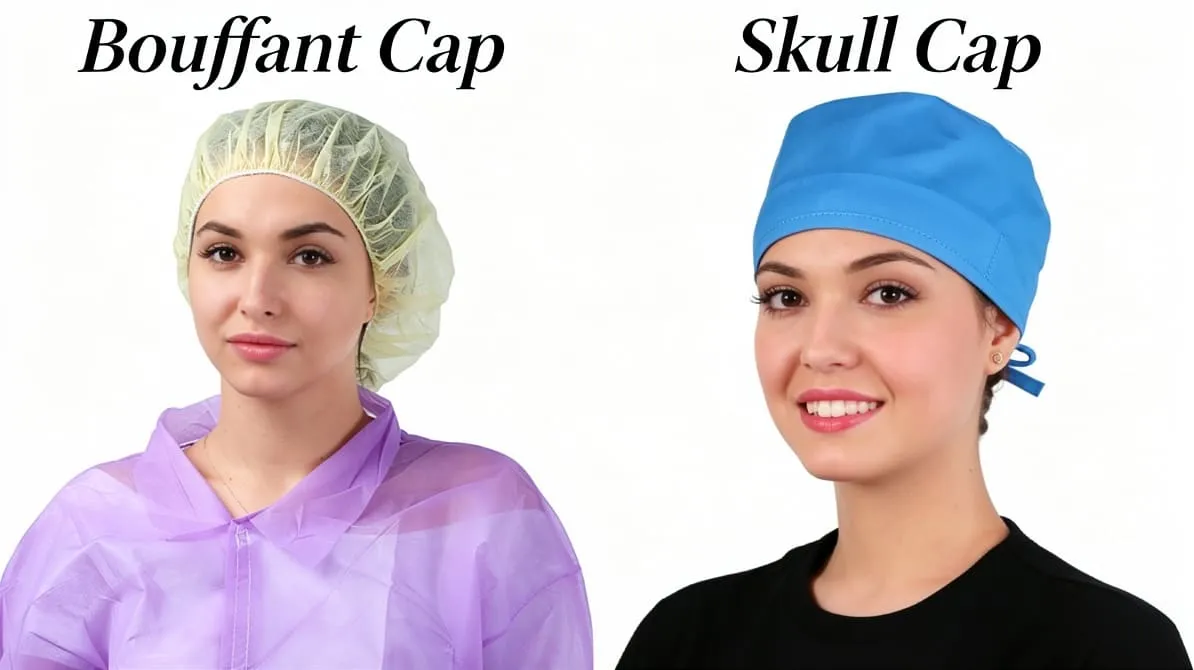
The honest answer comes down to one thing: how much hair you’re working with.
A skull cap sits close to the skull — snug, shaped to fit the head, stable. A bouffant cap gives you room — a looser dome, a softer fit, space for a bun or braid without the squeeze. Both solve the same problem. But after six or eight hours, they solve it in very different ways.
For short to medium hair, skull caps outperform bouffants. The snug, beanie-like fit doesn’t shift when you tilt your head, reach across a patient, or work under equipment that grazes the top of your cap. Surgeons who’ve worn both for decades tend to say the same thing: skull caps stay put. Bouffant caps don’t — not during long procedures where stopping to fix your cap isn’t an option.
For long, thick, or full hair, the bouffant wins. Its dome gives braids and buns real room to sit without creating pressure inside. The double-layer forehead design absorbs sweat that builds up over longer shifts. Skull caps flatten everything — fine for a low ponytail, but uncomfortable with a lot of volume on top.
Here’s a quick breakdown of how the two compare over a full shift:
|
Feature |
Bouffant Cap |
Skull Cap |
|---|---|---|
|
Migration during movement |
More likely |
Minimal |
|
Fit for thick/long hair |
Strong |
Poor |
|
Sweat absorption |
Double forehead layer |
Elastic sweatband |
|
Stability with tools |
Lower |
High |
|
Adjustability |
Fixed elastic |
Ties/buttons available |
A study of 1,543 cases found skull caps used in 61% of procedures versus 39% for bouffants. Unadjusted SSI rates trended lower for skull caps (5% vs. 8%), though the difference became non-significant after procedure-type adjustment. That’s not a definitive comfort verdict. But it does reflect real-world preference patterns among surgical staff.
Here’s how to pick:
-
Short or medium hair → skull cap. It’s lighter, more secure, and won’t shift mid-task.
-
Long, thick, or pinned-up hair → bouffant. Size up with significant volume on top. Look for moisture-wicking or cotton options to manage heat.
-
Working 8–12-hour shifts? Go for tie-back or button-closure versions. Adjustability at the back takes pressure off the elastic band. You get control at hour ten that a fixed band can’t give you.
Your current cap has been feeling off? It’s the wrong cap — just not for the reason you think.
FAQ: Common Bouffant Cap Questions From Real Users

These questions keep coming up — from nurses, food handlers, and cleanroom techs who’ve been dealing with the same frustrations for years.
How do I know which size to buy?
Bouffant hair caps come in 18″, 21″, 24″, and 28″ diameters. Measure your head first. Then factor in hair volume. Heavy or pinned-up hair needs more dome space. Size up, or you’ll feel the squeeze by midday.
Can I get a bouffant cap without an elastic band?
Yes. Some caps are sewn with no elastic at all. That works well if latex sensitivity or band pressure is your issue. Test the fit before wearing one for a full shift.
Why use a bouffant cap instead of a hairnet?
Hairnets have mesh openings. Hair slips through those gaps. Bouffant caps are solid polypropylene — no gaps, no slippage. They’re also easier to spot during compliance checks. In food service, the FDA requires full hair coverage for all handlers. A hairnet often falls short of that standard.
How often should I replace mine?
For disposables: once per procedure or once per shift — no exceptions. Cleanroom environments with higher ISO ratings (ISO 5 or 6) may need more frequent changes throughout the day. Reusables get washed after every shift, no skipping.
Are bouffant caps safe for people with latex allergies?
Most standard bouffant caps use latex-free elastic. Check the product spec before ordering to be sure. That said, most modern caps from reputable suppliers are latex-free by default — so you’re likely covered either way.
Conclusion
Bouffant cap discomfort isn’t something you have to push through. Now you know there’s a better way.
The fix is usually simple. Wrong size, wrong material, or the cap sitting slightly off on your head — that’s it. Match your bouffant cap to your head circumference, your shift length, and your work environment. The difference shows up fast. No more elastic band headaches halfway through a shift. No more yanking it off the second you clock out.
Start here:
-
Measure your head before ordering
-
Test the elastic tension on a single cap before placing a bulk order
-
Choose breathable SMS non-woven fabric if heat and sweat are your main issues
Your head covering should disappear into the background. Once it fits right, it stops pulling your attention — and you stay focused on the work that matters.
Ready to find a cap that fits the way it should? Browse morntrips.com’s full range of hair cover caps built for real working conditions — not just the box.