

Finding a reliable shoe cover supplier in the Philippines is harder than it sounds. For procurement teams in hospitals, pharma facilities, and food processing plants, a bad supplier choice can trigger compliance failures, operational delays, and real safety risks.
The Philippine PPE market has grown fast in recent years. So has the number of suppliers claiming to offer “medical-grade” and “industrial-grade” protective footwear covers. Some deliver. Many don’t.
This guide profiles six credible local suppliers. You’ll see their product specs, certifications, and MOQs side by side — so you can make a faster, smarter sourcing decision without the guesswork.
1. Mednax Trading Corporation (Medical-Grade Disposable Shoe Covers)
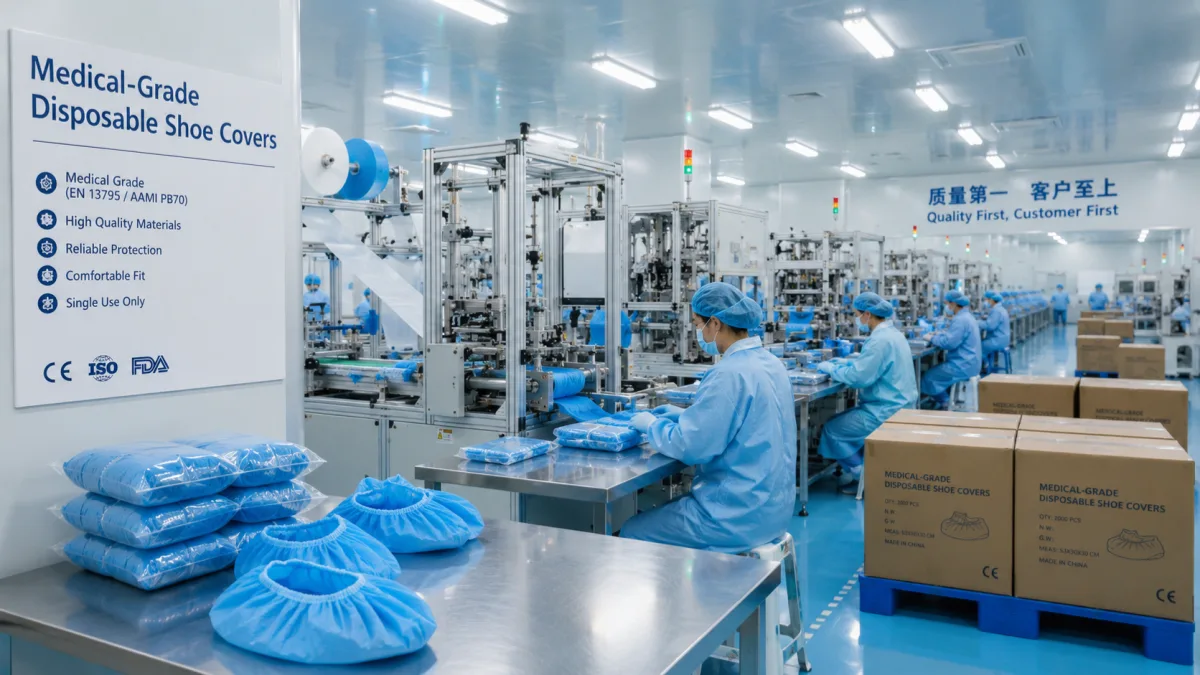 Mednax Trading Corporation sits at the crossroads of compliance paperwork and urgent hospital orders. For Metro Manila procurement teams, that combination is hard to find — and most suppliers don’t take it seriously enough.
Mednax is registered as a local trading corporation under the Philippine SEC. It works as a distributor, not a direct manufacturer. That’s worth knowing upfront. The company sources medical-grade shoe covers from established overseas manufacturers. Then it handles the documentation, delivery logistics, and specification flexibility that Philippine institutional buyers need to clear procurement approval.
Product Specs Worth Knowing
The main product line focuses on disposable non-woven shoe covers built for hospital use. Three material tiers define the range:
- Polypropylene (PP) non-woven, 25–40 gsm — standard hospital wards, clinics, and outpatient centers
- SMS non-woven, 35–45 gsm — higher fluid resistance for ICUs and isolation rooms
- PE-coated or polyethylene variants — wet environments like operating rooms and maternity wards
Sizing follows a one-size-fits-most design: 42 cm length × 15 cm height, with elastic openings spanning 40–55 cm. That’s enough to fit men’s shoes up to US size 12–13. The full 360° elastic band is heat-sealed or sewn into the top edge. Heavy-duty variants add double elastic or ankle ties for high-movement settings.
Durability holds up well for the price point. Standard PP covers last a full 6–8 hour shift in dry conditions and 2–4 hours in fluid-heavy environments. Tear resistance clears 5,000 steps on standard hospital flooring.
Certifications and Compliance
Philippine hospital procurement requires solid documentation — no exceptions. Disposable shoe covers fall under Class A medical devices per the Philippine FDA classification. Mednax-type distributors should hold or provide:
- FDA CPR (Certificate of Product Registration) for medical marketing to hospitals
- Manufacturer-level ISO 13485 certificates for quality management
- ISO 9001 for corporate QMS — relevant for government and PhilHealth-linked tenders
- ASTM F1671 test documentation for viral penetration resistance on premium-tier SKUs
Sourcing for a tertiary or teaching hospital? Request the full compliance folder before you commit to an MOQ.
Pricing and Minimum Order Quantities
Wholesale pricing benchmarks for Metro Manila PPE distributors of comparable spec:
| Material | Price Per Piece (PHP) | Typical MOQ |
|---|---|---|
| PP non-woven, 25–30 gsm | PHP 1.00–1.80 | 5,000–10,000 pcs |
| SMS / PE-coated, 35–45 gsm | PHP 1.80–3.50 | 5,000–10,000 pcs |
| ASTM F1671-compliant premium | PHP 3.50–6.00 | Varies |
Retail small-lot packs (50 pcs) run PHP 100–250, or about PHP 2–5 per piece. That’s a useful number to have if you’re comparing wholesale rates against walk-in pricing.
Delivery and Customization
Stock items ship within 1–3 days across Metro Manila and 3–7 days provincially via LBC, J&T, or JRS. For urgent hospital orders, on-hand inventory of standard PP covers supports same-week fulfillment in most NCR cases.
Large institutional accounts placing ≥50,000 pcs get access to custom logo printing and color selection (blue, green, white). That’s a practical option for hospitals running color-coded zoning systems. Logo customization adds PHP 0 . 20–0.50 per piece. Anti-skid embossed or coated soles are also available for wet-floor environments. Expect a 10–20% price premium over the smooth-sole standard for that option.
Best fit for : Public and private hospitals, clinical and diagnostic labs, pharmaceutical QC environments, and food processing facilities that need cross-industry medical-grade coverage.
2. Zuellig Pharma / Healthcare PPE Distributors (Pharma & Cleanroom-Grade Covers)
Zuellig Pharma doesn’t compete on price. It competes on compliance infrastructure. For pharmaceutical manufacturers and biotech labs sourcing cleanroom shoe covers in the Philippines, that difference is huge.
Zuellig is headquartered at Km 14 West Service Road, Sun Valley, Parañaque City. It’s Asia’s largest integrated healthcare solutions company. The Philippine office (+63 2 8236 6488) handles distribution for major international pharma brands. For PPE procurement teams, here’s what matters most: the warehousing and distribution network runs under GDP and GMP guidelines. ISO quality management standards apply across the full supply chain. That’s the compliance backbone ISO 5–8 cleanroom facilities need to see from a supplier — before they’ll even request a sample.
What They Actually Supply?
Zuellig doesn’t publish a public PPE catalog. This is a B2B operation, not a storefront. Its role as a primary medical consumables distributor for Philippine hospitals and pharma clients means the product scope covers protective footwear, alongside gloves, coveralls , and masks . Large medical distributors at this level carry two to three international PPE brands at a time. In the Philippine market, cleanroom-grade shoe covers from 3M, Kimberly-Clark/Halyard, and DuPont move through this type of channel.
Cleanroom Spec Matching
Your ISO zone sets the spec requirements:
- ISO 5–6 (Class 100–1,000) : Full gowning required. Shoe covers must be low particle-shedding, low static, sterile-packaged, and compatible with full cleanroom protocols.
- ISO 7–8 (Class 10,000–100,000) : CPE or multi-layer composite covers work here. Key criteria: dust resistance, low particle release, anti-slip sole design.
For ESD-sensitive environments — semiconductor-adjacent pharma lines or static-sensitive compound handling — covers must meet IEC/ESD S20.20 surface resistance specs (10⁵–10¹¹ Ω range).
CPE vs. PE at a glance :
| Material | Thickness | Best For |
|---|---|---|
| CPE (Chlorinated Polyethylene) | 30–60 μm | ISO 7–8, wet corridors, high-traffic cleanrooms |
| PE (Polyethylene) | 20–40 μm | Visitor areas, ISO 8, low-risk zones |
Best fit for : GMP pharmaceutical manufacturers, biotech and research laboratories, hospital operating rooms under ISO cleanroom standards, and any facility where supply chain traceability is a non-negotiable procurement requirement.
3. Indoplas Philippines Inc. (Medical PPE Manufacturer – Certified Shoe Covers)
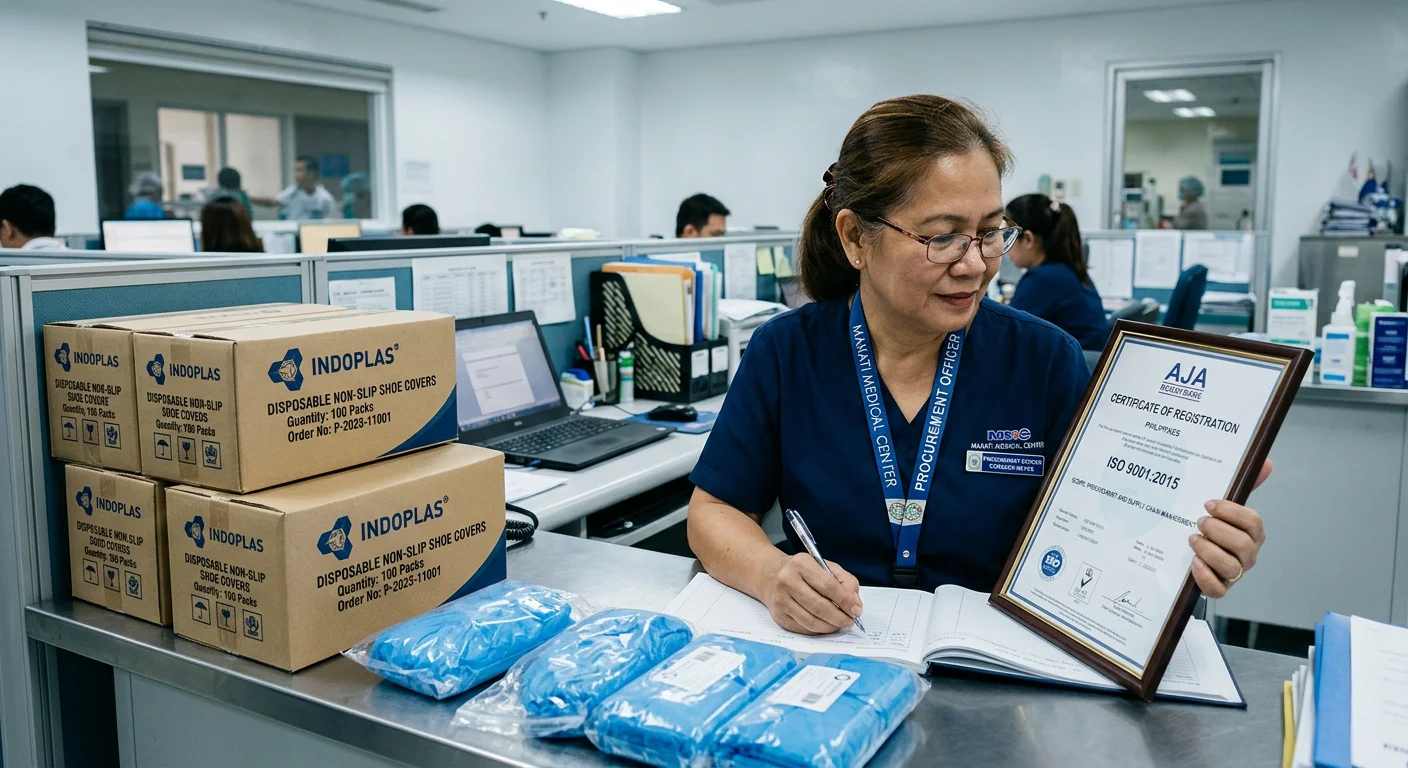 Indoplas Philippines Inc. is one of the few local manufacturers that gives you an ISO certificate with a real number on it. That number is Q107558. The certification is ISO 9001:2015, issued 4 May 2018. Hospital procurement officers working through government tender checklists will find that kind of specificity far more useful than any marketing brochure.
The company focuses on the institutional medical PPE segment — hospitals, clinics, and laboratories. Its flagship product is the Indoplas Non-slip Shoe Cover , sold in packs of 100, in blue.
What the Product Delivers?
The cover uses PP non-woven material in the 25–40 GSM range — the standard for medical-grade disposable shoe covers. The non-slip sole sets it apart from most options on the market. Most generic imports drop that feature. That’s a real problem on wet tile and vinyl hospital floors, where a slip incident means liability. Indoplas builds in a textured sole that targets a static coefficient of friction ≥ 0.5 on dry surfaces.
Size runs 40–42 cm heel-to-toe and 15–17 cm in height. That covers EU sizes 36 to 46 — one size fits most. Fluid resistance handles light splashes at a hydrostatic head of 10–20 cm H₂O. It works fine for standard ward and clinic use. It’s not built for heavy chemical exposure.
Pricing and Sourcing
| Channel | Pack Size | Est. Price (PHP) |
|---|---|---|
| Lazada / Shopee | 100 pcs | PHP 150–350 |
| Institutional direct | ≥10,000 pcs (10 cartons) | Negotiated contract rate |
Indoplas supplies bulk institutional orders directly. Each carton holds 1,000 pcs. Most hospital contracts set a minimum of 10–20 cartons per order.
Best fit for : Philippine hospitals, government health facilities, and clinical laboratories that need documented ISO compliance, non-slip performance, and a local manufacturer you can audit directly.
4. VMED Medical / VMed Prohealthcare (Hospital Supply Distributor)
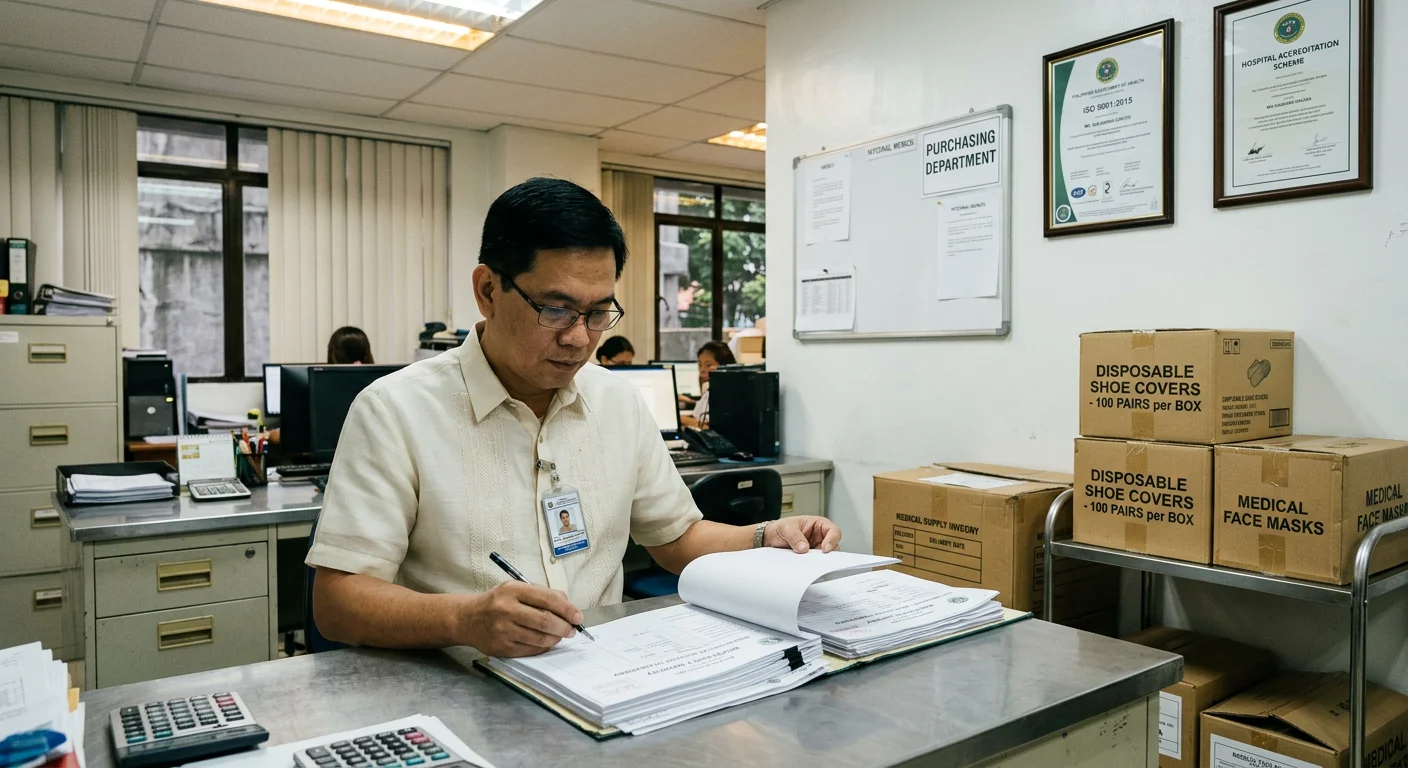 VMED Medical has been moving hospital supplies across the Philippines since 2013. That’s over a decade of hands-on distributor experience in a market that drops unreliable vendors fast.
Based in Manila, VMed Prohealthcare works as an importer and distributor — not a manufacturer. That difference matters. You’re buying from a company that sources from upstream suppliers, handles import paperwork, and ships nationwide. For procurement teams that don’t want to deal with international freight, that’s a solid setup.
The catalog covers a lot: medical equipment, hospital furniture, laboratory supplies, first-aid items, and general healthcare consumables. Shoe covers fall under the hospital supplies category. Their Facebook materials list FDA-approved products — a good starting point, but you still need to verify at the SKU level before placing orders.
What to Verify Before You Order?
The compliance claim on their page is broad. Before committing to any volume:
- Request FDA registration documents for the specific SKU you’re sourcing — not a general company-level statement
- Ask for an official quotation with MOQ, lead time, and unit pricing — none of these are listed on their public pages
- Pull the product catalog, certificates, and spec sheet as your first step
Best fit for : Clinics, small hospitals, and institutional buyers across the Philippines. A good pick if you need a wide-catalog distributor with nationwide shipping and want to skip managing direct imports.
5. Migatsu Ent. Philippines Inc. (OEM Nonwoven Shoe Cover Supplier)
Most distributors hand you a catalog. Migatsu hands you a conversation — and that’s where OEM sourcing begins.
Migatsu Ent. Philippines Inc. runs out of Manila as an OEM-focused supplier of industrial and medical consumables. The setup is B2B by design. No retail window, no public price list. You get direct access to a team built — in their own words — around “exemplary and long-term business relationships.” For procurement managers running recurring supply contracts, focus matters more than a flashy storefront.
What You Can Specify for OEM Orders?
This is a supplier you build a spec with, not just order from. Define these parameters before sending your first RFQ:
- Material : PP nonwoven (20–40 gsm) for standard single-use covers; SMS nonwoven (35–45 gsm) for higher fluid repellency in hospital or cleanroom settings
- Size : Common OEM cuts run 40×15 cm or 41×16 cm — fits up to US size 12–13
- Color : Blue or green for medical; white for food processing and cleanroom environments
- Anti-skid sole : Optional PVC or embossed pattern, friction coefficient 0.4–0.6 on smooth floors
- Fluid resistance : SMS variants handle 20–40 cm H₂O hydrostatic pressure — solid for wet clinical corridors
For cleanroom and electronics facilities, you can also spec low particle-shedding nonwoven with residual static below 2 kV at 20% RH. That’s the standard for ESD-compatible environments.
MOQ and Lead Time
| Order Type | MOQ | Lead Time |
|---|---|---|
| Unprinted standard PP covers | 5,000–10,000 pcs | 7–15 days (repeat orders) |
| Custom OEM with logo print | 10,000–20,000 pcs | 15–30 days (first order) |
Logo printing goes up to two colors on side panels, with a max print area of around 5×3 cm per side. Each carton holds 1,000–2,000 pcs and weighs 6–12 kg, depending on GSM. That range helps with freight planning on large institutional orders.
Best fit for : Hospitals, food processing plants, and cleanroom facilities in the Philippines that need custom-branded or private-label nonwoven shoe covers with defined specs, repeatable quality, and a local OEM partner who picks up the phone.
6. Endure Medical (Small-Scale PPE Distributor & Retail Supplier)
Endure Medical has been moving pharmaceutical and medical supplies through Philippine institutions since 2002. That’s over two decades in a market that doesn’t forgive inconsistency.
The company is headquartered at Tektite East Tower on Exchange Road in Pasig. It’s 100% Filipino-owned and operates as an importer and distributor of pharmaceutical products, hospital equipment, and laboratory devices. The team runs between 201 and 500 people. That’s modest by healthcare distribution standards, but large enough to keep reliable institutional coverage across Metro Manila.
What to Know Before Reaching Out?
Endure Medical isn’t a spec-sheet supplier. No public MOQ thresholds. No published PPE pricing. No certification list sitting on a website waiting for you. What you get instead is a physical retail presence. The company runs a dedicated showroom carrying medical equipment essentials and IVD products. There’s also a separate Davao branch serving Mindanao buyers.
That geographic spread is useful for regional procurement teams. You get a local pickup option — no freight dependency required.
Contact Details
| Channel | Details |
|---|---|
| Mobile | 0928-521-9798 |
| Email (Manila) | emishowroom305@gmail.com |
| Email (Davao) | emishowroomdavao@yahoo.com |
Best fit for : Small clinics, diagnostic centers, and retail-scale buyers across Metro Manila and Davao. You can source medical consumables here — including protective footwear covers — without the volume commitments that larger distributors push on you.
Supplier Comparison Table: Quick-Reference for B2B Buyers
Six suppliers. Three industries. One table. Here’s what matters most on your procurement checklist.
Compliance comes first in this table — not price. In medical and industrial sourcing, a cheap shoe cover that fails an FDA audit costs more than the whole order. Price and lead time come after.
| Supplier | Primary Use | Material | Price Range (PHP/pc) | MOQ | Lead Time | Key Certifications | Editor’s Pick |
|---|---|---|---|---|---|---|---|
| Mednax Trading | Medical | PP / SMS / PE-coated, 25–45 gsm | PHP 1.00–6.00 | 5,000–10,000 pcs | 1–7 days | FDA CPR, ISO 13485, ISO 9001, ASTM F1671 | 🏥 Best for Hospitals |
| Zuellig Pharma | Medical / Cleanroom | CPE 30–60 μm / PE 20–40 μm | Quote-based | High-volume institutional | By arrangement | GDP, GMP, ISO QMS | ✅ High-Compliance Medical Grade |
| Indoplas Philippines | Medical | PP non-woven, 25–40 gsm | PHP 1.50–3.50 | 10,000 pcs (10 cartons) | 3–7 days | ISO 9001:2015 (Q107558) | 🏥 Best for Hospitals; Best Value |
| VMED Medical | Medical / General | FDA-approved (SKU-dependent) | Quote-based | Quote-based | Nationwide shipping | FDA-approved products | 🚚 Wide-Catalog Distributor |
| Migatsu Ent. | Medical / Industrial / OEM | PP 20–40 gsm / SMS 35–45 gsm | Quote per 1,000 pcs | 5,000–20,000 pcs | 7–30 days | OEM-dependent; specify per order | 📦 Best for Large-Volume OEM |
| Endure Medical | Medical / Retail | Distributor-dependent | Walk-in/quote | No stated minimum | Metro Manila + Davao | Distributor-level compliance | 🏪 Best for Small-Volume Buyers |
How to read this table: Compliance drives the sort order — not price.
- Hospital and pharma buyers : Compliance is a hard requirement. Start at the top of the list.
- Industrial and OEM buyers : Go straight to Morntrip and Migatsu. They fit your needs better.
- Small clinics that can’t meet bulk MOQs : Endure Medical and VMED are your best starting points. No large minimum orders required.
FAQ: Shoe Cover Suppliers Philippines — Buyer’s Most Asked Questions
Procurement teams ask the same five questions. Here are direct answers.
Q1: What’s the real difference between medical and industrial shoe covers?
The gap is bigger than most buyers expect — and it matters at the audit.
Medical covers (hospitals, clinics, pharma cleanrooms) use PP non-woven or PE film. They focus on fluid barrier performance, pathogen resistance, and anti-slip soles. Key certifications: FDA Philippines registration, ISO 13485, and GMP compliance for pharma environments.
Industrial and cleanroom covers use denser synthetic materials — coated PE, CPE , and high-density PP. These are built for low particle shedding, chemical resistance, and ESD control. The standard that applies here is ISO 14644 cleanroom classification, not medical device regulation.
Disposal follows the same logic. Medical shoe covers with blood or body fluid contact go into biohazard bags for incineration. Keep them separate from general waste — no exceptions. Industrial covers from chemical environments are classified as hazardous industrial waste. Standard dust-only covers go through ordinary disposal.
Q2: Where can I buy cheap disposable shoe covers in bulk in Manila?
Three solid channels exist for bulk buyers:
- Local medical distributors near hospital zones stock PP/PE non-woven covers in 100-pair packs at PHP 1.0–3.0 per pair. Stock orders ship within the same week.
- Lazada B2B and Shopee B2B Philippines list covers made in China and Vietnam at USD 0.02–0.06 per pair FOB. Use these to benchmark your local wholesale quotes.
- Manila-based PPE distributors with warehouse stock fill full carton orders (1,000–2,000 pairs/carton) in 1–3 business days for NCR buyers.
For the lowest bulk price, order 10–50 cartons minimum. Lock your pricing 1–3 weeks in advance. That protects you from freight and currency swings.
Q3: What certifications do hospitals and pharma plants require?
Hospitals need FDA Philippines-registered products from a licensed local importer. Operating rooms and ICUs add ISO 13485 from the manufacturer. Each batch also needs lot numbers and sterility labeling.
GMP pharmaceutical facilities run stricter checks. You need low particle-shedding materials matched to their cleanroom ISO class. Supplier-level ISO 9001 or ISO 13485 is required. A full document package is non-negotiable — that means a Certificate of Conformity, MSDS, and particle release test reports.
Q4: Disposable vs. reusable — which is cheaper?
Run the numbers before defaulting to disposable.
A 100-person entry zone using disposable PP covers at PHP 1.50/pair across 250 working days adds up to PHP 37,500 per year. Reusable fabric covers cost PHP 150/pair and last 50 washes at PHP 4 per wash. That works out to PHP 7 per use — higher per use, but much lower in waste volume.
The practical rule is straightforward. High-infection-risk environments (ICU, OR) — disposable, every time. High-traffic, stable-workforce environments — electronics lines, outer pharmaceutical zones — can justify reusable covers. This works best where centralized laundering is already in place.
Q5: What are typical MOQs and lead times from Philippine suppliers?
| Source | MOQ | Lead Time |
|---|---|---|
| Local Manila distributor (stock) | 1,000–2,000 pairs | 1–3 days (NCR); 3–7 days provincial |
| Local institutional contract | 10,000–50,000 pairs | Negotiated per framework |
| Import (China/Vietnam via sea) | 20,000–100,000 pairs | 22–45 days total (production + freight + customs) |
One thing to flag: orders that require FDA Philippines classification as a medical product need extra customs documentation. Sort that paperwork before your production window opens. Getting it done after the shipment lands at Manila port will cost you time and money.
Conclusion
Finding the right shoe cover supplier in the Philippines doesn’t have to be hard. The stakes are real — patient safety, cleanroom compliance, job site protection. You need to get this right.
The seven suppliers listed here cover the full range of needs. You’ll find hospital-grade disposables, certified cleanroom covers, bulk OEM options, and retail access. Sourcing for a 500-bed hospital? There’s a match here. Running a food processing facility on three shifts? There’s a match here, too.
Your next step is simple:
- Shortlist two or three suppliers based on your industry requirements
- Check MOQ tolerance and certification standards
- Request samples before placing a bulk order
In procurement, overpaying isn’t the biggest risk. The real cost comes from picking the wrong supplier — and finding out only after the delivery lands at your door.
Start with the right information. Make the call with confidence.