

One missing certification mark. That's all it takes to turn a routine clinical procedure into a serious liability — or worse, a patient safety incident.
Yet every day, procurement teams, clinic managers, and individual buyers purchase disposable medical supplies with no reliable way to confirm that what's in the box meets medical-grade certification standards. A compliant, hospital-ready product and a packaged imitation can look identical to the untrained eye.
That's the problem this guide solves.
By the end, you'll have a clear, step-by-step framework for spotting real quality markers — from regulatory certifications to packaging integrity. You'll walk away ready to make purchasing decisions with genuine confidence.
What Does "Medical Grade" Mean for Disposable Supplies?
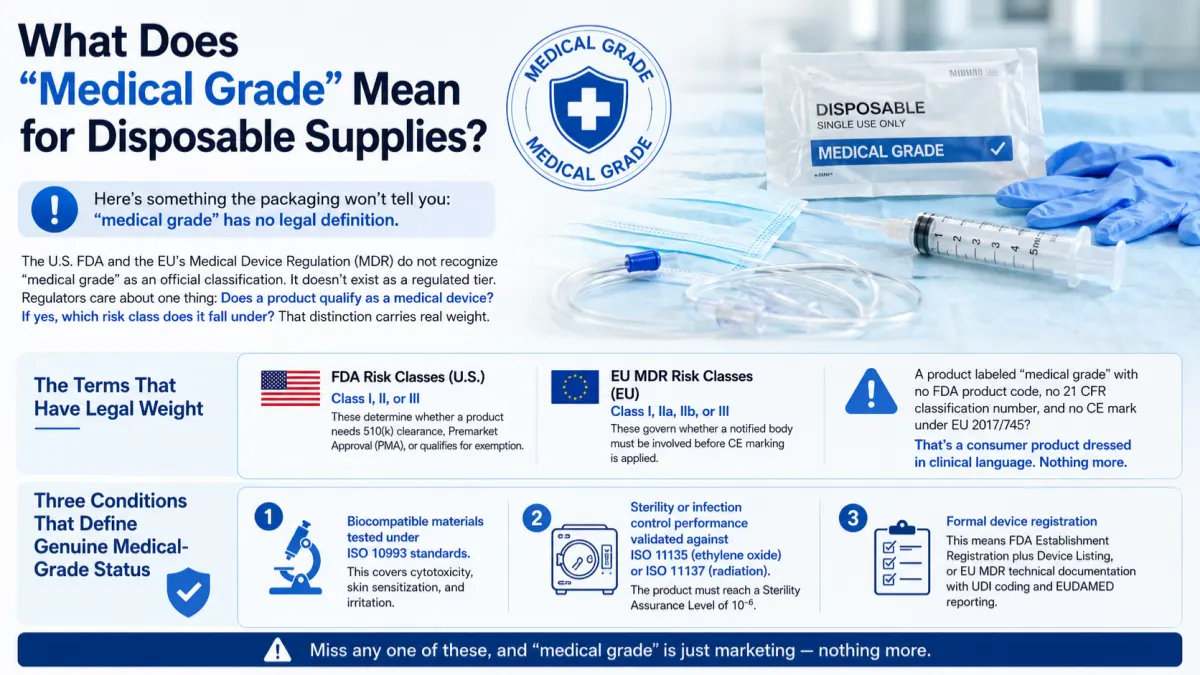
Here's something the packaging won't tell you: " medical grade " has no legal definition.
The U . S. FDA and the EU's Medical Device Regulation (MDR) do not recognize "medical grade" as an official classification. It doesn't exist as a regulated tier. Regulators care about one thing: Does a product qualify as a medical device? If yes, which risk class does it fall under?
That distinction carries real weight.
The Terms That Have Legal Weight
Check these classifications — they're the ones with real regulatory force for disposable medical supplies :
-
FDA Risk Classes (U.S.): Class I, II, or III — these determine whether a product needs 510(k) clearance, Premarket Approval (PMA), or qualifies for exemption
-
EU MDR Risk Classes: Class I, IIa, IIb, or III — these govern whether a notified body must be involved before CE marking is applied
A product labeled "medical grade" with no FDA product code, no 21 CFR classification number, and no CE mark under EU 2017/745? That's a consumer product dressed in clinical language. Nothing more.
Three Conditions That Define Genuine Medical-Grade Status
Real hospital-grade supplies and single-use medical devices must meet three hard requirements — no exceptions:
-
Biocompatible materials tested under ISO 10993 standards. This covers cytotoxicity, skin sensitization, and irritation.
-
Sterility or infection control performance validated against ISO 11135 (ethylene oxide) or ISO 11137 (radiation). The product must reach a Sterility Assurance Level of 10⁻⁶.
-
Formal device registration — this means FDA Establishment Registration plus Device Listing, or EU MDR technical documentation with UDI coding and EUDAMED reporting.
Miss any one of these, and "medical grade" is just marketing — nothing more.
Step 1: Check the Product Label and Intended Use Statement
The label is your first line of defense. It tells you more than most buyers ever notice.
A real medical-grade disposable carries more than just a product name. It has a specific clinical identity. Look for exact terminology: " Sterile Powder-free Surgical gloves ," "Peripheral IV Catheter 22G," or "surgical mask Type IIR." Vague descriptors like "protective glove" or "multi-purpose tube" are a warning sign right away.
Four Things Every Compliant Label Must Show
-
Intended use statement — names the clinical setting in plain terms ("for use by healthcare personnel during surgical procedures"), not just generic safety language
-
Single-use designation — "Single Use Only" or "Do Not Reuse," along with sterility confirmation and sterilization method (EO, Gamma, Steam)
-
Traceability data — Lot/Batch number, manufacture date, expiry date, and UDI code for sterile disposable products
-
Manufacturer registration details — device registration number, licensed facility address, and authorized representative information
Red Flags That Signal a Non-Medical Product
Check the packaging carefully. Words like "heavy-duty," "industrial strength," "reusable," or "household use" are red flags. No mention of "medical device," clinical indications, contraindications, or risk warnings? You're looking at a commercial product dressed up in clinical packaging.
No batch number. No expiry date. No UDI. Walk away.
Step 2: Identify and Verify Regulatory Certifications (FDA, CE, and Beyond)
Certification claims on packaging are worthless if you can't verify them — and most buyers never check.
That's where real procurement discipline pulls ahead of guesswork. A supplier can print "FDA approved" or "CE certified" on any box. What they can't fake is a verified record in an official regulatory database. That's your leverage.
What Does Each FDA Pathway Actually Mean?
Not all FDA certifications carry the same weight. Before you open any database, know which designation you need:
-
"FDA Cleared" (510(k)) — applies to Class II moderate-risk devices. The manufacturer proved their device is substantially equivalent to a predicate device already on the market. Look for a K-number (e.g., K123456 ) on the label or Instructions for Use.
-
"FDA Approved" (PMA) — reserved for Class III high-risk devices only (life-sustaining, implantable). A PMA-approved product is the only one that can claim "FDA approved." A device using this label but showing only a 510(k) record is a red flag.
-
"FDA Registered" — means the facility is listed in the system. It does not mean the product is cleared or approved for sale. Suppliers who push "FDA registered" while skipping a 510(k) or PMA number are using a misleading half-truth.
Verify in under two minutes: Search the FDA 510(k) database or PMA database by manufacturer name, device name, or clearance number. The decision should read "Substantially Equivalent (SE)" or "Approved." Cross-check the device class against the product type the supplier claims.
CE Marking: The Detail That Changes Everything
A CE mark alone tells you almost nothing. The number beside it tells you everything.
Under EU MDR 2017/745, any Class IIa device or higher must pass through an independent Notified Body. That body's four-digit number must appear right next to the CE mark (e.g., CE 0123 ). No number? For anything above Class I, that's a compliance gap — flag it.
Also worth knowing: CE MDR (under EU MDR 2017/745) and CE PPE (under EU 2016/425) are two different certifications. A surgical mask with CE PPE certification meets filtration performance standards. It does not meet the clinical safety requirements for a regulated medical device. For ISO certified medical supplies meant for clinical use, the MDR pathway is the only one that counts.
Verify CE-marked devices through EUDAMED using the manufacturer name, UDI, or Notified Body number. Check that the device classification, intended purpose, and certificate validity date all match what the supplier states.
Global Markets: Four Registries Worth Bookmarking
Sourcing disposable medical supplies from international suppliers? These databases are non-negotiable:
|
Region |
Registry |
What to Verify |
|---|---|---|
|
China |
NMPA Database |
Registration number (e.g., 国械注准 2020XXXXXX), certificate status |
|
Canada |
MDALL |
Medical Device Licence number, device class |
|
Australia |
ARTG |
ARTG ID, intended purpose, product category |
|
EU |
EUDAMED |
UDI registration, NB certificate, and economic operator status |
The Verification Checklist Before Any Purchase
-
Find the product's risk classification using the FDA's Product Code Classification Database
-
Match the claimed pathway (510(k) vs. PMA) to that classification
-
Search the correct database — confirm the status, not just that a number exists
-
For CE-marked products, find the four-digit NB number and validate it in NANDO or EUDAMED
-
Compare the certificate's intended use against your actual clinical application
A supplier who refuses to share a clearance number or a certificate PDF that matches public database records — that refusal is your answer.
Step 3: Confirm ISO Certifications — What Each Standard Guarantees
ISO certifications can build procurement confidence — or expose your organization to serious risk. It all depends on whether you read the label correctly.
Here's what most buyers miss: ISO 13485 certifies a manufacturer's process. It does not certify that a specific product is safe.
That gap matters far more than most purchasing checklists ever address.
ISO 13485: What It Controls
An ISO 13485 certificate is proof that a supplier's Quality Management System (QMS) has passed an independent audit. The audit covers design controls, production validation, supplier management, complaint handling, and recall procedures. In short, it documents the full lifecycle of how a device gets made.
It does not mean the product in the box passed any biological safety test.
Two more things to know about the certificate itself:
-
Certification requires a two-stage audit — first a document review, then an on-site inspection — followed by annual surveillance audits
-
The certificate is valid for 3 years — check the issue date every time
Procurement move: Don't just accept "ISO 13485 certified." Ask the supplier to confirm the certificate scope covers the exact factory site and specific product family you're purchasing. A certificate tied to a different facility or product line does not carry over.
ISO 10993: The Biocompatibility Standard for Anything Touching the Body
Comes into contact with patients — medical-grade gloves, catheters, wound dressings — ISO 10993 is the standard used to evaluate. For disposable medical supplies that contact patients — disposable gloves , medical-grade catheters, wound dressings — ISO 10993 is the standard that evaluates biological risk.
It tests for cytotoxicity, sensitization, irritation, systemic toxicity, and genotoxicity. The scope of testing depends on where the device contacts the body and for how long.
Ask for the full ISO 10993 test report set — not just a certificate summary. Check that the tests match your device's specific contact site and contact duration.
Product-Specific Standards You Can't Skip
Outside the core ISO framework, category-specific standards cover common single-use medical devices :
|
Product Type |
Standard to Request |
|---|---|
|
Medical gloves |
EN 455 series |
|
Surgical / medical grade face masks |
ASTM F2100 and/or EN 14683 |
|
Catheters / direct-contact tubing |
USP Class VI (alongside ISO 10993) |
Fast ISO Verification Checklist
Before approving any supplier, run through these five checks:
-
ISO 13485 certificate scope — covers the correct legal manufacturer and factory site
-
Product family coverage — named clearly in the scope statement
-
ISO 10993 test matrix — matched to contact type and duration
-
Supplementary standard reports — EN 455, ASTM F2100/EN 14683, or USP Class VI, as applicable
-
Actual test reports — not just certificate summaries
Any supplier who claims "ISO certified product safety" but can't produce the test reports and scope statement? That claim is incomplete. And that gap becomes your risk to carry.
Step 4: Evaluate Sterility Claims and Packaging Integrity
Counterfeit and substandard disposable medical supplies most often slip through at the sterility claims stage. One overlooked detail can break an entire clinical workflow.
What a Compliant Sterile Label Must Show?
A sterile product must say so on the label. Look for the word "STERILE" printed on the outer packaging. The label also needs to show the sterilization method used:
-
EO — ethylene oxide
-
Gamma — gamma radiation
-
Steam — autoclaving
No sterilization method listed? Treat the product as unverified. Also check the expiry date in YYYY-MM-DD format, the manufacture or sterilization batch number, and the storage conditions — temperature range, humidity limits, and light exposure requirements.
EO-sterilized products are particularly sensitive to storage. Poor storage speeds up packaging breakdown. This voids the sterility guarantee well before the printed expiry date.
How to Read Packaging Integrity?
A sterilization indicator changing color does not mean the product is safe to use. A compromised package means lost sterility — full stop.
Reject any package showing:
-
Pinholes or micro-tears — even under 0.5 mm, these create microbial pathways
-
Moisture or liquid staining — visible wet marks mean barrier penetration
-
Seal interruptions exceeding 3 mm , seal width below 75% of the design specification, or visible "tunneling" along the seal edge
-
Any through-layer tear , regardless of size
Sterile vs. Non-Sterile Medical Grade: Know the Difference
Not every legitimate single-use medical device carries a STERILE designation. That's normal. Examination gloves and medical-grade face masks sit in the non-sterile medical category. They follow performance benchmarks instead:
|
Product |
Key Standard |
|---|---|
|
Examination gloves |
AQL 1.5–2.5 (pinhole rate) |
|
Surgical gloves |
AQL 0.65–1.5 |
|
Surgical masks |
BFE ≥ 95–98% |
For invasive procedures, the rules are stricter. A product must show a sterilization method, a "STERILE" designation, and a validated SAL of 10⁻⁶. No exceptions — it has no place in that clinical setting.
Step 5: Request and Review Validation Documentation
Suppliers always claim their products are safe. Documents prove this claim in medical procurement. You verified their regulatory status (like FDA or CE) in earlier steps. Now, you need to check the test reports. Examining these files shows you whether these disposable medical supplies resist actual biological risks.
The Core Documents You Must Request
Do not settle for vague summaries. A reliable supplier provides these files right away:
-
Biocompatibility Records: Ask for full ISO 10993 test reports. Also requires a complete Biological Evaluation Report (BER).
-
Technical Datasheets: Find details on material grades, additive limits, and sterilization parameters. You also need a Certificate of Analysis (CoA). This document guarantees batch-level traceability.
-
Performance Testing: Look for bench performance data. This includes packaging validation reports outlining accelerated aging and transport simulation.
How to Verify Your Documents?
Getting a heavy folder of PDFs is just half the job. Look for these specific details inside the files:
-
Check for Accredited Labs: The testing facility needs independent ISO 17025 accreditation (like SGS, TÜV SÜD, or Intertek). In-house lab reports lack independent proof.
-
Look for Exact Matches: Read the product name, material description, and sample batch numbers in the report. These details must match your purchase order.
-
Review the Dates: Request an update for reports older than five years. A manufacturer might change their process or materials over time. Current reports confirm active safety standards.
Handling Reluctant Suppliers
Suppliers sometimes push back and cite "confidentiality." Do not let this stall your supply chain. Request a redacted summary instead. The supplier can block out private formulas. They still need to show you the lab name, test dates, and final conclusions.
A supplier refusing a redacted version leaves the risk on you. Run independent third-party tests yourself. Or, just walk away. I view a supplier resisting basic checks as a massive red flag. Good partners welcome verification.
Supplier Grading System
Grade your vendors with this framework before sending any payments:
|
Supplier Tier |
Documentation Status |
Recommended Use |
|---|---|---|
|
Tier 1 |
Full ISO 10993 reports + BER + Accredited lab data |
Approved for all clinical applications |
|
Tier 2 |
Partial documents or unaccredited lab results |
Conditional — requires extra 3rd-party testing |
|
Tier 3 |
Refusal to share core test records |
Sample evaluation. NO patient-contact use |
Step 6: Check Manufacturer Credentials and Chain Traceability
Trading companies with borrowed certificates cause the most problematic shipments. These businesses do not make the products. A clinical incident happens, and they take zero accountability. Verify the true manufacturer with these steps. You skip repeating the basic regulatory checks covered earlier.
Match the Invoice to the Label
Check your paperwork. Compare the company name on your invoice to the product packaging. Review the regulatory certificates, too. Do the names match exactly? A slight mismatch points to a middleman. Suppliers often brush this off. They claim they belong to the "same corporate group." Reject that excuse. Corporate relationships do not transfer regulatory compliance. Working with a middleman? Demand a formal, dated authorization letter from the true manufacturer.
Trace the Batch Manually
Scan the Unique Device Identifier (UDI) barcode on the box. Ask the vendor for internal production batch records. Request the sterilization logs tied to that exact UDI. You must trace the finished product back to raw material intake. A real manufacturer pulls these records within 24 hours. Stalling or making excuses reveals a major traceability gap.
The "Three Names" Red Flag
Watch out for three different company names across your transaction. One entity sits on the ISO certificate. Another appears in the FDA or EUDAMED database. A third issue with your invoice. Spot this setup and walk away immediately. Treat it as an unverified source. Full stop.
A legitimate manufacturer hands over clear traceability data. This makes your procurement job easier. Plus, they prove their genuine dedication to medical product quality standards.
Medical Grade vs. Commercial Grade: Side-by-Side Comparison
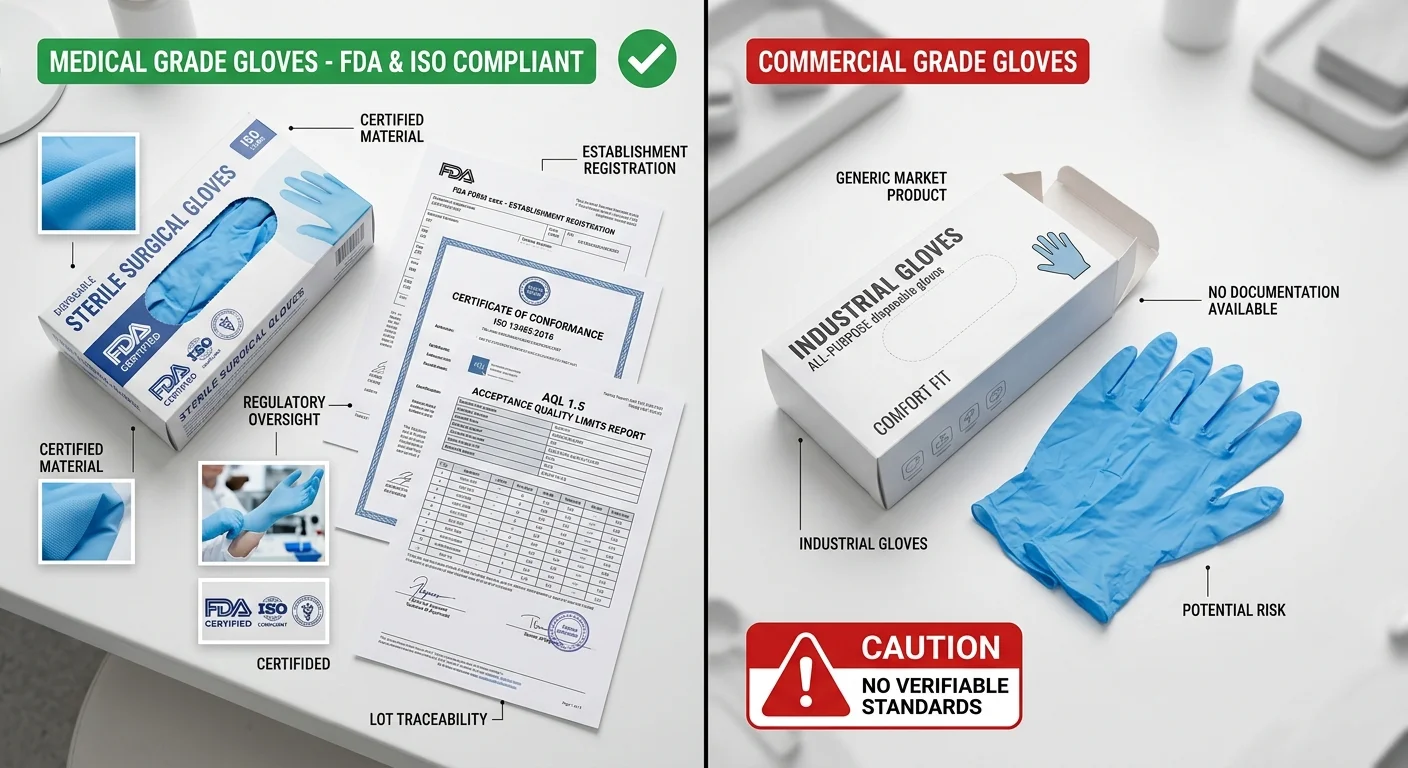
The packaging looks the same. The gloves feel the same. The price difference, though? That's where things get interesting.
Two products can share the same base polymer and still end up in very different regulatory categories. One gets tested, documented, and cleared for patient contact. The other gets built for cost and general performance — no clinical accountability attached. That gap matters. It's the difference between a smart procurement decision and a liability waiting to happen.
Here's the full picture, side by side:
|
Dimension |
Medical Grade |
Commercial Grade |
|---|---|---|
|
Regulatory Status |
Treated as a medical device — FDA reviews the finished product, including materials, processing, sterilization, and residues |
Meets general industrial or commercial quality standards — not confirmed safe for human contact or clinical use |
|
Biocompatibility Testing |
Full ISO 10993 risk assessment required, covering cytotoxicity, sensitization, irritation, systemic toxicity, and hemocompatibility |
No ISO 10993 evaluation required — no evidence chain for patient-contact risk |
|
Quality Management |
Backed by certified manufacturing controls, regulatory documentation, and batch consistency |
General manufacturing QC only — missing the documentation package that medical device registration requires |
|
Sterility Compatibility |
Materials tested against the target sterilization method — must survive the process without losing performance or releasing residues |
Sterilization compatibility is rarely checked — products that look the same may degrade, leach residues, or fail after processing |
|
Labeling Compliance |
Full regulatory specs: intended use, grade, sterility status, restrictions |
Standard commercial labeling only — no clinical-use evidence or contraindication details |
|
Traceability |
Full supply chain traceability — batch records, material documentation, process history |
Weak traceability in most cases — unable to support medical device lifecycle compliance |
The Nitrile Glove Reality Check
Nitrile gloves are a clear example of this problem. They're everywhere — and the risk gets underestimated all the time.
A medical grade nitrile glove targets clinical skin contact. You get consistent material composition, validated microbial control, biocompatibility documentation, and a regulatory file that backs its use in examination and patient care settings.
A commercial-grade nitrile glove can look and feel almost the same. But it skips biocompatibility testing, sterilization validation, and regulatory submission. Using it in clinical contact opens the door to skin sensitization, chemical residues, and unpredictable batch variation.
The risk doesn't usually appear as a visible product failure. It shows up as a biological reaction in a patient or healthcare worker. That's why the FDA requires evaluation of the finished product in its final use state — not just the raw material.
The bottom line: Commercial grade can look like medical grade. Without regulatory proof and biological safety validation, you can't use it at the clinical safety level — no matter how similar it appears.
Conclusion
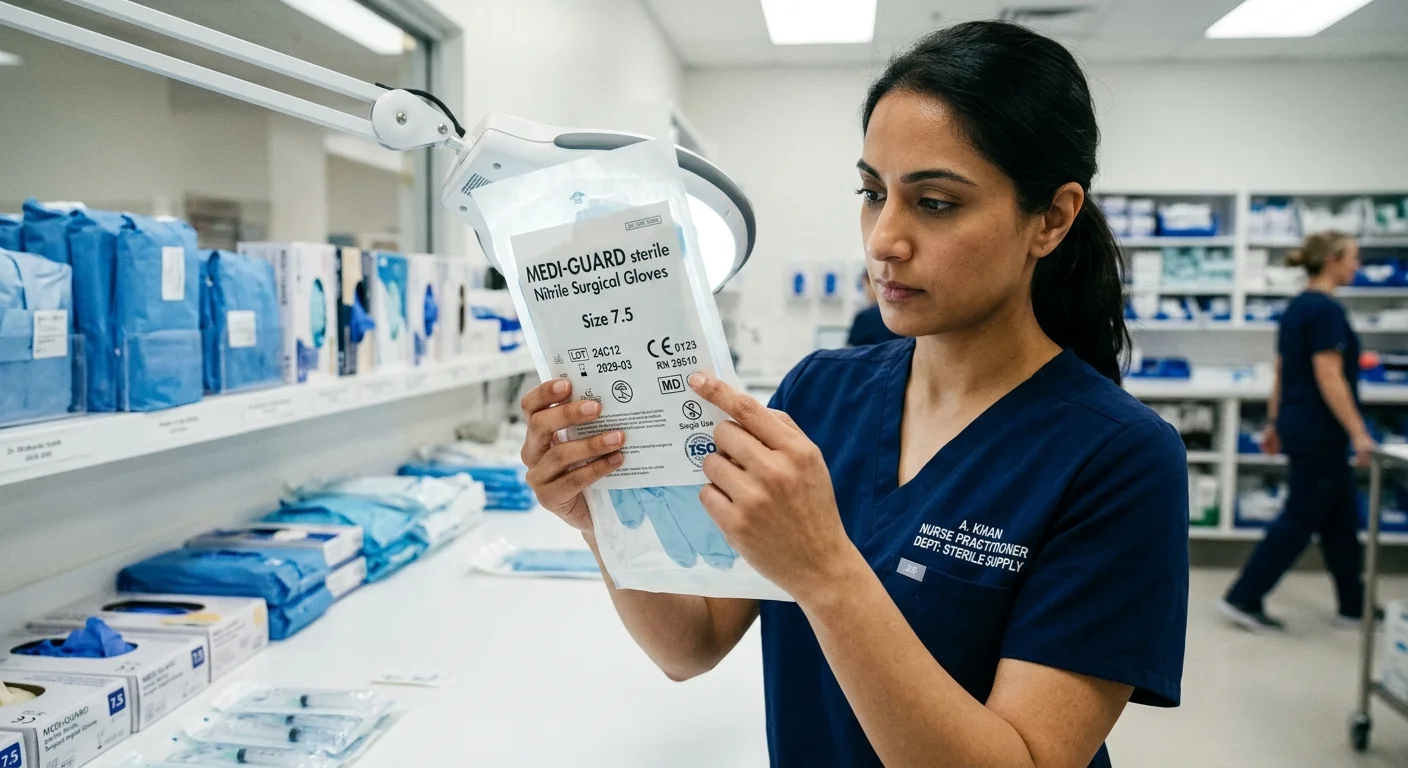
Knowing whether your disposable medical supplies are medical grade isn't guesswork. It's a skill built on the right knowledge. Check the label. Verify the certifications. Trace the manufacturer. Never skip the documentation. These steps aren't bureaucratic formalities. They're the difference between protecting your patients and putting them at risk.
Here's what to take away: FDA clearance, CE marking, and ISO certification aren't interchangeable badges. Each one tells a specific story about a product's safety, performance, and accountability. Aligned credentials mean you're holding something worth trusting.
So don't just file this guide away. Use the verification checklist on your next procurement review. Share it with your team. A supplier who can't back up their claims with real documentation? That silence is your answer.
The right supplies exist. Now you know how to find them.