

Picking the right mask shouldn’t feel like a science exam. Yet here we are — standing in the pharmacy aisle (or scrolling product pages at midnight) asking: is this slim surgical mask doing anything? Or is it time to switch to that boat-shaped KF94 mask everyone keeps talking about?
The gap between these two masks is bigger than most people think. It matters — for long-haul flights, packed train stations, or visits to someone at risk.
So let’s sort it out. KF94 filtration efficiency, seal design, breathability, cost — we’re covering all of it, straight and simple. No more guessing. You’ll know exactly what to wear before your next trip.
What Is a KF94 Mask? (Korean Filtration Standard Explained)
South Korea takes its masks seriously — and the KF94 is proof.
“KF” stands for Korean Filter. The “94” refers to its minimum filtration efficiency: ≥94% of particles at 0.4 and 0.6 micrometers in diameter. These are tiny airborne particles that carry viruses, bacteria, and fine pollution. The ones you never see coming.
South Korea’s Ministry of Food and Drug Safety (MFDS) issues the certification. This is the same body that oversees pharmaceuticals and medical devices. It’s not a brand claim. It’s a government standard. An authentic KF94 package shows three things: “Made in Korea,” a KF94 label, and the distinctive red-white-blue MFDS seal.
What does the Testing involve?
The MFDS sets a tough bar to clear. Here’s what certified masks must meet:
| Parameter | KF94 Requirement |
|---|---|
| Filtration Efficiency | ≥ 94% |
| Test Particle Size | 0.4 μm & 0.6 μm |
| Flow Rate | 95 L/min |
| Test Agents | NaCl and paraffin oil |
| Total Inward Leakage | ≤ 8% |
| Inhalation Resistance | ≤70 Pa |
| Exhalation Resistance | ≤300 Pa |
Two details stand out. First, the 95 L/min flow rate is higher than the 85 L/min used in US N95 testing. That means KF94 filtration gets verified under greater airflow stress. Second, the test uses both NaCl and paraffin oil. NaCl catches water-based particles. Paraffin oil catches oil-based ones. Together, they make KF94 one of the more thorough mask standards out there.
The Shape Is Part of the Science
That distinctive 3D boat shape isn’t a design quirk. It’s structural engineering. The multi-panel build includes side wings that press close against your nose, cheeks, and chin. This cuts down the gaps where unfiltered air slips through. Add an adjustable nose wire and ear loops, and you get a mask that fits your face rather than just sitting on it.
The real-world filtration numbers back this up. Certified KF94 masks reach 99.9% BFE (bacterial filtration efficiency) in lab conditions. Some premium models go further — Wellkeeps tests above 99.85% and Nepure above 99.91%. For fine particulate matter (PM2.5), most KF94 masks land between 91–95% filtration efficiency.
Heading into a crowded airport or a long-haul cabin? That mix of certified fit and high filtration is the core reason KF94 masks are worth your attention.
What Is a Surgical Mask? (Medical-Grade vs Standard Variants)
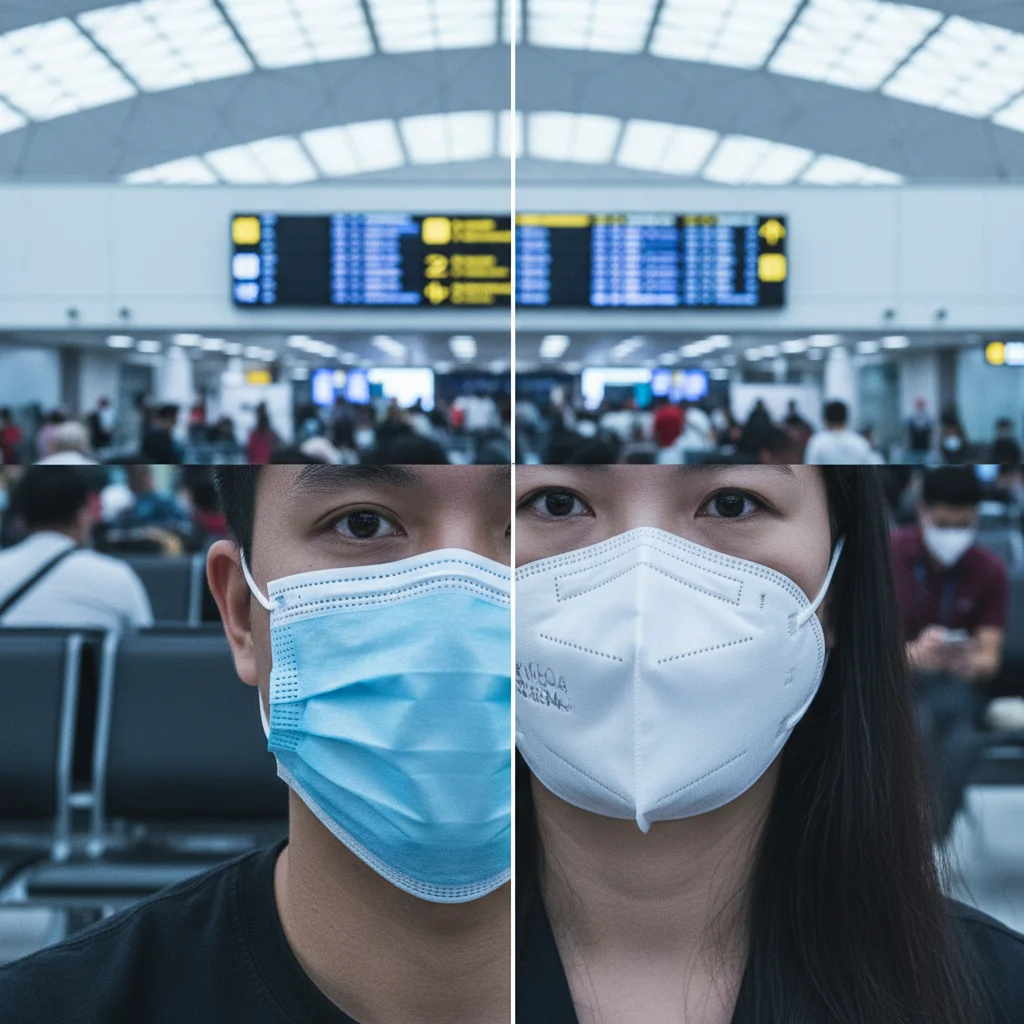
Surgical masks have been around for over a century. Yet most people wearing them today have no idea what they were built to do.
Here’s the truth: surgical masks were designed to protect patients from healthcare workers — not the other way around. They block droplets traveling outward. That’s their original purpose. The idea that a surgical mask shields you from airborne particles? That’s a stretch.
Not all surgical masks are equal, though. In the US, the FDA recognizes a three-tier system under ASTM F2100 . The differences between levels are real and worth knowing.
The Three ASTM Levels, Broken Down
| Level | Protection | Typical Use |
|---|---|---|
| Level 1 (Low barrier) | BFE ≥95%, fluid resistance at 80 mm Hg | Routine, low-risk procedures |
| Level 2 (Moderate barrier) | BFE ≥98%, fluid resistance at 120 mm Hg | Moderate-risk procedures |
| Level 3 (High barrier) | BFE ≥98%, fluid resistance at 160 mm Hg | High-pressure surgical environments |
Level 3 masks filter ≥98% of particles as small as 0.1 micrometers. That’s strong filtration performance — at least on paper.
The problem shows up outside a clinical setting.
The Consumer-Grade Reality
That blue pleated mask from the drugstore? It may not be medical-grade at all. Independent testing shows non-certified consumer masks have 20–50% lower BFE and PFE than medical-grade versions. It gets worse — up to 70% fail fluid resistance standards.
No FDA Class II clearance. No ASTM testing. That makes a standard surgical mask an unverified physical barrier. Better than nothing, yes — but no guarantee of real protection.
The packaging won’t tell you any of this. That gap is a serious problem when you’re stuck in a crowded departure gate for four hours straight.
KF94 vs Surgical Mask: Filtration Efficiency Head-to-Head
The numbers tell a story most people haven’t heard.
A KF94 filter≥94% of particles as small as 0.4 micrometers. A standard surgical mask? Somewhere between 60–80% for particles that size. That’s not a minor gap. Think of it as the difference between a locked door and one left wide open.
Surgical masks do well against large respiratory droplets — the kind from a sneeze or a loud laugh. They reach around 95% bacterial filtration efficiency (BFE). But viruses don’t travel in big droplets alone. They ride aerosols. Tiny, invisible, floating ones. That’s where surgical masks start to fall short.
What Happens When Someone Coughs?
One study tested both mask types in a real-world setting. Patients with confirmed SARS-CoV-2 coughed while wearing each mask type. The results were clear.
With surgical face masks , viral particles showed up on both the inner and outer surfaces. The mask didn’t contain them. With KF94 masks — which meet N95-equivalent standards — no viral particles were detected. None.
That one finding changes the whole conversation.
Why the Filtration Gap Exists?
It comes down to how each mask is built.
KF94 masks use a multi-layer construction with a melt-blown polypropylene filter at the core. This layer works in two ways:
- Physical interception — blocks particles by size
- Electrostatic adsorption — attracts and captures charged particles, like a magnet pulling iron filings
Together, these two mechanisms create a filtration system that’s hard to get past.
Surgical masks use a simpler 3-layer non-woven structure. That works well for large droplets. It’s not built to capture fine aerosols the way a melt-blown layer does.
| Metric | KF94 | Surgical Mask |
|---|---|---|
| 0.4μm Particle Filtration | ≥94% | 60–80% |
| Viral Aerosol (Cough Test) | Blocked — no detection | Leaked through both sides |
| Max Lab Performance | Up to 99.9% | Lower, varies by brand |
In an airport terminal, a subway car, or a crowded gate — aerosols are what you’re up against. The KF94’s face seal and filtration efficiency work together to deliver a level of protection that a surgical mask wasn’t built to match.
Fit & Seal: Why the 3D Boat Shape Makes a Critical Difference
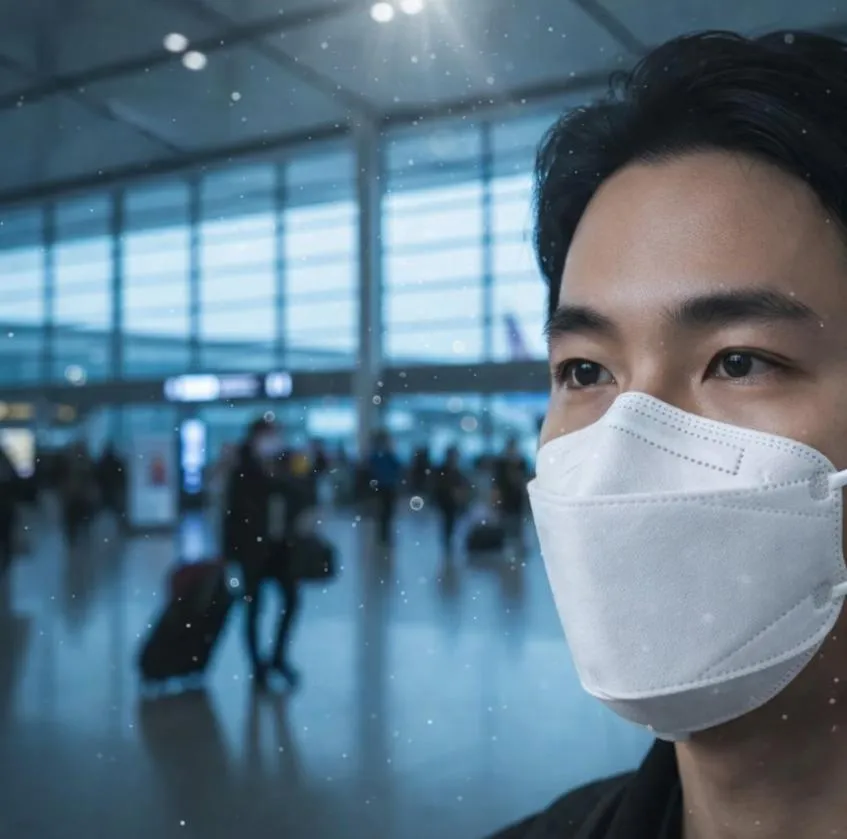
Here’s something that doesn’t get talked about enough: filtration efficiency means nothing if the mask doesn’t seal to your face.
A KF94 rated at 94% filtration sounds reassuring. But air slips in through the gaps at your cheeks with a flat mask. That’s guaranteed. So you’re not getting 94% of anything. You’re getting whatever makes it through the unfiltered edges. Depending on how the mask sits, that could be a lot.
This is the quiet problem with surgical masks. They’re flat. They drape over the face — they don’t conform to it. There’s no structure holding them out. Talk, turn your head, or breathe hard, and those side gaps flex open. Unfiltered air flows straight in.
The Boat Shape Solves a Geometry Problem
The KF94’s distinctive silhouette — wide in the middle, tapering at the chin, arching away from the mouth — isn’t a style choice. It fixes a geometry problem that flat masks never addressed.
The 3D boat-shaped structure creates an interior air chamber. The mask sits away from your lips and nose. That does two things: breathing gets easier, and the filter layer stays intact instead of pressing flat against your face. A collapsed filter layer means collapsed filtration.
The side wings handle the sealing work. These stiff panels fold outward along your cheeks and press firmly against the jaw, cheekbones, and sides of the nose. Add a moldable nose wire and ear loops that pull the mask inward — not just hold it up — and you get a perimeter seal that a pleated surgical mask can’t match.
The MFDS certification backs this up. KF94 masks must meet a total inward leakage rate of ≤8%. Surgical masks carry no equivalent seal requirement in standard testing. None.
For travelers — in a plane cabin, a crowded terminal, a packed train — that sealed perimeter is what separates a mask that filters from one that performs.
Comfort & Breathability: Extended Wear Performance Compared
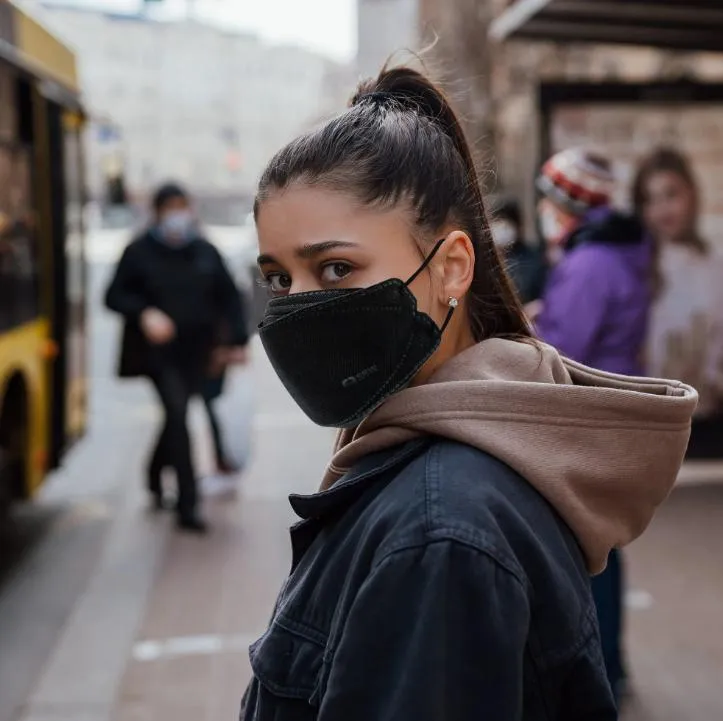
Four hours into a long-haul flight, filtration efficiency stops being the main concern. All you’re thinking about is getting this thing off your face .
That’s where the KF94’s boat-shaped cavity earns its keep. The internal air chamber holds the face mask away from your mouth and nose. No fabric pressing against your lips. No filter layer collapses flat with every breath. User studies report 20–30% less jaw fatigue compared to flat masks worn for the same duration. It’s a small detail — but by hour three, it feels like everything.
Breathing resistance tells a similar story. KF94 masks run at 50–80 Pa inhalation resistance. Surgical masks land much higher — 100–150 Pa. That gap means 25% more effort during physical activity. Walk briskly through a terminal with a carry-on, and you’ll feel it.
Humidity hits surgical masks hard. Above 80% relative humidity — recycled cabin air, underground transit, a packed covered market — surgical masks collapse 30–50% against your face. Discomfort rises 40% after just one hour of wear. The mask that felt fine at boarding starts feeling suffocating somewhere over the Pacific.
KF94 structures hold over 95% stability in those same conditions. They also deliver 22% better moisture dissipation. Air permeability runs higher too: 12–15 mm/s for KF94-style construction versus 8–10 mm/s for standard surgical masks. That difference cuts microclimate humidity inside the mask by up to 20% across long wear periods.
For anything beyond a quick errand, that gap separates a mask you tolerate from one you can actually wear.
Durability & Cost: Single-Use vs Multi-Day Value Analysis
The cost question is simpler than it looks — once you do the actual math.
Surgical masks are designed for one use. Wear it, bin it, open a new one tomorrow. At $0.05–$0.10 per mask, a 30-day supply costs almost nothing on its own. But 30 masks add up fast. And that assumes you wear just one per day.
KF94 masks cost more upfront — $0.50–$1.50 per mask, depending on brand. The key difference? A well-maintained KF94 holds up through multiple wears before you need a new one. With 5–10 uses per mask, your real per-use cost drops to a fraction of what you paid at the start.
The break-even point arrives faster than most people expect.
Time to Retire a KF94 Mask
More important than cost is knowing when to stop reusing . A few clear signals tell you the mask is done:
- Ear loops stretch or lose tension — the seal is gone
- The nose wire no longer holds its shape — fit is lost
- The filter layer looks flattened or damaged — filtration drops
- You’ve worn it through high-exposure environments — crowded flights, hospitals, packed transit
Any one of these? Replace it. No exceptions.
The Real-World Value Calculation
For travelers, the case for KF94 is strong. A single long-haul trip can stretch across multiple days — airports, transit hubs, crowded spaces back to back. A few KF94 masks, rotated across those days, beat packing 10 surgical masks that deliver lower filtration and no reliable fit.
See the cost difference as a small investment in real protection — not just the appearance of it.
KF94 vs Surgical Mask: Which One to Pack for Your Trip
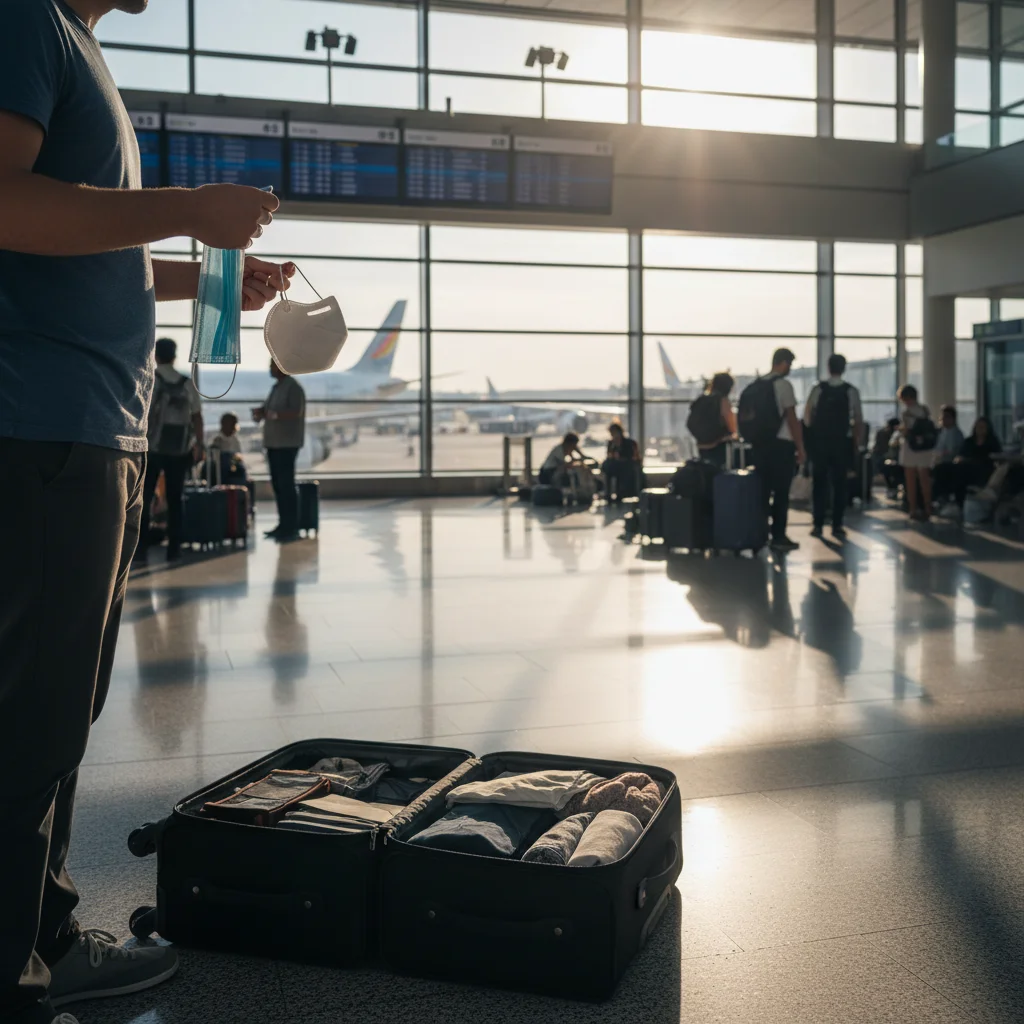
The mask you pack matters. The right choice depends on where you’re going and what you’ll face there.
Here’s a practical breakdown for the most common travel situations.
High-Risk Travel Scenarios: Reach for the KF94
Long-haul flights. Packed subway cars. Theme parks are at peak season. These are the environments where surgical masks fail you — quietly and consistently.
Recirculated air in enclosed spaces is where KF94’s ≥94% filtration and sealed perimeter work together. In a cough test with SARS-CoV-2 patients, KF94 masks showed zero viral detections on test surfaces. Surgical masks? Three out of seven cases showed particles breaking through. That difference is not a small technicality. It’s the air you breathe for six hours over the Pacific.
Real-world indoor data backs this up. People wearing N95/ KN95 -equivalent masks — the class KF94 belongs to — had an 83% lower risk of testing positive compared to wearing nothing. Surgical mask wearers saw 66% lower risk. Meaningful, but a clear step down.
Low-Risk Scenarios: Surgical Masks Hold Their Own
Short stops. Well-ventilated spaces. A quick walk through an open-air market. In these cases, a surgical mask is a reasonable, cost-effective choice. Its adjusted protection odds (aOR=0.34 versus no mask) still show real, measurable defense — especially with brief exposure and some distance from others.
Special Cases Worth Knowing
- Immunocompromised travelers : Go with KF94, no exceptions. Surgical masks allow viral particles on both inner and outer surfaces. KF94 contains them.
- Flu season trips : KF94 outperforms surgical masks on droplet blocking, per Duke University research.
- Southeast Asia and polluted cities : Black KF94 variants add another layer of defense — averaging 95.51% UVA reduction, combining air filtration with UV and pollution protection.
Quick-Reference Table
| Situation | Best Choice |
|---|---|
| Flight or transit over 2 hours | KF94 |
| Crowded indoor venue | KF94 |
| Brief outdoor stop, distanced | Surgical |
| Immunocompromised or high-risk | KF94 + goggles |
Not sure which fits better? Test the seal. No gaps means real protection. KF94 wins that test every time.
FAQ: Most Common Questions About KF94 and Surgical Masks
These questions come up all the time — from travelers packing for long-haul trips, from people trying to protect older relatives, from anyone standing in a pharmacy aisle feeling lost. Here are the straight answers.
Can you reuse a KF94 mask?
No. KF94 masks are disposable under the Korean MFDS standard. Reusing one drops filtration below the certified 94% threshold. Leakage around the edges goes up, too. Once you’ve worn it, it’s done. That’s not just manufacturer caution — it’s built into how the certification works.
Does a surgical mask protect against viruses?
It helps, but the limits are real. In controlled cough tests, surgical masks failed to contain viral particles in 3 out of 7 cases. KF94 and N95 -equivalent masks? Zero detections across all 7. Surgical masks were built for source control — keeping others safe from you — not for filtering what you breathe in.
How does KF94 compare to N95?
N95 comes out ahead on fit. In testing, adequate protection rates stood at 48.7% for N95 versus 1.1% for KF94 without any adjustment. Add an ear hook strap, and KF94 protection jumps from 1.1% to 12.8% — that’s a real gain. For high-aerosol settings, N95 still leads.
Does KF94 work with facial hair?
Better than most options. KF94 holds N95-level filtration even with facial hair, and it beats KN95 in real-world use. Fit still decides everything, though. Press the nose wire down and check the seal before you head out.
How do you get more out of a KF94?
One small fix makes a clear difference: use a hook extender on the ear straps. That one change pushes adequate protection rates from 1.1% to 12.8%. It also cuts leakage rates from 2.8% to 11.1%. Press the nose bridge down firmly — do it before you walk out the door.
Conclusion
Most comparison articles skip the real answer: the right mask depends on where you’re going and what you’re walking into.
Long-haul flight? Crowded transit hub? Medical visit? The KF94’s boat-shaped fit and ≥94% filtration efficiency make a real difference there. For a quick errand or a low-risk outdoor gathering, a quality surgical mask does the job fine.
Smart travelers don’t stick to one mask. They pack both.
Before your next trip, take five minutes to look over your itinerary. Break it down like this:
- High-density crowds, enclosed spaces, or long transit hours? Grab the KF94.
- Everything else? Your surgical mask has it covered.
Your health is the one souvenir worth protecting. Pack for both scenarios — your future self will thank you.
If you need bulk orders or private label customization, contact us for product details and a competitive quote.