

Grab a diaper, a rain jacket, and a surgical drape — what do they share? Each one relies on a clear choice between hydrophobic and hydrophilic nonwoven fabric. Get that choice wrong, and a product built to protect soaks through. Or one meant to absorb ends up repelling liquid instead. That’s not a small detail — it’s the difference between a material that works and one that fails. This guide breaks down what separates these two fabric types. You’ll see the chemistry behind each one, the industries that depend on them, and how to pick the right option for your needs.
Hydrophobic vs Hydrophilic Nonwoven Fabric: 7 Key Differences
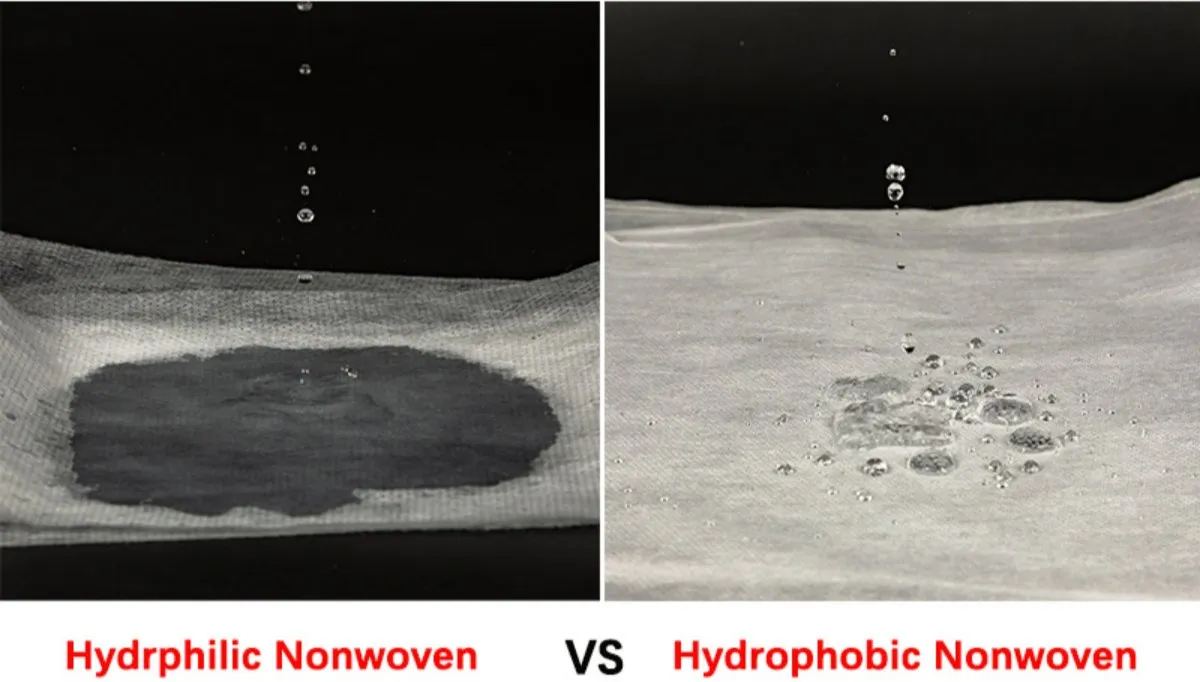
Seven differences. That’s what separates a material that keeps a baby dry from one that causes a leak at 2 a . m. These aren’t minor technical details — they’re the engineering decisions that determine whether a product works in the real world or breaks down under pressure.
1. Water Contact Angle: The First Signal
Water contact angle is the most basic measurement in nonwoven fabric properties. A hydrophobic nonwoven fabric produces a water contact angle above 90°. After a hydrophobic finish goes onto PP spunbond nonwoven, that angle lands around 110–120°. Water droplets bead up and sit on the surface like mercury on glass.
A hydrophilic nonwoven fabric does the opposite. Its contact angle drops below 90°. Hydrophilic treatment fabric agents push it down to 0–30°. Water doesn’t bead. It spreads. Fast.
2. Liquid Penetration Speed
Speed matters in hygiene products. Hydrophilic nonwovens used in diaper topsheets are built for strike-through times under 3 seconds. Liquid hits the surface and moves into the absorbent core almost at once.
Hydrophobic nonwovens meet the opposite standard: zero visible penetration within 3–5 minutes under low pressure. One fabric is built to let liquid through. The other is built to stop it completely.
3. Fiber Chemistry and Finishing
Here’s something that surprises many buyers: both fabric types often start with the same base material. Standard Polypropylene nonwoven fabric — like most nonwovens — is hydrophobic at the fiber level by nature.
Water repellent nonwoven fabric stays that way through surface coatings: fluoropolymers, silicones, paraffin, or fluorine-free acrylics. Water absorbent nonwoven fabric starts from the same PP spunbond base, then changes it. Manufacturers either apply hydrophilic agents during web production or add hydrophilic masterbatch into the fiber at the spinning stage. The base polymer is close to the same. The surface energy is not.
4. Mechanical Behavior When Wet
Hydrophilic nonwovens absorb liquid and hold their structure. In diaper topsheets, this is critical. The fabric handles repeated fluid exposure without falling apart. After each fluid pass, the surface returns to a dry feel against skin. Liquid moves down into the SAP core. The surface bounces back.
Hydrophobic nonwovens work differently. The fibers never absorb water, so tensile properties stay stable in both dry and wet states. For standing leg cuffs and outer barrier layers, that dimensional stability is exactly what the job needs.
5. Functional Roles in Multilayer Products
A standard diaper uses both fabric types. Their positions are fixed — not interchangeable.
Hydrophilic layers go where liquid must move: – Topsheet (inner cover): sits against skin; pulls urine through within seconds – Core WRAP: surrounds the SAP/pulp core; channels fluid inward for absorption – Wet wipes and surgical drape zones: anywhere active fluid absorption is needed
Hydrophobic layers go where liquid must stop:
– Standing side cuffs: block lateral leakage around leg openings
– Sanitary napkin wings: prevent sideways fluid movement
– Outer cover laminates: hydrophobic spunbond + PE film, pairing soft handfeel with a liquid-blocking barrier
6. Performance Tests and Targets
Each fabric type gets tested by different standards. That’s because each one solves a different problem.
|
Test |
Hydrophilic Target |
Hydrophobic Target |
|---|---|---|
|
Strike-through time |
< 3–5 seconds |
No penetration at the specified time |
|
Re-wet weight |
Minimal (dry surface feel) |
Not applicable |
|
Wicking height/area |
High (uniform core utilization) |
Not applicable |
|
Hydrostatic head |
Not applicable |
High (varies by GSM/process) |
|
Spray rating |
Not applicable |
Maximum (minimal surface wetting) |
7. Basis Weight and Structural Design
Hydrophilic nonwoven designs lean lighter and more open. Topsheets for baby diapers and sanitary napkins run 12–18 GSM . Open pore structures push liquid flow downward fast while keeping the surface soft against skin.
Hydrophobic nonwovens run a bit heavier. Cuff and leg band materials fall in the 15–25 gsm range. You’ll find these in spunbond nonwoven fabric or SMS (spunbond-meltblown-spunbond) builds — stiff enough to hold a standing shape, soft enough for body contact. Outer cover laminates in value diapers use 15–18 gsm hydrophobic spunbond bonded to a 15–20 µm PE film. That construction gives you tactile softness and a solid moisture barrier in one layer.
These seven differences aren’t abstract. Every diaper that holds. Every surgical drape should stay dry on the outside. Every wet wipe that stays intact. Behind each one, a material engineer chose between hydrophobic vs hydrophilic — and got it right.
Why Some Nonwoven Fabrics Repel Water While Others Absorb It?
The answer starts at the molecular level — and it’s simpler than most people expect.
Every fiber has a surface energy. High surface energy draws water molecules in. They spread. They absorb. Low surface energy gives water nothing to grab onto. The droplets bead up and roll off.
That’s the whole mechanism. Everything else — the coatings, the fiber choices, the structural engineering — is just a way of controlling which side of that equation a fabric lands on.
It Begins With the Fiber Itself
Polypropylene (PP), polyester (PET), and polyethylene (PE) are hydrophobic by nature. Their molecular structure is nonpolar. Water finds no chemical foothold. Moisture vapor regain for these synthetics sits at less than 1% by weight — close to zero.
Cellulosic fibers tell a different story. Cotton absorbs moisture at 10–14% regain. Wool pushes past 30%. These fibers carry polar hydroxyl groups along their molecular chains. Those groups pull water in. The chemistry invites it.
So the starting point of any nonwoven’s water behavior comes down to one question: what’s the fiber made of?
Then Comes the Finish
Here’s where it gets interesting. A plain PP nonwoven isn’t a strong water repellent — it’s just indifferent to water. Turning it into something that repels or absorbs requires a deliberate treatment step.
To repel, manufacturers coat the fabric with silicone, paraffin, or fluoropolymer. – Paraffin fills the gaps between fibers, cutting off liquid pathways. – Silicone drops the surface energy low enough that water beads and rolls off. – Fluoropolymer DWR goes further — it blocks both water and oils.
To absorb, the same PP base gets treated with hydrophilic surfactants. Surface energy rises. Water spreads instead of beading.
Same fiber. Opposite behavior. The finish decides everything.
Structure Amplifies the Effect
Fiber chemistry and surface treatment set the direction. Pore structure determines how far that direction goes.
Tight, dense constructions — like SMS (spunbond-meltblown-spunbond) — slow liquid penetration on their own, before any repellent coating is added. The meltblown layer builds a maze of fine fibers with no clear path for water to follow.
Open, lofty webs do the opposite. More internal surface area means more capillary channels. More capillary channels pull liquid in faster — as long as the surface is hydrophilic to start with.
This is why advanced nonwoven products use both principles at once:
– An outer hydrophobic layer blocks liquid from the outside.
– An inner hydrophilic layer pulls it inward and holds it there.
One material can’t do both jobs well enough on its own. Two layers, built to work against each other, handle it far better together.
Common Uses of Hydrophobic Nonwoven Fabric
Water repellent nonwoven fabric shows up in far more places than most people expect — and it goes well beyond hygiene products.
Disposable Hygiene: Barriers That Hold
The most obvious use is in diapers and sanitary products, but the role is very specific. Hydrophobic nonwoven fabric never touches skin as the topsheet — that layer needs to absorb. It works around the edges instead: the outer backsheet, the standing leg cuffs, the sanitary napkin wings.
-
Diaper outer covers and side panels: PP spunbond nonwoven at 12–25 gsm forms a soft outer surface. It blocks leakage and stays breathable.
-
Sanitary napkin wings: Hydrophobic nonwoven at 10–18 gsm stops fluid from moving sideways. This protects fabric from side leaks.
-
Adult incontinence products: Backsheet laminates paired with PE film hit hydrostatic head values above 1,000 mm H₂O in premium builds.
Medical and Protective Applications,
Surgical masks, Isolation Gowns , and shoe covers — they all use water-repellent nonwoven fabric as a first defense layer.
A standard 3-ply surgical mask puts a hydrophobic spunbond PP outer layer at 20–25 gsm on the outside. It knocks back droplets before they reach the filtration layer. Medical gowns use SMS composites in the 25–60 gsm range, built to resist water penetration above 20 cm H₂O.
Lighter versions at 10–25 gsm cover surgical caps , bed sheets, and shoe covers . They’re low-cost, disposable, and handle splashes well.
Industrial, Filtration, and Construction
This is where the hydrophobic coating fabric gets its most technical reputation.
-
Oil–water separation mats: Superhydrophobic nonwovens with contact angles above 150° pull in oil at 10–20× their own weight while pushing water away completely.
-
HVAC pre-filters: Hydrophobic PP composites resist moisture buildup in humid airstreams. This prevents pressure-drop spikes.
-
Roofing underlays and housewrap: PP or PET spunbond layers shed rain while letting vapor pass outward.
-
Automotive backing layers: Moisture-resistant, lightweight panels sit behind headliners and door trims. They block water uptake and keep mold from forming.
Everyday Products You Wouldn’t Expect
Reusable shopping bags made from hydrophobic spunbond PP at 60–100 gsm wipe clean after grocery spills. Disposable tablecloths at 30–50 gsm resist drink penetration at catered events. Some cosmetic wipes use hydrophobic substrates too — not to soak up the formula, but to hold it at the surface for a controlled release.
The core logic is the same across all these uses. Polypropylene nonwoven fabric and PET composites — made as spunbond, meltblown, or SMS — hold water contact angles above 90° and basis weights between 10–70 gsm for most disposable applications. The polymer is cheap. Chemical resistance is high. Water absorption stays under 0.4% by weight. That combination puts hydrophobic nonwoven among the most flexible barrier materials in manufacturing today.
Common Uses of Hydrophilic Nonwoven Fabric
Absorption is a job requirement. Every product in this category shares one functional demand — liquid must move in, and it must move fast.
Water-absorbent nonwoven fabric works across four distinct industries. Each one asks the same thing of the material: pull fluid in, hold structure, don’t fall apart.
Hygiene and Personal Care
This is the largest market by volume. The logic is simple.
-
Diaper topsheets: The layer touching a baby’s skin must pass liquid through in under 3 seconds. Hydrophilic nonwoven fabric at 12–18 gsm does this job while keeping the surface feeling dry.
-
Sanitary napkins and pads: Fast fluid pickup matters here for the same reason. Comfort depends on quick transfer away from the skin.
-
Baby wipes, facial wipes, and cosmetic pads: These carry formula or cleansing agents and release them on contact. The moisture-wicking nonwoven structure spreads liquid across the full sheet — not just the center.
Medical Applications
Hospitals depend on hydrophilic treatment fabric. Surgical gowns and drapes need zones that handle fluid directly — blood, saline, irrigation fluid. Wound dressings and bandages use absorption to keep the wound area clean. Medical wipes and swabs need steady, controlled uptake without dropping fibers into sensitive areas.
The performance standard here is stricter than hygiene. Wet-condition strength is non-negotiable.
Household and Industrial Cleaning
Dish towels, floor wipes, window cloths — the entire household cleaning category runs on water-absorbent nonwoven fabric. Industrial polishing cloths and wiping materials fall here, too. The deciding factor is straightforward: how fast it pulls liquid and how well it covers a surface.
Agriculture
Hydrophilic nonwoven fabric shows up in seed germination mats and greenhouse covers. The functional need is different here. It’s less about absorption speed and more about spreading moisture across the full surface. Plus, the material must keep air and light permeability to support plant growth.
The material choice follows the task. Where fluid needs to be captured, moved, or held, hydrophilic nonwoven fabric is what gets specified.
Why Many Hygiene Products Use Both Materials?
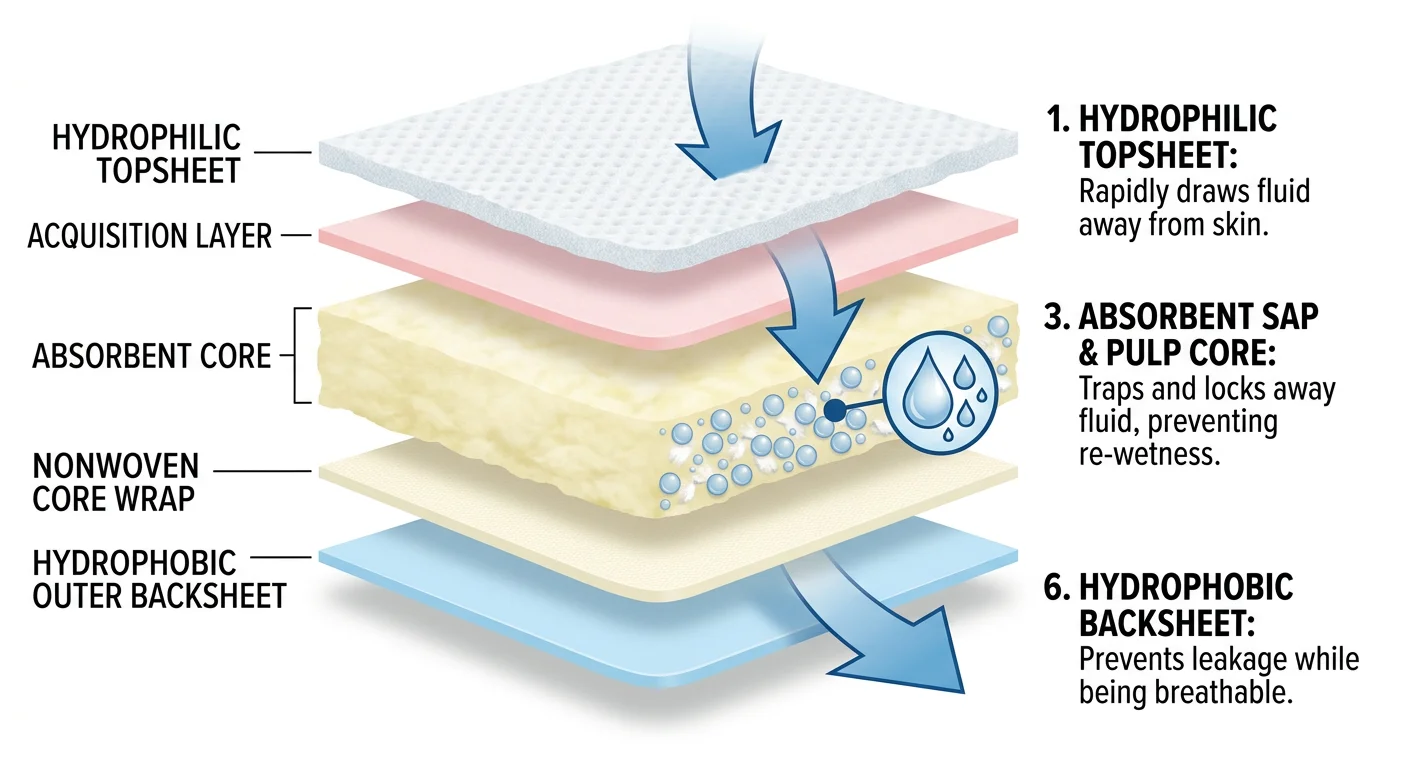
No single material can do every job a diaper needs done. That’s not a design compromise — it’s the engineering reality behind every multi-layer hygiene product on the market.
A baby diaper has three competing demands. It must pull liquid away from skin fast, hold it for hours, and stay thin enough to fit under clothing. Hydrophilic nonwoven fabric on the topsheet handles the first part. Below it, the real work falls to a combination of fluff pulp and superabsorbent polymer (SAP) — and neither material alone gets the job done.
The Pulp + SAP Problem
SAP is highly efficient. Sodium polyacrylate absorbs 30–60 times its weight in saline under no load. In real diaper conditions, usable capacity sits around 20 g/g. Pulp handles 4–8 g/g under pressure. So why not use pure SAP?
Because SAP gels. A saturated SAP core swells into a dense, rubbery plug. That plug blocks liquid from getting through. Pulp fiber fixes this by forming capillary channels through the gel mass. Those channels keep the intake speed high even after the second and third insult. Most mass-market baby diapers keep 20–30% pulp by core weight as a gel-blocking buffer. Even ultra-thin premium designs — where SAP climbs above 80% — still rely on some pulp for this reason.
The absorption numbers make the tradeoff clear. A size-4 premium diaper targeting 350–450 mL total absorption runs: – 8–10 g SAP at 20 g/g → 160–200 mL stored – 15–20 g pulp at 6–8 g/g → 90–160 mL plus lateral wicking
Neither component hits the target on its own.
The Multi-Layer Stack
Past the core, every modern diaper splits its structural functions across separate material layers:
-
Topsheet: Hydrophilic spunbond PP at 10–18 gsm, built for strike-through times under 2–3 seconds
-
Acquisition/distribution layer (ADL): Carded polyester or bicomponent nonwoven at 20–60 gsm — this layer boosts intake rate by 30–60% and moves liquid away from the insult zone before the core fills up
-
Core wrap: Lightweight tissue or nonwoven at 8–15 gsm — holds SAP particles in place and keeps the core shape stable during movement
-
Backsheet: Microporous PE film bonded to a soft nonwoven, with MVTR above 1,000–2,000 g/m²/24h while blocking liquid at 30–60 cm water column
The film blocks liquid. The nonwoven facing keeps it comfortable against the skin. A friction coefficient below 0.3 separates a product that prevents rash from one that causes it. Film alone can’t reach that number.
The same logic applies across product categories. Sanitary napkins combine 1.5–4 g pulp with 0.5–3 g SAP to hit absorbency above 150–250 mL in a pad under 3–4 mm thick. Adult incontinence briefs push core SAP mass to 15–40 g alongside 20–60 g pulp in zoned layouts. At 600–1 , 500 mL target capacity, pure SAP would gel-block and fail fast. Pure pulp would bulk out to the point of being unwearable.
The pattern is consistent across every format. Functions get separated. Materials get specialized. The combined system beats any single material — and it’s not even close.
How to Choose the Right Nonwoven Fabric
The wrong material choice doesn’t show up during product development. It shows up later — in a leak, a failed test, a customer complaint.
Four decisions drive every nonwoven selection. Work through them in order.
Define the job in measurable terms first. Skip “it needs to be soft.” Instead, nail down the exact GSM, strike-through time, and hydrostatic head. Set the lifetime — disposable drape or five-year geotextile. List the exposure conditions: temperature range, UV hours, and chemical contact. Add any regulatory Requirements, such as ISO 13485 for medical use or ASTM D4491 for geotextiles. Vague requirements lead to vague specs. Vague specs fail in the field.
Use GSM as your first hard filter. Here’s a quick breakdown:
-
Under 20 gsm — ultralight hygiene topsheets
-
20–40 gsm — medical drapes and lightweight protective garments
-
40–80 gsm — shopping bags and moderate filtration
-
Above 80 gsm — heavy-duty geotextiles and automotive insulation
Lower GSM gives you more square meters per kilogram. That translates directly to lower cost per m².
Match fiber to performance, not habit. PP is the go-to choice — low cost, resistant to chemicals, and hydrophobic by nature. PET holds its shape under heat and stress. Cotton and viscose absorb moisture, so they belong in wound dressings and hygiene layers. Need to meet a sustainability requirement? Look at PLA with EN 13432 certification.
Specify finishes before you source. Hydrophilic or hydrophobic treatment, antistatic, UV stabilization, flame retardant — these are not add-ons to sort out later. They are core functional requirements. Ask for test data upfront: surface resistivity, spray rating, and hydrostatic head values. A supplier who can’t hand over those numbers is not the right supplier.
Request samples from three to five suppliers. Run them against your actual end-use conditions. That’s the test that counts.
FAQ About Hydrophobic and Hydrophilic Nonwoven Fabrics
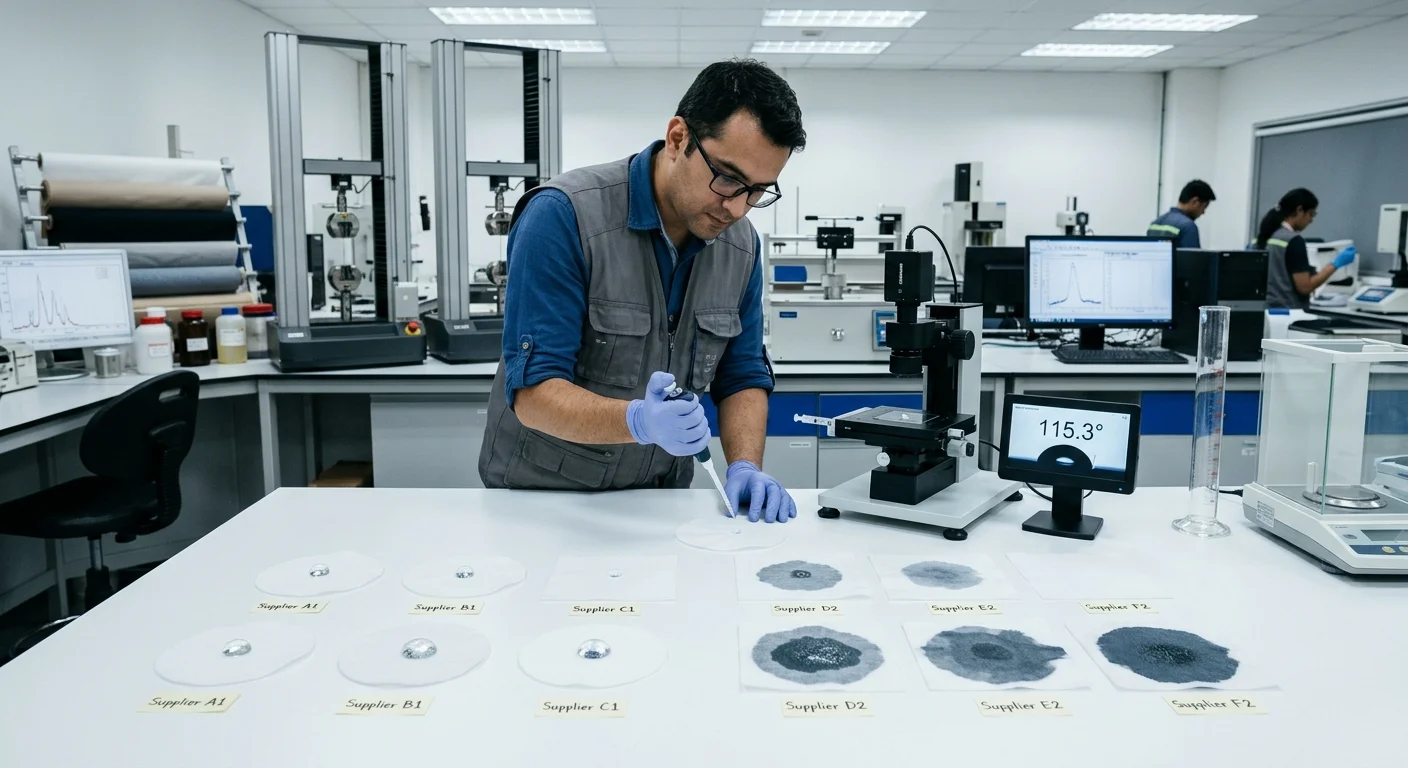
Buyers ask the same questions. Engineers ask the same questions. Here are the ones that matter most — with actual numbers attached.
Q: How fast should a hydrophilic nonwoven wet out?
Water should spread within 1–5 seconds on a standard drop test for hygiene topsheets. A hydrophobic grade does the opposite. The droplet stays beaded for 60 seconds or more. It never penetrates the surface.
Q: Are hydrophobic nonwovens always polypropylene? No. Polyester, rayon, and cotton blends can all carry hydrophobic finishes. PP still dominates disposable hygiene and medical products, though. It’s cheap and easy to process — hard to beat on both counts.
Q: How durable is a hydrophilic treatment?
Single-use products still need to perform across 3–5 insult cycles. Strike-through time should not increase by more than 1–2 seconds between cycles. Manufacturers choose nonionic surfactant finishes for this reason — they resist migration over the product’s shelf life and hold performance steady.
Q: Can one production line make both fabric types?
Yes. Manufacturers start with a base PP spunbond. That base material is hydrophobic by nature. From there, they either leave it untreated or add a surfactant finish at 0.2–1.0% owf. Same line, opposite results.
Q: What tests do buyers specify?
– Hydrostatic head (ISO 811) — measures barrier performance
– Strike-through time and rewet (EDANA/INDA methods) — checks topsheet hydrophilicity
– Contact angle — classifies hydrophilic (<90°) vs hydrophobic (>90°)
Q: Does a hydrophilic topsheet compromise the liquid barrier?
No, not in a well-built product. Hydrophilic layers are never a barrier. That job belongs to the hydrophobic SMS or film laminates underneath. Those layers handle the load, reaching hydrostatic head values of 50–100 cm in medical protective garments.
Conclusion
Hydrophobic and hydrophilic nonwoven fabrics aren’t competing — they serve different jobs. The goal is to match the right material to the right use.
Need moisture barriers, liquid runoff, or protective coverage? Water repellent nonwoven fabric is the right pick. Need absorption, skin-contact comfort, or fluid management? Hydrophilic wins every time. And your product needs both? Layer them — just like modern hygiene products have done for decades.
The core question is simple: what does water need to do in your product? Answer that, and the material choice becomes clear.
Ready to move forward? Browse our full range of spunbond nonwoven fabric solutions. Or reach out to our team — we’ll help you pin down which material spec fits your application, your budget, and your production needs.
The right fabric is out there. Now you know how to find it.