
Workers worry about leaks, uncomfortable fits, or low protection in hazardous environments. Ansell coveralls provide reliable chemical, particle, and biological safety. Here, you’ll learn step-by-step how to select the right Ansell coverall for your tasks, so your team stays safe without wasting money.
Step-by-Step Selection Guide for Ansell Coveralls
Five simple questions help you pick the right Ansell coverall for your workplace. This guide cuts through the options. You get protective gear matched to your actual hazards.
Step 1: Define Your Primary Hazard Category
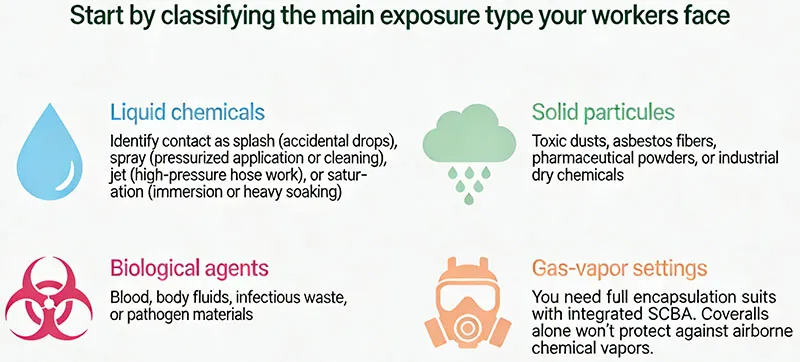
Start by classifying the main exposure type your workers face:
- Liquid chemicals – Identify contact as splash (accidental drops), spray (pressurized application or cleaning), jet (high-pressure hose work), or saturation (immersion or heavy soaking)
- Solid particulates – Toxic dusts, asbestos fibers, pharmaceutical powders, or industrial dry chemicals
- Biological agents – Blood, body fluids, infectious waste, or pathogen materials
- Gas/vapor settings – You need full encapsulation suits with integrated SCBA. Coveralls alone won’t protect against airborne chemical vapors.
Classify exposure frequency: continuous (all-shift contact), frequent (multiple times per shift), occasional (tasks done each week), or accidental (emergency response). Pharmaceutical powder weighing means continuous particulate exposure. Tank cleaning creates frequent liquid spray contact. These scenarios need different Type certifications.
Step 2: Characterize Chemical Details and Permeation Risk
Document every chemical by name, concentration percentage, physical state (liquid/powder), temperature, and expected contact duration. Generic “acid” or “solvent” descriptions won’t work. Ansell’s Guardian® Chemical database has permeation testing on over 7,000 single chemicals and 17,500 mixtures—use it.
Search for your exact chemical against tested materials. The system reports breakthrough time (BT) in minutes before the chemical gets through the fabric at 1.0 µg·cm⁻²·min⁻¹. Match your expected task duration against these bands:
- <10 minutes – Not recommended (no effective barrier)
- 10-60 minutes – Splash protection (limited barrier for brief contact)
- 60-240 minutes – Medium protection (good for moderate tasks)
- >240 minutes – Good protection (extended wear without breakthrough)
A 45-minute decontamination task using toluene needs material with a minimum 60-minute BT. Pick a 30-minute BT suit? You create invisible exposure risk.
Step 3: Match Hazard to Required EN Type Rating
Your hazard assessment from Steps 1-2 shows which Type certification of disposable Ansell coveralls you need:
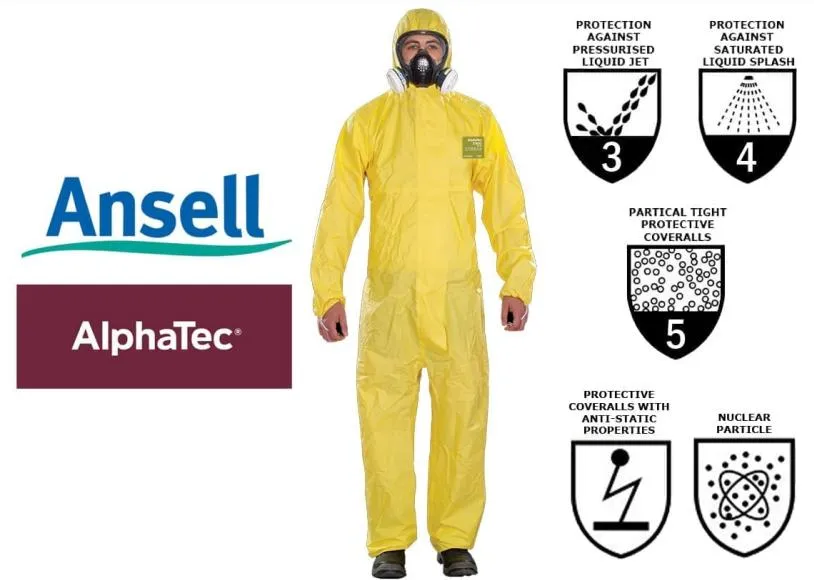
- Type 3 (Liquid-Tight) – High-pressure jets, forceful chemical streams, or emergency spill containment where liquid hits the suit under pressure
- Type 4 (Spray-Tight) – Sustained liquid spray, aerosol misting, or pressurized cleaning without high-force jets
- Type 5 (Particle-Tight) – Airborne solid particles, hazardous fibers, toxic dusts, or dry powder handling
- Type 6 (Limited Splash) – Minor liquid splashes, light contact during transfer work, or low-risk chemical handling
Biological hazards need EN 14126 certification for infectious agent protection. The AlphaTec 2000 Standard has Type 3/4/5 plus EN 14126, ASTM F1670/F1671 (blood-borne pathogens), and DIN 32781 (pesticides). You get multi-hazard coverage in one disposable garment.
Step 4: Verify Compliance Standards and Leakage Limits
Check that your selected Ansell coverall model meets performance thresholds:
Type 5 particulate coverall suits allow individual leakage up to 30% at specific test points. The average across all tested suits must stay below 15%. This matters during kneeling, bending, or reaching. Movement creates temporary gaps. Suits meeting this standard maintain barrier integrity during real-world motion.
Confirm certifications match your regulatory needs:
– EN 14605 (Type 3 & 4 liquid protection)
– EN 13982-1 (Type 5 particulate)
– EN 13034 (Type 6 limited splash)
– EN 14126 (biological agents)
– ASTM F1670/F1671 (blood and blood-borne pathogen resistance)
– DIN 32781 (pesticide protection)
OSHA inspections verify PPE certification compliance. Missing required standards? You face citations and work stoppage orders.
Step 5: Select the Right Ansell Coverall Family
Based on your hazard assessment and required EN Type ratings, choose the Ansell coverall family that fits your workplace:
- AlphaTec® Series – For chemical splash, spray, or mixed hazards, including repeated or high-risk exposures.
- Microchem/Microgard® Series – Disposable protective coveralls for particle and light splash protection, ideal where contamination control or single-use convenience is critical.
- BioClean® Series – For cleanroom and sterile environments, providing particle and pathogen control at the highest hygiene standards.
Each series addresses specific risk levels and applications. Detailed information on individual products and their intended uses is provided in the following sections.
Ansell AlphaTec Coverall Series: Chemical Protective Coveralls Selection
AlphaTec is Ansell’s top chemical protective line. It’s built for workers who face harsh chemical environments where standard PPE won’t cut it. The series ranges from breathable splash-resistant models to complete PAPR-integrated suits. Six key factors will determine which one keeps your workers safe and efficient.
Match Protection Level to Chemical Contact Intensity
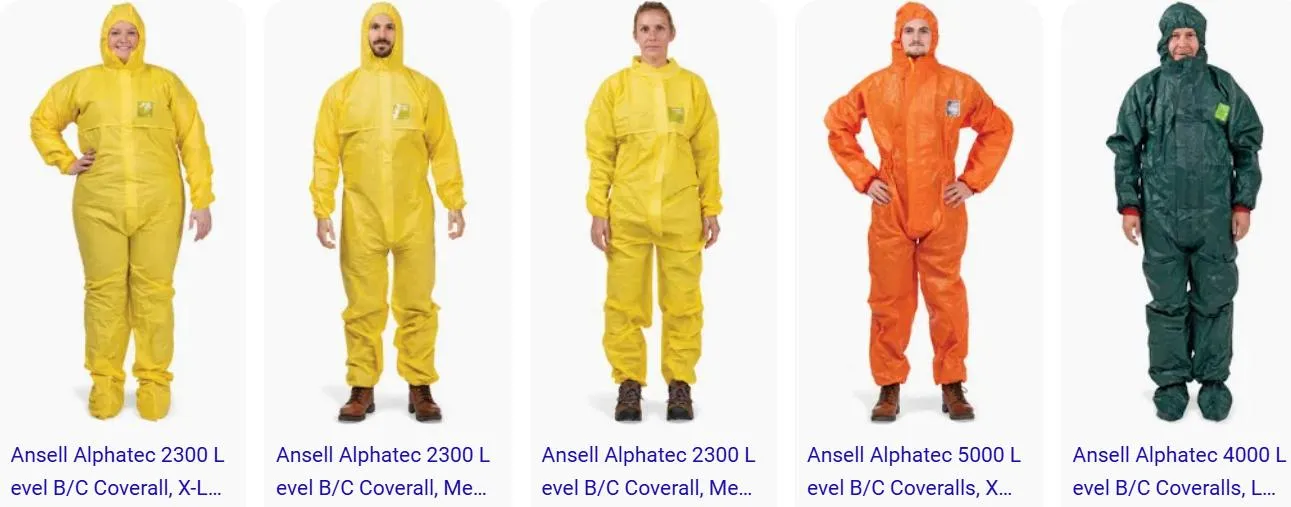
Start with how chemicals reach your workers. Splash-tight protection (66-667) handles accidental liquid contact during chemical transfers or mixing. Spray-tight barriers (66-300 Model 111) stand up to sustained liquid sprays under low pressure. These are essential for cleaning operations or pesticide application. For vapor-heavy environments or IDLH atmospheres, you need gas-tight encapsulation (AlphaTec 3000 PAPR).
The AlphaTec 66-300 Model 111 delivers EN 14605 Type 4 spray-tight certification. You get PVC-coated polyamide fabric on both sides. Double-welded seams stop seepage at stress points. This reusable suit includes a drawstring hood with a chin flap, open legs with elastic, and a nylon zipper. A double splash guard with press studs protects the zipper. It guards against alkalis, acids, and infective agents (EN 14126:2003 certified). The bayonet glove ring system lets workers swap contaminated gloves in seconds. No need to remove the entire suit. This matters for long tasks. Each delivery includes 2 spare locking pins and Molycote lubricant for O-ring maintenance. Available in eight sizes (2XS through 3XL) with a 7-year shelf life.
Choose Reusable vs. Limited-Use Based on Exposure Frequency
Reusable AlphaTec coverall models (66-300, 66-667, 3000 PAPR) cost more upfront. But they pay off through multiple decontamination cycles. A 66-300 withstands 50+ uses. That costs less per wear than disposable options. Limited-use suits work for occasional chemical exposure. They also work in contamination-sensitive environments where cross-contamination risks matter more than reuse savings.
Prioritize Breathability for Extended Wear
PVC-coated suits like the 66-300 create complete liquid barriers. But they trap body heat. Workers wearing these for over 2 hours in moderate temperatures face heat stress. The AlphaTec 66-667 solves this problem. You get breathable polyester fabric. It maintains NFPA 1990 (used to be NFPA 1992) Level B splash protection. Stitched and taped seams plus Velcro front closure give you chemical resistance. No sauna effect. Pick 66-667 for tasks beyond 2 hours or when temperatures exceed 75°F. Save the PVC-coated 66-300 for short, high-exposure scenarios.
Account for Secondary Hazards
Chemical environments often hide extra risks. The AlphaTec FR 66-677 combines flame-retardant and arc-resistant properties with breathable chemical splash resistance. This model protects against flash fires in petrochemical facilities. It also handles electrical arc hazards during maintenance on energized equipment. EN 1149-5:2008 antistatic certification (standard on 66-300 and FR models) prevents static discharge. Static could ignite flammable vapors.
Integration Requirements Drive System Selection
Will workers use SCBA or supplied-air respirators? The AlphaTec 3000 PAPR features factory-integrated powered air-purifying respirators. No compatibility concerns. This suit protects against over 200 chemicals. Continuous positive pressure prevents inward leakage. Pick this for confined space entry or emergency response. Respiratory protection can’t fail in these situations.
For standard applications, verify glove and boot compatibility. The 66-300’s bayonet glove ring system works with AlphaTec 08-354 (Scorpio) gloves. You can also attach task-specific gloves in the field. Open-leg designs fit varied boot types. Integrated boot models limit footwear choices. But they remove the ankle-seal weak point.
Ansell Microchem/Microgard Coverall Series: Disposable Particle and Splash Protection
Disposable protection tackles a different problem than reusable suits. Cross-contamination risks sometimes matter more than cost-per-use. Ansell’s Microchem and Microgard lines give you single-use barriers. No decontamination needed. These names now sit under the AlphaTec umbrella. The purpose stays the same: protect workers from particles and liquid splashes, then throw away the contaminated garment.
Microchem 1800 and 2000 Coverall: Entry-Level Particle and Light Splash Barriers
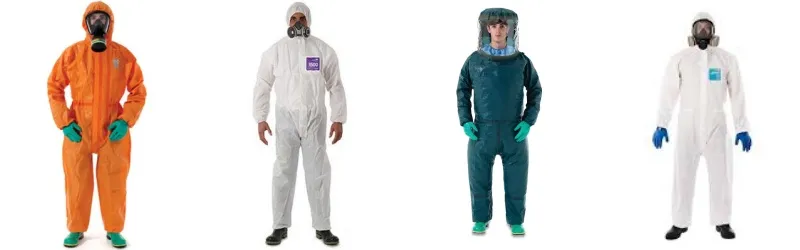
The AlphaTec 1800 STANDARD (Model 111) works for low-hazard areas. Think nuisance dust and minor liquid contact. Type 5/6 certification means it stops airborne solid particles. It also blocks limited liquid splashes. The 1800 COMFORT Model 195 variant uses 53 gsm microporous polyethylene laminate on the main body. Back panels, underarms, and hood use 50 gsm anti-static polypropylene. This lets air through. Two fabrics work together to cut heat buildup during long wear. Particle filtering stays strong.
Microchem 2000 Oversleeves (Model 600) shield exposed forearms during repetitive chemical work. The 63 gsm microporous polyethylene laminate construction blocks low-concentration liquid chemicals and biological hazards. Bound seams and CE Category I classification mark this as minimum-risk PPE. The 5-year shelf life makes them practical for pharmaceutical clean rooms and food processing. Low-linting properties help too. Workers swap out contaminated sleeves without taking off entire work coveralls . Productivity keeps moving.
Microchem 3000 Coverall: Multi-Hazard Disposable Protection
The AlphaTec 3000 Model 111 WT steps up to CE Category III protection. This goes beyond particle filtering. Type 3-B certification means it handles liquid jets under pressure. Type 4-B adds spray-tight performance. Type 5-B and 6-B cover particles and light splashes. EN 14126 certification protects against infectious agents. EN 1073-2 handles radioactive particles in non-critical uses. EN 1149-5 antistatic properties prevent ignition risks around flammable vapors.
Multi-layer nonwoven barrier laminate fabric builds the base. Welded and taped seams remove weak points. Stitching creates gaps—this doesn’t. Bright yellow color boosts visibility in industrial settings. Forklifts and overhead cranes operate there. Double zip closure with storm flap stops chemical entry at the front opening. Double cuffs—inner and outer layers—seal wrists twice. Elasticated hood, waist, and ankles fit body shapes. Movement stays free.
Sizes run from S through 5XL. This fits different worker builds. Fit quality stays high. The 2-piece hood design lets you adjust the hood independently. Neck seal stays intact. A 5-year shelf life works well for bulk buying. Emergency response teams need this. So do planned maintenance shutdowns.
Common uses include filling and blending operations. Chemical splashes mix with the airborne powder there. Cleaning plant machinery creates residual liquid contact and disturbed particles. Loading trucks involves manual handling. Splash angles become hard to predict. Product inspection in pharmaceutical manufacturing needs infectious agent barriers plus particle control. The 3000 series handles all these jobs in one disposable garment. No decontamination cycle needed. No reuse liability. You get complete barrier protection, then proper disposal.
Ansell BioClean Series: Cleanroom and Sterile Environment Coveralls
Sterile manufacturing needs particle control. Standard disposable coverall suits can’t handle it. Ansell’s BioClean series works for pharmaceutical production, biotech research, and aseptic processing. Even tiny contamination ruins batches worth millions. These gamma-irradiated garments meet ISO Class 4 cleanroom requirements and EU GMP Grade A/B standards. That’s the strictest contamination control in industrial hygiene.
BioClean-D™ with Integrated Boots: Maximum Sterility Assurance
The BioClean-D™ Coverall with Hood and Integrated Boots (S-BDFC) fixes the ankle seal problem in two-piece cleanroom systems. Integrated anti-slip boots stop floor-to-garment contamination. Gamma irradiation at a minimum 25kGy achieves Sterility Assurance Level (SAL) 10⁻⁶. That’s a one-in-a-million chance of non-sterility. Medical device production and injectable drug manufacturing need this level.
CleanTough™ fabric combines polyethylene and polypropylene in a static-dissipative blend. Charge half-decay time hits 0.07 seconds (EN1149-3). This stops particles from sticking to the surface of the suit. Low-linting properties matter just as much. Fiber shedding contaminates product contact surfaces. The material repels 30% sulfuric acid and 10% sodium hydroxide at >90% efficiency (Performance Class 3, ISO 6530). Chemical penetration stays under 1% for these same substances. Pharmaceutical cleaning often uses these chemicals. Your sterile barrier holds up during validated cleaning exposure.
Single-needle stitched seams with a protective front zip flap keep the barrier intact. Sizes reach 3XL (chest 84-92 cm, height 5’4″ to 5’7″ for small reference). The 3-year shelf life works for planned inventory or emergency pandemic response stockpiling.
BioClean™ 2000 Sterile: Aseptic Donning Innovation
The BioClean™ 2000 Model 111 Sterile brings disposable microporous protection into ISO Class 5 and Grade C/D environments. CE Category III Type 5/6 certification adds compliant particle and splash resistance. But the real breakthrough is the aseptic fold packaging. EU GMP Annex 1 paragraph 7.13 requires procedures that prevent outer garment surface contact during donning. BioClean 2000’s fold design lets operators step into the suit without touching the exterior. It won’t contact non-sterile floors either. This reduces gowning area contamination incidents that trigger investigation protocols and batch hold decisions.
Microporous polyethylene laminate with SBPP fabric creates breathability. You still get particle filtration. Bound seams beat standard stitched construction for liquid and particle blocking. Thumb loops, elasticated back, three-piece hood, and ankle cuffs seal critical entry points. Gamma sterilization (SAL 10⁻⁶) arrives ready for immediate Grade A/B zone transfer.
Drop-Down Design for Restricted Access Points
The BioClean-D™ Drop-down Coverall (S-BDSH) solves gowning room space problems. Workers pull the suit up instead of stepping through the leg openings. Elasticated hood, cuffs, ankles, and thumb loops keep the seal tight. This model has the S-BDFC’s CleanTough™ material performance. Same chemical blocking, same flex cracking resistance (>50,000 cycles), same 3-year shelf life. Available in cases of 15-20 units for batch campaign planning.
BioClean suits cost more per garment than Microchem disposables. But they prevent six-figure losses. Viable particle counts spike during aseptic filling and cause major problems. Regulatory compliance drives the investment. FDA Form 483 observations for poor cleanroom garments trigger remediation costs. Those costs far exceed proper PPE selection.
Ansell Coveralls Sizing Guide: How to Find the Right Fit
If your coverall doesn’t fit, it can’t protect you properly. A suit that is too tight might rip when you bend over. A suit that is too loose creates trip hazards. Taking three minutes to measure yourself can prevent these safety risks.
1. Measure Your Body
Grab a measuring tape and check these four simple spots:
- Chest: Measure around the fullest part under your arms. Keep the tape flat.
- Waist: Measure around your natural waist (usually just above your belly button).
- Hips: Stand with feet together and measure the widest part of your hips.
- Inseam: Measure from the crotch down to your ankle bone.
2. Ansell Coveralls Size Chart
Once you have your numbers, match them to the chart below. Note:
BioClean sterile coverall suits
fit tighter than standard suits.
| Size | Chest (Inches) | Waist (Inches) | Height |
|---|---|---|---|
| Men’s Standard Sizing | |||
| Medium (M) | 38-40″ | 32″ | 5’8″ – 5’11” |
| Large (L) | 41-43″ | 34″ | 5’11” – 6’2″ |
| XL | 44-46″ | 37″ | 6’2″ – 6’4″ |
| 2XL | 48-50″ | 40″ | 6’4″ – 6’6″ |
| Women’s Sizing | |||
| Small (S) | 34-36″ | 26-27″ | 5’4″ – 5’7″ |
| Medium (M) | 36-37″ | 28-29″ | 5’7″ – 5’10” |
| Large (L) | 38.5-40″ | 30.5-32″ | 5’10” – 6’1″ |
3. Quick Fit Tips of Ansell Coveralls
- When to Size Up: If your measurements fall between two sizes (like a 43″ chest), pick the larger size (XL). This gives your arms room to move.
- Winter Clothes: If you wear thick clothes underneath, go up two sizes.
- The “Move” Test: Before working, try squatting down and reaching up high. If the suit pulls tight or your wrists stick out, it’s too small.
Where to Buy Ansell Coveralls?
Get Ansell coveralls from big suppliers like Grainger, Fastenal, and Uline. Need sterile coverall suits for labs? Check Fisher Scientific or VWR.
Price Guide of Ansell Coveralls
- Basic Dust Coverall Suits: $3–$8 each. Good choice for simple protection.
- Chemical Splash Coverall Suits: $12–$25 each. You get better safety against liquids here.
- Reusable Coverall Suits: $200–$450 upfront. High initial price, but they save cash over time. Wear a $350 suit 50 times. That cost drops to $7 per use.
Sterile Cleanroom Coverall Suits
: $25–$60 each. You typically need these for strict medical or drug-making rules.
How to Save Money?
Buy in Bulk: Skip single Ansell coverall suit purchases. Grab full cases to save 15-30% on the price.
Watch Shipping Costs: Spend over $500 at many Coverall suppliers for free shipping. Add extra items to your cart to hit that limit. This saves you that $40 delivery fee.
Reusable vs. Disposable: Do the math. Say you use 500 disposable suits a year. That runs you about $58,000. Switch to reusable suits. That cost drops to $11,000. Constant chemical work makes reusable gear cheaper in the long run.
Conclusion
Choosing the correct Ansell coverall keeps your team safe, comfortable, and productive across chemical, particle, and biological hazards. From reusable AlphaTec suits to disposable Microchem or sterile BioClean models, proper selection prevents accidents and ensures compliance. For custom protective coveralls or bulk orders, contact us for a personalized quote today.