

Picking the wrong disposable surgical cap seems like a small procurement mistake. But it can trigger a compliance audit, contaminate a sterile field, or get rejected by your cleanroom supervisor on day one.
Most buyers underestimate how much variation exists between cap styles, fabric grades, and certification Requirements. A bouffant cap built for a hospital corridor performs far from an SMS-fabric hood designed for an ISO Class 5 cleanroom. Get that wrong at scale, and you’re wasting budget — plus creating real operational risk.
This guide breaks down what matters most in selecting a medical-grade head cover: materials, styles, certifications, and the specific scenarios where each option earns its place.
Why Disposable Surgical Caps Matter More Than Most Buyers Think?

Here’s a number worth paying attention to: non-woven disposable surgical caps now account for 70% of global surgical cap usage in hospitals and clinics. That’s not a habit. It’s the result of decades of real-world evidence on contamination control, workflow efficiency, and cost predictability.
Yet procurement teams often underestimate what’s at stake in this category.
The Contamination Risk Hidden in Plain Sight
Every reusable cap depends on a laundering process. One failure in that chain — wrong temperature, overloaded machines, a missed cycle — and the cap entering your sterile environment is no longer clean by any reasonable standard. Disposable non-woven surgical caps cut out that variable. Each cap arrives with zero carryover bioburden. You open it, use it, discard it.
In high-risk environments — isolation rooms managing MRSA, C. difficile, or active respiratory outbreaks — infection control teams don’t treat this as a preference. They treat it as policy.
The Cost Math Most Buyers Get Wrong
A polypropylene surgical cap bought at volume costs $0 . 03–$0.07 per unit. Compare that to a reusable cloth cap. The true per-use cost of laundering one — factoring in energy, water, detergent, labor, and tracking systems — runs $0.15–$0.30 in typical U.S. and EU hospital settings.
Disposables aren’t the expensive option. They’re often the cheaper ones. The cost structure is straightforward: it grows in line with procedure count and needs no laundering infrastructure behind it.
The 4 Most Common Disposable Surgical Cap Styles
Four styles dominate the disposable surgical cap market. Each one exists for a reason — built around real surgical environments, specific hair types, and hard lessons from infection control teams who’ve seen what goes wrong with the wrong cap.
1. Bouffant Caps — The OR Workhorse
Walk into any high-volume operating room in the U.S. or Canada, and you’ll find bouffant caps. Hundreds of them move through a single theatre every week.
The design is simple: a dome-shaped, shower-cap -style cover with elastic running all the way around. You get 18″, 21″, and 24″ flat-lay diameters to choose from. That range covers everything from close-cropped hair to buns and turbans — more than 95% of hair volume by infection-control benchmarks.
Material runs spunbond polypropylene (SBPP) at 10–25 GSM. That’s breathable enough for long shifts. Basic versions handle splashes. SMS-laminated upgrades give you a stronger fluid barrier. Color-coding adds a practical layer on top:
-
Blue — surgeons
-
Green — surgical teams
-
Pink or light purple — scrub nurses
-
White — trainees
One glance tells you who’s who across a crowded theatre.
2. Skull Caps — Precision Over Volume
Neurosurgeons don’t want excess fabric. Neither do oral surgeons work millimeters from critical anatomy. Cardiac specialists wearing heavy loupes and headlights through a six-hour case feel the same way.
The disposable skull cap — also called a surgical scrub cap in single-use form — sits low and close to the scalp. No billowing. No loose material catching on equipment. It runs 15–25 gsm in standard polypropylene, stepping up to SMS at 30–40 gsm for high-fluid procedures. Fit range sits at 54–60 cm, with a partial elastic back holding everything in place — no pressure points.
Minimal seams. Minimal particle shedding. Maximum sterility control.
3. Tie-Back Caps — For Staff Who Move
Not everyone stays in one room. Anesthesiologists move. Senior scrub staff rotate between theatres. The tie-back surgical cap solves a specific problem for these people: a secure, adjustable fit that holds up through repeated donning and doffing across a full shift.
Two ties at the back let the wearer dial in the tension. That matters when you’re also managing glasses, mask straps, or hearing aids. The fit range stretches to 52–64 cm via tie adjustment. Once secured, the cap stays fixed through multi-hour procedures — no repositioning needed.
Some models include a built-in nonwoven sweatband — 30–40 gsm layering at the forehead — for comfort during extended cases. Post-COVID, integrated button tabs for mask straps have become a standard feature. They eliminate the ear pressure that came with pandemic-era PPE combinations.
4. Ponytail and Extended-Coverage Caps — Long Hair, High Fluid
Standard bouffants and skull caps weren’t built with a surgical nurse’s long ponytail in mind — especially not during an orthopedic revision case. Ponytail caps were.
A structured rear pouch — 10–15 cm deep — captures the ponytail and holds it clean. It stays out of the sterile field without bunching or slipping mid-procedure. The front fits like a skull or tie-back cap. The pouch handles the rest.
Extended-coverage versions go further. Longer side and nape panels — built from fluid-resistant SMS at 30–45 gsm — are standard in cardiac and orthopedic settings. In those environments, irrigation fluid and blood splatter aren’t surprises. They’re expected.
Quick Comparison: Which Style Fits Which Scenario?
|
Style |
Best For |
GSM Range |
Key Advantage |
|---|---|---|---|
|
Bouffant |
General OR, mixed hair types |
10–25 gsm (SBPP) |
Maximum hair volume coverage |
|
Skull Cap |
Neuro, dental, short hair |
15–40 gsm ( SBPP/SMS ) |
Low profile, precision fit |
|
Tie-Back |
Anesthesia, high-rotation staff |
10–40 gsm (SBPP/SMS) |
Adjustable tension, stays secure |
|
Ponytail/Extended |
Long hair, ortho, cardiac |
15–45 gsm (SBPP/SMS) |
Ponytail containment + fluid barrier |
These four styles cover the vast majority of disposable surgical cap use across acute-care hospitals. Getting the right match between style and setting isn’t about preference. It’s about contamination control, barrier performance for specific procedures, and comfort that holds up across a twelve-hour shift.
What Really Matters When Choosing a Disposable Surgical Cap?
Four variables separate a cap that protects from one that just looks the part. Get these right, and the procurement decision is simple. Get them wrong, and you’re dealing with compliance failures, staff complaints, and contamination incidents — all traced back to a spec sheet nobody read.
Material and Barrier Performance
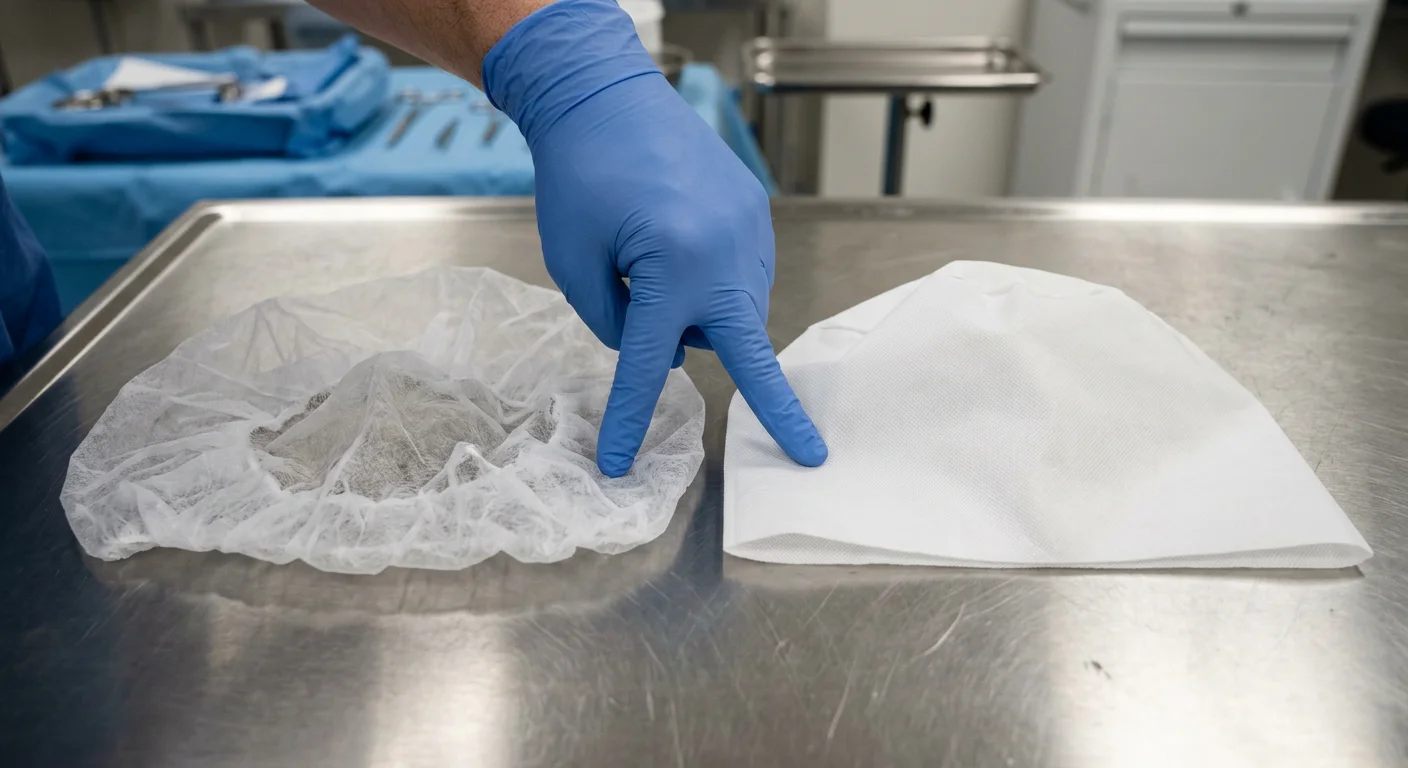
Not all nonwoven polypropylene is equal. A basic polypropylene surgical cap at 10–20 gsm works fine for visitor corridors and low-risk wards. It won’t hold up in an active OR.
For surgical environments, the minimum standard is SMS polypropylene at 25–40 gsm. The meltblown middle layer does the real work. It gives the fabric fluid resistance that single-layer spunbond can’t match. Look for materials tested to AATCC 42 and AATCC 127 liquid barrier standards. Many facilities align their medical-grade head cover specs with their gown policy — AAMI PB70 Level 3–4 for high-fluid procedures — even where the caps themselves aren’t PB70-rated.
Research shows ultra-thin disposable caps rank among the weakest barriers to particle transmission across all cap types. Choosing a thicker SMS fabric surgical cap isn’t over-engineering. It’s closing a known gap.
Hair Coverage — Where Most Specifications Fall Short
Coverage is the main job of any disposable bouffant cap . It’s also the variable most procurement specs define poorly. The standard rule: the cap must cover scalp hair, sideburns, and the nape. High-risk cases often require ear coverage on top of that.
Sizing has a direct impact. Skull caps create measurable hair protrusion risk once hair length passes 5–7 cm. Your staff may include people with long hair, braids, or thick styles — if that’s 30–40% or more of your team, stocking 24-inch bouffants alongside standard 21-inch isn’t optional. A one-size policy in a mixed-hair environment is a coverage policy in name only.
Fit, Elastic, and Real-World Compliance
Elastic tension is where the cap design earns trust or loses it. Too loose and the cap shifts during a procedure, exposing hair at the nape or temples. Too tight and you get pressure headaches, skin marks, and staff cutting corners on fit by the third hour of a long shift.
Most standard one-size disposable surgical caps fit head circumferences in the 52–62 cm range. For teams with a wide size spread, tie-back or drawstring designs handle the variation without the compliance drop that comes with a poor elastic fit. All elastic must be latex-free. Latex allergy rates run 1–6% across healthcare staff. A cap spec that ignores this creates an avoidable occupational health problem.
Cost in Context — The Numbers That Drive Decisions
Basic Polypropylene bouffant caps in bulk run $0.015–$0.04 per unit. OR-grade SMS surgical caps step up to $0.04–$0.12, depending on barrier level and features. Eco-disposable options made from PLA or biodegradable PP blends sit at $0.06–$0.15 — about 20–50% above standard PP.
Unit costs don’t tell the full story. Incineration of clinical waste runs $0.40–$1.00 per kilogram in most systems. At 10–20 grams per cap, that adds $0.004–$0.02 per unit in disposal cost. That figure almost never shows up in purchase-price comparisons.
For a 200–400-bed hospital using 8 , 000–30,000 caps per month, those fractions add up fast. One policy change — requiring caps across all clinical corridors — can double monthly consumption. Build your supplier agreement around that total volume number, not the per-unit price alone.
The Practical Selection Checklist
Before locking in any cleanroom head protection or surgical cap specification, work through these steps in order:
-
Define risk level first — high-fluid OR procedures need SMS ≥25 gsm, low-lint, latex-free; general ward use allows lighter PP options
-
Survey your staff’s hair profiles — if long or thick hair is common, make a 24-inch bouffant your primary stock
-
Require documentation — ISO 13485 manufacturer certification, biocompatibility testing to ISO 10993, and particle/lint test data per batch
-
Run a structured trial — 1–2 weeks, 20–50 staff minimum, scoring comfort, heat, slippage, and containment
-
Calculate true cost per use — unit price plus disposal cost, checked against reusable program benchmarks where relevant
-
Secure primary and backup suppliers — both must match your GSM specification, elastic grade, and color range without exception
The variables that move the needle are the same across every environment: correct size for actual hair volume, GSM and fabric construction matched to procedure risk, latex-free compliant manufacturing, and a cost calculation that covers what you spend getting rid of the cap — not just what you paid to buy it.
What I Always Check Before Ordering in Bulk?
Bulk procurement feels like control. It’s not — not until you’ve done the unglamorous work of checking eight things most purchase orders never mention.
Start with the delivered unit cost, not the list price. A bouffant cap quoted at $0.03 each means nothing. Add freight, surcharges, and minimum-order packaging fees first. Divide the total invoice by the actual unit count. That number is your real baseline.
Check certification documentation before samples, before pricing conversations. Any medical-grade head cover going into a surgical or cleanroom environment needs ISO 13485 manufacturer certification and biocompatibility data per ISO 10993. Ask for it upfront. Suppliers who hesitate on this tell you something important.
Fabric spec must match your risk level. A non-woven surgical cap labeled “surgical grade” with no GSM stamp is a red flag. Confirm SMS construction at 25–40 gsm minimum for OR use. Get particle and lint test data by batch — not just by product line.
Run a physical sample trial before committing to volume. Test it across 20–50 staff for one to two weeks. Score each factor on its own: comfort, slippage, heat retention, and hair containment. Staff who quietly drift out of wearing a cap the right way are a contamination event waiting to happen.
Verify your supplier has a backup source. One primary supplier for 15,000 disposable surgical caps per month is a single point of failure. Pin down a secondary supplier who matches your GSM spec and elastic grade to the same standard — not a close match. The same spec, full stop.
Common Problems Buyers Run Into Surgical Caps

Buyers across different facilities keep making the same procurement mistakes. The reasons are always the same, too.
Ordering by label instead of specification. “Surgical grade” printed on a box means nothing without a GSM stamp and material construction to back it up. Most buyers accept that claim without asking for SMS confirmation, particle test data, or batch-level documentation. You end up with a non-woven surgical cap that looks fine on a visual check — then fails a contamination audit.
Applying a single-size policy to a mixed-hair workforce. A 21-inch bouffant fits most staff. It doesn’t fit all of them. Once hair volume pushes past what the elastic can hold, coverage breaks down at the nape and temples. This happens on every shift, without anyone catching it.
Evaluating unit price in isolation. A polypropylene surgical cap at $0.03 looks cheap on paper. Add freight, minimum-order packaging, and incineration disposal cost — that number climbs fast. Buyers who skip that math are chasing the wrong figure.
Skipping supplier redundancy. One qualified source for 15,000 disposable surgical caps per month is a supply chain risk. That’s not a procurement strategy. Shortages hit without warning. A backup supplier matched to the same GSM and elastic specs isn’t a safety net — it’s a basic operational requirement.
FAQ: Real Questions Buyers Ask
These questions come in every time. Procurement managers at 200-bed hospitals. Cleanroom supervisors at semiconductor facilities. The wording changes, but the gaps are the same.
What’s the actual difference between a surgical cap and a regular dust cap?
Two things: construction and certification.
A standard dust cap uses lightweight SBPP fabric. It’s breathable, but the barrier protection is minimal. A medical-grade head cover for OR use is built to a different standard entirely:
-
Meets biocompatibility requirements under ISO 10993
-
Uses SMS fabric at 25 gsm minimum
-
Ships with documented particle and lint test data
One keeps hair out of food. The other keeps your sterile field intact under AAMI or ISO 13485 standards.
What grade of cap does a cleanroom require?
It depends on your ISO classification.
-
ISO Class 7–8 — Standard non-woven surgical caps at 25–40 gsm SMS work here.
-
ISO Class 5–6 — You need heavier SMS construction, 40–60 gsm, with low-lint certification and full hood coverage.
Your contamination control protocol sets the baseline. The cap spec follows from that — not the other way around.
Are sterile surgical caps necessary, or is non-sterile sufficient?
Most procedural environments run on non-sterile disposable surgical caps. That covers general OR, procedure rooms, and cleanrooms. Sterile packaging is for specific scrub-in situations or direct sterile field contact.
No facility policy mandating sterile? Non-sterile SMS caps with documented biocompatibility cover nearly every use case — and cost far less per unit.
Can one cap style work across our entire facility?
No. Not reliably.
A disposable bouffant cap covers general ward use and mixed-hair OR populations well. But it won’t hold up for a neurosurgeon wearing optical loupes through a six-hour case. It also won’t meet full nape coverage requirements for cleanroom technicians.
Facilities that push a single-style policy find out about the exceptions during a compliance audit — not before.
Conclusion
Picking the right disposable surgical cap isn’t complicated. It just asks you to look beyond the price tag.
Cap style matters. Fabric matters. Certifications matter. Buying for a cleanroom or surgical environment? Every one of those details carries real consequences — failed compliance audits, contamination reports, and problems you’d rather never face.
Here’s my take: don’t let a $0.03-per-unit difference drive a decision that carries a $30,000 risk. Know your environment. Match your material to your protection standard. Verify certifications before a single pallet ships.
Ready to move from research to sourcing? The next step is straightforward:
-
Request samples
-
Compare performance under real conditions
-
Partner with a supplier who can back up their specs with proof
The right cap is out there. Now you know what to look for.