

Sourcing Disposable coveralls at scale seems simple — until the first shipment arrives damaged, mislabeled, or packed so poorly your warehouse team is ready to quit.
Here’s the reality: how a disposable coverall manufacturer packages their product tells you almost everything about how much they care about the export process. Every detail matters. There is a poly bag around each suit. The carton dimensions your freight forwarder needs for CBM calculations. None of this is an afterthought — it’s a clear sign of whether a supplier knows what they’re doing.
This guide breaks down what professional disposable coveralls export packaging looks like. You’ll learn what questions to ask, how to plan your logistics with confidence, and how to spot suppliers who handle exports the right way.
Standard Inner Packaging for Disposable Coveralls (Poly Bag Formats)
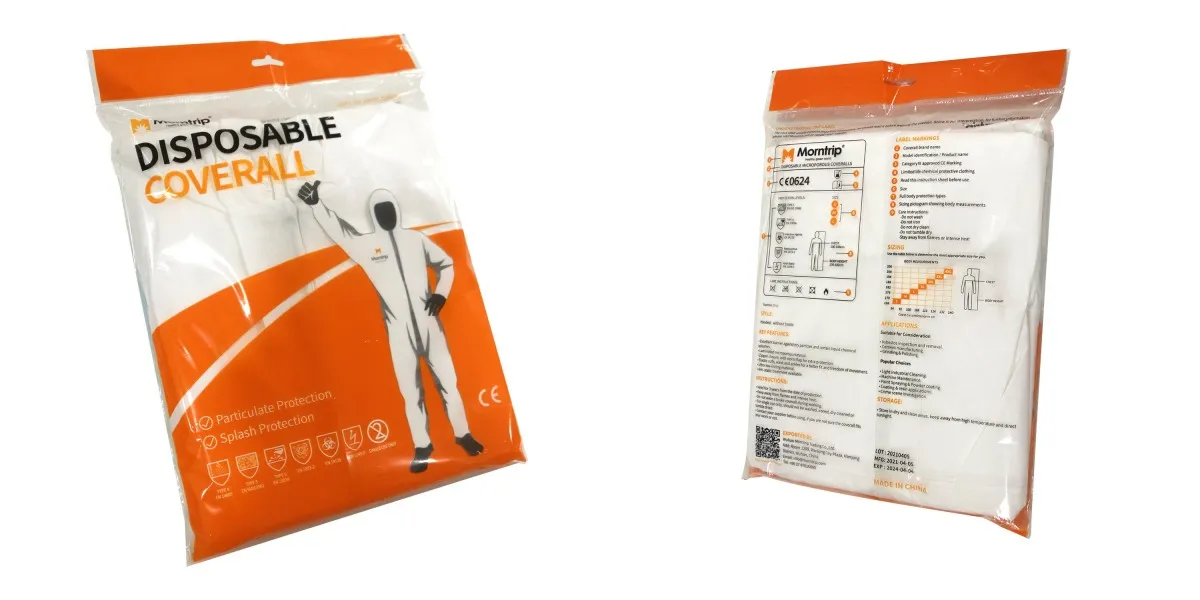 Every disposable coverall leaves the factory inside a poly bag. That single bag — its thickness, its size, its closure method — tells you more about a supplier’s export competence than almost anything else in the shipment.
Two primary inner packaging formats exist in this industry. They are not interchangeable.
The two standard configurations:
- 1 pc / poly bag — the standard for higher-protection coveralls (Type 3/4, microporous, or infection-control applications). Individual packing keeps suits clean, makes traceability easy, and protects high-value garments from handling damage.
- 5 pcs / poly bag — the go-to format for bulk industrial supply. Standard PP or SMS Type 5/6 coveralls ship this way. Most cartons hold 10 bags, landing at 50 pcs/carton. That setup keeps carton gross weight between 10–15 kg and cubic volume around 0.06–0.07 m³.
Poly Bag Specs That Matter
The bag itself is not one-size-fits-all. Here’s what professional suppliers specify:
| Format | Bag Dimensions | LDPE Thickness | Closure |
|---|---|---|---|
| 1 pc/bag (PP/SMS) | 280–350 mm × 400–500 mm | 1.5–2.0 mil | Heat-sealed or zip-top |
| 5 pcs/bag (PP/SMS) | 350–450 mm × 450–550 mm | 2.0–3.0 mil | Heat-sealed |
| 1 pc/bag (microporous Type 4B/5B/6B) | ~330 × 450 mm | 1.5–2.0 mil | Zip-top or sealed pouch |
Thickness matters more than most buyers expect. A standard PP coverall weighs 100–250 g per piece. Bundle five together, and you’re loading up to 1.25 kg into a single bag. At that weight, anything under 2.0 mil LDPE risks tearing during warehouse handling. Torn inner bags lead to damaged suits, failed inspections, and unhappy end users. That’s a problem you don’t want to explain to a customer.
What Should Be Printed on the Bag?
A plain, unmarked poly bag is a red flag for experienced buyers. Professional export packaging prints — or labels — the following on each inner bag:
- Product name and protection type (e.g., Type 5/6, Type 4B/5B/6B)
- Material (PP, SMS, microporous laminate)
- Size code (S / M / L / XL / XXL)
- Quantity per bag (“1 pc” or “5 pcs”)
- Lot/batch number and manufacturing date
- CE marking and applicable EN standard icons (EN 13034, EN 13982, EN 14126, EN 14605)
This isn’t decoration. Buyers importing into the EU or supplying regulated industries need these labels for compliance. Missing labels can hold up customs clearance or trigger product recalls. That’s not a risk worth taking.
Export Carton Specifications: Quantity, Size, and Weight Per Carton
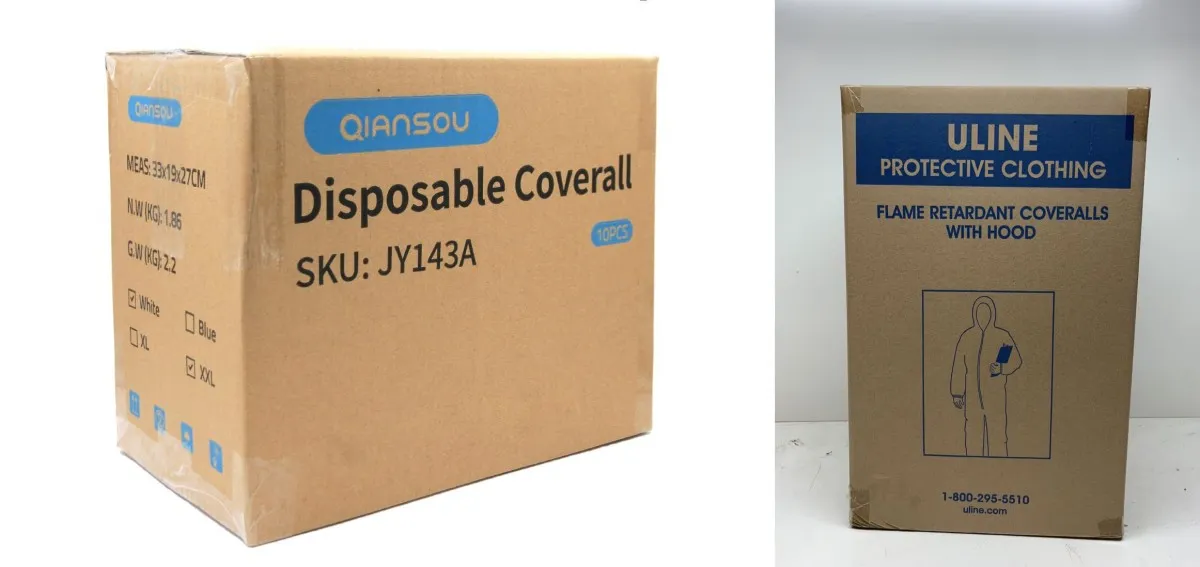 The outer carton is where supplier promises meet freight reality.
Get these numbers wrong — or never ask for them — and your logistics costs will blow up fast. Freight forwarders price by CBM or gross weight, whichever hits you harder. Carton specs aren’t optional. Professional importers get them before placing the order. That’s how they protect their margins.
Here’s what a standard disposable coveralls export carton looks like:
| Configuration | Qty per Carton | Carton Dimensions (L×W×H) | Net Weight | Gross Weight | CBM |
|---|---|---|---|---|---|
| PP/SMS, 5 pcs/bag × 10 bags | 50 pcs | ~60 × 40 × 40 cm | 10–13 kg | 11–15 kg | ~0.096 m³ |
| PP/SMS, 1 pc/bag × 50 bags | 50 pcs | ~62 × 42 × 38 cm | 10–14 kg | 11–15 kg | ~0.099 m³ |
| Microporous/Tyvek, 1 pc/bag × 25 bags | 25 pcs | ~55 × 38 × 35 cm | 8–12 kg | 9–13 kg | ~0.073 m³ |
These are working benchmarks — not fixed rules. Real specs shift with coverall material weight, size mix (an XXL SMS suit runs heavier than a medium PP suit), and how tightly your supplier packs each carton.
Why Gross Weight Stays Under 25 kg?
There’s a clear reason for this. International export carton standards — and nearly every major retailer import spec — cap manual-handling cartons at 25–27 kg gross (≈60 lb). Go over that, and dock workers need mechanical help. Freight handling classifications change. Damage risk goes up. Experienced coveralls exporters set their pack counts to land gross weight in the 10–20 kg sweet spot. Light enough for one person to carry. Heavy enough to fill the container space well.
Also worth knowing: an empty double-wall corrugated export carton — the standard grade for non-woven coveralls bulk packaging — weighs 800 g to 1.5 kg on its own. Build that into your net-to-gross calculation when you compare supplier quotes.
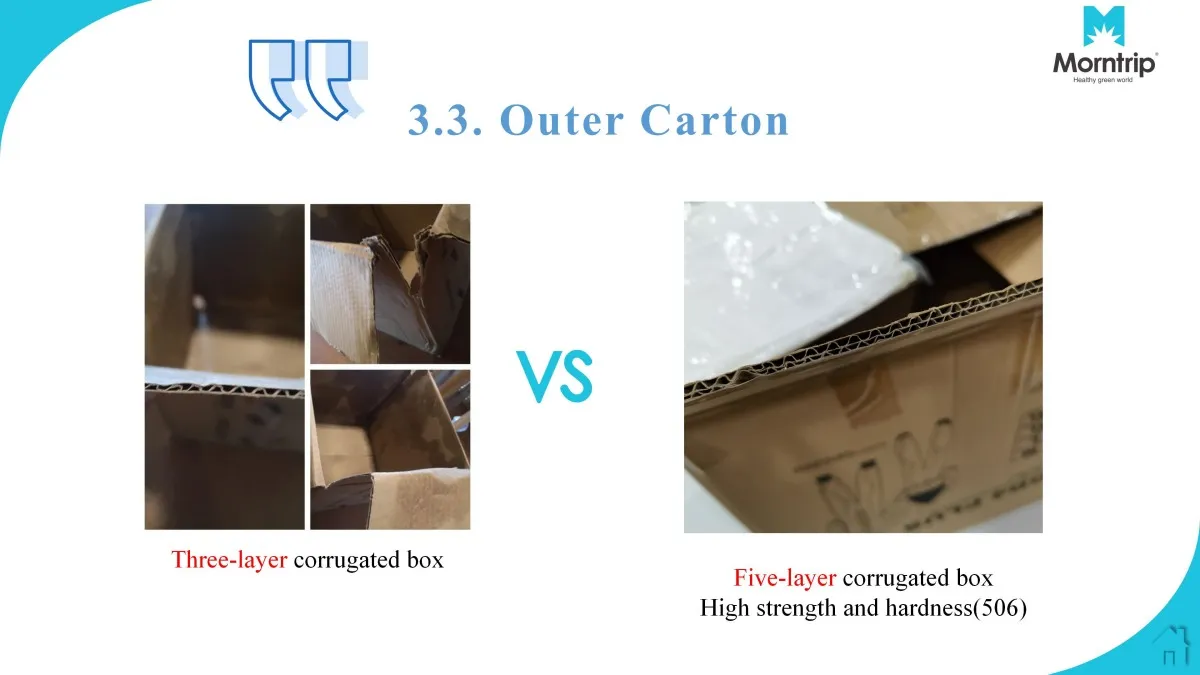
The Corrugated Board Grade Matters More Than You Think
Not all cartons are built equal. For disposable protective suits export shipping, look for:
- Double-wall BC flute corrugated board
- Burst strength: minimum 200 lb (≈90 kg)
- Edge Crush Test (ECT): minimum 32 lb/in
Why does board grade matter for coveralls? Polypropylene and SMS garments are light but bulky. Cartons stack four to six high on pallets inside shipping containers. A carton built to basic domestic standards will buckle under that load. Crushed cartons lead to crushed suits, failed delivery inspections, and chargebacks you never planned for.
What to Ask Your Supplier Before You Book the Freight?
Get these four numbers in writing before you confirm any large order:
- Carton internal dimensions (L × W × H in cm)
- Gross weight per carton (kg, packed and sealed)
- CBM per carton (or total CBM per 1,000 pcs)
- Pallet configuration (cartons per pallet, pallet gross weight)
Your freight forwarder needs those figures to give you a real price. Without them, you’re quoting blind — and in international logistics, that gets expensive fast.
How to Calculate CBM and Shipping Cost for Bulk Disposable Coveralls Orders?
CBM is the number your freight forwarder runs on. Don’t know how to calculate it yourself? You’re handing control of your logistics budget to someone else.
Here’s the formula. It’s simpler than it looks:
CBM per carton = Length (m) × Width (m) × Height (m)
Take a standard disposable coveralls export carton: 60 × 40 × 35 cm. Convert each dimension to meters, then multiply them together. You get 0.084 m³ per carton. That’s your working unit for everything that follows.
Scaling CBM for Bulk Orders
Got your CBM per carton? The math scales fast:
Total CBM = CBM per carton × Number of cartons
| Order Size | Pcs/Carton | Cartons | Total CBM |
|---|---|---|---|
| 5,000 pcs | 50 | 100 | 8.4 m³ |
| 10,000 pcs | 100 | 100 | 8.4 m³ |
| 20,000 pcs | 100 | 200 | 16.8 m³ |
For container planning: a 20′ container holds 33 m³ usable volume — that’s about 392 cartons at 0.084 m³ each. A 40′ container fits around 798 cartons. Real stacking limits will pull those numbers down a bit. Still, CBM gives you a solid planning baseline to book with confidence.
Ocean vs. Air: What CBM Actually Costs You
Ocean freight (LCL) is quoted in USD per CBM. Take your total CBM, multiply by the rate, and that’s your base cost.
8.4 m³ × $60/CBM = $504 ocean freight
Air freight works differently — and costs more. Airlines charge by chargeable weight . That means whichever is greater: actual weight or volumetric weight.
- Volumetric weight (kg) = Total CBM × 167
- Disposable coveralls weigh ~0.12 kg each — lighter than their size suggests
For 10 , 000 coveralls: actual weight = 1,200 kg. Volumetric weight = 8.4 × 167 = 1,403 kg. Volume wins. At $3.20/kg, that’s ≈ $4,490 — about nine times the ocean cost for the same shipment.
That gap explains why most bulk protective coveralls orders move by sea.
The Five Numbers You Must Collect First
Before asking your freight forwarder for a quote, get these five things from your supplier in writing:
- Master carton dimensions (L × W × H in cm)
- Pieces per carton
- Total order quantity
- Gross weight per carton (kg)
- Whether carton sizes are uniform or mixed
Those five numbers let you calculate your own CBM, cross-check your forwarder’s quote, and go into any shipping conversation with clear data — not guesses.
Palletization Standards for Disposable Coveralls Export Shipments
Palletization is where bulk orders hold together — or fall apart. Sometimes that’s not a figure of speech.
Your cartons are packed and sealed. Now the real question isn’t “how many fit in a container?” It’s “how do they survive getting there?” That’s what palletization standards are for. For disposable coveralls export shipments, those standards are more specific than most buyers expect.
When Palletization Is Required?
The rule is straightforward. Your total shipment to one destination exceeds 250 lb (113 kg) in weight or 20 ft³ in volume? Palletization is required — full stop, not optional. For bulk coveralls orders, you’ll cross both thresholds before you’ve packed your third carton.
Choosing the Right Export Pallet
Pallet size should match your container’s internal width. Standard ISO containers run 230–240 cm wide on the inside. The most common pallet options:
- 40 × 48 in (1016 × 1219 mm) — North American standard
- 800 × 1200 mm (EUR/EPAL) — Standard for EU destinations
- 1000 × 1200 mm — Common for larger PPE export loads
Wood pallets require ISPM-15 compliance — no exceptions for export. That means heat treatment to 56°C for at least 30 minutes. The IPPC stamp must appear on two opposite sides, showing the country code, facility code, and treatment method (HT or MB). A missing or unreadable stamp gets your shipment turned away at the border. Not delayed. Rejected.
Plastic pallets skip the phytosanitary requirement entirely. That makes them worth a look for repeat closed-loop shipments or buyers with strict hygiene requirements.
How to Stack Coverall Cartons on a Pallet?
Take a standard 60 × 40 × 40 cm carton on a 1000 × 1200 mm pallet. Here’s what the numbers look like:
- 4–6 cartons per layer , 3–4 layers high
- Total cartons per pallet: 12–24
- Total coveralls per pallet: 300–1,200 pcs (at 25–50 pcs/carton)
- Gross pallet load: 150–300 kg
Stay well under the OSHA benchmark of 60 inches (1.52 m) total stacked height. Three to four layers of coverall cartons put you in the safe zone. The load stays stable enough to handle container vibration and light enough for standard forklift handling.
Stacking rules that matter:
- No overhang — cartons must stay within pallet edges
- Heaviest cartons on the bottom , lighter ones on top
- Use a brick (staggered) pattern for stability — column stacking collapses under pressure
- Keep labeled or precision-marked cartons centered on the pallet
Securing the Load
Stretch WRAP is the baseline. How you apply it makes the difference. Minimum standard: 3 wraps at the bottom, 3 wraps at the top, with full-height film coverage down to the pallet base.
Tall or heavy pallets — height over 1.2 m or load over 300 kg — need 2–4 plastic or steel straps across the load. Also, add corner boards. They protect carton edges and stop the stack from bowing under the stress of ocean transit.
Pallet Labeling for Export
Every pallet needs a label on at least two sides. Each label must show:
- Destination address
- Purchase order and lot number
- Item description (e.g., Disposable Coveralls, Type 5/6, SMS, Size L )
- Carton count and total piece quantity
- Gross weight
These details must match your packing list and commercial invoice. Any mismatch causes customs problems at the worst possible time.
Export Carton Labeling Requirements and Compliance Markings
A carton label is not administrative paperwork. It is the language your shipment speaks at every border crossing, every customs checkpoint, and every warehouse receiving dock — from your supplier’s factory floor to your end customer’s hands.
Get it right, and freight moves without delay. Get it wrong, and a single missing field can stop an entire container cold. One absent HS code. One unreadable batch number. One country-of-origin statement that doesn’t match the commercial invoice. That’s all it takes.
Here’s what professional disposable coveralls export carton labeling requires.
Mandatory Data Fields on Every Export Carton
Every outer carton leaving a factory should carry these elements, printed legibly on at least one long side and one short side:
- Exporter name and full address — street, city, postal code, country
- Importer / consignee name and full delivery address
- Product description — material type (PP, SMS, microporous), protection category (Type 5/6, Type 4B), size range
- Quantity per carton — e.g., “50 pcs” with net weight and gross weight in kg
- Country of origin — stated as “Made in China” or equivalent; must match the product label, inner pack, packing list, and commercial invoice without any deviation
- Purchase order number and carton sequence number — e.g., “Carton 12 of 50”
- HS code — 6 to 10 digits depending on the destination country’s customs requirements
- Batch / lot number and manufacture date — essential for traceability and any downstream recall process
Gross weight tolerances matter here. Most experienced importers specify ±2–3% on gross weight. A supplier who can’t hold that tolerance is a supplier worth reconsidering.
Language Requirements by Market
The destination country sets the label language. There is no universal standard. Know your market before you print a single label:
| Destination | Language Requirement |
|---|---|
| EU member states | Official language(s) of the country of sale |
| Canada | English and French together |
| GCC / Middle East | Arabic mandatory; English + Arabic common |
| China | Simplified Chinese required |
| US | English; origin statement must be unambiguous |
Minimum font height for critical data — origin, quantities, hazard statements — is ≥2–3 mm. Go smaller than that, and customs officers and warehouse scanners treat your label as unreadable. That’s not a minor technicality. It’s a rejection trigger.
Compliance Markings for Disposable Coveralls
Disposable protective coveralls fall under regulated goods in most major markets. Your outer carton should reflect that:
- CE marking — required for EU market entry. It must show on the carton, repeating what’s on the product label, so customs inspectors can confirm conformity without opening the shipment
- UKCA mark — the equivalent requirement for the UK market post-Brexit
- EN standard references — EN 13982, EN 13034, EN 14126, EN 14605, as applicable to the protection type
- GHS pictograms — relevant only if the coveralls are packaged with any chemical treatment or coating classified as hazardous; the outer carton then requires a signal word (“Danger” or “Warning”), hazard statements, and precautionary statements
Shipping Marks and Barcode Label Placement
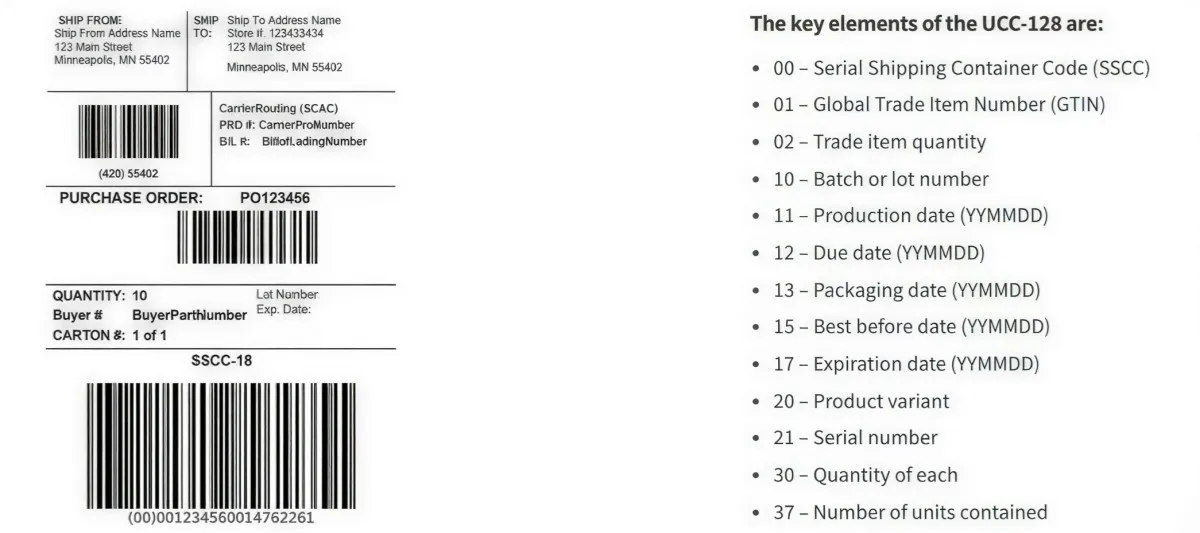
Retailer and distributor supply chains add another layer: GS1-128 / UCC-128 barcode labels.
Placement is fixed. The label goes on the lower right-hand corner of the short end of the carton. Size must fall between 4″ × 6″ (101 × 152 mm) and 8.5″ × 11″ (216 × 279 mm). The barcode cannot wrap over carton edges. The carton itself must be at least 4 inches tall and 6 inches wide to hold the label without distortion.
One rule that trips up suppliers regularly: no plastic office tape over labels. Ever. Tape makes barcodes unscannable. It also triggers automatic chargebacks from retail buyers. Plus, it makes ASN (Advanced Shipping Notice) data unverifiable. ASN data that doesn’t match physical carton contents brings financial penalties — fast.
A Pre-Shipment Labeling Checklist
Run through this sequence before any bulk coveralls shipment leaves the warehouse:
- Confirm destination-country language and regulatory mark requirements
- Verify all mandatory data fields are present and accurate
- Cross-check batch/lot number against production records and packing list
- Confirm carton sequence numbers match the total count on the packing list
- Check font legibility and label contrast under warehouse lighting conditions
- Confirm no labels are covered by strapping or stretch wrap
- Verify that at least one labeled side stays visible from each pallet position
That last point matters more than most buyers expect. A carton with perfect labeling, buried inside a pallet with the label facing inward and hidden under stretch film, is no different from an unlabeled carton. A customs officer can’t verify what they can’t see.
Label compliance is not complexity for its own sake. It’s the difference between a shipment that clears in 24 hours and one that sits in a bonded warehouse while you negotiate with customs brokers at $200 an hour.
FAQ: Key Packaging Questions Buyers Ask Before Placing Bulk Orders
Most packaging conversations happen too late — after the order is placed, after the deposit is wired, after the container is booked. The buyers who avoid expensive surprises ask the hard questions first.
Here are the questions that matter most, with the specific numbers you need to hold suppliers accountable.
What is your MOQ, and can you scale when demand spikes?
Custom printed packaging starts at 2,000–5,000 pcs for standard runs. Larger industrial facilities push that to 10,000+ pcs. Also, ask whether the supplier can increase output by 50–100% during peak seasons. Find out how much notice they need — most require 60–90 days.
What lead time should I plan around?
Tooling takes 1–3 weeks. Mass production adds another 1–4 weeks after sample approval. Total lead time: 2–15 weeks, depending on complexity. For holiday or seasonal launches, get the last confirmed-order date in writing. Many suppliers set cut-offs 4–8 weeks ahead.
What are the one-time startup costs not listed in the unit price?
Cutting dies, printing plates, artwork setup fees — these often get buried in quotes. Ask your supplier to itemize tooling charges on a separate line. Do this before you compare quotes side by side.
What does your quality control process look like — in writing?
The industrial benchmark is a ≤1–2% defect rate on printed cartons. Ask about color ΔE tolerance and dimensional accuracy (±1–2 mm). Also, ask how wrong barcodes or SKU errors get caught before shipment. Get all of this in writing.
What certifications do you hold that are relevant to my market? ISO 9001 covers quality systems. FSC certification matters if your buyers require sustainable sourcing documentation. EU-bound protective coveralls packaging needs additional conformity records. Ask for current certificates and their audit dates. An expired cert is no cert at all.
What happens when something goes wrong?
This question separates professional suppliers from those who disappear after payment. Push for concrete terms:
– The defect threshold that triggers a free reprint — >2–3% defective units
– The resolution timeline — 5–10 working days
– Whether the supplier covers replacement freight
No clear answers here? That tells you something.
Can you provide pre-production samples, and at what cost?
Most factories offer blank structural samples, digital mockups, or press-proofs. Sample lead times run 5–15 business days. Some suppliers charge a fixed sample fee, then credit it back once bulk orders cross a set threshold — often $5,000+. Confirm this policy upfront so there are no surprises on your invoice.
Do you offer fulfillment services beyond manufacturing?
Some suppliers handle pick/pack, kitting, palletizing, and direct shipment to your 3PL or distribution center. Bundling those services can cut logistics costs by 5–15% compared to using separate providers. Ask about this early — before you build your supply chain around a third party.
Every answer your supplier gives to these questions is data. Vague answers, shifting numbers, and reluctance to put anything in writing — that’s data too.
Conclusion
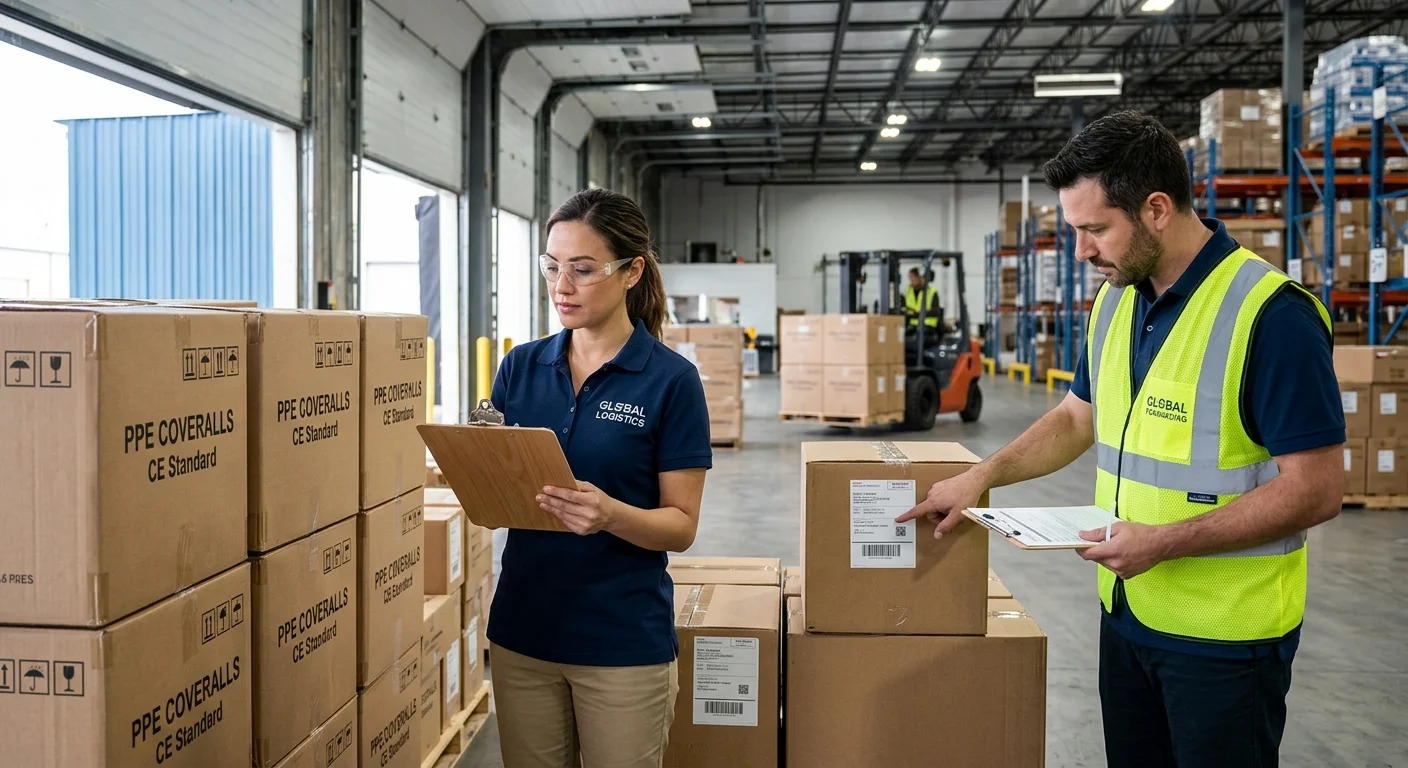 Packaging isn’t just a box. It’s the first physical connection between your supplier and your warehouse floor — every step counts.
Knowing how disposable coveralls are packaged for export matters. This covers individual poly bags, outer carton specs, CBM calculations, and compliance labeling. You’re not just collecting data. You’re cutting out the guesswork that slows procurement and hides extra logistics costs.
The right supplier shows you all of this upfront — before you even ask.
Planning a bulk order? We’re ready to help. Send you a full product datasheet with exact protective coveralls packaging specs, carton dimensions, and custom OEM branding options. We match it to your destination market and order size.
Request your free packaging spec sheet today. Take the uncertainty out of your next import shipment.
Strong buyers don’t just find good products. They find suppliers who make the whole process clear and easy to trust.