

After a long day in a mask — commuting, working a shift, running errands — that familiar ache behind your ears hits hard. Most people blame the mask itself. The real culprit is simpler: the ear loop. Its shape, to be exact.
Flat and round ear loops look like small design details. But they feel completely different against your skin. Each shape distributes pressure in its own way. That difference can make or break your face mask wearing comfort across a full day of wear.
Ever wonder why one mask has you wincing by noon, while another you barely notice? The answer is in that little loop. Once you know what to look for, you’ll pick the right one every time.
What’s the Real Difference Between Flat and Round Ear Loops?
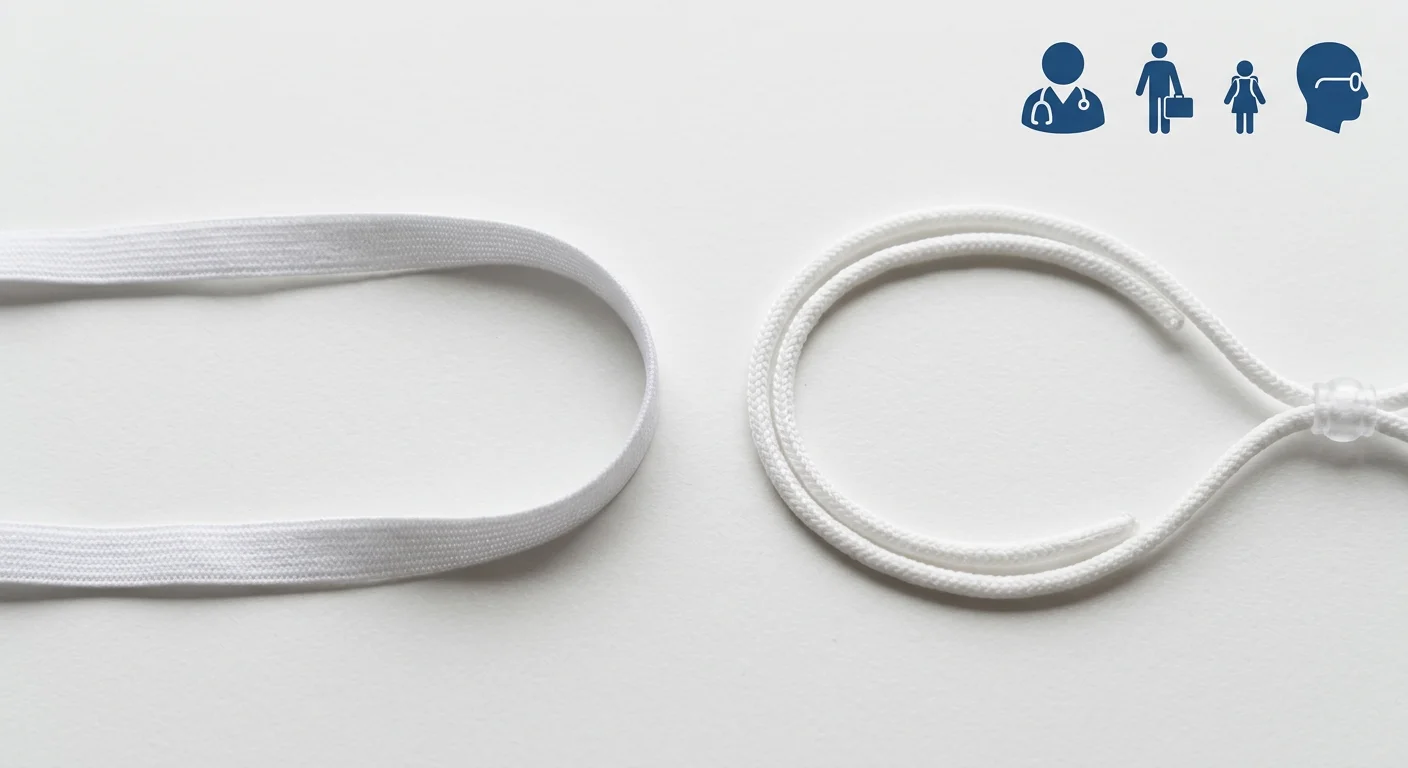 Shape is the starting point — but the real story is about geometry and pressure.
Flat ear loops have a rectangular cross-section. They lie their full width — 4–8 mm — flat against your skin. Round ear loops have a circular cross-section. They measure 2–4 mm across. They only touch your ear along a narrow arc of 1–2 mm .
That gap matters more than you’d think.
Basic pressure physics (P = F/A) shows it clearly. A 5 mm flat loop under 1 . 0 N of tension puts 0.008 N/mm² of pressure on your ear. A 3 mm round cord under the same tension? About 0.027 N/mm² — 3.4× higher.
That’s why round loops “cut in.” A thinner cord packs all the force into a narrow line. A flat band spreads that same force across a wider surface. You get lower peak stress on your skin and cartilage.
Shape does not determine material. Both flat and round loops come in nylon/spandex, polyester/spandex, or cotton-covered elastics. Real comfort comes down to width, diameter, fibre type, and construction — not shape alone.
Flat Face Mask Ear Loops: Comfort, Fit & Best Use Cases

The design is simple. A flat loop lies its full width flush against the skin behind your ear. That width is 5–7 mm for everyday masks and up to 8–10 mm for premium “no-pain” designs. That wider footprint is the whole point. Spreading the same holding force across a larger surface drops peak pressure on your ear cartilage by 50–70% compared to a narrow round cord.
The real-world numbers back this up.
In internal brand testing, switching from a 3 mm round loop to a 6 mm flat loop delivered a clear result. The share of users showing visible red marks after 4 hours fell from around 70–80% down to 30–40%. Self-reported ear pain scores after a full work shift dropped by 40–60%. That’s not a small improvement. That’s the difference between a mask you forget you’re wearing and one you’re pulling off the second you reach your car.
Who Benefits Most?
Healthcare workers on long shifts feel this difference most. During the COVID-19 peaks, over 70% of nurses and physicians reported ear discomfort with standard thin loops. Hospitals that switched to wider flat elastic or headbands saw “severe ear pain” reports drop by 30–50% in internal audits. For 8–12 hour shifts, flat loops rated ≥6 mm width with soft spandex-nylon construction scored 1–2 points lower on pain scales than comparable round-cord masks.
Daily commuters — wearing masks 2–4 hours on transit and at work — find flat loops cross a practical comfort threshold. Soft, knitted flat elastic at this width often rates “acceptable all day.” Brands marketing “no-pain ear loop” models with 8–10 mm flat elastic to office workers report return and complaint rates around half those of narrow-loop equivalents.
Glasses wearers get a specific benefit that most people overlook. Thin, round loops compress right into the groove where the spectacle temple already sits. That creates a three-point pressure stack that turns painful around hour three. A flat loop — 5–8 mm wide — gives enough surface area to sit above or below the glass’s arm instead of right under it. User-group tests show comfort scores improving by 1–2 points on a 10-point scale after 3–5 hours of combined wear.
Where Flat Face Mask Ear Loops Fall Short?
The width advantage disappears fast if the elastic is stiff or the loop is cut too short.
A flat band made from high-modulus Polyester with low spandex content — stretched tight around a larger head — can generate tension above 0.6–0.8 N per loop. At that point, the wider contact area stops helping. Sheer clamping force takes over. Several mask complaint analyses found that stiff 5–6 mm flat loops caused close to the same ear pain as soft 3–4 mm round elastic. The reason? Loop length and material elasticity didn’t match the strap width.
Heat is the other trade-off nobody talks about. Wider bands mean more skin contact. That creates a small but real rise in local skin temperature — +0.3–0.7°C under elastic bands over several hours. In humid climates or active work, it shows up as a sweaty, sticky feeling behind the ears. People with sensitive skin or seborrheic dermatitis may notice itching after long contact with a damp, wide band.
Also, a very soft and stretchy flat loop may feel great, but it holds the mask too loosely. You end up with gaps in your cheeks when talking or chewing. Comfort must not compromise seal. For high-risk environments requiring N95 or FFP2 protection, head-strap systems remain the standard.
Recommended Widths by Use Case
| Use Case | Recommended Width | Material |
|---|---|---|
| Daily commute / office | 5–7 mm | Soft nylon-spandex |
| Healthcare (4–8 h shifts) | 6–8 mm | Pre-tensioned, good elastic recovery |
| Children / small faces | 4–5 mm | Softer elastic, shorter loop |
| Glasses wearers | 5–8 mm | Knitted or brushed flat elastic |
Get the width, material, and loop length working together. Do that, and a flat ear loop earns its reputation as the more comfortable choice for extended face mask wearing comfort.
Round Face Mask Ear Loops: Comfort, Fit & Best Use Cases
 Round ear loops have a reputation problem — and some of it is earned.
A standard round cord measures just 1.5–2.5 mm in diameter. That narrow profile pushes all the holding force into a contact arc of 1–2 mm against your skin. Consider the pressure math: shrink the contact width from 4 mm down to 2 mm, and the peak pressure at your ear cartilage doubles. That’s not a small difference. That’s the line between a mask you tolerate and one that leaves a groove behind your ear.
The discomfort follows a clear timeline:
- Under 30 minutes : Early pain with thin, round loop points to the “worst-case combo” — narrow cord, no adjuster, larger head circumference (>58–60 cm). The loop is working too hard just to stay on.
- 2–3 hours in : Visible red marks show up in most wearers with high-tension round cords. Light numbness can set in, too. Sustained pressure squeezes the small sensory nerve branches running behind the ear.
- After 4–8 hours : Surveys of healthcare and service workers show ear pain and pressure complaints hit 40–60% among continuous wearers, with thin, round loops over-represented in every category.
The mark behind your ear tells you a lot. Still visible more than an hour after removing the mask ? The loop tension is at least one to two grades too tight.
Where Round Ear Loops Actually Belong?
None of that makes round loops the wrong choice. It makes them the wrong choice for the wrong situation.
Short trips — under two hours — are where round loops work well. Quick grocery runs, brief commutes, in-and-out public spaces. The design is simple. They slip on and off without catching in your hair. Below the two-hour mark, most people don’t build up enough pressure to feel real pain. The discomfort that ruins a full nursing shift is hard to notice on a quick lunch errand.
Children and smaller faces are another strong fit. Kids’ head circumferences tend to run 48–54 cm, a full size smaller than the adult average. A wide flat loop sized for adults goes too loose on a child’s face and breaks the seal at the cheeks. A 2–3 mm round cord builds enough return tension at lower stretch to hold securely without excess slack. Many children’s masks pair a fine round loop with a small adjuster clip — slide it forward to tighten the seal, slide it back to ease ear pressure. It’s a small detail that solves a real fitting problem.
The Adjuster Changes Everything
A fixed-length round loop is the source of most complaints. An adjustable one is a different product entirely.
The best combination: a 2.5–3.5 mm diameter round cord in soft nylon-spandex construction, paired with a rear-positioned adjuster clip. Internal comfort evaluations show that adding an adjuster to a standard round loop cut subjective ear pain scores by 30–50% over extended wear — a drop of two to three points on a ten-point scale. That’s the difference between “I’m aware of this mask” and “I keep forgetting it’s there.”
Fitting it right takes about thirty seconds:
- Put the mask on and check the nose wire seal first.
- Slide the adjuster toward your ear until the mask sits flush against your cheeks and jaw — no gaps, no pulling.
- Open your mouth wide a few times. Feel tension spike in your ear? Ease the adjuster back toward your head 3–5 mm.
Choosing the Right Round Loop: Key Specs
| Factor | What to Look For |
|---|---|
| Diameter | 2.0–3.0 mm for short daily use; 3.0–4.0 mm for longer wear or sensitive skin |
| Material | Nylon-spandex or polyester-spandex with elastic core; look for “soft elastic ear loop” in listings |
| Stretch recovery | 130–200% working stretch; >80% rebound after 100+ uses |
| Surface finish | Plush or brushed coating spreads pressure and reduces cutting sensation |
| Adjuster | Non-negotiable for anyone with a larger head or plans to wear it for more than two hours |
Do a quick test before buying: WRAP the loop once around your wrist and stretch it to about 125% of its resting length. The skin mark fades within a minute of releasing it? The tension profile is gentle enough for extended face mask wearing comfort. The cord snaps back hard, and the mark lingers? Keep looking.
Round ear loops aren’t the enemy. Thin, rigid, unadjustable round loops worn for eight hours straight are. Know the difference, and the format earns its place in your rotation.
Head-to-Head Comparison: Flat vs Round Face Mask Ear Loops
Numbers tell part of the story. The real truth hits around hour three — you’re still in a meeting, and your ear has started making itself known in a way that’s hard to ignore.
Here’s how flat and round loops compare across every dimension that matters.
Comfort Over Time
This is where the gap between the two types becomes clear.
Flat loops have a low-friction surface. That smoothness keeps skin irritation in check. In the first few minutes, they feel almost invisible — that’s the whole point. That quiet, unremarkable feeling builds into real relief over the course of a long day.
Round loops make their presence felt from the start. The textured surface creates stronger initial contact. Some people prefer that firm feel for short wear. But friction adds up. Between the 1–4 hour mark, what felt like a secure fit starts to feel like pressure. For the past four hours, it has become hard to ignore.
| Wear Duration | Flat Loop Experience | Round Loop Experience |
|---|---|---|
| Under 1 hour | Light, smooth, immediate comfort | Noticeable grip, stronger feedback |
| 1–4 hours | Comfort advantage grows over time | Friction and pressure begin to build |
| 4+ hours | Low irritation, wearable all day | Cumulative discomfort, worse with movement |
Fit and Seal
Flat loops hold their shape against the face through surface contact. That wide, flush footprint keeps the mask stable through normal movement — talking, turning your head, shifting between tasks. The seal stays predictable.
Round loops have a raised surface texture. That creates a stronger grip in one spot. It sounds like a better seal in theory. In practice, more friction leads to more adjusting over time. Each small tug shifts the mask a little, and small gaps open at the cheeks.
Verdict : For a consistent fit across a full day, flat loops come out ahead. For short wear where a snug initial feel matters, round holds its own.
Material and Construction
Both formats come in nylon-spandex and polyester-spandex blends. Shape alone doesn’t determine quality. But there are structural differences worth knowing:
- Flat loops tend to use tape-style or woven constructions. More material in the band means greater durability — and a higher price point.
- Round loops use a core-wrap construction. They’re produced at higher volume, cost less, and are easier to replace.
Price and lifespan trade-off : Round loops cost less upfront. Flat loops last longer and hold their elasticity through more wash cycles. Buying for a single-use situation? Round makes sense. Outfitting a healthcare team or building a reusable mask collection? Flat is the better long-term investment.
Who Should Choose What?
| User | Better Choice | Why |
|---|---|---|
| Healthcare workers | Flat | Long shifts, repeated wear, low-friction priority |
| Daily commuters (2–4 hrs) | Flat | Comfort holds up for all-day wear |
| Children | Flat | Sensitive skin, comfort drives compliance |
| Glasses wearers | Flat | No added friction at the temple-ear junction |
| Active/athletic use | Round (grip) or Flat (low friction) | Depends whether hold or smoothness matters more |
| Sensitive skin | Flat | Less surface contact, lower irritation risk |
| Short errands under 2 hrs | Round | Simple, functional, no need to optimise for duration |
The Practical Decision Rule
Two questions cut through most of the noise:
How long will you wear it? Under two hours, round-trip is fine. Over two hours — over four in particular — flat is worth the upgrade.
Do you have a complicating factor? Glasses, sensitive skin, a larger head circumference, a high-movement job? Each one is another reason to go with flat.
The loops are small. The difference they make over a full day is not.
What to Look for When Buying Face Mask Ear Loops?
Not all ear loops are equal. The difference between a good one and a bad one comes down to four specific details.
Width first. For adults, flat elastic should be at least 4–5 mm wide . Anything thinner pushes all the pressure into a thin strip of skin — that hurts fast. A round cord under 2.5 mm ? Put it back. That size is the main cause of those deep red grooves behind your ears.
Elasticity next. Stretch a 10 cm sample — it should reach 15–20 cm under a firm pull, then snap back with no slack. Below 1.4× stretch feels stiff. It fights you every time you put the mask on. Above 2.5× recoils too hard and loses its shape after a few washes.
Surface feel matters more than most people expect. Look for knit or fabric-covered elastic — nylon-spandex, cotton-spandex, anything with a slight fuzz to it. Rub it against your inner wrist. No scratch, no redness? Good to go. Glossy bare rubber is a hard pass for anything longer than a quick errand. It digs in and irritates the skin within minutes.
Adjustability is a must for extended wear. Fixed loops sized for an average head pull, too tight on larger faces and a gap on smaller ones. A cord lock, silicone slider, or sewn fabric adjuster gives you real control over the fit. Without one, you’re guessing — and the fit usually doesn’t land right.
One red flag to keep in mind: pinch the loop. Does it feel wire-like and stay stiff? Does it refuse to flatten out? That’s low-grade elastic. The label doesn’t matter — the feel tells you everything.
FAQ: Flat vs Round Face Mask Ear Loops
These are the questions people type into search bars at midnight. Usually, after a long day. Ears still sore. Trying to figure out what went wrong.
Are flat ear loops always more comfortable than round ones?
Not by default. Comfort comes down to width, elasticity, and how the loop sits on your skin. Industry testing puts standard disposable mask loops at 2.8–3.2 mm round — that spec exists because it works for most people in most situations. Flat loops spread pressure over a larger surface. That helps during long wear. But a stiff flat loop with low stretch can dig in just as hard as a thin round cord. The number that matters most: stretch rate ≥280%. Run the home test — stretch a 10 cm piece to 28 cm or beyond, hold for a minute, release to ≤12 cm. That tells you more than the shape label ever will.
Which type works better for larger heads?
Prioritise high elasticity over shape. A softer round loop with ≥280% stretch adapts to a larger frame without over-tightening. Loop length matters too — look for ≥18 cm. The simplest fix for large-head discomfort? Tie both ear loops together behind your head with a shoelace or elastic band. Pressure moves away from your ears — flat or round, it doesn’t matter anymore.
What about kids?
Children’s heads run 48–54 cm, much smaller than adult sizing. The adult loops the gap and breaks the seal. The fix is simple: tie small knots in each loop to shorten the length, then recheck coverage. For very sensitive ears, connect both loops behind the head with a clip. The whole thing works like a head strap instead.
How do I stop ear pain mid-wear?
Three moves that work on any loop type:
- Widen the contact area — slide a fabric sleeve or silicone cushion over a thin cord. More surface area means less concentrated pressure
- Wrap loops around your glasses arms — the frames carry the tension, your ears get a break
- Convert to a head strap — thread both loops through an extender, or tie them behind your head at mid-occiput
Does the loop shape affect the mask seal?
Seal quality depends far more on nose wire fit + loop tension + mask size than on flat versus round. Round loops with good stretch (≥280%) move with your jaw. That supports a more consistent seal throughout the day. For the tightest fit overall, convert any loop type to a back-of-head strap. It pulls the mask against your face more evenly than ear anchoring alone.
Does flat or round work better with glasses?
Round loops double-wrap around glasses arms with less effort — the frames take the load, and your ears stay comfortable. Flat loops can slip on smooth plastic. Twist or knot them first to keep them in place. Either way, route the loop around the glasses arm rather than behind your ear. That solves most ear pain on the spot.
Conclusion
 There’s no single “better” ear loop. The right one is the one that fits your ears, your face, and your day.
Long shifts in a mask? Flat ear loops spread pressure across a wider area. Your ears stay comfortable longer, and the upgrade is worth it. Need a tight, secure fit that holds through movement and sweat? Round loops do that job well. The gap between the two seems minor — until your ears are throbbing at hour six. Then it’s everything.
No matter which style you pick, don’t stop at shape. The elastic ear loop material matters just as much.
Look for these three things:
– Softness — rough elastic digs in fast
– Stretch — too stiff or too loose, and the fit fails
– Width — wider loops spread tension, narrower ones concentrate it
Most people only learn this after one bad choice. You don’t have to.
Pick masks with care . Your ears take on a lot during a long day. Comfort isn’t a bonus feature — it’s the whole reason the mask needs to work in the first place.