

A face mask nose wire may look like a small component, but it has a major impact on mask fit, comfort, and sealing performance.
When choosing a face mask nose wire , most manufacturers and buyers will encounter two common designs: single-core and double-core nose wires. While both help shape the mask around the nose bridge, they differ in durability, flexibility, and fit performance.
This guide explains the differences between single-core and double-core nose wires, their advantages and limitations, and which option works best for different types of masks.
What Is a Face Mask Nose Wire? (And Why the Design Matters)
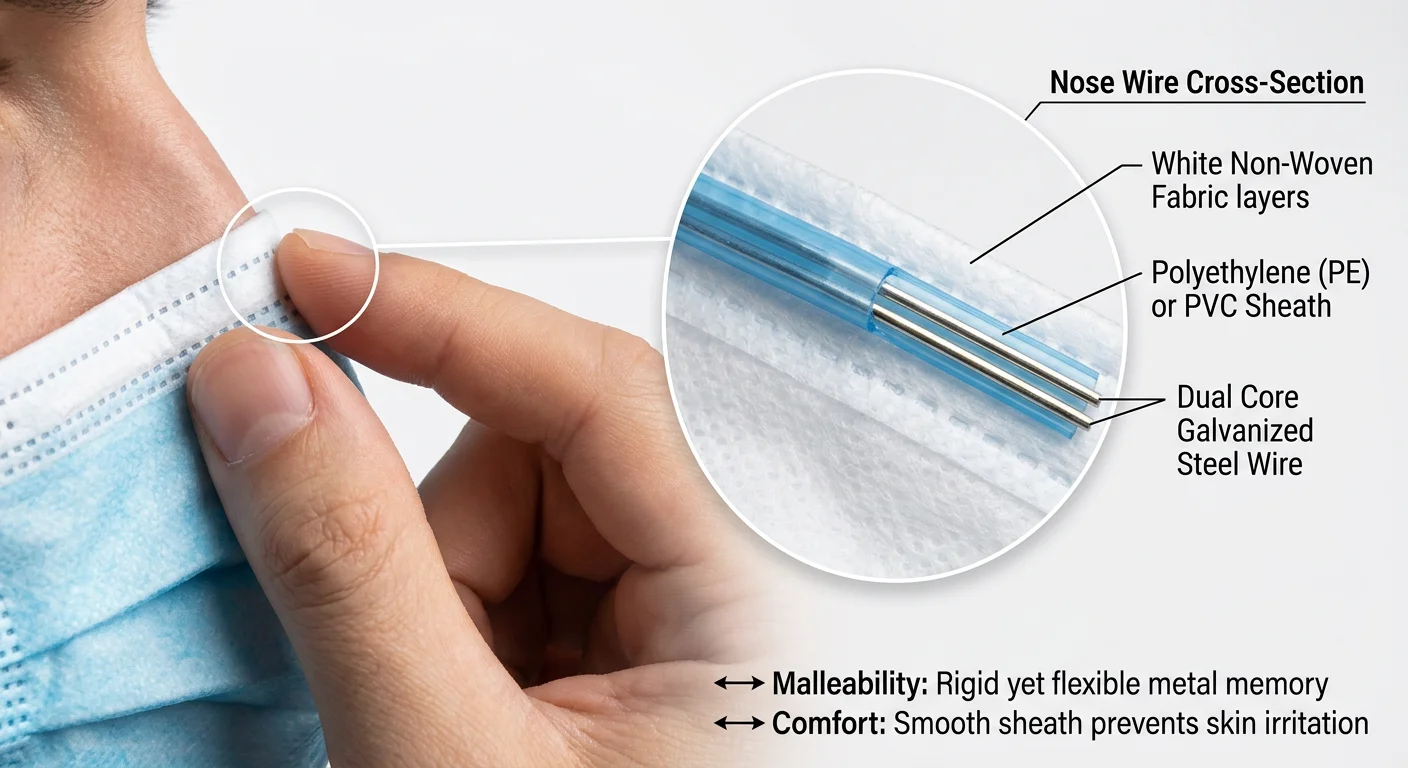 Take a close look at the top edge of any mask — that slim, bendable strip sewn into the fabric is doing more structural work than most people expect.
The Face Mask nose wire (also called a nose bridge wire or mask nose clip) is a short, shapeable strip — 80–100 mm long — built from a metal core wrapped in a plastic sheath. Press it down over your nose bridge, and it holds whatever shape you give it. Your mask goes from loose and leaky to a real, working seal. Respirator standards like N95 and FFP2 treat the nose wire as a critical component, not a minor detail. That makes sense: the nose-to-cheek gap is the biggest leakage point on most masks.
Here’s what a well-designed moldable nose wire controls:
- Seal: A fitted wire closes the gap where droplets enter, most right along the nose and cheek edges.
- Anti-fog: For glasses wearers, a snug metal nose wire mask cuts the upward airflow that fogs lenses within minutes.
- Stability: It holds the mask in place, spreading pressure across the face so the fit stays consistent through hours of wear.
Wire length matters too. Short wires that span only the bridge — not the full top edge — let the corners lift and leak. Longer wires run across the entire upper edge. This lets you press the mask into the cheek area, sealing side gaps that shorter designs can’t reach.
Material makes a big difference as well. Aluminium nose wire bends with minimal effort, holds its shape, and withstands repeated reshaping without losing its structure. Stainless steel runs slimmer and resists deformation better over time. Both beat the soft, weak metal found in cheap disposable masks — the kind that springs back the moment you release it.
Single-Core Face Mask Nose Wire: Structure, Strengths, and Limitations
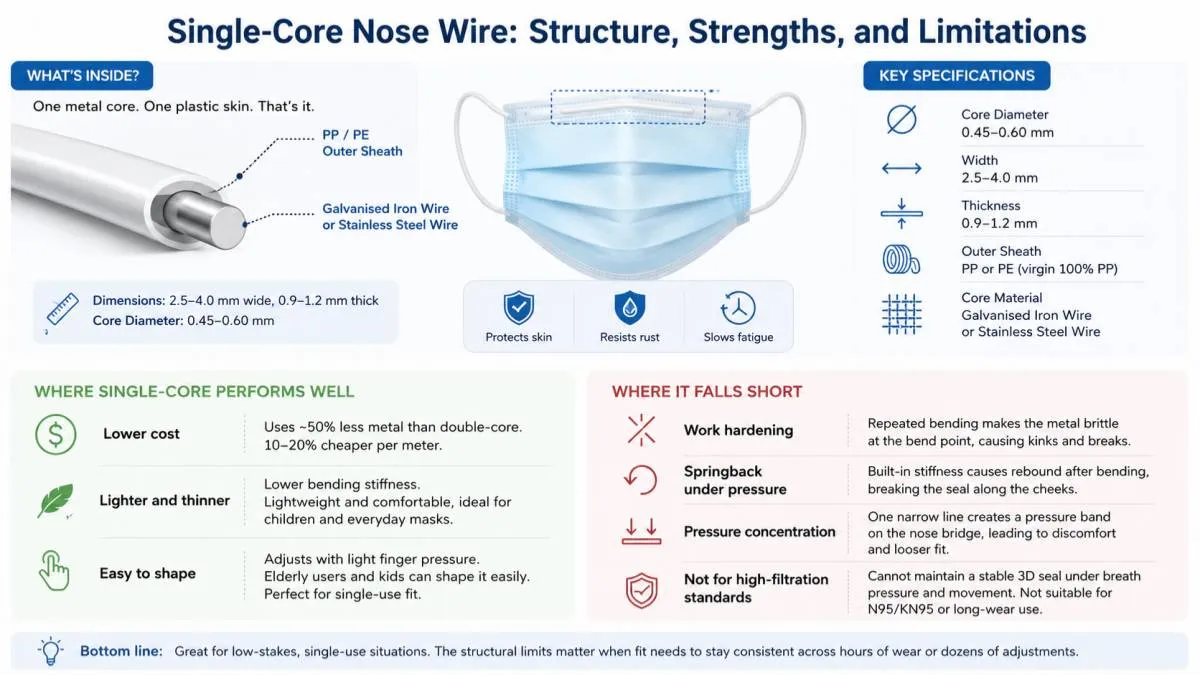 Strip away the fabric on a standard disposable mask, and you’ll find it: one metal filament, 0 . 45–0.60 mm in diameter, wrapped in white polypropylene. That’s the single-core nose wire. Simple by design. Effective enough — until it isn’t.
What’s Inside?
The construction is exactly what the name says. One metal core. One plastic skin. That’s it.
The metal is either galvanised iron wire or stainless steel wire. Each core gets wrapped in a PP or PE outer sheath — sometimes labelled “virgin 100% PP” to confirm no recycled material enters the coating. Total dimensions stay slim: 2.5–4.0 mm wide, 0.9–1.2 mm thick. Slim enough to sit inside lightweight mask fabric without adding bulk.
That plastic sheath does real work. It protects your skin from direct metal contact, slows metal fatigue, and stops the core from rusting in humid air. Without it, a galvanised iron core pressed against your face will oxidise over time.
Where Single-Core Performs Well?
The lean build has real advantages in the right context.
- Lower cost. One core uses about 50% less metal per unit than double-core designs. Per-meter pricing runs 10–20% cheaper — and that gap adds up fast at production scale.
- Lighter and thinner. Less metal means lower bending stiffness. The wire shapes with light finger pressure. Children’s masks and everyday lightweight masks benefit from this — the nose piece stays light and doesn’t stiffen the whole mask.
- Easy to shape. One or two gentle presses fit it to the nose bridge. Elderly users and kids can adjust it without difficulty. For single-use masks that need to fit just once, that’s all you need.
Where It Falls Short?
The same traits that make single-core wires light and easy to shape also make them weak under repeated bending.
Work hardening is the main problem. Each time you bend a solid metal wire, the crystal structure gets a bit stiffer. Bend it back. Stiffen again. After enough cycles, the metal turns brittle at the flex point and snaps. A single-core mask nose clip concentrates all that bending stress along one narrow line — there’s no width to spread it across. You end up with a sharp “V” crease that pushes the mask fabric away from your face and breaks the seal.
Springback under pressure. Single-core wires — galvanised iron in particular — carry enough built-in stiffness to bounce back after a sharp bend. Press hard over a high nose bridge, let go, and the wire eases back toward straight. That small rebound breaks the seal along your cheek edges.
Pressure concentration at contact points. One deformation line creates a narrow pressure band against your nose bridge. On the bony upper bridge, that focused load gets uncomfortable within an hour. Users respond by pressing less hard, and a loosely shaped adjustable nose wire stops doing its job.
Not built for high-filtration standards. N95 and KN95 masks need a stable 3D contour that holds up under breath pressure and head movement. A single-core wire — prone to springback, kinking, and fatigue — can’t hold that shape through a long shift. For mask leakage prevention in clinical or high-exposure settings, the fit tolerance is too tight for a single-core design to meet with any consistency.
For low-stakes, single-use situations — a quick errand, a child’s school day, a one-time disposable — single-core gets the job done. The structural limits only become real problems when fit needs to stay consistent across hours of wear or dozens of adjustments.
Double-Core Face Mask Nose Wire: Structure, Strengths, and Limitations
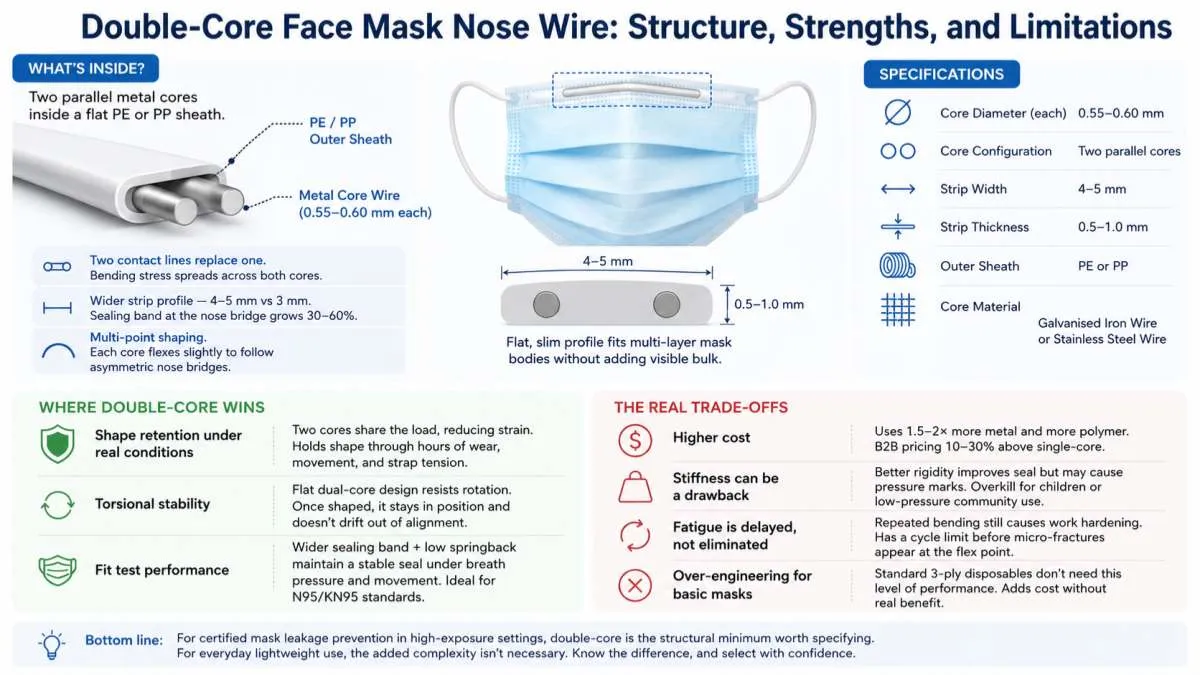 Two metal cores. That’s the whole structural secret behind why N95 and KN95 Masks seal tighter, hold longer, and survive repeated reshaping that destroys a standard disposable wire in a week.
What’s Inside?
A double-core nose wire runs two parallel metal filaments — each 0.55–0.60 mm in diameter — side by side inside a flat PE or PP sheath. They don’t twist. They don’t cross. They run straight, locked in place by the plastic jacket around them.
That geometry changes how bending works — in useful ways:
- Two contact lines replace one. Bending stress spreads across both cores instead of focusing on a single narrow point.
- Wider strip profile — 4–5 mm versus 3 mm for single-core — grows the sealing band at the nose bridge by 30–60%.
- Multi-point shaping becomes possible. Each core can flex a little on its own. So the strip conforms to asymmetric nose bridges that a single-hinge wire can’t track.
The strip stays flat and slim — 0.5–1.0 mm thick — so it fits into multi-layer mask bodies without adding visible bulk.
Where Double-Core Wins?
Shape retention under real conditions. Two cores share the load on every bend. Per-wire strain drops. The risk of sudden springback — or fatigue failure at a crease point — drops with it. Press a double-core adjustable nose wire into place, and it holds through hours of wear, strap tension, and jaw movement.
Torsional stability. A single round wire can rotate along its axis when the strap tension pulls unevenly. The dual-core flat design resists that rotation. Once shaped, the mask nose piece holds its position. It doesn’t drift back out of alignment between adjustments.
Fit test performance. N95 and KN95 masks require a contour that holds under breath pressure and head movement. The double-core’s wider sealing band and springback resistance give it the consistency that single-core designs struggle to maintain across a long shift.
The Real Trade-Offs
None of this comes free.
Cost runs higher. Double-core strips carry 1.5–2× the metal mass of a comparable single-core wire. Wider PE coating adds polymer use. B2B pricing runs 10–30% above single-core, depending on gauge and order volume — a gap that adds up fast at production scale.
Stiffness is a feature that can become a flaw. Greater rigidity is what makes the seal better. It’s also what leaves pressure marks on sensitive skin when straps are tight. For children’s masks or low-pressure community use, that rigidity is overkill. Manufacturers choose softer single-core or all-plastic designs for comfort-focused products instead.
Fatigue isn’t eliminated — just delayed. Each metal core is still a thin wire. Repeated bending at the same point causes work hardening over time. For single-use N95/KN95 masks, this doesn’t matter. For any extended reuse scenario, even a double-core metal nose wire mask has a cycle limit before micro-fractures develop at the flex point.
Over-engineering for basic masks. Standard 3-ply disposables don’t need double-core performance. The added stiffness and cost deliver no real benefit when the mask design itself doesn’t support a tight fit.
The right call depends on what the mask needs to do. For certified mask leakage prevention in high-exposure settings — clinical, industrial, high-particulate environments — double-core is the structural minimum worth specifying. For everyday lightweight use, the added complexity isn’t necessary. Know the difference, and you stop guessing and start selecting the right option.
Head-to-Head Comparison: Which Face Mask Nose Wire Should You Pick?
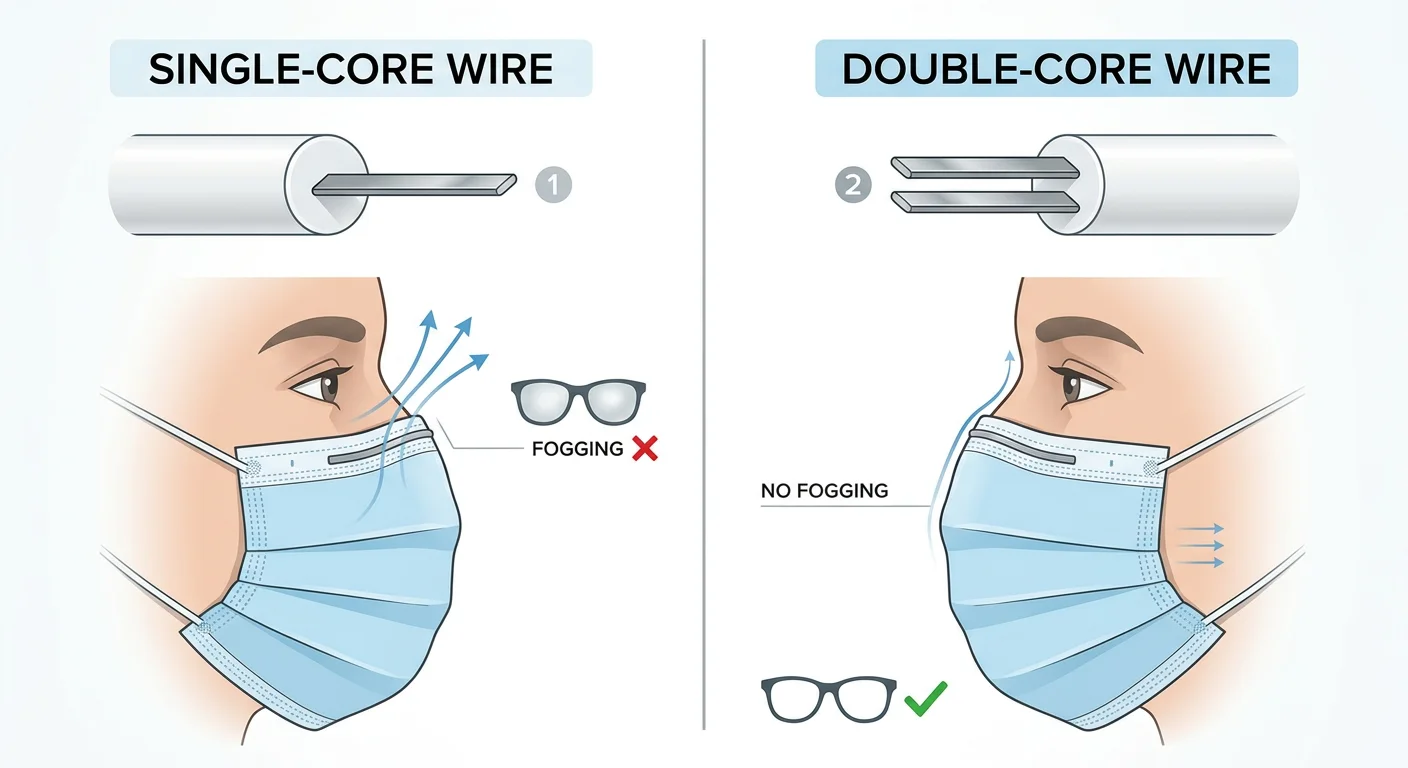 Let’s keep things simple. Here is what separates a great mask from a bad one. This also explains why your glasses keep fogging up.
| Performance Area | Single-Core Wire | Double-Core Wire |
|---|---|---|
| 1. Seal Quality | Good for quick trips. But it tends to spring back and leave small gaps. | Excellent. It holds its shape to stop air leaks. |
| 2. Durability | Constant bending snaps the metal. Good for basic disposables. | Strong and flexible. Reusable masks last much longer with this style. |
| 3. Comfort | The thin shape can pinch your nose. It might leave red marks. | A wider design spreads the pressure. This gives you a much better feel. |
| 4. Cost | Much cheaper to produce. Perfect for standard 3-ply masks. | Costs more. But it adds huge value for N95S or premium masks. |
1. Seal Performance (How well it stops air)
Bend a cheap wire. It always tries to pop back straight. Your breath escapes through that small gap. Then your glasses fog up. Double-core wires hold their bent shape. They mould right to your face and stay put. You get a true, secure seal every time.
2. Durability (How long it lasts)
Grab a throwaway mask just to run errands. A single-core wire does the job fine here. You toss the mask long before the wire breaks. Washable cloth masks need something stronger. Daily bending snaps a thin single strip. A double-wire design shares the bending stress. You can adjust the mask many times. It survives without breaking.
3. Comfort (How it feels on your face)
Nobody likes a painful red dent on their nose. A thin, single wire focuses all strap tightness on one tiny spot. Double-core wires have a wider build. They spread the pressure across your skin. Glasses wearers or workers on long shifts notice this right away. You feel a big boost in comfort.
4. Cost (What it means for your budget)
Double-core wires use more metal and plastic. They cost more to make. Standard disposable masks work best with cheaper single-core wires. This choice makes sound financial sense for basic use. High-end respirators like N95S need top-tier materials. The double-core option is an absolute must here. It guarantees safety and adds real value to the product.
Which Nose Wire Is Best For Different Masks?
Using the wrong nose wire wastes your money and ruins the mask’s protective seal. Match the wire to the specific job. Check this simple guide to pick the right one.
N95 / KN95 / FFP2: Always Use Double-Core
These masks must filter air with zero leaks. A 3–5 mm double-core metal wire gives you the tightest fit. It holds its shape well across your face. Plus, this option stops your glasses from fogging up.
Surgical & Medical Masks
Your choice depends on the location. High-risk settings like operating rooms need a tight seal. A wide aluminium or double-core wire works best here. A standard 3–4 mm single-core wire suits a regular doctor’s visit.
Everyday Disposable 3-Ply Masks
Keep your choice simple and low-cost. A standard 2.5–3 mm single-core wire works great for quick store trips or bus rides. Save your budget on masks you toss out in a few hours.
Masks For Children
Kids have sensitive skin. Comfort is your top priority. Pick a soft, short single-core wire. A width of 2.5–3 mm works best. Heavy or stiff double-core wires leave painful red marks on small faces.
DIY Masks & Glasses Wearers
Fixing foggy glasses or making your own masks requires the correct wire width. Pick a 3–4 mm wide wire. Add a thin piece of soft foam inside the mask edge. This foam layer blocks your hot breath.
Quick Wire Guide
| Mask Type | Best Wire | Size & Details |
|---|---|---|
| N95 / KN95 / FFP2 | Double-core metal | 3–5 mm wide, 85–95 mm long |
| Surgical / High-risk | Wide aluminum or double-core | ≥4 mm, foam seal optional |
| Normal medical | Single-core metal | 3–4 mm, 80–90 mm |
| Everyday 3-ply | Single-core | 2.5–3 mm, cheap & basic |
| Kids’ masks | Soft single-core | 2.5–3 mm, 60–80 mm long |
| DIY / Glasses | Wide aluminum or double | 3–4 mm + soft foam layer |
Common Face Mask Nose Wire Problems
Is a double-core nose wire better than a single-core?
It really depends on what you need. Honestly, a double-core is much better if you are wearing an N95 and need a perfect, tight seal. It just doesn’t lose its shape easily. But what if you only need a cheap 3-ply mask for a quick trip to the grocery store? A single-core wire works perfectly fine and costs a lot less.
Can a face mask nose wire be reused?
Not forever. Think about it: if you bend a metal wire back and forth enough times, it gets weak and breaks. A thin single-core wire might snap after just a few days of use. However, if you use a wider aluminium strip in a washable cloth mask, it can usually survive hundreds of adjustments before it finally gives out.
Does a wider nose wire improve mask fit?
Yes, absolutely. A super thin wire can poke into your skin, hurt your nose, and still leave awkward gaps. A wider wire spreads that pressure out so it doesn’t hurt. It feels much more comfortable, especially if you wear the mask all day. Plus, it hugs the flatter parts of your cheeks better, which stops air from leaking in.
Conclusion
The difference between a single-core and double-core face mask nose wire isn’t just a manufacturing detail. It’s the gap between a mask that seals and one that doesn’t.
Here’s the short version: single-core wires are lightweight, cost-effective, and good enough for everyday casual use. Double-core wires hold their shape, resist springback, and give you a reliable, contoured fit. That matters in medical settings, high-filtration masks, and for anyone tired of fogged-up glasses.
Know your use case. The right choice follows from that.
Sourcing components as a manufacturer? Or mid-project as a DIY maker? Use the checklist in this guide as your decision filter — not guesswork. Shopping for masks as a consumer? Look for adjustable nose wire callouts on product pages. That one detail tells you more about fit quality than almost anything else on the label.
Small component. High stakes. Pick the one that fits your needs.