
A small mistake in workwear can cause big problems. Dust, fibers, or skin particles may damage products without anyone noticing. This confusion leads many teams to compare cleanroom coveralls vs. standard protective clothing. This article explains the key differences, so you can choose the right protection for your environment.
Cleanroom Coveralls: Core Features and Contamination Control Technology
Cleanroom coveralls work as a barrier system. They trap particles your body releases—skin flakes, hair, bacteria. This stops contaminants before they reach your product or workspace. Standard protective gear does the opposite. It blocks outside hazards from reaching you.
Material Engineering for Particle Control
Microporous film laminates lead the disposable cleanroom wear market. Take the BioClean™ 2000 Model 111. It combines microporous polyethylene film with spun-bonded polypropylene (SBPP). You get a lightweight, breathable fabric. It blocks particle escape. It also allows water vapor to pass through. Workers stay comfortable during long shifts. Contamination control stays intact.
Stricter environments need tougher materials. ISO 4 (Class 10) to ISO 5 cleanrooms use spun-bound polypropylene with enhanced microporous layers. These materials achieve ultra-low linting. They pass Helmke Drum Test Category II standards. This test measures actual particle shedding under controlled conditions.
Reusable coveralls use a different method. Polyester/carbon grid-pattern fabrics provide static control for ISO 6–8 environments. These woven materials work more like filters than barriers. They handle repeated washing cycles. But they don’t block particles as well as disposables.
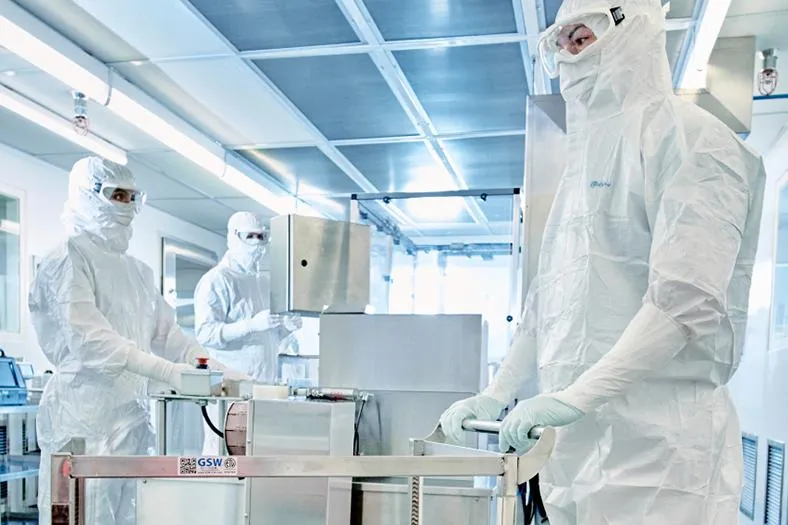
Design Features That Prevent Contamination
Every seam, closure, and opening can let contaminants through. Modern cleanroom coveralls fix these weak points:
- Bound seams create solid barriers. They repel liquid chemicals. They stop particle leakage at stitch lines.
- Integrated hoods and feet close gaps where regular protective wear meets gloves or boots.
- Thumb loops keep sleeves in place during movement. This prevents wrist exposure.
- Military-style collars with boot attachment snaps seal the neck and leg areas.
Zipper systems need careful design. Protective flaps with dust-blocking layers cover the zipper track. This stops particles from escaping through the gaps in the teeth. Standard protective clothing often fails here.
Elastic components (back panels, cuffs, ankles) create gentle pressure. This keeps a secure fit. Movement stays unrestricted. These adjustable zones fit different body types. The seal stays intact.
Sterility Protocols for Critical Environments
Pharmaceutical and biotech facilities need Sterility Assurance Level (SAL) 10⁻⁶. This means fewer than one live microorganism exists per million sterilized units. Gamma irradiation achieves this standard. Pre- sterilized disposable coveralls arrive ready for EU GMP Grade A/B environments.
The aseptic donning technique (Ansell fold method, compliant with EU GMP Annex 1 Section 7.13) keeps the sterile garment safe:
- Unfold the coverall without touching the outer surface
- Step into the garment. Keep it off the floor.
- Touch just the interior surface during the whole process.
This careful procedure keeps the coverall’s protection level from the package to the cleanroom.
Anti-Static Properties: Dual Protection
Electronics manufacturing and explosive areas need static control. Cleanroom coveralls use carbon fibers or conductive threads. These bleed off static buildup. This protects sensitive semiconductor wafers. It also prevents spark-ignition risks in chemical processing areas.
Standard protective clothing skips static control. This single gap disqualifies it from electronics cleanrooms. Many pharmaceutical operations reject it, too. Static discharge can damage products or ignite vapors.
Performance Validation Standards
Cleanroom coveralls carry certifications that standard protective wear skips:
ISO 14644 validates airborne particle containment through strict testing. Garments must prove they don’t add particles to the controlled environment.
CE PPE Category III Type 5/6 certification confirms protection against solid particles (Type 5) and limited liquid spray (Type 6). This dual rating makes one garment work for different contamination scenarios.
ISO 374 and ISO 13982 add chemical resistance and solid particle protection checks. Pharmaceutical compounding and hazardous material handling need these.
Disposable vs. Reusable: Contamination Control Trade-offs
Disposable cleanroom coveralls
(like BioClean™ 2000) offer total barriers. Their non-woven laminate construction stops particle penetration both ways. You get guaranteed sterility. No laundry validation issues. No long-term rental contracts. Each shift starts with fresh protection.
Reusable cleanroom coveralls (such as Uniform Technology™ lines) use woven polyester/carbon fabrics. These work more like high-grade filters. They perform well for ISO 6–8 cleanrooms. Total particle exclusion isn’t critical here. These garments need validated washing processes. But they cut per-use costs over time.
Your cleanroom classification drives the choice. ISO 4/5 environments (semiconductor fabs, sterile compounding) need disposables. ISO 6–8 spaces (general pharmaceutical manufacturing, some biotech labs) can use either. Cost models and contamination risk tolerance guide the decision.
Standard Protective Clothing: Hazard Protection and Built to Last
Standard protective clothing keeps workers safe from outside dangers. Chemical splashes, molten metal, sharp objects, pathogens—these garments block hazards before they touch skin. The protection works inward. This flips the cleanroom model.
Performance Testing Against Real Hazards
Testing recreates real workplace dangers. Standards check how well fabrics resist specific threats:
- Molten metal splash tests expose materials to liquid metal drops at extreme heat
- Liquid pesticide resistance checks if chemicals get through fabric layers
- Hypodermic needle puncture tests verify protection in medical settings
- Blood-borne pathogen barriers confirm fluid resistance for healthcare workers
Rules drive the market. The global work protective clothing sector hit $16.8 billion in 2024. Growth runs at 14.8% each year. Stricter safety rules worldwide push this growth.

Built to Last, Not Throw Away
Standard protective wear goes through many stress cycles. Single-use cleanroom coverall doesn’t. Heavy-duty materials handle washing, scraping, and chemical contact. Workers need garments that last months, not just shifts. You pay more upfront. But cost per use favors the tough stuff.
The British Safety Industry Federation (BSIF) tested PPE from December 2023 to December 2024. Results showed big quality gaps:
- 90% of non-member supplier products failed basic safety standards
- BSIF Registered Safety Suppliers hit 86% compliance
- Member companies fixed bad items fast
Poor protective clothing gives false safety. Workers think they’re protected. They’re not.
Usage Gaps That Kill
Protective clothing makes up 21.79% of the PPE market (2016), hit 23.65% by 2020, and settled at 22.74% by 2026. But having gear doesn’t mean you’re protected.
Worker actions show big problems:
- 59.4% use PPE often across industries
- 64% use it right —a 35.6% gap between having gear and using it right
- Bad or wrong PPE causes 34% of work accidents
Protective clothing usage shows low consistency:
| Frequency | Percentage |
|---|---|
| Always used | 37.82% |
| Often | 2.24% |
| Sometimes | 7.11% |
| Rarely | 25.64% |
| Never | 27.34% |
More than half skip protective clothing often. Compare this to harnesses (88.76% always used) or respirators (58.42%). Workers skip protective suits far more.
Real Results of Protection Failures
Accident records link injuries straight to missing or bad protective wear:
- Falls happen without harnesses in high-risk zones
- Chemical burns happen from gloves that lack proper ratings
- Breathing problems develop from skipping masks in hazardous areas
- Eye injuries hit 18,510 workers each year (1.7 cases per 10,000 full-time employees in 2020)
OSHA reports thousands of workers go blind each year from avoidable eye injuries. About 40% of work-related diseases and injuries could be stopped with correct PPE use.
Rules and Enforcement
United States (OSHA) requires protective clothing to meet American National Standards Institute (ANSI) specs. Employers must train workers and keep equipment in good shape. Breaking rules costs up to $70,000 per incident.
United Kingdom’s 2022 rules expanded PPE requirements to all workers, including casual and part-time employees. Companies need routine checks and records.
EU Regulation (EU) 2016/425 sets strict safety marks across member states. This makes protection standards the same for cross-border work.
These rules push makers toward better materials. They force employers to run training programs. But enforcement changes from place to place. The gap persists in many sectors.
ISO Cleanroom Classification vs General Protection Standards
Cleanroom classifications use strict numbers. General protective clothing ? No particle limits apply. ISO 14644-1 sets cleanroom classes by counting particles per cubic meter. Standard protective wear uses hazard-based ratings. These are two separate testing systems. They don’t overlap.
ISO Classification Numbers Explained
ISO cleanroom classes measure airborne particles at specific sizes. Lower numbers mean cleaner air:
- ISO 5 allows 3,520 particles (≥0.5 µm) per cubic meter
- ISO 7 permits 352,000 particles at the same size
- ISO 8 tolerates 3,520,000 particles
Your typical office holds over 1 million particles per cubic meter. Even ISO 8—the least strict cleanroom level—beats regular air by far.
The old FS209E standard (withdrawn in 2001) measured particles per cubic foot. ISO switched to metric units. It also added more classification levels. ISO 3 matches the old Class 1. ISO 8 equals Class 100,000. The pharmaceutical industry uses both terms for equipment specs.
EU GMP Grades Add Operational Context
European pharmaceutical rules create a dual-state system. Each grade has two classifications:
| EU Grade | At Rest | In Operation | Use Case |
|---|---|---|---|
| Grade A | ISO 5 | ISO 5 | Sterile filling, vial sealing |
| Grade B | ISO 5 | ISO 7 | Background to Grade A |
| Grade C | ISO 7 | ISO 8 | Solution preparation |
| Grade D | ISO 8 | Not defined | Component handling |
“At rest” means no workers, no equipment running. “In operation” means people move and machines work. Grade B jumps from ISO 5 to ISO 7 during active use. Your coveralls must handle both states. They can’t shed extra particles.
Standard protective clothing has no operational classification. Testing happens once. Static conditions apply. No one tracks particle generation.
Materials and Construction Technology Comparison
Fabric choice separates cleanroom coveralls from standard protective wear at the molecular level. These differences shape particle retention, durability, comfort, and cost-per-use across very different work settings.
Cleanroom-Specific Material Technologies
Standard PPE protects the wearer from hazards. But woven fabrics shed lint. This creates a mess for any cleanroom. Cleanroom coverall protects the product instead. We use specialized non-woven laminates or continuous-filament polyester. These materials trap skin flakes and bacteria inside the suit. Nothing drifts into the air.
Construction Methods That Control Contamination
Construction matters as much as the fabric. Standard gear uses sewn seams with needle holes. Think of them as particle escape routes. Cleanroom suits use ultrasonic welding instead. This creates air-tight seals. We even shield the zippers to prevent leaks.
Durability vs. Disposability Engineering
You also need to choose between disposables and reusables. Disposables give you a guaranteed sterile barrier every shift. Critical manufacturing demands this. Reusable items save money in less critical ISO 7/8 zones. But you must have a strict laundry process. Standard gear in a controlled room ensures contamination. It is a major error.
Contamination Control: Particle Containment vs User Protection
Cleanroom coveralls and standard protective clothing solve opposite problems. One keeps workers’ particles away from sensitive products. The other keeps dangerous substances away from workers. This difference determines which garment type you need.
The Human Contamination Challenge
People create 70% of all cleanroom particles. Equipment adds 15%. Workstations contribute 10%. Your workers—not your machines—create the biggest contamination threat.
Each person sheds 100,000 to 1 million particles per minute through normal movement. Skin flakes measure 0.5-10 microns. Hair fragments reach 40-50 microns. Dead skin cells carry bacterial colonies. A single uncovered sneeze releases 40,000 droplets.
Standard protective clothing doesn’t stop this outward particle flow. Cotton lab coats make the problem worse. They shed lint constantly. The fabric weave releases fibers with every arm movement.
Reducing human particle generation by 50% cuts pharmaceutical defect rates by up to 35%. Particle control links directly to product quality. Better containment means fewer rejected batches.
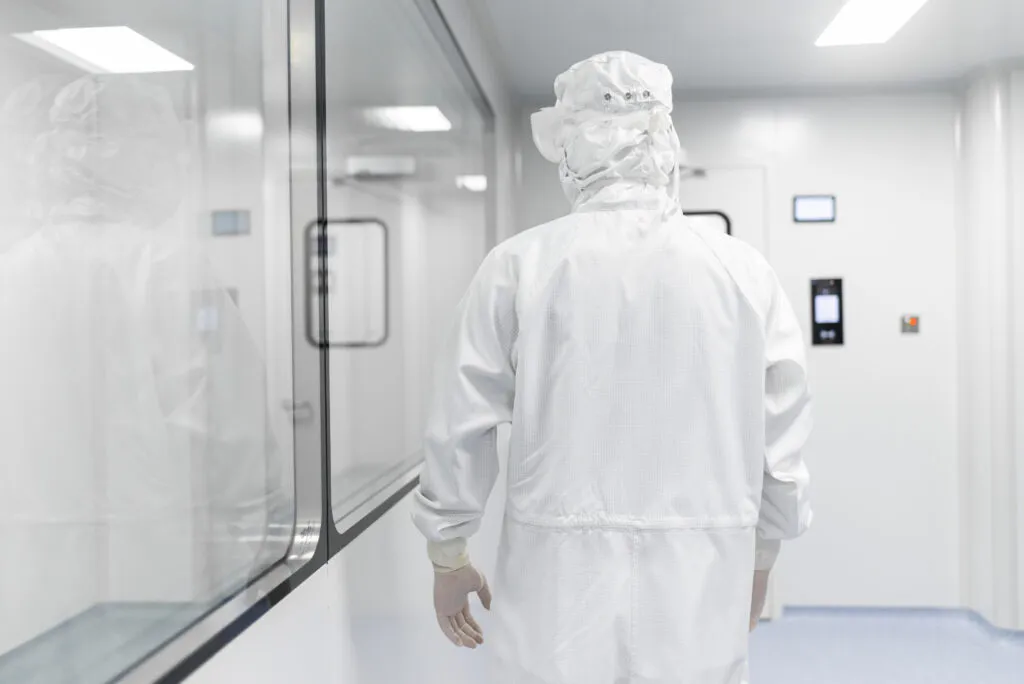
Filtration Performance Under Real Conditions
Cleanroom coverall fabrics achieve >99% retention efficiency for particles between 0.15-15 microns. This range captures most human-generated contaminants. Some designs let larger particles escape through closure points, seams, or material gaps.
ISO 7 cleanrooms limit airborne particles to 352,000 per cubic meter (≥0.5 μm). Just a few active workers without proper containment garments exceed this threshold. Standard protective suits offer zero filtration in this particle size range.
The difference shows up fast in optical particle counter (OPC) measurements. These devices operate at 50% counting efficiency at their sensitive sizing threshold. This balance between sensitivity and specificity reveals accurate particle distribution.
High OPC counting efficiency shows true contamination levels. Low efficiency underreports particle sizes. You misinterpret actual cleanliness. Your quality control decisions use bad data.
Industry-Specific Contamination Impacts
Semiconductor manufacturing faces extreme particle sensitivity. A single 0.5-micron particle destroys an entire chip. One contamination event costs millions in scrapped wafers. Cleanroom coveralls prevent this. Standard protective wear guarantees failure.
Industry-Specific Applications: Real-World Case Studies
Cleanroom garment needs change by sector. You must balance strict rules against your daily costs.
Pharmaceuticals: Sterility is Paramount
EU GMP Annex 1 demands Grade A/B protection for sterile work. A Boston biotech firm hit a wall here. Their reusable coveralls caused a contamination spike 340% above the limit. They switched to disposable SMS laminates with bound seams. This move cut particles by 94% and fixed their compliance issues.

Electronics: The ESD Factor
Semiconductor labs need two things: ISO 5 particle control and static dissipation. A Taiwan LCD manufacturer saw huge gains here. They dropped defect rates from 23% to 4.8%. The fix was swapping laundered suits for fresh microporous disposables. Laundered suits often shed fibers. The switch saves them $340,000 every quarter in yield protection.
Medical Devices: Cost vs. Risk
Making non-implantable devices? Validated reuse works well here. A Michigan facility tweaked its ISO 7 protocol. They moved to validated reusable systems. This kept quality standards high. Even better, it saved the company $156,000 over three years.
Food Processing: Pass Your Audit
Food safety worries less about ISO ratings. You need strong barriers against pathogens. A dairy processor focused on this after failing an audit. Cotton fibers were the problem. They switched to low-lint SMS disposables to fix it. This dropped particle counts by 89% and saved their contracts.
Manufacturing leads in using cleanroom coveralls. Different products need different particle control levels. Semiconductor fabs use ISO 5 environments. Pharmaceutical compounding needs sterile Grade A/B zones. Medical device makers work in ISO 7 spaces. Each sector has its own protocols.
Cost-Benefit Analysis: Disposable vs Reusable Economics
A $6 disposable cleanroom coverall suit looks like a bargain next to a $75 reusable one. But look past the sticker price. That number tricks you. You need the real facility economics. Count the hidden costs: disposal fees, laundry logistics, and strict validation rules.
Where Reusables Win: Reusable coveralls make smart financial sense in standard ISO 7/8 environments. They break even after just 6 to 15 washes. We’ve seen facilities, like semiconductor fabs, save over $730,000 in three years. They switched to a validated reusable program. Also, think about sustainability. You cut your carbon footprint significantly. This beats the waste from tossing thousands of single-use suits.
Where Disposables Win: Sterile Grade A/B manufacturing brings different challenges. Validating sterility for reusables gets expensive. You face $12,000+ upfront costs plus ongoing bioburden testing. Pre-sterilized disposables work better in these critical zones. You pay $15-28. This saves money and stops compliance headaches.
The Bottom Line: Look beyond the purchase price. Need absolute guaranteed sterility? Disposables offer a safer, cheaper path. But consider general contamination control in support zones. The reusable route fits your budget and helps the planet.
Compliance Certification and Audit Readiness Checklist
CE marks alone won’t do. Auditors want proof that your garments work in real operations. Missing docs cause delays and inspection failures. Follow these steps to keep your facility ready.
Essential Documentation
Inspectors usually ask for product records in the first 30 minutes. Make sure your files contain these:
- ISO 14644-1 Certificates: Shows you meet classification rules.
- Type 5/6 Data: Validates barrier performance for pharmaceutical grades.
- Helmke Drum Tests: Proof of particle shedding limits.
- Sterility Validation: Gamma irradiation records (SAL 10⁻⁶). Required for disposables.
- ESD Testing: Confirms surface resistivity (10⁶-10⁹ ohms/sq).
Operational Validation & Traceability
Certificates show capability. Records show reality. You need to validate gowning procedures (per EU GMP Annex 1) with written observation. Link environmental monitoring data to specific coverall lots. This spot material defects. Changing suppliers? Run formal change control protocols first. Track lots via POs (disposables) or barcodes (reusables). This helps you find contamination sources fast.
90-Day Audit Preparation Timeline
- 90 Days Out: Check certificate deadlines. Ask vendors for missing docs now.
- 60 Days Out: Check grooming habits. Retrain staff if adherence scores fall under 95%.
- 30 Days Out: Organize trend reports. Fix outliers and document the actions.
- 1 Week Out: Build final packages. Include current lot numbers and visual inspection records.
Common Myths About Cleanroom Coveralls – FAQ
Most procurement teams think all protective clothing works the same. This myth causes compliance failures, contamination events, and budget waste. Cleanroom coverall myths cost facilities thousands in mistakes that could be avoided.
“Any White Coverall Works for Cleanroom Use”
Wrong. Standard protective clothing sheds 10,000-50,000 particles per square meter during normal movement. ISO 7 cleanrooms allow just 352,000 particles per cubic meter total. Five workers in regular white coveralls ? They exceed room limits within 15 minutes.
Cleanroom-rated garments use continuous-filament polyester or microporous laminates. These materials generate fewer than 100 particles per garment under Helmke Drum testing. The fabric structure matters more than color.
“Reusable Coveralls Always Cost Less Long-Term”
This depends on your classification.
Sterile Grade A/B environments need validated autoclaving. They also need bioburden testing and particle counts every three months. Validation costs $12,000-28,000 per year. Disposables at $15-28 each often beat reusable economics in these spaces.
ISO 7-8 environments flip the math. Reusables break even after 6-15 uses. A 100-worker facility saves $76,500-112,000 per year versus disposables.
“Higher ISO Number Means Better Protection”
Think the opposite. ISO 5 (3,520 particles/m³) beats ISO 8 (3,520,000 particles/m³). Lower ISO numbers mean stricter particle control. Buyers get confused. They assume bigger numbers mean better performance.
“ESD and Particle Control Are the Same Thing”
These are separate needs.
Antistatic coveralls prevent static discharge (10⁶-10⁹ ohms/square resistivity). Lint-free garments stop particle shedding. Electronics manufacturing needs both properties in one garment. Pharmaceutical work? It doesn’t need ESD features in most cases.
Ordering ESD-rated suits for non-electronics cleanrooms wastes 15-25% of your budget. You’re paying for specs you don’t need.
Conclusion
Choosing the wrong workwear risks product loss, audit failure, and wasted cost. Cleanroom coveralls control human-generated particles, static, and sterility, while standard protective clothing focuses on worker safety from external hazards. Match garments to your ISO class and risk level. If you need customized cleanroom coveralls or protective solutions, contact us for a tailored quote and expert support.