

Choosing the right coveralls for your team can be overwhelming. You need protection without breaking the budget. Cordova Defender coveralls offer a cost-effective solution, but are they up to the task? Here’s what you need to know about their performance and how they fit your specific needs.
What Makes Cordova Defender Coveralls Stand Out in Industrial Protection?
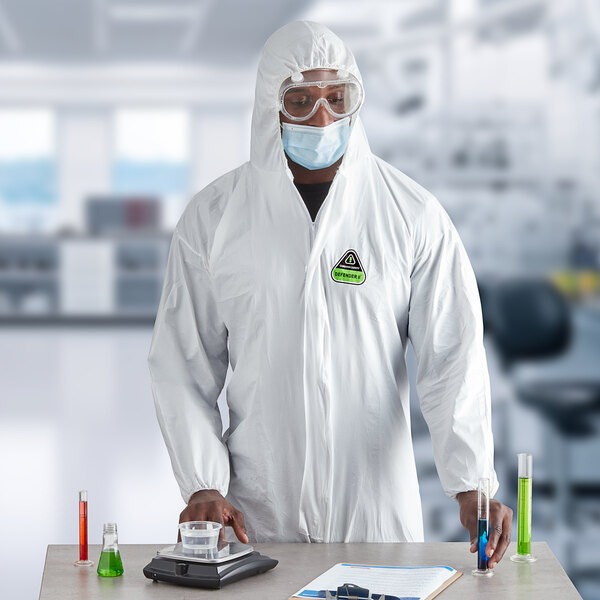
Cordova Defender Coveralls are crafted with advanced fabric technology that differentiates them from basic disposable coveralls. Their core material combines a microporous film with polyolefin nonwoven fabric, creating tiny pores that block liquid splashes and fine particles while allowing air and moisture vapor to escape. This design offers effective protection without the discomfort of non-breathable plastic.
Fabric Technology: Protection and Comfort in One
While most budget disposable coveralls use spunbond polypropylene, which only blocks larger particles, Cordova Defender Coveralls feature a microporous barrier that blocks both dry particles and light liquid splashes—common hazards in environments like painting, pharmaceutical labs, and maintenance.
Breathability is crucial during long shifts, especially in hot environments. Unlike traditional coveralls, Cordova Defender’s microporous structure allows body heat and sweat vapor to escape while maintaining liquid protection. This ensures comfort and productivity without heat stress.
Construction Built for Industrial Demands
Serged seams improve the durability and barrier strength of Cordova Defender Coveralls, ensuring superior joint integrity compared to basic stitched seams. This is vital for stress points like the shoulders, crotch, and underarms, which are areas where regular coveralls tend to fail.
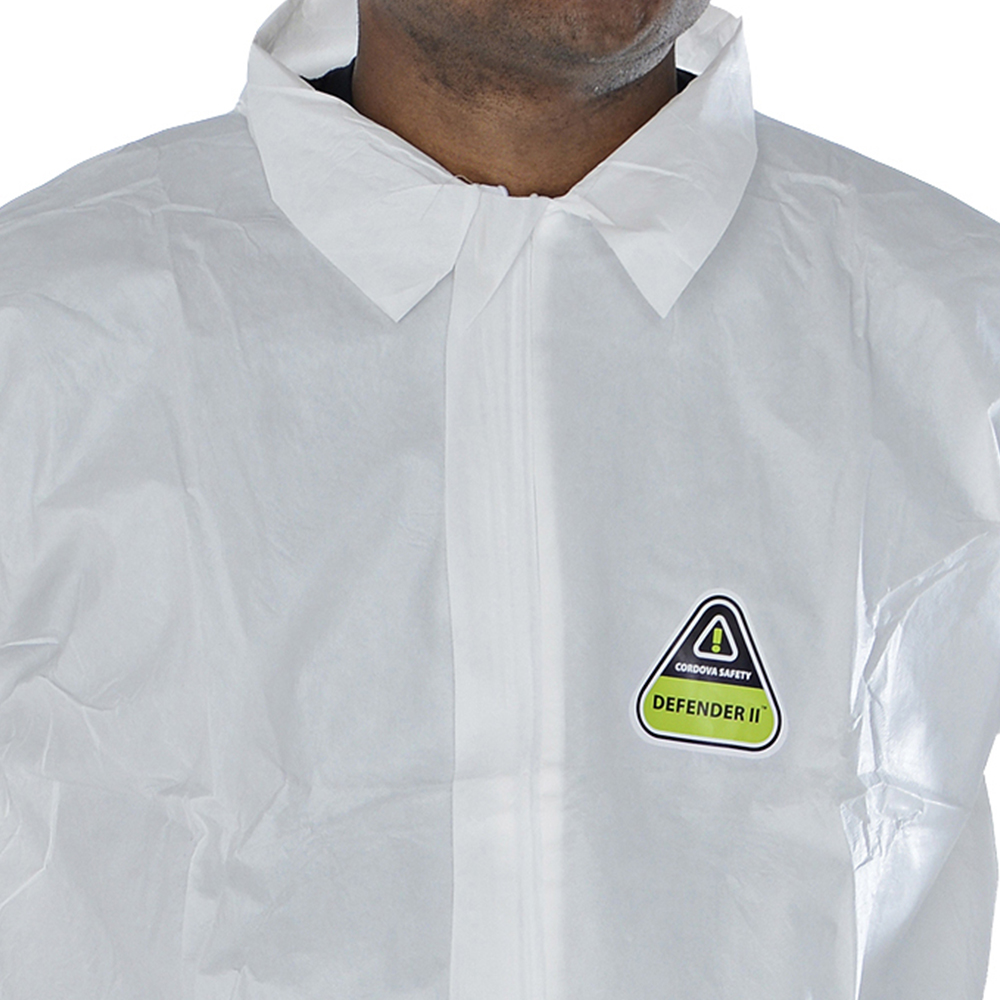
The full-length zipper, extending from the collar to the crotch, ensures complete coverage. Some models include a storm flap that blocks contaminants during spray operations or chemical handling.
Elastic features enhance functionality:
Elastic wrists and ankles : Prevent sleeves and legs from riding up during movement.
Elastic waist (MP100, MP300 models) : Offers a better fit and reduces billowing.
Elastic at the hood opening (MP300, MP400) : Ensures a secure face seal to minimize exposure.
Configurations Tailored to Specific Hazard Levels
Cordova offers four protection levels with the same microporous fabric, helping safety managers select the right coveralls for specific hazards :
Base Defender Model : Features a collar, zipper front, and elastic wrists/ankles. Ideal for general maintenance and light cleaning tasks, without head protection.
Defender II MP100 : Adds an elastic waist for a better fit, perfect for moderate contamination tasks like paint mixing and assembly areas.
Defender II MP300 : Includes an attached hood, plus elastic at the waist, wrists, and ankles. Suitable for pharmaceutical production, insulation removal, and mold cleanup where airborne particles pose a risk to the head and neck.
Defender II MP400 : Provides full-body protection with a hood, boots, and a storm flap. Recommended for high-risk environments such as asbestos work, chemical splash zones, and biohazard cleanup.
With sizes ranging from M to 5XL, Cordova Defender Coveralls offer a consistent fit across workers, making inventory management easier and ensuring effective protection.
Understanding the Cordova Defender Coveralls Product Line: CP, CPE, CPH, CPHB
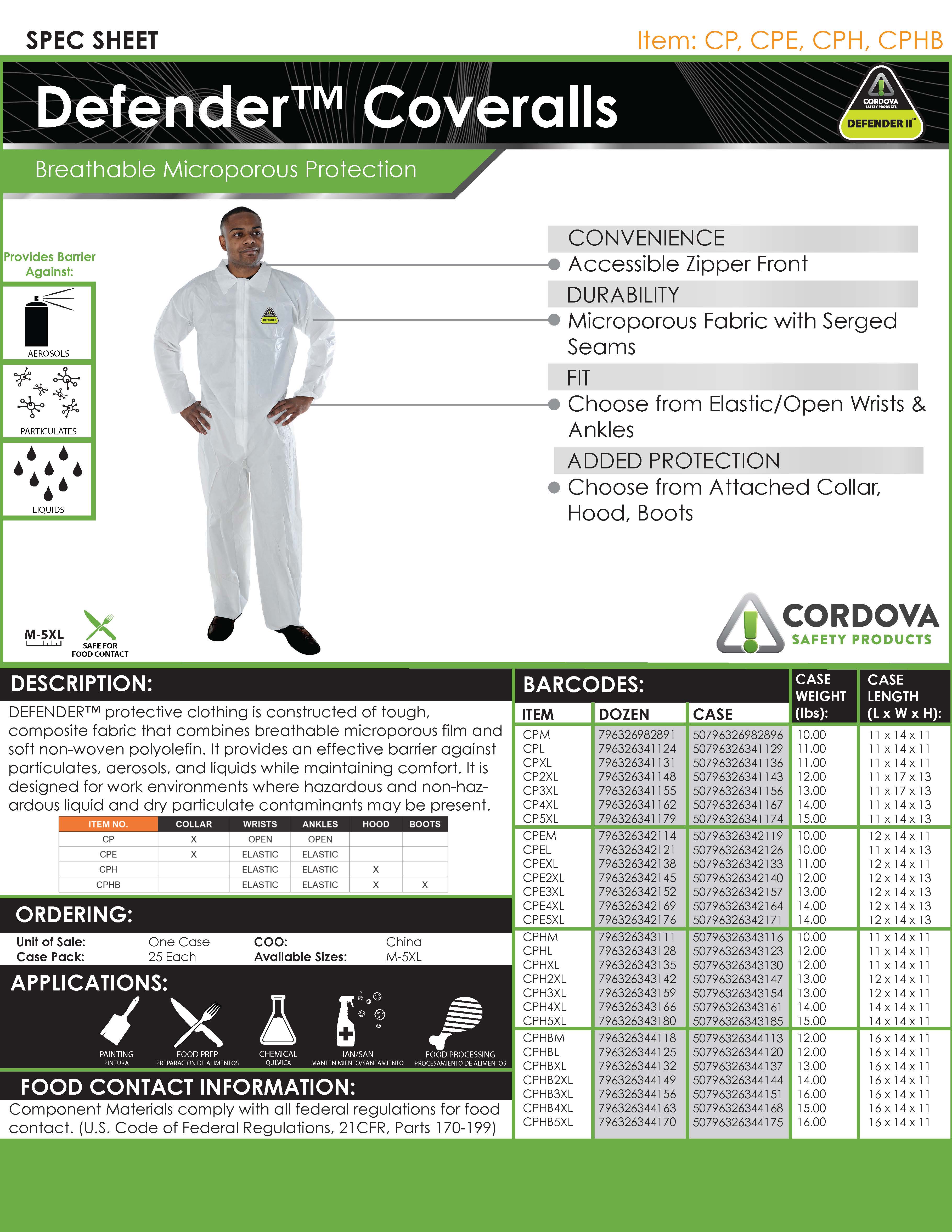
Cordova’s model naming can be confusing for first-time buyers. The letters CP, CPE, CPH, and CPHB represent two key factors: fabric type and coverage. Misunderstanding these details can lead to ordering hooded suits when basic coveralls for men are required, or vice versa.
The Defender line includes two fabric families. CPH and CPHB models feature premium microporous composite material, combining breathable microporous film with non-woven polyolefin. CPE models are made from 100% non-woven polyolefin, without the microporous layer. Both fabrics protect against liquid splashes and dry particles, but the microporous composite offers a stronger barrier, while polyolefin is lighter and more cost-effective.
Material Differences That Impact Protection
The microporous composite in CP, CPH, and CPHB models provides a physical barrier with tiny pores that block liquids and fine particles while allowing air and water vapor to pass through. This makes them ideal for industries like pharmaceuticals, asbestos removal, and chemical handling, where strong protection and comfort during long shifts are crucial.
CPE’s non-woven polyolefin structure blocks larger particles and light liquids but allows more airflow, improving breathability. It also offers anti-static properties certified to EN 1149 standards, making CPE coveralls ideal for electronics, powder coating, and food processing, where static discharge and dust are concerns.
Both fabric types comply with ANSI/ISEA 101-2014 sizing standards, with CPE also certified for food safety, making it suitable for meat plants, kitchens, and beverage bottling lines.
Configuration Codes Explained
The model codes indicate key features:
CP (Coverall Premium) : Base microporous coverall with collar, zipper front, serged seams, and elastic wrists/ankles. Ideal for paint mixing, light maintenance, and general contamination control without head or foot protection.
CPE (Coverall Polyolefin Economy) : Similar to CP, but with lighter, lower barrier-strength polyolefin fabric. Best for short tasks, dust protection, or environments where static control matters more than chemical resistance.
CPH (Coverall Premium with Hood) : Adds an attached hood with elastic at the opening for a secure fit. Ideal for insulation work, mold cleanup, and spray jobs where airborne contaminants may pose a risk to the head and neck.
CPHB (Coverall Premium with Hood and Boots) : Full-body hazmat coverall with boots and storm flap for complete protection. Essential for high-risk environments like asbestos removal and biohazard cleanup.
Matching Series to Work Environments
Light Industrial Tasks : CPE models are cost-effective, 30-40% cheaper than microporous alternatives. Their anti-static properties make them ideal for electronics and grain handling.
Medium-Hazard Jobs : CP and CPH models are best for automotive paint prep, pharmaceutical compounding, and agricultural chemical mixing. CPH's hood offers extra protection for overhead or spray work.
High-Contamination Zones : CPHB provides full-body protection with a hood and boots, necessary for asbestos removal, chemical splash zones, and high-risk environments. Emergency response teams often stock CPHB suits for handling unknown hazardous substances.
All Defender series share durable serged seams and consistent zipper designs, ensuring ease of use across models. The key difference is the level of barrier protection and body coverage required for specific tasks.
Cordova Defender Coveralls: Microporous Film vs. Tyvek vs. Polypropylene
Three main fabric types dominate the disposable coverall market, each offering unique protection, chemical resistance, durability, and comfort. Understanding these materials helps you choose the right protective gear for your environment.
How Each Material Creates Its Barrier
Microporous Film : A thin polypropylene film laminated to fabric layers, creating tiny pores that block liquids and fine particles while allowing air and moisture vapor to escape. Cordova Defender Coveralls use this film with SMS fabric (spunbond-meltblown-spunbond) for balanced protection and breathability.
Tyvek : Made from continuous polyethylene fibers bonded into a sheet through flash-spinning. This structure creates small openings that block liquids and particles, providing excellent durability and chemical resistance.
Polypropylene SMS : Comprised of three layers—two spunbond layers for strength and a meltblown middle layer to block larger particles and some liquids. However, this material offers the weakest protection of the three.
Protection Performance: The Rankings That Matter
Chemical Resistance : Tyvek outperforms both microporous film and SMS in chemical protection. Tyvek resists chemicals like 40% sodium hydroxide and 18% sulfuric acid for over 480 minutes, while microporous film fails much earlier. SMS allows chemicals to penetrate almost immediately due to its open structure.
Abrasion Resistance : Microporous film provides the best resistance to liquid pressure before wear, but degrades quickly after 10 abrasion cycles. Tyvek maintains its resistance even after heavy abrasion, making it more durable for rough handling or extended wear.
Mechanical Strength : Tyvek’s fiber structure is much stiffer than microporous film, offering superior tear and puncture resistance. SMS is the weakest in mechanical strength, with a much lower resistance to wear.
Breathability: The Comfort Trade-Off
Vapor Release : Breathability is crucial for long shifts. SMS provides the best moisture release, followed by Tyvek. While microporous film offers better protection, it traps more vapor, making it less breathable than Tyvek but more comfortable than SMS for longer shifts.
Airflow : Tyvek allows more air movement (27 nm⁻¹) compared to microporous film (111 nm⁻¹), which restricts airflow. While microporous film excels at blocking airborne particles, it can cause heat buildup during physically demanding tasks.
Particle Protection in Real Use
Particle Barrier : In practical use, Tyvek Type 5 suits show much lower particle infiltration compared to microporous film or SMS suits. The fiber network in Tyvek offers fewer pathways for contamination, making it the best option for environments requiring tight particle containment.
Linting : Tyvek’s bonded structure produces minimal lint, making it ideal for cleanrooms and pharmaceutical settings. Microporous film generates more lint as the layers bend, and SMS creates the most contamination from loose fibers, making it unsuitable for clean environments.
Conclusion: Which Material Is Best for Your Needs?
Tyvek provides the best overall protection, especially for environments with chemical hazards, high abrasion, or the need for particle containment. Microporous film suits like Cordova Defender offer a balanced approach between protection and breathability, making them versatile for moderate chemical or particulate exposure. SMS, while more affordable, is best for light tasks where comfort is prioritized over barrier strength.
Choosing the Right Cordova Defender Coveralls for Your Work Environment
Selecting the wrong coverall can lead to unnecessary expenses and safety violations. For example, a Type 6 coverall used during asbestos removal won’t meet OSHA standards, while a Type 3 coverall in a warehouse could lead to overheating. It's important to match the protection level with the hazards present to ensure safety and cost-efficiency.
Start with Hazard Identification
Begin by listing all substances workers encounter, including chemicals, dust, biological materials, and liquids. Pay attention to concentration levels— a 10% acid solution requires different protection compared to a 40% solution. Also, consider the physical state of the substance: liquid sprays require tighter barriers than settled dust.
Measure exposure intensity to choose the right suit. For example:
High-pressure chemical jets? Opt for Type 3 liquid-tight suits.
Light splashes from mixing chemicals? Type 6 splash protection is sufficient.
Airborne asbestos or silica dust? Choose Type 5 particulate barriers that meet ISO 13982-1 standards.
Map Hazards to Protection Standards
Each hazard requires specific certifications:
Solid airborne particles (e.g., asbestos, coal dust, fiberglass): Use Type 5 protection (ISO 13982-1). Cordova Defender CP and CPH models are suitable as they block fine particles while offering comfort.
Liquid chemical sprays : Choose Type 4 spray-tight or Type 3 liquid-tight suits. Ensure pesticide applications also have DIN 32781 certification.
Infectious agents (e.g., healthcare, crime scene cleanup): Look for EN 14126 biological protection. The CPHB series, with built-in boots, provides the necessary protection for such high-risk environments.
Light contamination (e.g., food processing, electronics assembly): Type 6 or basic polypropylene suits with EN 1149 anti-static properties are ideal. The CPE polyolefin line fits these needs.
Factor in Work Conditions
Task type impacts the coverage required. For overhead work, such as spray painting, a suit with an attached hood is necessary to protect the head and neck. For lower-risk tasks like floor grinding, basic coveralls without a hood are sufficient.
Consider the work intensity to ensure comfort. For physically demanding tasks, breathable safety coveralls are essential to prevent heat stress. Cordova Defender coveralls’ microporous film allows sweat vapor to escape while maintaining liquid and particulate protection, which is key for long shifts in hot conditions.
Also, evaluate mechanical stress points. Lightweight suits can tear when crawling through tight spaces or kneeling on rough surfaces. Cordova Defender coveralls use serged seams, which are more durable than basic lock-stitch seams, ensuring longevity at stress points like the knees, elbows, and crotch.
Validate and Test
Before purchasing, check technical data sheets to ensure the coveralls meet your hazard needs. Confirm certifications such as ANSI/ISEA 101-2014 for consistent sizing, and ensure European imports have CE marks, indicating compliance with PPE Regulation (EU) 2016/425.
Before placing bulk orders, conduct trial tests with your team. Workers can identify fit issues, mobility constraints, and heat buildup that technical specifications might not reveal. Use their feedback to adjust your selection, ensuring the coveralls offer the right balance of protection, comfort, and practicality.
Key Features of Cordova Defender Coveralls: Elastic Cuffs, Hoods, and Zippers
What separates professional-grade disposable protective coveralls from low-quality alternatives is their design features. Components like elastic cuffs, hoods, and zippers enhance both protection and comfort. Cordova Defender Coveralls prioritize these details for maximum efficiency in high-risk industrial environments.
Elastic Cuff Performance: The 30-70% Stretch Rule
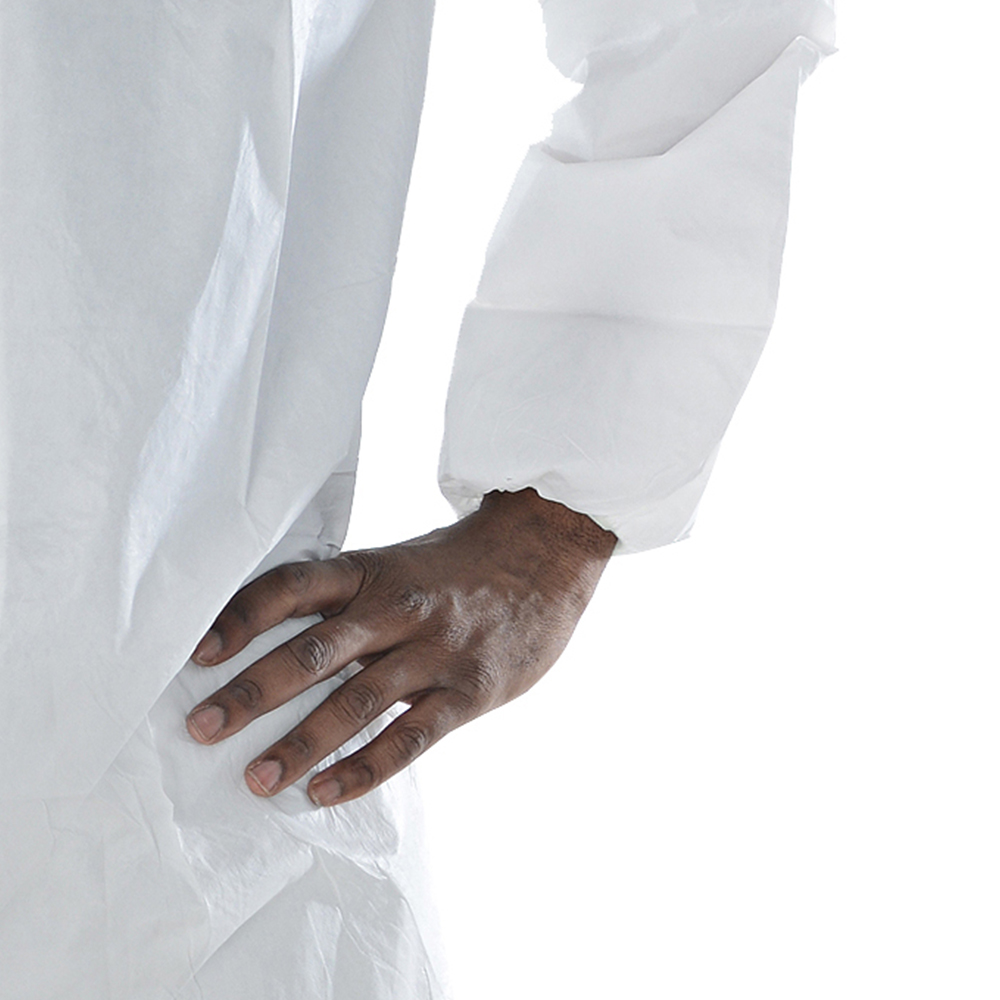
Cordova Defender Coveralls offer superior elastic cuffs compared to cheaper alternatives. High-quality elastic stretches 30-70% beyond its normal size, ensuring a secure fit over work gloves without restricting circulation. In contrast, low-grade elastic weakens quickly, creating gaps where fine particles and liquids can penetrate.
Cordova Defender strategically places elastic at key points:
Wrists: Seals around gloves to prevent contaminants during reaching or tool work.
Ankles: Prevents pant legs from riding up when kneeling or climbing.
Waist (MP100, MP300 models): Reduces billowing and prevents snags around machinery.
Hood openings (MP300, MP400 models): Provides a secure seal around the face for better protection.
The elastic is securely sewn into tunnels, ensuring it remains in place during movement, unlike exposed elastic, which may tear or shift.
Hood Design: Three-Piece Construction vs. Single Panel
Cordova's three-piece hood design offers superior fit, comfort, and functionality compared to the single-panel hoods found in budget suits. This design reduces fabric around the face, improving visibility and ensuring a better seal around respirator straps, which is essential for tasks requiring head protection.
Single-panel hoods tend to create gaps during bending or overhead work, allowing contaminants to reach the skin. The three-piece design minimizes these risks, providing a snug fit for:
Spray booth work, where clear vision is critical.
Pharmaceutical mixing, especially with respirators.
Insulation removal in tight spaces.
Tasks requiring head protection and face masks.
The MP400 model pairs the three-piece hood with built-in boots for full-body protection, ensuring no gaps between components.
Zipper Systems: Storm Flaps for Enhanced Protection
Cordova Defender Coveralls feature full-length zippers for quick donning and doffing. However, zippers can create weak points where contaminants may seep through, especially in spray environments. To mitigate this, the MP300 and MP400 models include storm flaps that cover the zipper track, adding an extra layer of protection against liquid penetration.
The storm flap runs the full length of the zipper, sewn on one side, and lies flat over the teeth to block contaminants. This is especially beneficial in high-exposure environments such as:
Paint spray jobs with heavy overspray.
Chemical mixing, where splashes hit the torso.
Agricultural spraying, which frequently soaks the coverall front.
Emergency response to chemical or unknown substance incidents.
Cordova also reinforces the zipper with extra fabric at the bottom to prevent blowouts during bending or squatting—common weak points in lower-quality coveralls. Models like the base Defender and MP100 are ideal for dry particle jobs but should be avoided in liquid splash zones. Always match the zipper system to your specific work hazards.
When Not to Choose Cordova Defender Coveralls: Key Limitations
Cordova Defender Coveralls offer reliable protection in many tasks, but they have clear limitations. Exceeding these limits could result in safety failures or compliance violations.

Sizing Issues and Safety Gaps
Cordova Defender sizing may not align with industry standards, particularly for larger workers. For example, a 130-pound, 5'6" woman found the Large size too tight. Tight coveralls can tear at seams during movement, creating gaps. Loose coveralls can snag on equipment or break seals under respirators.
Avoid Cordova Defender if:
Your workforce requires a consistent fit across brands.
Full mobility without restrictions is necessary.
Chemical exposure demands tight seal integrity.
You cannot test sizes before critical jobs.
Consider sizing up or opting for brands with ANSI/ISEA 101-2014 sizing compliance for a more consistent fit.
Chemical Exposure Limits
Cordova Defender suits offer protection against light splashes and particulates but are not suitable for high-hazard chemical environments. They fail against aggressive solvents such as sodium hydroxide, sulfuric acid, and petroleum products.
Avoid Cordova Defender for:
Chemical manufacturing or bulk mixing.
Hazmat responses or unknown spills.
Agricultural spraying with concentrated pesticides.
Drug compounding or tasks requiring EN 14605 protection.
Always consult the Safety Data Sheet (SDS) for chemical compatibility.
Wear and Tear at Stress Points
The microporous film in Defender Coveralls is breathable but not as abrasion-resistant as heavier fabrics. High-stress points like knees, elbows, and crotch may wear out quickly.
Avoid Cordova Defender for:
Demolition or insulation work with rough surfaces.
Mechanical repairs or construction cleanup.
Jobs requiring extended wear (over 8 hours).
For high-stress environments, consider reinforced or reusable coveralls .

Heat and Flame Hazards: Avoid Polyolefin-Based Fabrics
Cordova Defender uses polyolefin-based microporous film, which melts at low temperatures. This fabric is unsuitable for environments with heat or flame hazards.
Never wear Defender near:
Welding or cutting torches.
Molten metal splash zones or furnaces.
Open flames or arc flash zones require NFPA 70E protection.
For these environments, use flame-resistant (FR) garments.
Biological Hazard Barriers Need Medical-Grade Protection
Cordova Defender is designed for chemical and particulate protection, not biohazard or infectious disease control. The line lacks certifications for viral penetration or bloodborne pathogen resistance.
Avoid Defender for:
Healthcare isolation rooms or infectious disease work.
Biohazard cleanup (medical waste, sewage).
Laboratory work with BSL-2 or higher pathogens.
Tasks requiring EN 14126 biological protection.
For biohazard tasks, select medical-grade or biohazard-certified PPE.
Cordova Defender coveralls provide a cost-effective solution without compromising on safety. With advanced microporous fabric, they protect against liquids, particles, and dust, making them ideal for a range of industries. However, they’re not suitable for all environments, especially those involving high-hazard chemicals or extreme physical wear. Make the right choice based on your work needs. For customized solutions or pricing on our protective products, feel free to reach out to us today.