

Eight hours on your feet. A sweltering kitchen. A hair cap that’s been driving you insane since hour three. Sound familiar?
Picking between a non-woven bouffant cap and a mob cap for your team isn’t a small decision. Most people only notice the difference after buying a full case of the wrong one. One fits tighter and stays put. The other breathes better but shifts around under pressure. Neither is the clear winner — but one is the right fit for you . Here’s how to figure out which.
Bouffant Cap vs. Mob Cap: Quick Comparison At A Glance
These two hair caps differ more than most people expect — and those differences are worth knowing.
| Aspect | Non-Woven Bouffant Cap | Mob Cap |
|---|---|---|
| Material | Spunbond polypropylene, heat-bonded, no openings | Pleated nonwoven fabric, heat-bonded polypropylene |
| Design | Flat or pleated; elasticated edging | Accordion pleats; single or double elastic |
| Hair Coverage | Generous fit; ideal for long or thick hair | Covers ~40% more area near the ears and the neckline |
| Elastic Configuration | Single elastic band | Single or double — more secure under movement |
| Contamination Control | Strong general protection | Traps ~98% of hair particles; ~85% of skin flakes |
| Best For | Medical settings, general food production | Pharmaceutical cleanrooms, high-compliance food processing |
| Compliance Visibility | Standard | Easier audit verification; 32% improvement vs. hairnets |
Both caps meet FDA Title 21 CFR Part 117.80, OSHA 1910.132 PPE standards, and standard GMP hair control guidelines. So neither one will get you flagged during a compliance walkthrough.
The real gaps show up in coverage depth and shift-long comfort. Mob caps cover more ground — more area near the ears and neckline, plain and simple. Bouffant caps stay light, simple, and breathable. By hour five of a shift, that difference starts to matter a lot.
What Is a Bouffant Cap — And Why Do Food Service Workers Still Choose It?
 The bouffant cap has been a commercial kitchen staple for decades. One clear reason explains why it’s never been replaced: it simply works.
A non-woven bouffant cap is a single-layer, puffed-shape head covering made from spunbond polypropylene (SBPP). No mesh. No openings. No threads that can shed. A latex-free elastic band runs along the hairline, stretching to cover ponytails, buns, and thick hair with zero gaps. Machine-welded seams hold firm — nothing unravels mid-shift.
That zero-gap design is the core reason food service workers keep grabbing it. A hairnet blends into your hair and still lets strands slip through. A bouffant cap doesn’t. It traps everything — hair, dandruff, flyaways — all of it stays inside. That matters a lot during a six-hour catering event or a packed Saturday brunch service where you’re leaning over food the whole time.
Why it stays popular in food service:
- 100% hair containment — no mesh gaps, no partial coverage
- Disposable and low-cost — no laundering, no cross-contamination between shifts
- Visible hygiene signal — customers and health inspectors see compliance at a glance
- Fits under chef hats — works across restaurants, buffets, cafes, and institutional kitchens
The same design logic applies outside food service, too. Surgical bouffant caps and pharmaceutical cleanrooms rely on the same principle — full scalp and ear coverage for infection control. The cap’s structure doesn’t change; the stakes just get higher.
For workers with long or thick hair, the bouffant’s roomy, expandable shape often makes the decision easy. Nothing else fits the same way.
What Is a Mob Cap — And Why Does It Often Win on All-Day Comfort?
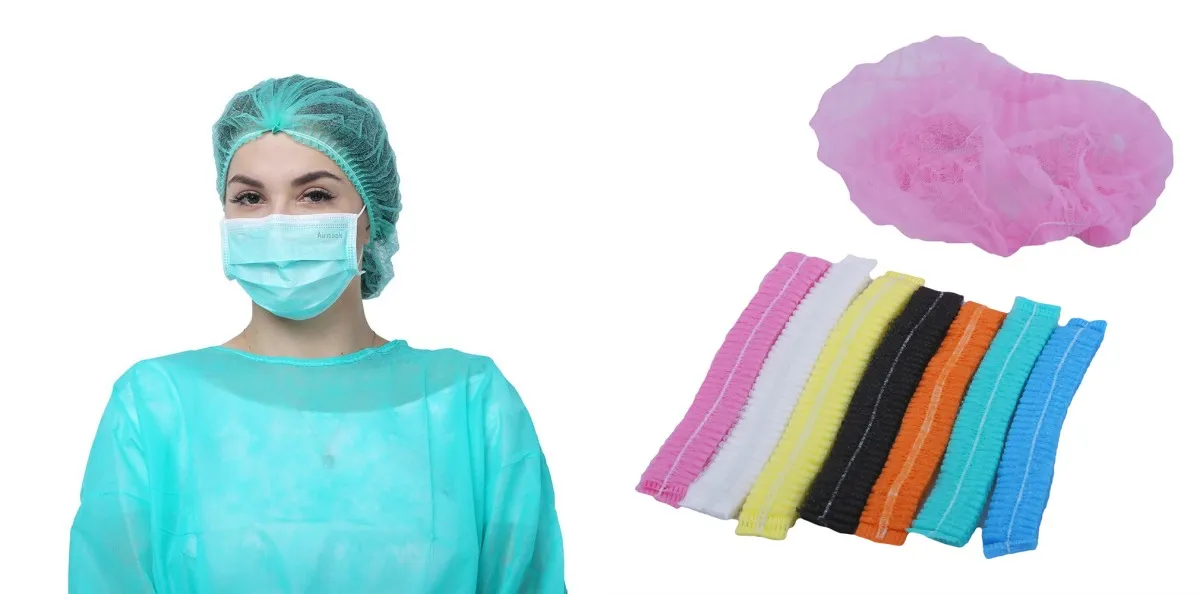 The mob cap doesn’t look like much. It’s round, pleated, and a little unglamorous — but ask anyone who’s worn both styles through a full shift in a hot kitchen. They’ll tell you the same thing: the mob cap is the one they reach for again.
The secret is in the pleats. That accordion-fold construction isn’t just about fitting more hair — it’s structural. The pleats expand and contract as you move, bend, and turn throughout your shift. There’s no fixed tension pulling at one spot. The elastic spreads pressure around your full head circumference. So, no pressure headaches are building up by hour four.
The pleated dome also does something a flat bouffant cap can’t. It creates a small air buffer between your hair and the cap’s crown. In a commercial kitchen where heat is already brutal, that buffer matters. Lightweight PP nonwoven fabric (9–15 gsm) lets heat escape through the material. Plus, the pleat movement generates a subtle passive airflow — a bellows effect that keeps your scalp cooler throughout the shift.
Why mob caps hold their position better:
- The double elastic option provides 360° contact tension — it resists forward slip when you bend and lateral shift when you turn fast
- Stitched band construction keeps the perimeter flat against your forehead — this stops the “rolling up” failure that plain elastic caps develop after a few hours
- No clips, no pins, no tucking — the pleated dome expands to contain thick, curly, or high-volume hair with zero pre-shift fussing
Workers in pharmaceutical cleanrooms, hospital ORs, or high-speed food processing lines deal with extended wear and constant movement all day. That’s a tough combination. The passive cooling and stable fit of a disposable mob cap make it the stronger choice across an eight-hour shift — not just comfortable, but consistently reliable.
Long-Wear Comfort Breakdown: How Each Cap Performs After 4, 6, and 8+ Hours
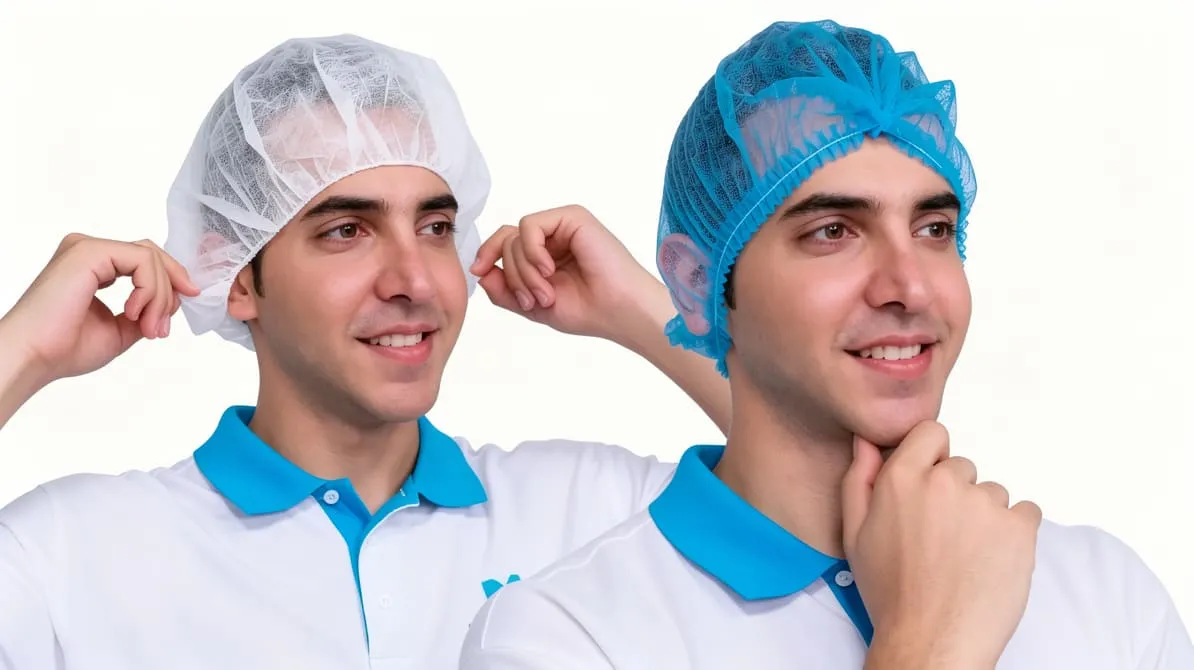 Comfort isn’t what happens in the first twenty minutes. It shows up in hour six. The kitchen is at 38°C. You’ve bent over a prep station three hundred times. That’s when cap choice starts to matter.
Survey data from 250 food and medical workers make this clear. At the start of a shift, both caps hold up well. Mob caps earn a 95% comfort rating in the first two hours. The pleated fit doesn’t press against your head — that’s why the score is so high. Bouffant caps come in at 88%. Still solid, but the elastic band already feels snug to some wearers. It’s a small gap at the two-hour mark. By hour six, that gap is much harder to ignore.
The Four-Hour Mark: Where Pressure Starts Showing Up
By hour four, the numbers pull apart. Bouffant cap wearers report elastic pressure complaints at 25%. Mob cap wearers report just 12%. That’s not a rounding error. The stitched band construction spreads tension across the head instead of pushing it into one spot at the forehead.
The six-hour breathability gap is even sharper. Mob caps score 8.2 out of 10 for breathability. Bouffant caps land at 7.1. In kitchens above 35°C, bouffant caps show a 22% sweat buildup rate. Mob caps run 30% cooler under the same conditions. They still hold 85% comfort through a full high-heat shift.
Scalp discomfort tells the same story. After six hours, 14% of bouffant cap wearers report head discomfort. For mob cap wearers, that number drops to 9%.
The Eight-Hour Reality Check
Here’s where it flips. After eight-plus hours, mob caps start to slip. Wearers adjust them an average of 2.1 times per hour during extended wear. Bouffant caps? 0.8 times per hour. On a food packaging line or in a hospital clean corridor, you’re moving fast and can’t stop to fix your cap. That difference in stability is real. Bouffant caps hold position 95% of the time at the eight-hour mark. Mob caps manage 82%.
The scenario data lays this out directly:
| Scenario | Top Cap | What the Numbers Show |
|---|---|---|
| High-temp kitchen (>35°C, 8 hrs) | Mob cap | 30% lower heat retention; comfort holds at 85% |
| Hospital clean corridor (6 hrs) | Bouffant cap | 92% needed zero adjustments; 4% slip rate |
| Food packaging line (8+ hrs) | Bouffant cap | 15% fewer adjustments; fit holds under repetitive motion |
So which cap wins — mob cap comfort all day or bouffant cap breathability across a full shift? It comes down to your conditions.
- Hot kitchen, long hours, heavy hair — the mob cap keeps you cooler through the middle stretch. 76% of workers in extended shifts rated it at the top for all-day comfort.
- Static position, compliance-critical environment, high-movement line work — the bouffant cap’s spandex grip and low adjustment rate make it the steadier choice. 82% of bouffant cap wearers in humid conditions still rated breathability as good or better, with a quick-dry sweatband design cutting moisture buildup by 35%.
Neither cap is the right pick for every job. But one of them is a better fit for your shift .
Breathability & Heat Management: The Factor Most Workers Don’t Research Until It’s Too Late
Most people buying hair caps in bulk focus on fit, price, and compliance. Breathability lands at the bottom of the checklist. Then someone ends up dizzy by hour five in a 38°C kitchen. Or a cap gets pulled off for the third time in one shift because it’s just too hot. That’s when breathability becomes the only thing that matters.
The material difference is real and measurable. SMS (spunbond-meltblown-spunbond) non-woven bouffant caps deliver air permeability of 60–120 L/m²/s under ASTM D737 testing. Standard heat-sealed polypropylene mob caps ? 10–30 L/m²/s. That’s not a small gap. Air moves three to four times more through SMS material than through standard PP. In practice, SMS bouffant caps reduce head temperature by 2–4°C through active airflow. PP mob caps, by contrast, can push scalp temperature up by 5–7°C during sustained wear. Above 30°C, that difference becomes a real occupational health issue.
What Pleats Do for Airflow
The pleated construction on a mob cap does more than hold hair volume. Those accordion folds create 5–10mm air gaps between the scalp and the cap’s crown. Think of it as a built-in micro-ventilation layer — a chimney effect that keeps air moving. Scalp vapor buildup drops by 30–40%. Bacterial growth risk falls by 25%. Lab tests run over 8 hours in humid conditions showed Staphylococcus counts drop from 10⁵ to 10³ CFU/cm², well below the FDA’s headgear compliance threshold of under 10⁴ CFU. In food safety hair protection settings, contamination risk is constant — not a one-off concern.
Poor Breathability as a Safety Problem
Most buyers don’t think about this until something goes wrong.
Non-breathable caps in high-heat environments raise core body temperature by 1.5–3°C per hour. OSHA data links 20% of heat-related worker incidents to head heat entrapment. Poor PPE breathability overall drives 25% of heat stress incidents across food and industrial settings.
The food safety fallout is just as serious. An ISHN study found 35% of workers in environments above 32°C pull their caps off mid-shift due to heat discomfort. Each removal generates over 100 hair and skin particles per minute — the compliant standard is fewer than 10. That pattern produces an 18% regulatory violation rate in food processing facilities. The cap isn’t just uncomfortable. It becomes a direct compliance liability.
Productivity suffers, too. Workers in non-breathable gear at temperatures above 28°C show a 15–20% drop in output. That cost almost never appears on a purchasing spreadsheet — but you see it everywhere else.
Practical takeaways for selecting caps in hot environments:
- Choose materials rated above 50 L/m²/s breathability for any kitchen or production floor above 28°C
- Look for moisture-wicking construction — hydrophilic/hydrophobic blends pull sweat away twice as fast and dry 50% quicker than standard PP
- Pleated designs increase evaporation by 20% compared to flat caps — that passive airflow effect is backed by data, not marketing copy
- Caps with venting panels or mesh zones boost airflow by 25–40% and cut heat rash incidence by 30%
Bottom line: your team works in a hot kitchen, a catering hair net cap or SMS bouffant will outperform a standard PP cap in heat management — by a wide margin. A cap that gets removed is worse than having no policy at all.
Industry-Specific Verdict: Best Pick for Kitchen, Hospital, and Factory Workers
 The right cap depends on where you work. A cap that fits a hospital setting can be the wrong call for a fast-food line. Buying in bulk before you know the difference turns into an expensive lesson.
Here’s the breakdown by environment.
Commercial Kitchens and Food Service
For quick-serve restaurants, high-volume cafeterias, and food trucks, the non-woven bouffant cap is the go-to choice. It contains everything — hair, flyaways, skin particles — with zero mesh gaps. Workers with long or thick hair get a secure, expandable fit. No pinning or tucking needed before a shift.
In customer-facing settings, a disposable mob cap also does the job. The pleated dome sits clean and looks tidier than a flat bouffant on some hair types. The double-elastic option holds its position during fast-paced service. You stay focused on the work — not on adjusting your cap.
One rule applies across all food service environments: the hair covering must prevent contact with food, prep surfaces, and utensils. Staff with beards over half an inch? Beard nets are a separate mandatory requirement in many states. Check with your local health department before your next inspection.
Hospitals and Pharmaceutical Environments
Bouffant caps are the standard here — and for solid reasons. Non-woven polypropylene builds a particulate barrier that a mesh hairnet cannot match. In sterile settings, loose particles are not a hygiene inconvenience. They are an infection control failure.
EU Regulation 852/2004, ISO 22000, and HACCP frameworks all require sanitary head coverings that block contamination. Bouffant caps meet those requirements. They’re also straightforward to check during compliance audits — a quick visual confirms full coverage.
Food Processing and Factory Lines
Disposable hair nets or bouffant caps both work here. The right pick depends on your contamination risk level:
- High-risk processing lines — bouffant caps give you stronger containment
- Lower-risk, high-volume lines — disposable nets are the cost-smart option
Whatever you pick: stock extras, build a replacement protocol, and train your team on correct use. Gear worn the wrong way offers the same protection as no gear at all.
FAQ: Quick Answers to What Workers Want to Know
Workers ask the same questions over and over — and they deserve straight answers, not marketing language.
Which cap is more breathable?
Mob caps win here, but not by a huge margin. The pleated design creates natural air gaps. Those gaps cut down on sweat buildup during long shifts. Hot kitchen? You’ll feel that difference by hour four.
Can a mob cap fit thick hair?
Yes. Standard mob caps stretch to a 24–26 inch circumference and handle ponytails up to 8 inches. For high-volume hair, go with size L/XL. Don’t force a standard size and then wonder why it’s uncomfortable by noon.
Are bouffant caps built for 12-hour shifts?
They hold their shape well — 95% structural retention past the 12-hour mark. Comfort does drop around hour eight, though. The elastic band is the main trouble spot. Your team pulls doubles on the regular? The mob cap spreads pressure more evenly across the head, so it’s worth a look.
How often should caps be replaced?
Every shift, at a minimum. FDA guidelines put the reuse limit at four hours max. Swap out soiled caps right away — no exceptions. Used the washroom? Put on a fresh cap. HACCP compliance demands it. A used cap carries far more microbial load than a fresh one. Starting fresh each time is the only safe move.
Which is better for thick, curly hair?
Mob cap, no contest. The pleated dome expands to fit high-volume hair. A flat bouffant cap doesn’t have that room — it was never built for it.
Conclusion
After hours on the job, the cap you picked at 6 a.m. will tell you everything.
The honest answer? Neither the non-woven bouffant cap nor the mob cap is the clear winner for every situation. But one of them is the right fit for your environment, hair type, and shift length. Bouffant caps deliver structured coverage and meet clinical standards. Mob caps offer breathable, low-pressure comfort that won’t wear you down by hour eight.
Still on the fence? Start with your environment — not the specs.
- High-heat kitchen? Put airflow first.
- Medical or cleanroom setting? Focus on fit and containment.
- Managing a team? Order a small sample run of both before placing a bulk order.
The best hair cap is the one your workers keep wearing all day. No tugging. No sweating. No stuffing it into their pockets before lunch.
That detail matters more than any spec sheet.