

You just received a shipment of nonwoven fabric — the supplier quoted 80 GSM, but something feels off. It’s lighter than expected, thinner than the last batch. Are you being shortchanged, or is it just your imagination?
Here’s the hard truth: without knowing how to verify nonwoven fabric weight yourself, you’re taking the supplier’s word for it. That’s a costly position to be in.
Procurement manager protecting your bottom line? Brand owner tightening up quality control? Consumer is trying to make sense of what you bought. Measuring GSM in nonwoven fabric doesn’t require a lab coat or expensive equipment. You just need the right method, applied the same way every time. Here’s how to do it.
What Is Nonwoven Fabric GSM (And Why It Matters for Buyers)
 GSM stands for grams per square meter — the weight of one square meter of nonwoven fabric, measured in grams. Not thickness. Not how it feels between your fingers. Weight.
The math is simple: a 1 m² piece of fabric weighing 80 grams = 80 GSM. That’s it. You can measure it on a scale. That makes GSM the standard quality benchmark across manufacturing specs, trade contracts, and international textile standards.
Why GSM Beats “Thickness” Every Time?
Here’s where buyers get tripped up. A fabric can feel thick and still be way underweight.
Nonwoven fabric manufacturers can change how non-woven fabric feels through heat-rolling, calendering pressure, and bonding treatments. All of these add stiffness — but no extra fiber. The result looks solid and feels firm. Yet the fiber density per square meter is lower than what was advertised.
GSM cuts through all of that. It shows you:
- Tensile and tear strength — how much load the fabric handles before it fails
- Barrier performance — filtration efficiency in PP spunbond nonwoven used for masks
- Durability — how many uses or stress cycles the material can survive in real conditions
Quick GSM Reference by Application
Not sure if a quoted GSM makes sense for your use case? Here’s a fast reference:
| GSM Range | Typical Applications |
|---|---|
| 10–20 gsm | Mask layers, face sheet, shoe covers , surgical drapes |
| 20–30 gsm | Surgical caps , mask filter layers, wet wipe base fabric |
| 30–50 gsm | Disposable gowns , light protective clothing, gift bag liners |
| 60–80 gsm | Standard reusable bags, reinforced surgical gowns |
| 80–100 gsm | Mainstream shopping bags (5–10 kg load), branded tote bags |
| 100–150 gsm | Heavy gift bags, furniture linings, reusable retail bags |
| 150 gsm+ | Geotextiles, agricultural ground cover, industrial-grade fabric |
A supplier quotes you 80 GSM for a lightweight promotional giveaway bag? That’s not generosity — that’s a signal worth investigating.
Tools You Need Before Testing Nonwoven Fabric Weight
The good news: you don’t need a lab to catch a GSM lie.
For most buyers, three basic items do the job:
- A digital scale with 0.01g precision
- A steel ruler (at least 30cm, with 1mm graduations)
- A sharp craft knife or scissors
Add a flat cutting surface and a calculator. That’s all you need.
One thing to watch on the scale: kitchen scales that read in whole grams won’t work here. You need resolution down to 0 . 01g to pull reliable numbers from a small sample. Before testing, check it against a known 100g weight. Acceptable home-testing error sits at ±0.02g.
Running a factory QC operation? Step up to a GSM circular cutter — 113mm diameter, cuts a fixed 100 cm² sample. Pair it with an analytical balance accurate to 0.001g. That setup meets ISO 9073-1 standards and gives you data you can defend.
No equipment at all? Cut a large sample — 50×200cm works well — and use a kitchen scale. Bigger samples reduce your margin of error. It’s not as precise, but it gets you close enough to spot a major discrepancy.
Method 1: The 1m² Direct Cut Method (Most Accurate for On-Site Verification)
Cut one square meter. Weigh it. The number on the scale is the GSM. No conversion. No formula. No room for supplier spin.
That’s the whole logic here — and it’s why experienced QC teams reach for this method at receiving docks when the stakes are high.
How to Cut Your Sample?
Start by pulling the fabric away from the roll edge. Move at least 15–20 cm inward before you mark anything. Selvedge edges hold weaving tension, sizing agents, and density shifts. These will throw off your result.
Mark your 1m² using one of these cutting combinations:
– 100 cm × 100 cm — the standard, easiest to verify
– 50 cm × 200 cm — useful for narrow rolls
– 80 cm × 125 cm — works when workspace is limited
Use a 90° L-square to confirm your corners are true right angles. A parallelogram cut looks like a rectangle — but it isn’t. That area gap will corrupt your reading. Once you’ve cut, re-measure both dimensions at least twice. Any edge that deviates more than ±3 mm means you need a fresh sample.
Weighing and Reading the Result
Place the sample flat on the scale pan — no folded corners, no air gaps. Take first. Wait for the display to stabilize, then record.
Repeat 2–3 times. Readings that vary by more than ±0.3 g? Check for air drafts or fabric bunching.
The final number is your GSM — no math needed. 186 g on the scale = 186 GSM. Compare it straight against your contract spec.
Where This Method Falls Short?
It’s not perfect for every situation:
- Narrow rolls under 90 cm wide can’t yield a standard 100×100 cm sample
- Finished goods can’t be cut without destroying the product
- High-value fabrics — technical materials, specialty blends — take a real financial hit. Three sample points on 300 GSM fabric at $8/kg adds up to $7.20 in material loss
- Confined spaces like container doorways make laying out 1m² a practical challenge
For bulk receiving inspections on industrial nonwoven, spunbond PP rolls, or heavy-duty reusable bags — where GSM is a contractual spec — this method gives you the most solid, representative result you can get without a lab.
Method 2: Small Rectangle Calculation (No Specialized Equipment Needed)
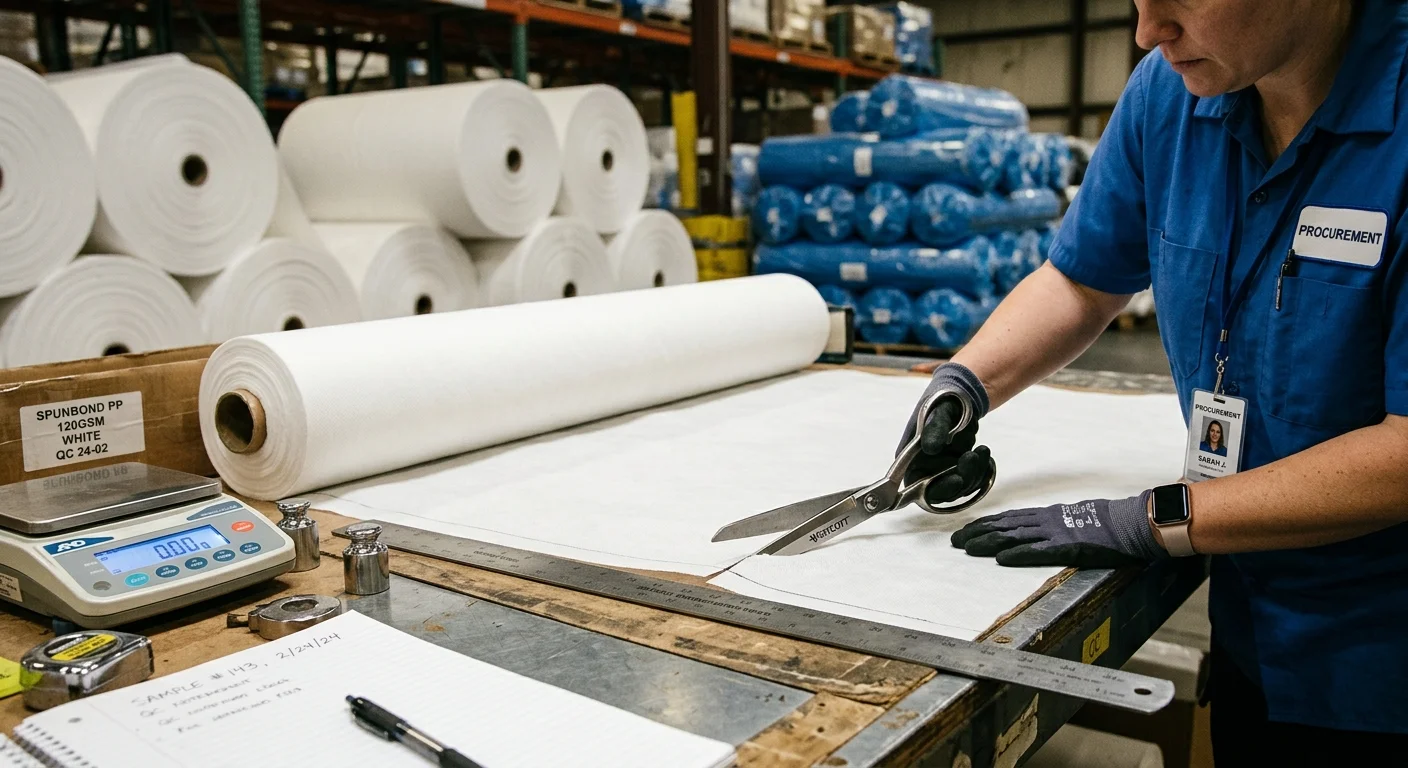 Scissors, a ruler, a scale. That’s the whole toolkit.
Cutting a full square meter isn’t always practical. Finished goods, narrow rolls, high-value materials — these all make it tricky. The small rectangle method gives you a reliable GSM reading without wasting much fabric. No lab equipment needed.
The Core Formula
The math here is simple:
GSM = Sample Weight (g) ÷ Sample Area (m²)
The trick is picking a sample size with a clean, easy multiplier. Here are three that work well in practice:
| Sample Size | Area | Formula |
|---|---|---|
| 20 cm × 25 cm | 0.050 m² | Weight (g) × 20 |
| 10 cm × 20 cm | 0.020 m² | Weight (g) × 50 |
| 10 cm × 10 cm | 0.010 m² | Weight (g) × 100 |
20 × 25 cm is the recommended default. The larger surface area softens the impact of fiber unevenness — those cloud-like density variations you’ll find in most spunbond nonwoven fabric . A 10 × 10 cm piece cuts fast, but small cutting errors get amplified fast, too.
Real numbers: cut a 20 × 25 cm sample and place it on the scale. It reads 4.8 g. Multiply by 20. You get 96 GSM. Done.
Step-by-Step
Step 1 — Gather your tools
– Steel ruler, minimum 30 cm
– Sharp scissors or rotary cutter with cutting mat
– 0.5mm pencil or fine-tip marker
– Digital scale with 0.01g precision (not a kitchen scale — a 1g-resolution scale introduces 20–30% error on a 4g sample)
Step 2 — Cut your sample
Stay 5–10 cm away from the fabric edge — selvedge zones have density shifts that skew your reading. Avoid visible stains, folds, or irregular patches.
Cut three samples from the same batch for better accuracy: one from the left side of the roll, one from the center, and one from the right. Average the results.
Want to keep cutting errors low? Make a 20 × 25 cm cardboard template and trace around it before cutting. Freehand cuts drift more than you’d expect.
Step 3 — Weigh each sample
Zero the scale first. Place the sample flat — no overlapping edges. Record to two decimal places (e.g., 4.83 g).
Step 4 — Calculate
Three-sample example:
- Sample weights: 4.80 g / 4.92 g / 4.88 g
- Individual GSM: 96.0 / 98.4 / 97.6 g/m²
- Average GSM: 97.3 g/m²
- Spread (max − min): 2.4 g/m² — a healthy, tight result
How Much Does a Cutting Mistake Cost You?
More than you might think. This matters most if your contract holds suppliers to a ±2% tolerance.
On a 20 × 25 cm sample cut from fabric with a true GSM of 160:
- A ±1mm cutting error → ~ ±0.4% GSM deviation — acceptable
- A ±5mm error → ~ ±2.0% GSM deviation — you’re at the edge of your tolerance now, and that’s before accounting for scale error or humidity
A 0.01g-precision scale keeps weighing error under 0.25% for a 4g sample. Cutting is where most mistakes happen. That’s why the cardboard template is worth the extra two minutes.
Method 3: 10cm × 10cm Quick Swatch Test (Home Use & Consumer Check)
No scale room. No GSM cutter. No lab access. Just scissors, a ruler, and a cheap digital scale — that’s all you need to spot a 30% GSM shortfall hiding inside a “premium eco bag.”
The math is dead simple. A 10cm × 10cm square equals 1/100th of a square meter. Weigh it, multiply by 100, and you have your GSM.
GSM = Sample Weight (g) × 100
How to Run the Test?
Cut your swatch. Pick a flat, crease-free spot — away from seams, handles, and edges. Mark 10.0 × 10.0 cm with care. A ±0.5 cm error throws your result off by ±10%. That’s the difference between catching a cheat and missing one.
Weigh it. Use a 0.01g-precision scale. A 0.1g kitchen scale adds ±10% error on a typical 1g swatch — that makes it useless for lightweight materials. Got thin fabrics under 30 GSM? Stack three identical swatches. Weigh them together, then divide by three.
Calculate. Swatch weighs 0.9g? That’s 90 GSM.
What Your Number Really Means?
| Result vs. Claimed | Interpretation |
|---|---|
| Within ±10–15% | Normal production variance |
| 20–30% below claimed | Reasonable suspicion of short-weighting |
| >30% below claimed | Strong evidence of misrepresentation |
A bag marketed at 80 GSM that tests at 50–55 GSM isn’t a measurement quirk. That’s a real problem worth escalating.
This method won’t hold up in a legal dispute. But it will tell you one clear thing — does that “eco-friendly shopping bag” deserve a second order?
Method 4: GSM Circular Cutter + Precision Balance (Factory & Lab Standard)
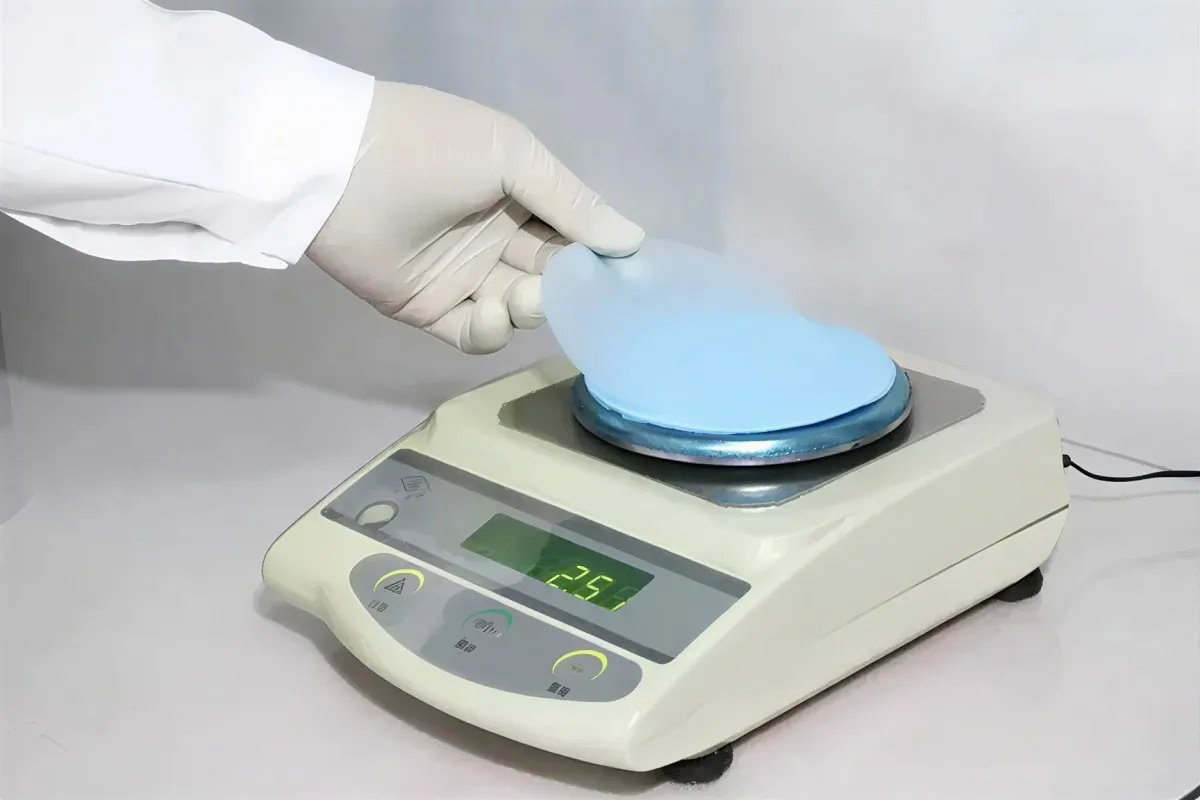 Disputed shipment? This is the method that settles it.
The GSM circular cutter is built around one fact: a fixed area removes the biggest source of human error. The standard cutter head — 113 mm in diameter — punches a perfect 100 cm² circle every single time. No ruler drift. No parallelogram corners. Fixed geometry, fixed result. The sample is always 1/100th of a square meter. So the formula collapses into one step:
GSM = Sample Weight (g) × 100
Weigh a circle at 1.30 g, you have 130 GSM. No conversion table needed.
The Standard Operating Procedure
Step 1 — Condition your samples first.
Lay the fabric in a controlled environment: 21 ± 2°C, 65 ± 5% RH, for at least 4.5–6 hours. This is not fussiness. Humidity shifts fiber moisture content. That shifts your reading — sometimes by 1–3% before you even touch the cutter. ISO 3801 requires it. Skip it, and your data becomes incomparable to anyone else’s.
Step 2 — Cut clean circles.
Spread the conditioned fabric flat on a cutting mat — no folds, no creases. Press the cutter down with even vertical pressure, rotate the full way around, then lift. The circle should have clean edges. Ragged cuts create area variance. Area variance produces bad data.
Step 3 — Weigh on a calibrated precision balance.
Use a balance with 0.001g resolution. Check it each day against a known reference weight. ISO 3801 specifies ±0.2% mass accuracy. Record each sample to three decimal places.
Step 4 — Run 5–10 points, not one.
Pull samples from the head, middle, and tail of the roll — left, center, and right across the width. Avoid the first 5 cm from any edge. Calculate the average. A CV% above 3–5% signals a fabric uniformity problem. Flag it now, before it turns into a customer complaint.
Why This Method Has Legal Weight?
ISO 3801, ASTM D3776 , BS 2471 — these are not just quality guidelines. A supply contract that references a specific test standard means the results carry contractual force. A well-documented Method 4 report — covering sample distribution, conditioning conditions, equipment calibration records, and multi-point averages — holds up in arbitration. The other methods in this guide help you spot problems. This one lets you prove them.
How to Sample Correctly: 5 Rules That Affect Your Results
Bad sampling ruins good measurements. You can own a precision balance and a calibrated GSM cutter — and still walk away with wrong numbers. The method is only as reliable as the sample feeding into it.
These five rules determine whether your GSM reading reflects reality.
Rule 1: Sample across the full roll, not just the middle.
Pull from at least three width positions — left, center, right — and three length positions: head, middle, tail. That gives you nine points minimum. On rolls wider than 1.8m or longer than 100m, push that to 15 points (5 width × 3 length). Nonwoven fabric density is never uniform across the roll. A single center-cut sample tells you what the middle weighs. It does not tell you what you are buying.
Rule 2: Avoid selvage edges, fold lines, and damaged zones.
Stay at least 2–5 cm in from any edge. Move 5 cm clear of any fold, crease, or visible defect. Edges carry density distortions. Fold lines compress fiber. Damaged zones add measurement noise that has nothing to do with the fabric’s true weight.
Rule 3: Cut more samples than you feel necessary.
For GSM and tensile data, aim for at least 5–10 points per batch. Fabric with visible uniformity problems — inconsistent texture, color variation, uneven surface — needs double that. Larger sample counts reduce your standard error. Going from 4 samples to 16 cuts your measurement uncertainty in half.
Rule 4: Keep your cutting tools sharp and your surface flat.
A dull blade creates ragged edges that shave 1–3mm off your sample — that’s a 2–3% area error before the scale even turns on. Replace blades every 200–300 cuts, or when edges look rough. A hard, flat cutting mat keeps cuts true. An uneven surface warps the sample shape. No formula can fix that after the fact.
Rule 5: Average your results — and drop the outliers.
Calculate each point on its own, then average across all points. Any single reading that deviates more than 20% from the group — and comes from an edge zone or crease area — mark it invalid and resample. Clean data beats large data.
How to Compare Your Test Result Against Supplier Specifications?
You’ve run the test. You have a number. Now what?
A raw GSM result next to a supplier spec sheet means nothing on its own. Put both in the same structure. Do the math. Then you have something to work with.
Build a Comparison Table for Every Shipment
Five columns. One row per spec item. No ambiguity.
| Item | Supplier Spec | Your Test Result | Deviation | Pass / Fail |
|---|---|---|---|---|
| GSM | 80 g/m² (±5%) | 74.8 g/m² | −6.5% | Fail |
The deviation calculation is simple:
Deviation % = (Test Result − Nominal Value) ÷ Nominal Value × 100
Run that number. Does it land inside the contracted tolerance? For nonwoven fabric GSM , the range is ±3–5% . Yes — the shipment passes. No, you have a documented nonconformance. Not a feeling. Not a suspicion. A number.
Know Where the Industry Tolerance Lines Are
Most nonwoven fabric contracts set ±5% GSM tolerance as the acceptance threshold. An 80 gsm spec covers fabric that tests anywhere from 76–84 gsm. Below 76? Nonconforming. No debate needed.
Here’s a real example. Supplier spec is 100 gsm ±5%. Your 10-sample average comes back at 92 gsm. That’s −8% — 3 percentage points outside tolerance. One line in the comparison table makes the case for you.
Turn Your Data Into a Conversation That Goes Somewhere
Escalating to the supplier? Lead with structure, not frustration.
- Cite the contract spec : “Per our agreed specification, GSM is 80 g/m² with ±5% tolerance — acceptance range 76–84 g/m².”
- State your method : “Testing performed per ISO 3801. Measurement system %R&R = 8%, confirming test reliability.”
- Present the data : “n=30 samples. Average: 74.8 gsm. Range: 72.5–77.1 gsm. Deviation: −6.5%.”
- Give them options : reshipment, price adjustment, or supervised regrading — with a response deadline attached.
Drop “your quality is bad.” Use “deviation is −6.5%, exceeding tolerance by 1.5 percentage points” instead. That one swap changes the whole conversation. Numbers are hard to argue with.
FAQ: Common Questions When Verifying Nonwoven Fabric Weight
 Real-world testing raises questions that step-by-step methods don’t cover. Here are the most common ones.
Q: No precision scale available. Can I still get a rough GSM reading?
Yes. Cut a 10 × 10 cm swatch and weigh it on any scale with at least 0.1g resolution. Multiply by 100. A 0.75g swatch = 75 GSM. No special equipment needed.
No scale at all? Use light and touch as a rough guide: – Under 20 GSM — close to translucent, distorts with light hand pressure – 30–40 GSM — typical disposable surgical caps and single-use bed sheets – 50–70 GSM — standard shopping bags; holds shape but still lets light through – 80–100 GSM — thick reusable bags; opaque, resists deformation under load
Q: Is higher GSM always better?
No. GSM measures weight per square meter — nothing else. A meltblown mask filter with too-high GSM creates dangerous breathing resistance. A disposable bed sheet at 80 GSM wastes material with no functional benefit.
Good nonwoven fabric quality control targets the lowest GSM that still passes your performance requirements. Then verify it with tensile, air permeability, and uniformity tests alongside the weight check.
Q: Why does 70 GSM feel so different across two suppliers?
There are three reasons: fiber fineness, bonding process, and uniform distribution. Finer fibers produce a denser, softer feel at the same weight. Thermal point bonding and spunlace are different bonding methods. Each one produces different loft and stiffness.
Specifying spunbond nonwoven GSM in a purchase contract? Add these alongside the weight figure:
– Cross-direction CV% ≤ 10%
– MD tensile strength ≥ X N/5cm
A GSM number on its own leaves too much room for interpretation.
Q: How do buyers and suppliers avoid measurement disputes?
Agree on the method before the order ships. No lab needed. Cut three 10 × 10 cm samples from the same roll. Weigh each one. Average the results. Do this with both parties on a video call, watching the process.
For bulk receiving, pull samples from the head, middle, and tail of each roll. Standard acceptance range: ±5% of nominal, or ±2 GSM — whichever is wider.
Q: In B2B negotiation, what contract language protects you?
One clause does most of the work: “If the batch average GSM falls below 90% of the labeled specification, the buyer reserves the right to request a proportional price adjustment or return the shipment.”
Before signing, request the supplier’s basis weight test report. It should include sample count, sample dimensions, and test conditions. A supplier who can’t produce that document is one worth reconsidering.
Conclusion
Verifying nonwoven fabric weight isn’t complicated. You just need the right method and a bit of discipline. Cutting a full square meter on the warehouse floor works. So does a quick 10×10cm swatch test at home. Either way, the math doesn’t lie. GSM measurement is your strongest defense against mislabeled materials and inflated specs.
You now have four tested methods, a sampling framework, and a GSM reference chart to work with. That’s real leverage in any supplier conversation.
Here’s what matters most: don’t wait until after a large order to verify. Test at multiple points across the roll. Document everything. Do it before you commit.
Evaluating suppliers right now? Explore our nonwoven fabric product pages — every spec is listed, and we welcome third-party verification. A supplier confident in their GSM has nothing to hide.