

Sourcing PP non woven fabric from China without a reliable shortlist is a blind gamble. You spend weeks chasing quotes. Then you find out the “factory” you’ve been emailing is a trading company with no production capacity at all.
This guide cuts through that noise.
We evaluated dozens of Chinese manufacturers, looking at product range, certifications, export history, and real buyer feedback. Based on that research, we put together the definitive Top 6 PP nonwoven fabric manufacturers worth your attention in 2026. The list covers everything from high-volume spunbond non woven fabric manufacturers to specialized medical and agricultural suppliers.
Placing your first container order? Expanding an existing supply chain? Either way, what follows saves you real time, real money, and a lot of sourcing headaches.
PP Non Woven Fabric Applications: Which Industries Drive China’s Export Demand
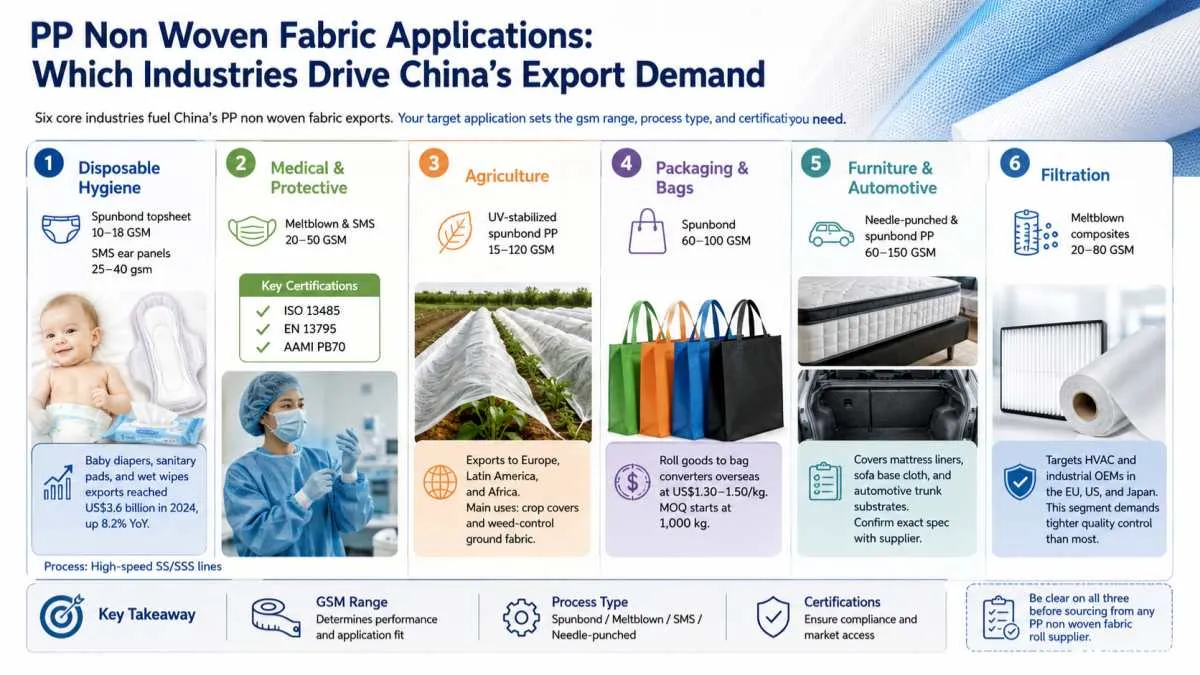 Six core industries fuel China’s PP non-woven fabric exports. Know which one fits your sourcing need. It changes how you pick and judge suppliers.
Here’s the breakdown:
- Disposable Hygiene — This is the single largest driver. Baby diapers, sanitary pads, and wet wipes alone generated US$3.6 billion in Chinese exports in 2024. That’s up 8.2% year-over-year. Spunbond topsheet runs 10–18 GSM. SMS ear panels hit 25–40 gsm. China’s high-speed SS/SSS lines lead this segment worldwide.
- Medical & Protective — surgical masks, gowns, and drapes need meltblown and SMS non-woven fabric . Look for 20–50 gsm specs. Key certifications include ISO 13485, EN 13795, and AAMI PB70. Make sure your supplier can meet all three.
- Agriculture — UV-stabilized spunbond PP rolls range from 15–120 gsm. They ship to Europe, Latin America, and Africa. Main uses are crop covers and weed-control ground fabric.
- Packaging & Bags — Reusable PP shopping bags use 60–100 gsm spunbond. Roll goods go to bag converters overseas at US$1.30–1.50/kg. MOQ starts at 1 , 000 kg.
- Furniture & Automotive — Needle-punched and spunbond PP at 60–150 gsm covers mattress liners, sofa base cloth, and automotive trunk substrates. It’s a broad gsm range, so confirm the exact spec with your supplier upfront.
- Filtration — High-value meltblown composites run 20–80 gsm. They target HVAC and industrial OEMs in the EU, US, and Japan. This segment demands tighter quality control than most.
Your target application sets the gsm range, process type, and certifications you need. Be clear on all three before sourcing from any polypropylene fabric roll supplier.
#1 Rayson Non Woven Fabric Co., Ltd.
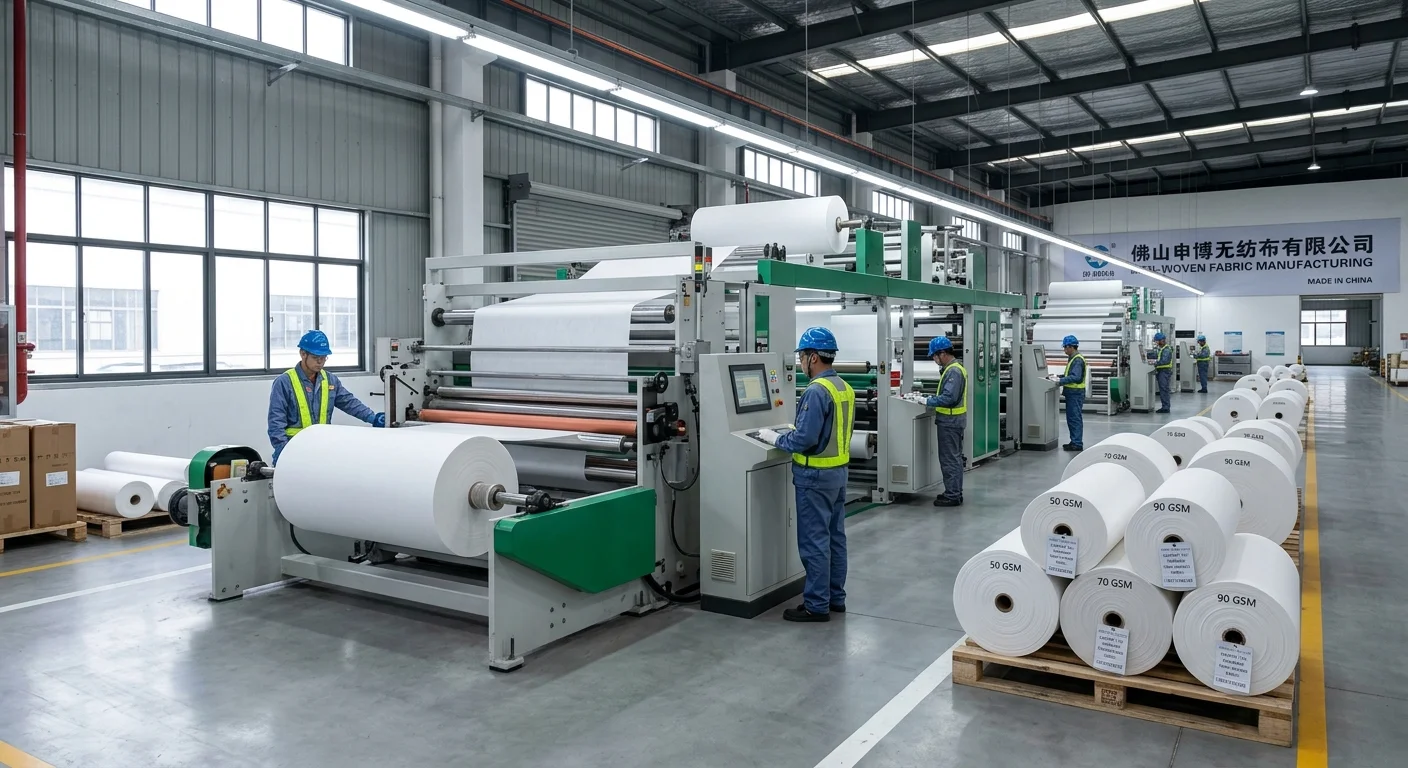 Rayson has been running production lines in Foshan since 2005. That’s two decades of spunbond manufacturing — long before most buyers had Guangdong on their radar.
The numbers speak for themselves. Six PP spunbond lines. Monthly output of 1,300–1,800 metric tons. Width capability up to 3.2 meters. GSM ranges from 9 to 150, with specialty runs pushing to 200 gsm. You get a production footprint large enough to handle both trial orders and full container programs without any issues.
This is also a Sino-US joint venture — not a pure domestic operation. That structure gives you a real advantage. Negotiating terms is smoother. Quality expectations are easier to align. Export documentation flows better with Western counterparts involved on the other side.
What they produce:
- PP Spunbond & SS nonwoven — the core business, covering hygiene, medical, furniture, and agricultural applications
- Furniture & mattress fabric — Serta, Sealy, Kingkoil, and Slumberland all source from the Rayson group; the nonwoven division feeds straight into that supply chain
- Agricultural cover fabric — 17–120 gsm weed control and crop protection rolls in black, white, and green
- Nonwoven bags — 100,000 die-cut bags per day production capacity, with full OEM printing
MOQ starts around 500 kg for standard colors and common GSM specs. Custom colors or niche weights require 1,000 kg. Their export ratio sits at 80–90%. Shipments go through Foshan, Guangzhou, and Shenzhen ports, reaching Europe, North America, Australia, and the Middle East.
Ask for their ISO 9001 certificate and SGS test reports upfront. Both are standard qualification documents for any serious spunbond non woven fabric manufacturer at this scale. Don’t skip this step.
#2 Suzhou Minghuiyuan Technology Co., Ltd.
Not every PP non woven fabric manufacturer on this list runs a high-volume spunbond rollgoods factory. Minghuiyuan fills a different niche — and for the right buyer, that’s the point.
Located in Suzhou’s Wuzhong District, this company works as a specialized OEM converter, not a raw fabric producer. Their production lines run at Class 10–Class 1000 cleanroom standards. That puts them at the high-value end: semiconductor, LED, PCB, and medical device manufacturing environments where particle counts and static control are non-negotiable.
What they make:
- Cleanroom wipers & rolls — woodpulp + PP spunlace composite, 40–68 gsm; polyester knit versions at 90–120 gsm; formats include cut sheets (4″×4″ to 9″×9″) and rolls up to 250 m
- Cleanroom paper — 60–150 gsm, particle release ≤ 0.5×10⁶ per ft² at ≥0.5 μm, compatible with laser and thermal printing
- Anti-static variants — surface resistivity 10⁶–10⁹ Ω/sq, meeting EIA-541 standards for ESD-sensitive environments
Their business model is worth understanding before you source. Minghuiyuan buys parent rolls from upstream spunbond non woven fabric manufacturers . Then they convert those rolls — slitting, rewinding, die-cutting, heat-sealing — all under cleanroom-grade conditions. You’re not buying grey fabric off a spunbond line. You get a finished, spec-compliant product that’s ready for MRO deployment.
Certifications on file: ISO 9001, SGS, MSDS, CE.
Annual export revenue sits at US$5–10 million. Shipments go through Shanghai Port. South Korea, Japan, Singapore, the US, and Germany are their main markets — all driven by electronics and medical device demand.
Best fit for: Semiconductor and medical device procurement teams sourcing cleanroom consumables, OEM brands that need private-label wiper solutions, or cleanroom facility operators looking to consolidate their supplier list.
#3 Zhejiang Hailide New Materials Co., Ltd.
Over 3,700 employees. Annual revenues near US$800 million. A public listing on the Shenzhen Stock Exchange since 2008 (ticker: 002206.SZ). Hailide’s numbers speak for themselves.
Founded in 2001, Zhejiang Hailide operates at a different level from most polypropylene fabric roll suppliers on this list. Their core business focuses on industrial and technical textiles — polyester industrial yarn, PVC-coated flex materials, and geotextile non woven fabric. They run an end-to-end production chain, starting from polyester chips and finishing with composite materials.
What makes their scale relevant to sourcing:
- Polyester fiber and industrial fabric capacity: 210,000 MT/year
- PET/PP needle-punched geotextiles: 150–800 g/m², widths up to 6.0 m
- Spunbond base fabrics for coating applications: 30–120 gsm, widths 1.6–3.2 m
- UV resistance, flame retardancy, and anti-static functional treatments — all built into existing product lines
Hailide runs a provincial-level technical research institute. That gives them real R&D capability for custom specs. Need UV-stabilized agricultural ground cover? Looking for heavy-duty geotextile non woven fabric manufacturer programs or functional coated base fabrics? Hailed engineers to your exact spec. They don’t just ship from stock.
Best fit for: Infrastructure contractors, civil engineering procurement teams, and industrial OEMs sourcing large-volume technical textile programs that require certified functional performance.
#4 Shandong Yinying Group Co., Ltd.
Shandong sits right next to China’s biggest petrochemical supply zones. Most mid-sized PP fabric buyers never think about that when comparing suppliers. It’s a real cost edge — and it’s built into the location itself.
Yinying Group is planted right in the middle of that edge. They sit near the Qingdao and Rizhao port corridors. The production setup runs 4–8 spunbond lines (widths up to 3.2 m), 1–3 SMS/SMMS composite lines, and multiple meltblown units. Total annual output hits 40,000–80,000 MT of spunbond and SMS fabric, plus 5,000–10,000 MT of meltblown. That’s not small-batch trial capacity. That’s the kind of scale that holds up across long-term, multi-SKU supply programs.
What they produce:
- Spunbond PP (S/SS) — 8–200 gsm; hygiene topsheets, bag fabric, furniture dustcovers, and industrial base cloth
- SMS/SMMS medical fabric — 15–80 gsm; surgical gowns, isolation apparel, and heavy-duty protective suits with hydrophilic, hydrophobic, or alcohol-barrier treatment
- Meltblown filtration fabric — 20–40 gsm; BFE ≥ 95–99%, PFE ≥ 95–99% at 0.1 µm
- Agricultural cover fabric — 70–120 gsm weed control, 15–30 gsm crop protection
- Functional variants — anti-static, flame-retardant, printed gift-wrap rolls
Here’s the cost side most buyers overlook. PP resin from nearby Sinopec Qilu or Dongming Petrochemical travels a short distance to this factory. Suppliers in Guangdong or Zhejiang haul the same resin much farther. That shorter trip cuts raw material freight by 30–80 RMB/ton. Volume purchasing contracts push pricing another 150–300 RMB/ton below the spot market. Raw materials make up 65–75% of total production cost. So the numbers add up to a 3–6% structural cost advantage — before you even start negotiating.
Certifications to request: ISO 9001 (standard), ISO 13485 (medical export programs). Outgoing inspection runs against GB/T 24218, EN 14683, and ASTM F2100 for US and EU shipments.
The export ratio sits at 20–40%. Main destinations include Southeast Asia, the Middle East, South America, and Eastern Europe. Most shipments go out as full-container loads — 10–12 MT per 20GP, 22–26 MT per 40HQ.
Best fit for: mask and protective garment manufacturers, packaging converters, or agricultural fabric distributors. You should be moving 10 MT or more per specification each month to make this supplier worth your time.
#5 Jiangsu Jinlun Nonwoven Co., Ltd.
Nantong has built a reputation for producing China’s most demanding medical nonwovens. Jinlun is a big part of that story.
Jinlun sits inside Jiangsu’s Nantong textile corridor. It runs a focused medical and hygiene nonwoven operation across three product lines: PP spunbond, meltblown, and SMS/SMMS composite fabric. The location works in your favor. Nantong groups PP spunbond and SMS medical fabric production in one zone. That cuts supply chain coordination time and speeds up production scheduling for medical customers.
What they produce:
- PP Spunbond — 9–80 gsm, widths up to 3.2 m; covers hygiene topsheets, surgical gown facings, and industrial base cloth
- Meltblown filtration fabric — 20–40 gsm; BFE ≥ 95–99%, PFE ≥ 95% at 0.1–0.3 μm NaCl; pressure drop ≤ 60 Pa/cm²; fiber diameter held at 1–2 μm for high-efficiency filtration
- SMS/SMMS medical composite — 25–60 gsm; BFE ≥ 98%, hydrostatic head ≥ 35–50 cm H₂O for surgical gown critical zones; available in 2.4 m and 3.2 m machine widths
The meltblown specs stand out. Jinlun uses electret masterbatch — MgSt, SiO₂, or PTFE-based — to hold electrostatic charge over time. That’s a real performance gap versus cheaper commodity meltblown. N95 -grade configurations at 30–40 gsm can hit NaCl filtration ≥ 95% at 0.075 μm particle size and 85 L/min airflow.
Certifications to verify:
- ISO 9001:2015 — this is the baseline. Confirm the scope covers both spunbond and SMS production lines
- ISO 13485 — ask for the certificate number and the issuing body (TÜV, SGS, BSI, or CQC). This one matters most if you supply EU or North American medical device brands
- BFE/PFE test reports — request reports from accredited labs such as Nelson Labs, SGS, or Intertek. Check that reports are dated within the last 12 months. Also confirm the sample specs match your target gsm
Best fit for: medical PPE converters, Surgical gown manufacturers, and mask producers sourcing meltblown or SMS rolls for EN 14683 Type II/IIR or ASTM F2100 Level 2–3 compliance programs.
#6 Zhengxin Group (ZXMEDPPE) — PP Nonwoven for PPE & Protective Wear
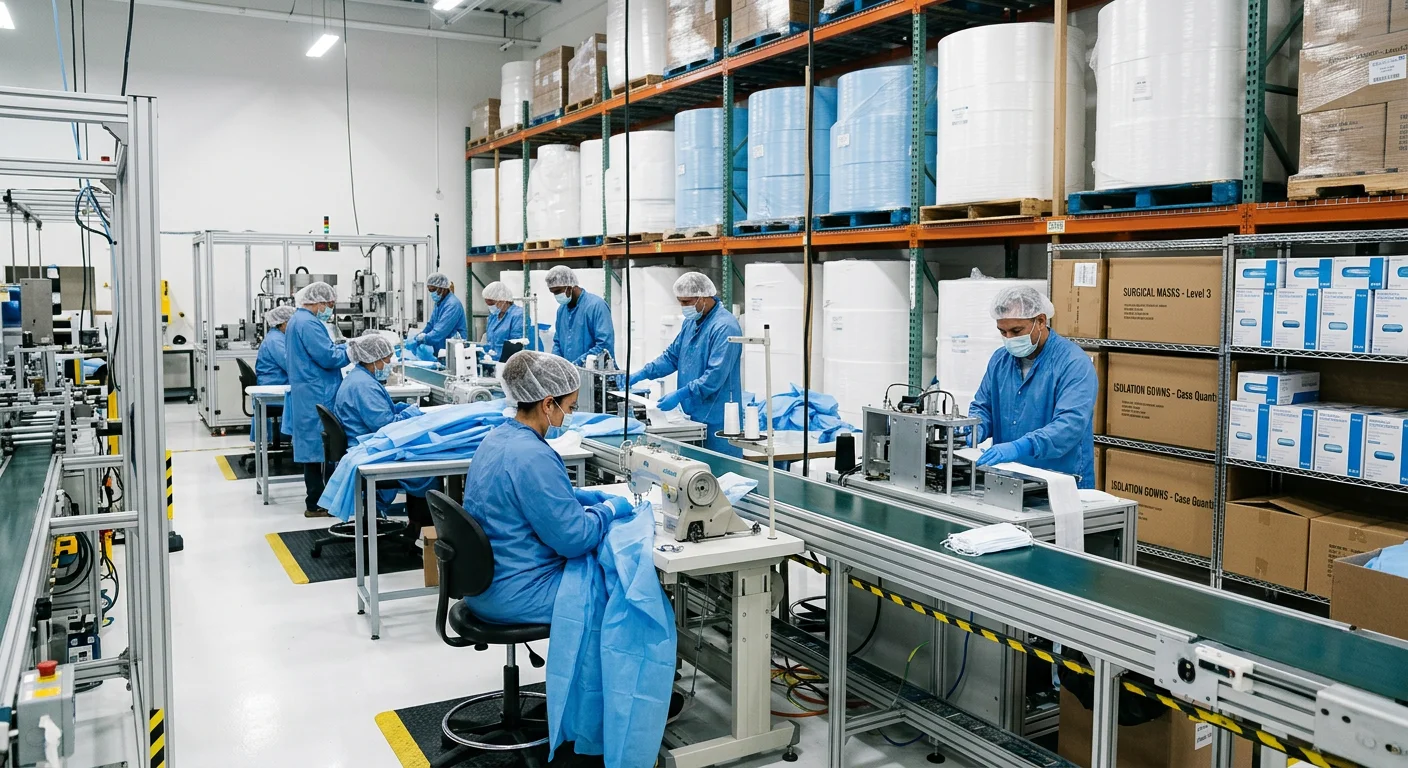 Zhengxin Group isn’t your typical PP nonwoven fabric mill. That difference is worth paying attention to.
Founded in 2011, with a nonwoven subsidiary running since 2014, ZXMEDPPE works as a PPE finished goods manufacturer with built-in nonwoven production. Their Guangdong facility runs over 50 automated production lines across 50,000+ m² of floor space, with more than 1,000 workers on site. The product range covers disposable masks, protective suits, shoe covers, caps, and Isolation Gowns — all made from PP spunbond, SMS, and meltblown fabric.
Here’s what makes them worth your attention as a sourcing option:
- PP Spunbond — outer/inner mask layers at 15–30 gsm; protective suit shells at 20–50 gsm
- SMS/SMMS composite — isolation gowns and surgical apparel with hydrostatic resistance ≥ 20 cmH₂O
- Meltblown filtration fabric — 20–25 gsm, BFE/PFE ≥ 95–98%, targeting EN 14683 Type IIR and FFP2 compliance
Their ISO, CE, and SGS certifications aren’t just paperwork. Shipping to the UK, Germany, Italy, Japan, and Southeast Asia takes real filtration performance data. So the meltblown and spunbond specs they hold to in production already clear serious regulatory thresholds.
The real advantage here is structural. Zhengxin also acts as a purchase agent. Need PP nonwoven rolls and finished PPE under one contract? They produce meltblown and spunbond in-house, bring in any extra materials from outside, then handle cutting, ultrasonic bonding, and final packaging — all under one roof. You negotiate once. One QC process. One shipment.
Best fit for: OEM PPE brands , medical distributors, or procurement teams that want finished protective wear and raw nonwoven rolls from a single supplier.
Top 6 PP Non Woven Fabric Manufacturers: Side-by-Side Comparison Table
Six PP non woven fabric manufacturers. One table. Every spec you need to make a confident sourcing decision.
This comparison covers process type, GSM range, capacity per month, certifications, MOQ, and lead time — all in one place. Use it as your first filter before you send a single inquiry.
How to read this table: Data comes from manufacturers’ public specifications and industry benchmarks. Items marked “confirm with supplier” vary by order configuration. Verify those figures directly with each supplier.
Process codes: S = Spunbond · SS = Double Spunbond · SMS = Spunbond-Meltblown-Spunbond · MB = Meltblown
| Manufacturer | HQ / Main Plant | Core PP Process | Typical GSM Range | Max Width | Est. Monthly Capacity (PP Nonwoven) | Core Applications | Key Certifications | Common MOQ | Primary Export Markets |
|---|---|---|---|---|---|---|---|---|---|
| Rayson Non Woven Fabric Co., Ltd. | Foshan, Guangdong, China | S / SS | 9–200 gsm | 3.2 m | 1,300–1,800 MT | Hygiene, medical, furniture, agriculture, bags | ISO 9001, SGS | 500–1,000 kg | Europe, North America, Australia, the Middle East |
| Suzhou Minghuiyuan Technology Co., Ltd. | Suzhou, Jiangsu, China | Spunlace composite (converter) | 40–120 gsm | 250 m rolls | Confirm with the supplier | Cleanroom wipers, semiconductor, medical device MRO | ISO 9001, SGS, CE, MSDS | Confirm with the supplier | South Korea, Japan, Singapore, the US, and Germany |
| Zhejiang Hailide New Materials Co., Ltd. | Zhejiang, China | S / Needle-punch / Coated composite | 30–120 gsm (spunbond); 150–800 g/m² (geotextile) | 6.0 m (geotextil) | 210,000 MT/year (fiber + fabric combined) | Geotextile, civil engineering, automotive, coated industrial fabric | ISO 9001, ISO 14001 | Project-based; confirm with the supplier | Global infrastructure and industrial OEM markets |
| Shandong Yinying Group Co., Ltd. | Shandong, China | S / SS / SMS / SMMS / MB | 8–200 gsm | 3.2 m | 40,000–80,000 MT/year (spunbond + SMS); 5,000–10,000 MT/year (meltblown) | Medical PPE, masks, agriculture, hygiene, and industrial | ISO 9001, ISO 13485 | 10 MT+ per spec recommended | Southeast Asia, the Middle East, South America, Eastern Europe |
| Jiangsu Jinlun Nonwoven Co., Ltd. | Nantong, Jiangsu, China | S / MB / SMS / SMMS | 9–80 gsm (spunbond); 20–40 gsm (meltblown); 25–60 gsm (SMS) | 3.2 m | Confirm with the supplier | Surgical gowns , mask media, and medical disposables | ISO 9001:2015, ISO 13485 | 1–3 MT per spec | EU, North America (medical compliance programs) |
| Zhengxin Group | Guangdong, China | S / SMS / MB (PPE finished goods + rollgoods) | 15–50 gsm | Confirm with the supplier | 50+ automated lines (finished PPE focus) | Masks, protective suits, isolation gowns, and shoe covers | ISO, CE, SGS | Confirm with the supplier | UK, Germany, Italy, Japan, Southeast Asia |
How to Use This Table as a Sourcing Filter?
Three questions cut your shortlist down fast:
1. What’s your application?
Medical and PPE buyers go straight to #5, #6, and #7. Agricultural distributors look at #8. Bag converters and packaging brands belong at #9, #10, and #12. Don’t compare a geotextile supplier (#3) with a hygiene roll goods factory (#4). They serve two separate markets with two separate sets of requirements.
2. What’s your volume per SKU each month?
- Below 1 MT: Start with #10 or #12. Both are built for small-batch, multi-SKU programs.
- Between 1–10 MT: #1, #5, #9, and #11 all fit that range well.
- Above 10 MT per spec, every month: #4 is the right conversation to have.
3. Which certifications are non-negotiable?
EU medical buyers must confirm that the ISO 13485 scope covers both spunbond and SMS lines — not just one. Agricultural importers selling into EU retail channels need OEKO-TEX Standard 100 or REACH documentation in hand before samples ship. Food-contact applications need specific migration test reports. Most general spunbond mills don’t carry those.
Run those three filters first. Then send inquiries to two or three suppliers that pass all three screens — not twelve.
Sourcing PP Non Woven Fabric from China: Logistics, MOQ & Pricing Guide
Pricing confusion kills more China sourcing deals than quality issues ever will. Here’s what the real numbers look like.
FOB benchmarks (2025–2026):
- 10–30 gsm spunbond PP: $1.10–$1.85/kg; dyed colors add $0.05–$0.20/kg
- 40–80 gsm spunbond PP: $1.20–$2.05/kg depending on width and UV additives
- 100 gsm+ heavy-duty PP: $1.45–$2.60/kg; laminated or flame-retardant finishes push the price higher
- SMS nonwoven: runs 15–35% above comparable spunbond gsm — typical range $1.60–$3.20/kg
MOQ reality check:
Standard white/black spunbond starts at 500–1,000 kg per color and gsm. Custom Pantone or specialty gsm jumps to 1–3 tons. There’s a simple way around this. Fill one 20′ or 40’HQ container with multiple colors and GSM specs. Your total order reaches 3–5 tons. At that point, individual SKU MOQs become open for negotiation.
Port selection drives your landed cost:
| Factory Region | Best Export Port | Inland Savings vs. Distant Hub |
|---|---|---|
| Guangdong | Shenzhen / Guangzhou | $80–$250/container |
| Zhejiang / Jiangsu | Shanghai / Ningbo | 0.5–2 days faster |
| Shandong | Qingdao | Standard routing |
Logistics can eat up 8–20% of your landed cost on smaller shipments. Pick the right port and pack your container well. Those two moves cut that number down fast.
Before you send any RFQ, spell out the details:
- GSM, width, color, roll diameter, core size, packing method, and required certifications
- Ask for both FOB-per-kg pricing and container loading plans
Do this upfront. It clears up 90% of the confusion that comes from comparing quotes.
Quick PP Non Woven Fabric Manufacturers Vetting Checklist Before You Place Your First Order
Bad suppliers don’t announce themselves. They look fine on Alibaba, respond fast, and quote competitive prices — right up until your first container arrives wrong.
Run every potential PP non woven fabric manufacturer through this checklist before you commit a single dollar.
Hard Requirements — No Exceptions
Dedicated PP nonwoven production lines. Ask for workshop photos, equipment lists, and a recent production video. “We manufacture in-house” means nothing without proof. Photos and videos are the proof.
Verified ISO 9001 certificate. Get the certificate number, issuing body, expiry date, and scope. Check that the scope covers nonwoven or textile production — not just “manufacturing.” Those are two very different things.
Six to twelve months of export records. Request shipment summaries or bill of lading abstracts. Sensitive client details can be redacted. You need proof of consistent export activity — not just one or two shipments.
Complete written specifications. GSM, width, tensile strength, color tolerance, packaging format — all in writing, before any money moves. Verbal commitments vanish after the deposit clears.
Sample turnaround within seven days. State this upfront in your inquiry. Suppliers who can’t meet that window have capacity or priority issues. Those problems will follow your orders too.
Strong Advantages — Serious Suppliers Carry These
- Accepts third-party inspection from SGS, Bureau Veritas, or Intertek — no pushback
- Provides SGS test reports covering GSM deviation, tensile strength, air permeability, and safety parameters
- Keeps documented AQL inspection records for incoming materials and outgoing shipments
- Runs double-shift or multi-line capacity to handle urgent reorders
Five Red Flags That Should Stop You Cold
| Warning Signal | What It Means |
|---|---|
| Promotional photos only — no factory floor footage | No real production facility behind the listing |
| ISO certificate with no verifiable number or expired date | Document is fabricated or borrowed |
| Quote well below market with no technical explanation | Material substitution, GSM underweight, or hidden price increases ahead |
| Refuses third-party factory audit | Something in the facility won’t hold up to inspection |
| Can’t produce a single SGS test report | No real quality control process in place |
First Order Sequence — Three Steps
Step 1: Small trial batch. Lock one MOQ on a single spec. Use the same raw material, same production line, and same process parameters you’d expect on any future large order.
Step 2: Incoming inspection on arrival. Check GSM, width, tensile strength, appearance, and packaging against your written spec. Anything off? Freeze the next order right there.
Step 3: Scale after the trial passes. Write delivery penalties, rework terms, and return conditions into the contract before you expand volume — not after the fact.
Your First-Order Vetting Checklist
Copy this into every new supplier inquiry:
- Factory photos and production video
- ISO 9001 certificate number and expiry date
- Export records — last 6–12 months
- Dedicated spunbond non woven fabric line confirmation
- Product spec sheet: gsm / width / tolerance / packaging
- Sample lead time: ≤7 business days
- MOQ, standard lead time, and peak-season lead time
- Third-party audit acceptance (SGS / BV / Intertek)
- SGS test report on file
- AQL standard and outgoing inspection records
Quick decision rule: A reliable polypropylene fabric roll supplier fills most of this list within 24–48 hours. Slow replies, missing documents, or vague answers on certification scope are signals — not noise. Act on them before you wire the deposit.
Conclusion
 Finding the right PP non woven fabric manufacturer from China is simpler than you think.
You now have a vetted list of 12 manufacturers. There’s a side-by-side comparison table, a 5-step decision framework, and a supplier vetting checklist. That’s everything you need to go from research to a confident purchase order.
Here’s the bottom line: don’t chase the lowest price. Chase the right mix of certifications, production capacity, export experience, and communication responsiveness. That combination separates a reliable long-term supplier from a costly mistake.
Your next move? Shortlist three manufacturers from this guide. Request samples. Run them through the vetting checklist before committing to an MOQ.
The best spunbond non woven fabric manufacturer for your business isn’t the most famous one. It’s the one that shows up on time, delivers on spec, and grows with you over time.
That supplier exists. Go find them.