

Most people in healthcare use the terms surgical cap and scrub cap the same way — and that works fine, most of the time. Until it doesn’t.
Picture this: you’re standing at the OR entrance, and someone flags your head cover for not meeting compliance standards. Suddenly, the difference is very real. It’s not a technical debate anymore — it has direct consequences.
Are you a scrub tech trying to figure out what your facility requires? A nurse deciding between disposable and reusable options? A purchasing manager sourcing headwear for a whole department? The choice of cap matters more than the name on the label.
This guide covers what you need to know — real use cases, infection control facts, material differences, and which options are worth buying.
 Step into any major hospital OR on a Tuesday morning. You’ll spot it right away: a surgeon in a fitted cloth skull cap with “Dr. Patel – Cardiac” printed across the front. A scrub nurse pulls on a ponytail cap at the supply station. A medical student grabs a disposable bouffant from the dispenser by the door. Same room. Three different caps. All correct.
That’s how it works in practice.
Where caps are mandatory — no exceptions:
Step into any major hospital OR on a Tuesday morning. You’ll spot it right away: a surgeon in a fitted cloth skull cap with “Dr. Patel – Cardiac” printed across the front. A scrub nurse pulls on a ponytail cap at the supply station. A medical student grabs a disposable bouffant from the dispenser by the door. Same room. Three different caps. All correct.
That’s how it works in practice.
Where caps are mandatory — no exceptions:
Cloth caps are thicker, tighter in weave, and lower in permeability. The reusable scrub cap leads in barrier performance — but that advantage depends on certified laundering. Home-washing without proper standards cancels it out.
Disposable surgical caps earn their place on speed and simplicity. No between-case handling. No laundering coordination. In high-volume ORs turning over every 45 minutes, that’s a real operational advantage.
 Six cap styles. One OR. All of them correct — it depends on who’s wearing them, what they’re doing, and which guidelines your facility follows.
Here’s the real breakdown of what gets pulled on before the first incision.
Six cap styles. One OR. All of them correct — it depends on who’s wearing them, what they’re doing, and which guidelines your facility follows.
Here’s the real breakdown of what gets pulled on before the first incision.
 At 5–15 cases per shift, disposable caps make pure logistical sense. No handling of contaminated textiles between quick turnovers. A 21–24″ disposable bouffant — one per case if soiled — keeps compliance straightforward.
Facilities running more than 10,000 cases per year can cut cap costs 10–30% with a mixed model. Cloth caps go to permanent staff. Disposables cover visitors and patients. It’s a simple split that adds up fast.
At 5–15 cases per shift, disposable caps make pure logistical sense. No handling of contaminated textiles between quick turnovers. A 21–24″ disposable bouffant — one per case if soiled — keeps compliance straightforward.
Facilities running more than 10,000 cases per year can cut cap costs 10–30% with a mixed model. Cloth caps go to permanent staff. Disposables cover visitors and patients. It’s a simple split that adds up fast.
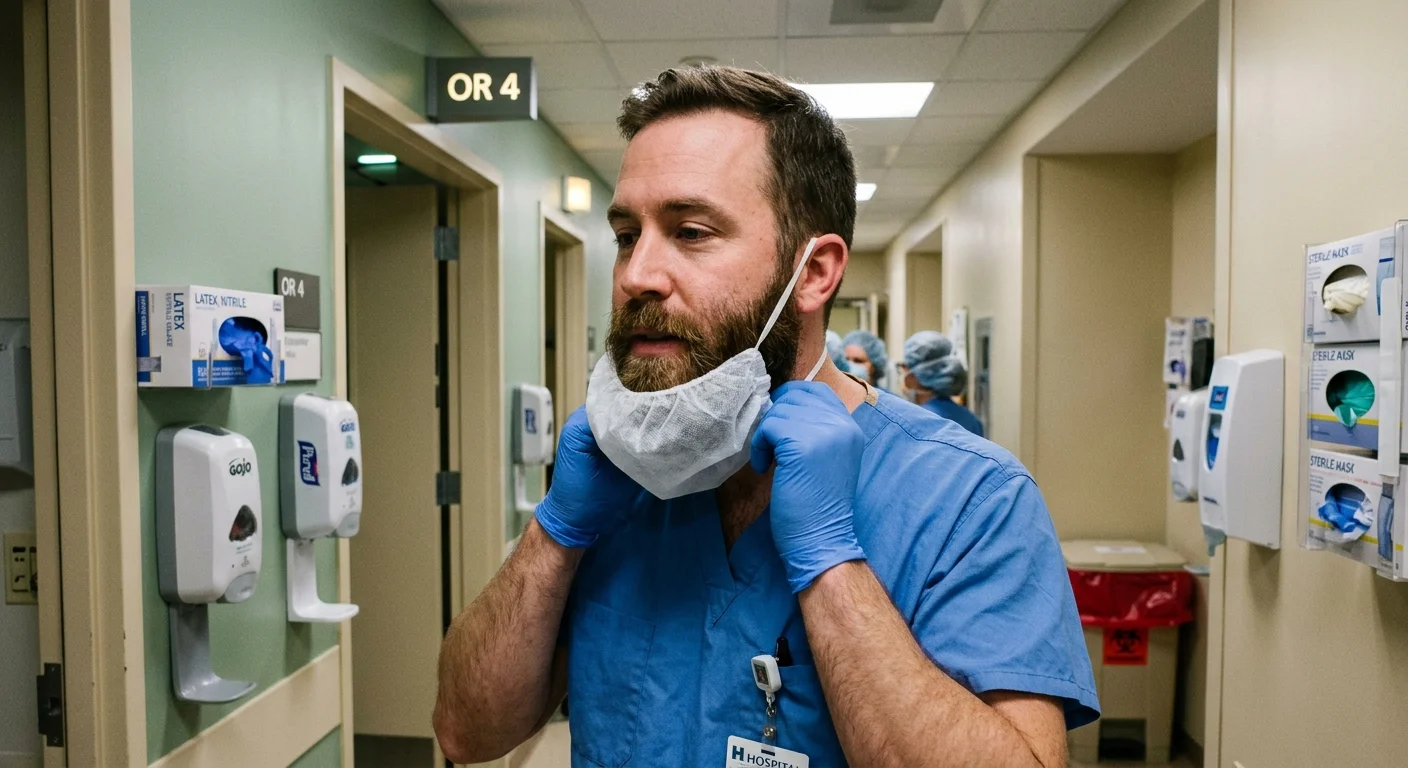 These questions come up every week in OR break rooms, supply closets, and infection control meetings. Here are straight answers — no hedging, no brand spin.
Can floor nurses and ED staff just wear a scrub cap all day? Yes. Scrub caps are built for that. Floor nurses, ICU staff, outpatient clinicians, PACU , pre-op — anyone not scrubbed into a sterile case. Step into the OR as part of the surgical team — scrub nurse, first assistant, surgical tech — and the rules change. You need a surgical cap with full ear and nape coverage. It has to fit snugly and stay in place.
Are cloth caps cleaner than disposables? The data says yes — but with one condition. Dr. Troy Markel’s research found that cloth skull caps have the lowest permeability of any headwear tested in OR conditions. An 85% majority of surgical staff preferred them. A six-month MGH study with 92 trainees showed no increase in SSI after switching from disposables to personalized reusable caps. The condition: certified laundering. Skip that, and the barrier advantage disappears.
Can I wear my printed personal scrub cap in the OR? Most of the time, yes. It needs to cover your hair, ears, and nape fully. It also needs daily laundering in hospital-grade laundry — no shortcuts. Some high-risk ORs (cardiac, transplant, deep brain) require disposable bouffants, regardless of your preference. Check your facility policy before your next case.
Do disposables reduce cross-case contamination? They make it simpler. A fresh cap in each case cuts out laundering variability. That said, a cloth cap washed to hospital standards matches — or beats — disposables on barrier performance. The real issue isn’t the material. It’s whether the process stays consistent.
Quick decision checklist
How Surgical Caps and Scrub Caps Are Used in Hospitals?
Step into any major hospital OR on a Tuesday morning. You’ll spot it right away: a surgeon in a fitted cloth skull cap with “Dr. Patel – Cardiac” printed across the front. A scrub nurse pulls on a ponytail cap at the supply station. A medical student grabs a disposable bouffant from the dispenser by the door. Same room. Three different caps. All correct.
That’s how it works in practice.
Where caps are mandatory — no exceptions:
- Operating rooms, procedure rooms, and C-section suites
- Interventional radiology and cath labs
- Endoscopy suites during high-risk procedures
- Sterile processing departments
What Each Cap Type Does Day-to-Day?
The primary job is containment. Scalp hair, skin flakes, sweat droplets — none of it belongs near an open surgical site or a sterile instrument table. Most hospital policies require 100% scalp coverage, including sideburns and nape hair. Beyond infection control, labeled caps solve a quieter problem. In large centers, 30–40% of team members in any given case may not recognize each other by name or role. A cap printed with “Alex – Circulating Nurse” in 3–5 cm text is readable from across the room. It costs almost nothing. It does improve team communication — and research links that directly to better perioperative safety outcomes.How Caps Move Through a Shift?
The workflow is more structured than most people outside the OR expect:- Staff change into hospital scrubs and pick their cap based on hair length
- The cap goes on before the mask — before crossing into the semi-restricted zone
- During surgery, the cap stays on — through scrubbing, through the procedure, through any mid-case exits that stay within the restricted corridor
- A cap gets soiled, wet, or dislodged? Step back. Remove it. Do hand hygiene. Put on a fresh one before returning to the field.
Key Differences Between Surgical Caps and Scrub Caps (Real-World Comparison)
Most people haven’t seen this data. In a controlled OR comparison, cloth caps showed an 8% contamination rate. Disposable caps came in at 20%. That’s not a small gap — it’s more than double. Yet disposable surgical caps stay the default choice in countless facilities. To understand why, you need to know what separates these two categories at the most basic level.Coverage, Fit, and Where Each Cap Belongs
Context is everything here. A scrub cap is everyday clinical wear. Think of a nurse charting in the hallway, a technician processing equipment, or a doctor moving between wards. It’s functional and comfortable — but not held to OR-level standards. A surgical cap — whether a tied skull cap or a full bouffant surgical cap — is built for one place: the operating room. Open wounds and sterile fields make every airborne particle a risk. Coverage reflects that gap:- Scrub caps come in simpler fits — beanies, basic bouffants — built for easy on/off across a full shift
- Surgical head covers wrap the hairline, ears, and nape. Back ties keep the cap in place through movement, repositioning, and hours under OR lights
Material and Barrier Performance
This is where the data gets specific — and where procurement decisions get harder.| Feature | Cloth Surgical Cap | Disposable Surgical Cap |
|---|---|---|
| Average thickness | 1.5 mm | 0.5 mm |
| Contamination rate (OR study) | 8% | 20% |
| Pore size | Smaller — lower particle passage | Larger — higher permeability |
| Environmental impact | Lower carbon footprint | Far higher over 6 months |
The Practical Decision
- Choose sterile, disposable surgical caps if OR protocol requires them, if cap contact with the sterile field is possible, or if your facility lacks laundering infrastructure
- Choose reusable cloth caps if barrier performance, cost control, and reduced medical waste are your priorities — provided certified washing is in place and consistently used
Surgical Cap Types: What People Use in the OR
Six cap styles. One OR. All of them correct — it depends on who’s wearing them, what they’re doing, and which guidelines your facility follows.
Here’s the real breakdown of what gets pulled on before the first incision.
The Main Types on the Floor
Bouffant caps are the high-volume, elastic-edged caps stacked in dispensers near every OR entrance. AORN pushed for disposable bouffants over cloth skull caps in 2014. After that, many US hospitals made them mandatory. They became the default for nurses, techs, and anyone with long or thick hair. Pediatric ORs use them too, sometimes in printed patterns. The goal there is simple: make the OR feel less scary to young patients. Skull caps — fitted, close to the head — never went away. Surgeons kept wearing them. A 1 , 543-patient OR study found skull caps in 61% of cases. Bouffants came in at just 39%. The American College of Surgeons backed this preference, endorsing cloth skull caps as acceptable OR headwear. Tie-back caps are the practical choice for long procedures. You get an adjustable fit. No slippage. Many include built-in sweatbands — and in a four-hour case, that’s not a bonus feature. It’s a necessity. Ponytail caps fix a real gap. Standard skull caps don’t account for significant hair volume at the back. Ponytail caps do. They use a dedicated pouch or opening to keep everything contained — no need to stack a bouffant on top.What the SSI Data Shows?
The bouffant-vs-skull-cap debate is messier than it looks. That same 1,543-patient study showed a crude SSI rate of 8% for bouffant users vs. 5% for skull cap users. That gap looks like a clear answer — until you adjust for procedure type. After that adjustment, the difference disappeared. AORN took note of this in 2019. They dropped the bouffant-only recommendation. Facilities following updated AORN and ACS guidance now give staff a choice — bouffant, skull cap, tie-back, or cloth. The requirements are straightforward: hair, sideburns, and nape must be covered, and the cap must be changed or laundered between cases. The real takeaway: cap type matters less than correct coverage and consistent use.Scrub Cap Types: What Works Best During Long Clinical Shifts
Eight hours in, the cap you grabbed at 6 a . m. either earns its keep or becomes the thing you’re adjusting every twenty minutes. The right nurse scrub cap for a long clinical shift isn’t about looks. It’s about fit, fabric, and whether it still does its job when you’re four procedures deep and running on cold coffee.Matching Cap Style to Hair Type
Hair type is the starting point. Everything else follows from there.- Short hair → Pixie cap or surgical skull cap. Close-fitting and stable. Nothing shifts around during fast movement.
- Medium hair → Tie-back cap. Adjustable ties give you a snug fit. You won’t get the pinching that elastic alone tends to cause by hour six.
- Long, thick, or coily hair → Bouffant surgical cap or ponytail cap. Bouffants handle volume well. Ponytail caps fix the rear-containment problem with a built-in pouch — no doubling up, no gaps in coverage.
- Mixed staff settings → Stock all three styles. Bouffant, tie-back, ponytail. Covering the full range costs almost nothing.
The Fabric Decision
Cotton and cotton blends win for long wear. They’re breathable, sweat-absorbent, and soft against the skin. Polyester blends last longer through repeated washing and resist stains. The trade-off? They trap heat, and that builds up fast over a long shift. Simple rule for 8–12+ hour shifts: put airflow and sweat absorption first. Durability comes second. A cap with an inner sweatband isn’t a bonus feature. In a four-hour case, it’s the difference between staying focused and fighting distraction. Wash durability matters too. A reusable scrub cap should keep its shape and fit through frequent laundering — not shrink, stretch, or fall apart after a few cycles. Bottom line : go bouffant for hair volume, tie-back for fit control, ponytail for long-hair containment — and pick cotton fabric if heat is your main problem.Infection Control Reality: What Matters in Practice
The cap debate — bouffant vs. skull cap, disposable vs. reusable — can pull your attention away from something more fundamental. Head coverings are just one layer of a much larger infection control system. Some practices in that system move the needle far more than others. Here’s what the evidence shows.Hand Hygiene Outperforms Everything Else
No piece of headwear comes close to what proper hand hygiene achieves. Not the most expensive reusable cap. Not the highest-barrier disposable. Well-executed hand hygiene programs cut healthcare-associated infections (HAIs) by 30–50% in real-world settings. That’s not a theoretical figure. Compliance typically sits at 40–60%. Push that up to 80% and above — through monitoring, feedback, and ABHR available at every point of care — and the numbers follow. A cap does its job by staying on and containing hair. Clean hands do their job every single time they touch a patient, a device, or a surface. That difference matters.Environmental Surfaces: The Risk Nobody Talks About
A patient placed in a room where the previous occupant had an HAI carries a 25% higher infection risk — even after terminal cleaning. High-touch surfaces do most of the damage: bed rails, IV pumps, door handles, call buttons. Standardized cleaning with EPA-registered disinfectants, checked through fluorescent markers or ATP testing, should cover 80–90% of marked high-touch sites per cycle. Fall short of that, and the environment works against everything else your team does right.The Real Hierarchy of Infection Control in the OR
In surgical settings, the practices with the highest return — ranked by impact — are:- Hand hygiene at every point of care transition
- Appropriate PPE matched to the actual procedural risk
- Environmental cleaning and disinfection with measurable verification
- Device minimization — each unnecessary central line or catheter day adds compounding infection risk
- Safe injection discipline — one needle, one syringe, one patient, no exceptions
How to Choose Between a Surgical Cap and a Scrub Cap (Simple Decision Logic)
Two questions. That’s all it takes. Most purchasing decisions in healthcare get buried in noise — product specs, brand loyalty, departmental habit. Strip that away. The surgical cap vs. scrub cap choice comes down to a clean two-step framework. Answer both questions, and the right cap picks itself. Question 1: Are you entering a sterile surgical environment? Yes — stop here. You need a surgical cap. Tied fit, full coverage from hairline to nape, ears included. It’s built for the OR, where an open wound makes every airborne particle a risk. No — move to question 2. Question 2: Do you want reusable comfort or disposable convenience? – Reusable, breathable, personalizable → cloth scrub cap – Single-use, fast turnover, facility infection-control policy → disposable surgical cap That’s the whole logic.The Four Factors That Refine the Decision
Still not sure? Four variables help narrow it down:- Use case — OR and sterile field: surgical cap. Ward rounds, non-surgical duties: scrub cap.
- Sterility requirement — Cap touching the sterile field? Go with a sterile surgical cap. No sterility requirement? Reusable or disposable scrub caps both do the job.
- Hair coverage — Need maximum containment with a secure fit? Surgical cap. Need basic containment with easy on/off across a full shift? Scrub cap.
- Turnover speed — High-volume OR with 45-minute case turnovers? Disposable surgical caps make more sense. Long-term daily wear? Cloth scrub caps win — better barrier performance, less waste, lower cost over time.
Best Surgical Caps and Scrub Caps (By Real Use Case, Not Marketing)
Forget star ratings. Forget “bestseller” badges. The cap that earns its place in a cardiac OR at hour five is a different beast from the one a floor nurse grabs at 6 a.m. Here’s what works — sorted by where you work, not what a product page tells you.High-Sterility OR: Long Cases, Transplant, Cardiac
In surgeries that run 4–6+ hours, fit stability and sweat management aren’t comfort features. They’re safety features. Cloth tie-back caps (Blue Sky Scrubs, Medicus Caps) are the working standard here. You get full ear and nape coverage. Built-in sweatband. These caps hold up through 75–100+ wash cycles, which brings the cost per use down to $0.08–$0.20. Bring 2–3 per shift — swap one out when it gets soaked. Your facility might require disposables for transplant or cardiac cases. Go with a 24–28″ high-coverage bouffant in spunbond polypropylene (14–25 GSM). Bulk pricing runs $0.05–$0.20 per unit. Short hair? size down to 21″ — it cuts cap movement under headlamps or loupes.High-Turnover Settings: Outpatient Surgery, Endoscopy, Cath Lab
At 5–15 cases per shift, disposable caps make pure logistical sense. No handling of contaminated textiles between quick turnovers. A 21–24″ disposable bouffant — one per case if soiled — keeps compliance straightforward.
Facilities running more than 10,000 cases per year can cut cap costs 10–30% with a mixed model. Cloth caps go to permanent staff. Disposables cover visitors and patients. It’s a simple split that adds up fast.
ICU and ER: Codes, Trauma, Constant Motion
The priority shifts here. You need rapid donning and a cap that stays put while you’re moving fast. Adjustable tie-back caps with cord-lock systems (Sunshine Caps Co makes a solid one) let you tighten with one hand — useful when seconds matter. Go for 130–145 g/m² poly-cotton blends. They hold up through a full shift and won’t trap heat.Ward Nurses and Outpatient Clinics
Eight to twelve hours. Non-sterile environment. Comfort and sweat control drive the decision here — not SSI data. Lightweight printed cloth caps from nurse-focused brands like KimKaps and Sunshine Caps are the practical standard. Look for adjustable elastic or ties that fit 52–62 cm head circumferences. Launder after each shift. And those printed patterns aren’t just for looks — they make a real difference in patient rapport.Long Hair, Thick Hair, and Specialty Coverage
Standard skull caps don’t cut it here. A ponytail-style bouffant with a back pouch (26–28″ circumference, cord-lock rear) holds braided hair to mid-back length and keeps everything contained. Hijab wearers have two solid options. Pair an underscarf with a bouffant, or use an integrated hood that tucks into the scrub top. Both give you clean OR-compliant coverage. Beards over 5–10 mm need a separate disposable polypropylene beard cover with neck/head elastic. Most OR policies require it — check yours before your next shift.Quick-Reference: Cap by Use Case
| Setting | Best Cap Type | Key Spec |
|---|---|---|
| Long OR cases | Cloth tie-back + sweatband | 100% cotton, 120–150 g/m², 75–100 wash cycles |
| High-turnover OR | Disposable bouffant | 21–24″, one per case |
| ICU/ER | Tie-back with cord-lock | 130–145 g/m², one-hand adjust |
| Ward/clinic nurses | Printed cloth, elastic, or tie | Lightweight, 52–62 cm fit range |
| Long/thick hair | Ponytail bouffant, back pouch | 26–28″ circumference |
| Sustainability-focused OR | Cloth staff caps + limited disposables | Target >70–80% reduction in disposable purchases |
FAQ: Surgical Cap vs Scrub Cap (Real Questions from Medical Staff)
These questions come up every week in OR break rooms, supply closets, and infection control meetings. Here are straight answers — no hedging, no brand spin.
Can floor nurses and ED staff just wear a scrub cap all day? Yes. Scrub caps are built for that. Floor nurses, ICU staff, outpatient clinicians, PACU , pre-op — anyone not scrubbed into a sterile case. Step into the OR as part of the surgical team — scrub nurse, first assistant, surgical tech — and the rules change. You need a surgical cap with full ear and nape coverage. It has to fit snugly and stay in place.
Are cloth caps cleaner than disposables? The data says yes — but with one condition. Dr. Troy Markel’s research found that cloth skull caps have the lowest permeability of any headwear tested in OR conditions. An 85% majority of surgical staff preferred them. A six-month MGH study with 92 trainees showed no increase in SSI after switching from disposables to personalized reusable caps. The condition: certified laundering. Skip that, and the barrier advantage disappears.
Can I wear my printed personal scrub cap in the OR? Most of the time, yes. It needs to cover your hair, ears, and nape fully. It also needs daily laundering in hospital-grade laundry — no shortcuts. Some high-risk ORs (cardiac, transplant, deep brain) require disposable bouffants, regardless of your preference. Check your facility policy before your next case.
Do disposables reduce cross-case contamination? They make it simpler. A fresh cap in each case cuts out laundering variability. That said, a cloth cap washed to hospital standards matches — or beats — disposables on barrier performance. The real issue isn’t the material. It’s whether the process stays consistent.
Quick decision checklist
- Scrubbed into a sterile case? → Surgical cap. Full coverage. No exceptions.
- Cap slipping or leaving ears exposed? → Upgrade to a fitted tie-back or XL style.
- Facility requires disposables for cardiac/neuro/transplant? → Use them, regardless of preference.
- Can’t guarantee daily hospital-grade laundering? → Go disposable. It removes the laundering risk completely.