

Grab a Tyvek suit off the shelf, and you might think hazard protection is sorted. It’s affordable. It’s disposable. You’ll find it everywhere — construction sites, paint booths, crime scene cleanups, pandemic supply closets. That widespread use has bred a dangerous assumption: one suit fits all threats. It doesn’t. In the wrong scenario, a Tyvek coverall isn’t just inadequate — it gives you a false sense of security. That false confidence can put you straight in harm’s way. There are six specific situations where reaching for that familiar white suit is the wrong call. The stakes are high. Getting this wrong isn’t just a compliance headache — it’s a real safety risk.
What a Tyvek Suit Protects Against (And What It Doesn’t)
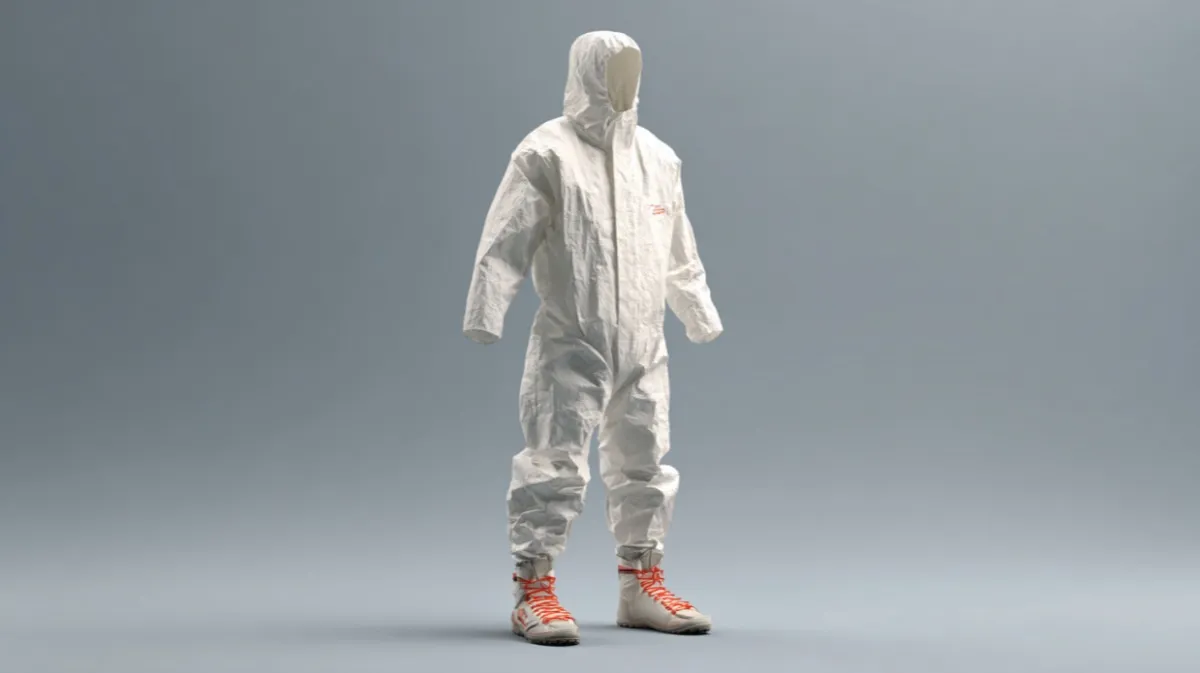
Here’s the honest picture: Tyvek does an impressive job at a specific tier of hazards — and breaks down at the next tier up.
What it handles well:
-
Dust and fine particles down to 1 micron. Asbestos fibers, lead dust, drywall particulate — this is Tyvek’s sweet spot. Type 5/6 ratings exist for dry particle environments. That’s what they’re built for.
-
Light liquid splashes — water-based liquids, aerosols, and low-concentration inorganic chemicals that make brief contact with the suit surface. Not pooling. Not soaking. Surface contact only.
-
Biological hazards : bacteria, viruses, and infectious bodily fluids. Healthcare workers and biohazard cleanup crews count on this barrier protection every day.
-
Physical abuse : The high-density polyethylene nonwoven construction resists tearing and puncture better than SMS fabrics and most microporous films. It also breathes about 6x better than microporous alternatives. That gap matters a lot for heat stress during extended wear.
Where it stops working:
-
Concentrated chemicals or full immersion — the seams aren’t liquid-tight. No Tyvek construction carries a rating for chemical permeation.
-
Gases and vapors — zero protection. None. The material doesn’t address airborne molecular hazards at all.
-
Heat and flame — Tyvek offers no real thermal protection.
-
Whole-body coverage — hands, feet, and face need separate protection, no matter which suit type you use.
The classification matters here. Type 5/6 suits handle particles and light splashes. Type 1 gas-tight suits handle the serious stuff. These are not interchangeable. They’re different categories of equipment built to solve different categories of problems.
Scenario #1: High-Concentration or Hazardous Liquid Chemicals — Tyvek Suit Is Not Enough
The seams will betray you. That’s not a metaphor — it’s a documented mechanical failure.
Standard Tyvek suits use stitched or serged seams. Every needle pass leaves a tiny hole. In dry particulate conditions, those holes don’t matter. Add liquid chemicals under pressure — or let a corrosive solvent sit against the fabric — and those gaps become direct pathways to your skin.
EPA field testing on uncoated Tyvek 1422 coveralls in hazardous waste sites confirmed this. Suits failed at stress points — crotch, underarms, back seams — where workers faced liquid chemical exposure. Workers discarded the suits after a single shift. The conclusion was clear: uncoated Tyvek is unsuitable for hazardous liquid applications.
Here’s how that plays out across common chemical types:
|
Chemical Type |
Why Tyvek Fails |
|---|---|
|
Strong acids/bases (HCl, H₂SO₄) |
Liquid pushes straight through uncoated seams |
|
Organic solvents (toluene, acetone, MEK) |
Tyvek absorbs and spreads organic molecules; no vapor barrier exists |
|
Pesticides/organophosphates |
The breathable design kills protection; you need a liquid-proof barrier |
|
Pressurized spray chemicals |
Stitched seams can’t hold up against spray-forced penetration |
What to Use Instead?
Tychem fabrics fix what Tyvek can’t handle. The laminated build blocks both liquid and vapor. Heat-sealed or sonic-welded seams cut out the needle-hole problem entirely. Each Tychem grade is tested against specific chemicals for permeation resistance.
The selection rule is simple:
-
Particulate only → Tyvek 400, stitched seams are fine
-
Liquid splash or saturation risk → Coated fabric, bound or sealed seams at minimum
-
Pressurized spray or high-concentration corrosives → Tychem, heat-welded seams, SCBA respiratory protection
Before any chemical work, pull the Safety Data Sheet. Check the chemical state, concentration, and PPE Requirements. Then run a permeation compatibility check — your suit material against your specific chemical. Breakthrough time under 10 minutes, or listed as unknown? Tyvek is already the wrong choice.
Scenario #2: Fire, Flash Fire, or High-Heat Environments — A Dangerous Mismatch
Tyvek melts at 135°C. Flashover environments hit 677°C. That gap isn’t a minor detail — it’s the difference between a suit and a death trap.
Here’s what happens in a flashover: accumulated gases ignite all at once, sending fireballs up to 100 yards in seconds. That explosion creates two heat threats at the same time. Convective heat makes up about 70% of total exposure — superheated fire plumes carry it straight toward you. Radiant heat accounts for the other 30%, blasting out from the flame zone itself. Tyvek fails against both. It absorbs convective heat and pushes it straight to your skin. Hit it with radiant heat, and it catches fire instead of going out. The HDPE fibers don’t char and form a protective layer — they melt and collapse.
The ASTM E84 Misconception
There’s a widespread misread in the industry worth addressing. Tyvek carries an ASTM E84 Class A rating — and that label sounds reassuring. But look at what that test measures: surface burn characteristics of building materials. Flame spread index. Smoke development. It says nothing about thermal protection or heat barrier capability for a person wearing the suit. Class A does not mean flame-resistant. It does not mean fire-safe. Treating it as either is a dangerous mistake.
What to Wear Instead?
|
Scenario |
Required Protection |
|---|---|
|
Flashover / direct flame |
NFPA 1971 structural firefighting ensemble |
|
Radiant heat exposure |
FR coveralls, TPP ≥ 5.0 cal/cm² |
|
Electrical arc flash |
NFPA 70E Category 2–4 FR clothing |
|
Industrial high-heat (non-flame) |
Nomex or Kevlar coveralls + insulated gloves/footwear |
Nomex is the baseline standard for good reason. Its melting point sits at 370°C — close to three times higher than Tyvek’s. It resists flame on its own, with no chemical treatment needed to hold that property. It self-extinguishes. It stays structurally intact under sustained heat. That’s why you find it in firefighter turnout gear and military flight suits.
The minimum for any fire-adjacent work: FR-rated coveralls with a thermal protection rating (TPP) of at least 4 . 0 cal/cm², NFPA certification matched to your specific hazard type, and full protection for hands, feet, and head. A Tyvek suit in this environment isn’t just the wrong choice — it’s a flammable layer you’ve strapped to your own body.
Scenario #3: Prolonged Outdoor Work or Direct Sun Exposure
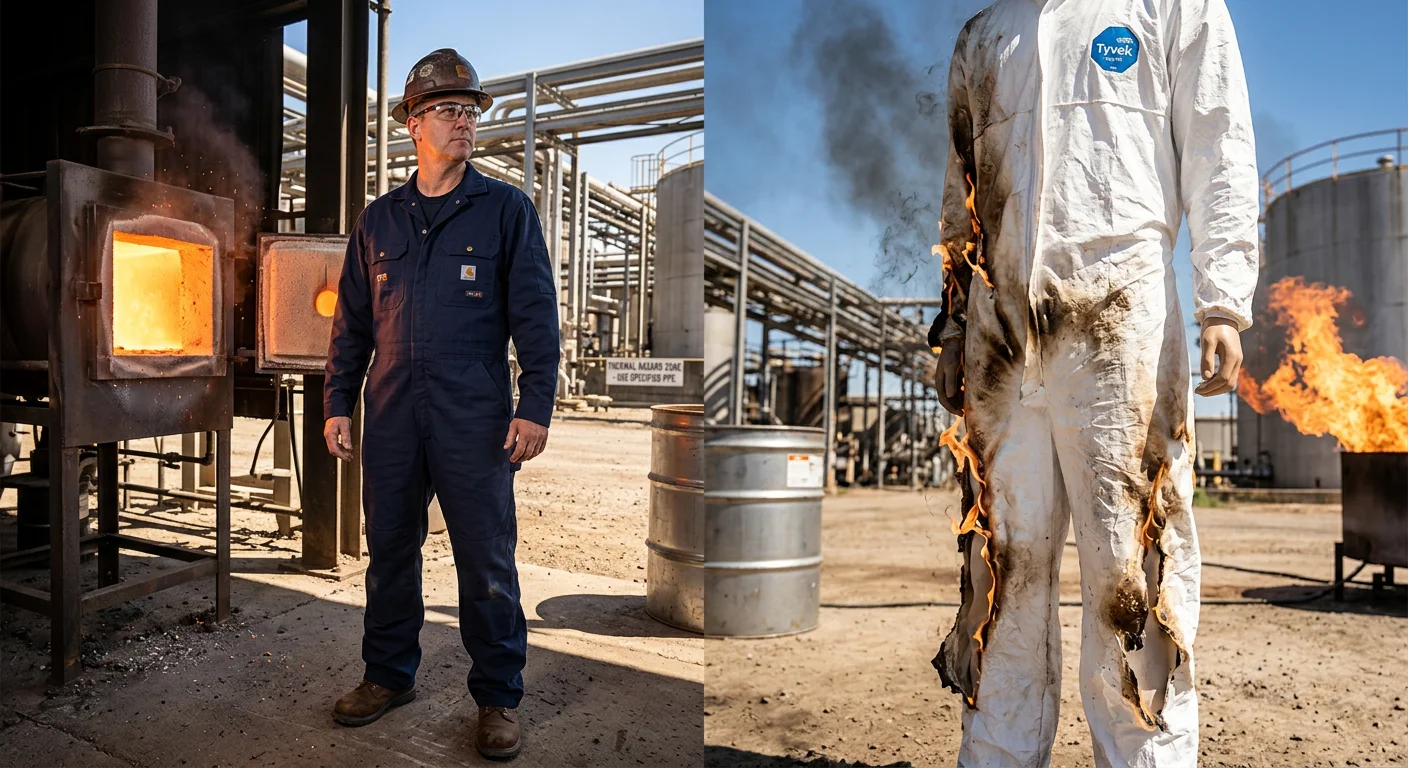
Five hundred hours of direct sunlight. That’s all it takes to strip a standard Tyvek suit of half its tensile strength.
Here’s what happens: UV rays attack the polyethylene fibers at the molecular level. They snap polymer chains and turn flexible material brittle. This process is called photo-oxidation. You’ll see initial cracking between 200 and 300 hours of cumulative exposure. That’s 8 to 12 days of continuous outdoor work. By 500 to 1,000 hours, the suit has lost its structural integrity. Tyvek 400N degrades 40% faster outdoors than indoors under ASTM G155 accelerated testing. There’s no warning sign. The suit just stops protecting you — silently.
UV damage isn’t the only problem. Heat piles on top of it. Outdoor workers pulling 6 to 8-hour shifts between 10 am and 4 pm face 3.5 times the skin cancer risk of indoor workers. Core temperature crossing 40°C triggers a real heat stroke risk. That threshold hits after 4 to 6 hours of sustained physical work. Dizziness is 4.44 times more common outdoors. Weakness, 3.17 times. The suit traps heat against your body and speeds up every one of those outcomes. BLS data recorded 37 sun- and heat-related worker deaths and 2,830 injuries in a single year. Those numbers concentrated in construction and agriculture — the same sectors that rely on Tyvek suits the most.
Working near snow or sand pushes the risk even higher. Reflective surfaces add 20 to 80% to your total UV dose. That cuts the safe exposure window by 25%.
What to Wear Instead of a Tyvek Suit?
Standard Tyvek outdoors has a safe use window of under 4 hours per day, with a UV index below 6. Go past that, and you need a different material.
|
Material |
UV Life (Direct Sun) |
Certifications |
Best For |
|---|---|---|---|
|
Tyvek 400N |
~500 hrs before failure |
ASTM F1670 |
Short-use only |
|
Nomex IIIA |
5,000+ hrs |
NFPA 2112 |
Construction, oil/gas |
|
UPF 50+ FR Coveralls (e.g., Bulwark) |
3,000+ hrs |
EN ISO 11612 |
Agriculture, wildland ops |
DuPont ProShield and Tyvek FlexGrid both include UV inhibitors. They hold up to 2,000+ hours before any meaningful strength loss — 4 times longer than standard Tyvek. For roofing or welding shifts running 8 or more hours, Nomex blocks 99% of UV and won’t melt under high heat. For long agricultural days, UPF polyester blends with reflective coatings beat standard Tyvek across every performance measure.
Switching to the right material cuts heat illness claims by 40 to 60%, per OSHA data. That’s not a small gain — that’s the difference between managing a real risk and pretending it doesn’t exist.
Scenario #4: Immersion, Heavy Rain, or Wet Environments
Thirty minutes. That’s about how long a DuPont Tyvek suit holds up in heavy rain before it turns into a wet sponge strapped to your body.
The culprit is physics. Tyvek’s flash-spun HDPE fibers contain tiny pores — 0.5 to 5 microns wide. In dry conditions, those pores work in your favor. They let moisture vapor escape, keeping you cooler than sealed suits do. In sustained rain above 40 mm/hr, those same pores pull water inward through capillary action. The fabric hits 80–100% saturation. Then liquid breaks through. Full soaking happens within one to two hours. At that point, the suit stops protecting you — it starts pushing water straight against your skin.
The hydrostatic head numbers show the real gap. Tyvek 400 holds up to about 10–15 cm H₂O. A proper PVC or neoprene immersion suit? Over 100 cm. That’s not a minor difference — it’s a separate category of equipment altogether.
|
Rain Condition |
Rate |
Tyvek Safe Window |
|---|---|---|
|
Moderate rain |
10–20 mm/hr |
2–4 hours |
|
Heavy rain |
40–80 mm/hr |
20–45 minutes |
|
Monsoon / pooling |
>100 mm/hr |
5–15 minutes |
OSHA data confirms this: 25% of users report inner wetting after just 30 minutes of heavy rain exposure.
The Layering Workaround (And Its Limits)
In light-to-moderate rain under 40 mm/hr, a layered setup gives you solid protection without losing all breathability. Here’s how to set it up:
-
Put PVC or rubber rain gear on first — fully seam-sealed
-
Wear the Tyvek coverall on top as your chemical splash barrier
-
Pull rubber boots and gloves over the cuffs
This setup keeps 70–80% of Tyvek’s moisture vapor transmission working. Core temperature rise stays under 2°C per hour — compared to 4–5°C inside a standalone PVC.
Rain above 50 mm/hr changes things. Water starts pooling. Any risk of immersion shows up. Drop the layering strategy and go straight to a fully impermeable suit.
What to Use Instead
Past Tyvek’s limits, switch to sealed PVC, neoprene, or Tychem suits . These materials carry hydrostatic ratings built for full submersion — not just surface splash. They hold up where Tyvek fails.
For fast field decisions, two steps help:
-
Check the rain rate — a simple rain rate app gives you a real-time number to work with
-
Run a quick pre-wet test — spray the suit for 10 seconds, then check for inner dryness
Fabric weight gain above 20% means the suit is done. Pull it and replace it.
Scenario #5: Virus Containment or Infectious Disease Environments
Tyvek suits were everywhere during the COVID-19 pandemic. That visibility left a lasting misconception. Healthcare workers in white coveralls made “Tyvek” feel the same as “biohazard protection.” That’s not entirely wrong. But it’s incomplete — and that gap can get people killed.
Here’s what the data shows: Tyvek 400/500 series suits, certified to EN 14126 Type 4B/6B, cut liquid and aerosol exposure risk by 95–99% under controlled conditions. That’s real protection. Yet DuPont’s own specs flag a hard ceiling — viral breakthrough becomes possible beyond 8 hours of continuous exposure. In a high-risk infectious disease setting, 8 hours isn’t a long shift. It’s just a Tuesday.
Aerosols make the gap worse. WHO’s 2020 COVID-19 interim guidance endorsed Tyvek for droplet precautions — spray-based transmission, close-contact scenarios. Airborne transmission is a different story. It needs a full seal. Tyvek doesn’t deliver one. The suit has no SCBA integration, no vapor barrier, and no positive-pressure capability. In practical terms, it sits at a Level C/D equivalent. Ebola aerosol exposure or smallpox containment needs Level A — fully encapsulated, SCBA-equipped, zero-permeability suits rated above APF 10,000.
Where Tyvek Works — and Where It Doesn’t
|
Infectious Scenario |
Tyvek Sufficient? |
Why / Why Not |
|---|---|---|
|
COVID-19 droplet (low-risk contact) |
✅ With layering |
EN 14126 covers droplet splash |
|
COVID-19 airborne (intubation, AGPs) |
❌ |
No seal; airborne mandates full respiratory barrier |
|
Ebola (low-to-moderate risk) |
✅ + N95 + layering |
CDC 2014 guidance supports this combination |
|
Ebola aerosol / BSL-4 breach |
❌ |
NIOSH sims show >20% failure rate at BSL-4 loads |
|
Unknown pathogen, transmission unidentified |
❌ |
Upgrade required until routes are confirmed |
The Layering Protocol That Gets Results
A Tyvek suit used on its own delivers around 70–80% efficacy in infectious environments. That number climbs fast once you build a proper system around it:
-
NIOSH-approved respirator (N95 minimum, P100 preferred) — APF 10–50
-
Anti-fog face shield or goggles — blocks 99% of splash contact
-
Butyl rubber sealing tape (3M 4412N works well) at wrists, ankles, and neck — cuts ingress by 90%
-
Double nitrile gloves (15 mil) plus boot covers
Full Level A gear isn’t always practical. Standard Tyvek alone can feel thin. powered air-purifying respirators (PAPRs) paired with Tyvek sit right in the middle. APF ratings reach 25–1,000. Units run $200–500 versus $2,000+ for Level A gear. They’re also 30% lighter. During the 2014 Ebola outbreak — 24,000 cases — PPE systems built this way cut healthcare worker infection rates by 85%.
The bottom line: you can’t identify the transmission route, so don’t rely on Tyvek alone. It’s a solid tool. It’s not a complete answer.
Scenario #6: Lead Abatement or Dust Environments Exceeding PEL
Lead dust doesn’t announce itself. It settles on floors, window sills, and furniture without a trace — and in pre-1978 homes, it’s almost always there.
Here’s where the Tyvek suit misunderstanding gets dangerous. The suit does work in lead dust environments. Tyvek 400 TY275 and Tyvek Flex 80 TY398 block over 99% of 0.3-micron particles on the outside. That’s real, legitimate protection — for your skin. What it can’t do is stop you from breathing lead in.
OSHA’s lead standard (29 CFR 1910.1025) sets the PEL at 50 µg/m³ as an 8-hour TWA. Power-sanding lead-based paint without dust collection blows past that limit by 10 to 50 times. At those concentrations, a Tyvek coverall is support equipment at best. It sheds dust from your outer layer. It is not a compliance solution.
The mandatory pairing at >PEL: – NIOSH-approved N100/P100 respirator (half or full-face) – HEPA vacuum systems for engineering control – Supplied-air respirator or PAPR if concentrations exceed 10x PEL
EPA’s 2024 rule tightened post-abatement clearance levels. Floors now require ≤5 µg/ft² — down from 10. In federally-assisted housing over $25,000/unit, any detectable lead triggers a full risk assessment. The suit alone won’t get you to compliance. Respirators will.
The 6 Most Dangerous Mistakes People Make With Tyvek Suits
Most Tyvek suit failures aren’t caused by bad equipment. Bad habits cause them — small, repeatable errors that eat away at the protection you’re counting on.
Mistake #1: Skipping the pre-wear inspection.
A pinhole tear is invisible at arm’s length. It’s not invisible to lead dust or biological fluids. Before putting on any disposable protective suit , run your hands across every seam, zipper, and panel. Tiny punctures are all a contaminant needs to get through.
Mistake #2: Rushing the donning process.
Tyvek tears under tension. Step into the legs with care. Feed your arms in without force. Zip from bottom to top in one smooth motion. A ripped suit found mid-task is worse than no suit at all — you’ve already committed to the work.
Mistake #3: Touching the outer surface without reason.
Once you enter a contaminated area, the outside of your suit is the hazard. Every time you touch it with gloved hands, you spread that contamination somewhere else. Touch the outer surface only when the task demands it.
Mistake #4: Reusing a single-use suit.
“It still looks fine” is not a safety standard. Tyvek’s fiber structure breaks down after one use. Material strength drops. Seams weaken. A suit worn twice may offer no real protection at all.
Mistake #5: Doffing without a protocol.
Most cross-contamination happens right here, at removal. Shake the suit, drag it across your legs, let it brush your forearm — and whatever was on the outside is now on you. Peel it inside out. Get rid of it right away. Never let the outer surface touch bare skin.
Mistake #6: Storing suits in poor conditions.
Direct sunlight, temperature swings, and unsealed packaging all break down Tyvek before you ever put it on. Keep suits in sealed bags, away from dust and heat, until you need them.
Each of these mistakes is preventable. None requires new equipment — just discipline.
Quick Reference: Tyvek Suit — Use It vs. Skip It (Scenario Comparison Table)
Every scenario above points to the same truth: Tyvek has a lane. Stay in it, and the disposable Tyvek suit does its job. Step outside it, and you’re carrying false confidence.
|
✅ Use It |
Why It Works |
❌ Skip It |
Use This Instead |
|---|---|---|---|
|
Asbestos / lead dust inspection |
Blocks fine particles; low-linting, abrasion-resistant |
High-concentration chemical splashes (pressurized jets) |
Tychem® with taped seams |
|
Pest control (dusts, sprays, bed bugs) |
Shields skin from irritants and residues |
Opioid / drug response (vapors, fluid contact) |
Tychem® Level B hazmat |
|
Industrial cleaning / waste treatment |
Repels water-based liquids; light but strong |
Flash fire or thermal exposure |
FR-rated coveralls |
|
Nuclear / radioactive dust (plants, labs) |
Tyvek 800J blocks radioactive particles |
High-radiation + vapors / heavy liquids |
Tyvek 800J or Level B hazmat |
|
Mechanics (oil, fuel, grime) |
Repels liquids; tough enough for shop work |
Chemical plants (gases, vapors) |
Tychem® or Level C suiting |
|
Environmental remediation (particulates) |
Breathable; barrier holds up against abrasion |
Rodent or bloodborne pathogen response |
Tychem® biohazard garment |
The pattern is clear: Tyvek handles particles, light water-based liquids, and biological splashes. Vapors, gases, pressurized chemicals, and heat — it does not. Picking the right suit for the hazard type is not a small detail. It’s the whole point.
How Long Can You Wear a Tyvek Suit? (Wear Duration Limits)
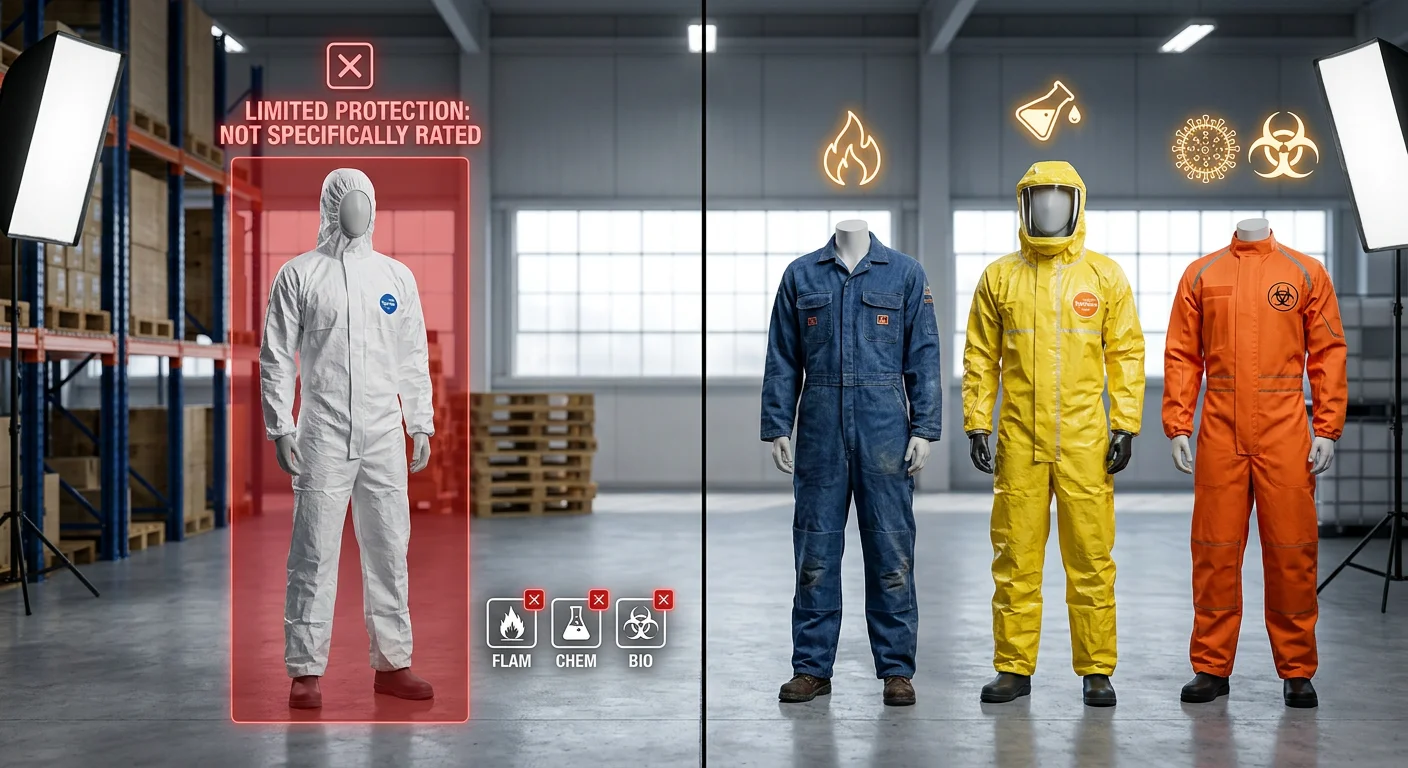
No clock tells you when a Tyvek suit is done. DuPont’s own specs confirm it — there’s no official time limit. No 4-hour rule. No shift-length mandate. The suit is finished when it is finished. The signals are physical, not time-based.
The real wear limit is condition-based, not time-based:
-
Torn seam or puncture → dispose of it now
-
Hazardous contamination → single use, full stop
-
Heavy soiling → don’t push it; replace it
-
Clean and undamaged → reusable, but inspect it every time before putting it back on
Industry benchmarks do give you a practical working window:
|
Condition |
Recommended Limit |
|---|---|
|
Low exertion, cool environment |
4–8 hours |
|
Heavy physical labor |
Reduce by 20–30% |
|
Temperature above 90°F |
Cap at 4 hours |
One hard limit worth knowing: Tyvek melts at 135°C (275°F). It is not flame-resistant. No amount of extra wear time changes that fact.
Sterile versions like Tyvek IsoClean carry a shelf life of 5 years unopened. That’s about packaging integrity, though — not how long you can wear the suit.
Three steps to follow every time: inspect before use, monitor the suit during wear, and dispose of it if you spot any damage.
FAQ: Tyvek Suit Safety Questions Answered
Most questions about Tyvek suits come down to the same few topics. Here are direct answers.
Can you wash and reuse a Tyvek suit?
No. DuPont doesn’t recommend washing for the Tyvek 400 series. These are single-use garments. Washing breaks down the fiber structure. It also risks spreading contamination you thought you removed. The suit gets a second use only if it never touched hazardous materials and shows zero damage. Check every seam and panel before you try.
Is a Tyvek suit waterproof?
Not really. It handles light splashes and aerosols — that’s what the Type 5/6 rating covers. Sustained liquid exposure, chemical immersion, or heavy rain gets past the seams. Bound seams reduce this risk. They don’t make the suit liquid-tight.
Can I use it for asbestos or spray painting?
Yes to both — but with conditions.
-
Asbestos: Size up one size. This prevents stress tears while you move. Tape any glove-to-sleeve gaps with duct tape.
-
Spray painting: Tyvek handles paint overspray and light splashes well.
Neither use covers chemical immersion or vapor exposure. Keep that in mind before starting either job.
Is Tyvek flame-resistant?
No. It’s flammable. Arc flash, flash fire, thermal exposure — grab FR-rated coveralls instead, every time.
Conclusion
A Tyvek suit is a useful piece of kit — right up until the moment it isn’t. That line between “adequate protection” and “false sense of security” is where injuries happen. Now you know where that line sits.
The key point is straightforward: Tyvek protects against dry particulates and light splashes. It does not protect against chemical immersion, fire, infectious pathogens at clinical levels, or environments that push past its material limits. Grab the wrong suit for the wrong job, and the coverall becomes a liability, not a shield.
Before your next job, run the scenario through the comparison table above. Pay attention to three things:
-
The chemical concentration
-
The heat index
-
The exposure duration
Any hesitation on these points is your cue to upgrade your chemical protective clothing to something rated for the actual hazard. Don’t talk yourself into a suit that isn’t built for what you’re facing.
The suit that saves you is the right one for the job. Not just the one on the shelf.