

Choosing the wrong hard hat isn’t just a bad purchase — it’s a liability. MSA has spent over a century building safety equipment that construction crews, electricians, and industrial workers stake their lives on. Does the reputation still hold up in 2026?
Outfitting a full crew or replacing a worn-out lid — this review cuts through the marketing noise. You’ll find out what the MSA hard hat delivers on real jobsites. You’ll also see where it falls short.
We’ll compare models and break down the ANSI Z89.1 ratings that matter for your work environment. By the end, you’ll know whether MSA is the right buy — or whether you should look elsewhere.
Is the MSA Hard Hat Worth Buying in 2026? (Quick Verdict)
Short answer: Yes — but only if your jobsite demands it.
MSA earns its place on worksites where the stakes are real. The Skullgard model is rated for 350°F radiant heat. That makes it the go-to choice for steel mills, oil refineries, and open-pit mining — places where standard helmets fall short. The MSA V-Gard hard hat is built from high-density polyethylene with a UV inhibitor. You get a lightweight shell and a FastTrack ratchet suspension that holds up comfortably through a full shift.
The numbers back this up. MSA models land inside the top five across multiple independent 2026 rankings. The Skullgard holds #5 in Best Hard Hats 2026 for ANSI-certified industrial protection. The V-Gard Full-Brim claims #3 on a separate top-five list.
Where MSA falls behind:
-
Carbon fiber options like the LIFT Dax are lighter by a clear margin
-
Honeywell’s Matterhorn leads on Type II side-impact protection
The bottom line — You’re an ironworker, welder, or safety manager outfitting crews for high-heat or high-voltage environments? MSA’s 100+ year track record and USA-made build quality justify the price. For lighter-duty sites, cheaper options get the job done just as well.
MSA V-Gard Hard Hat Review: The Jobsite Workhorse
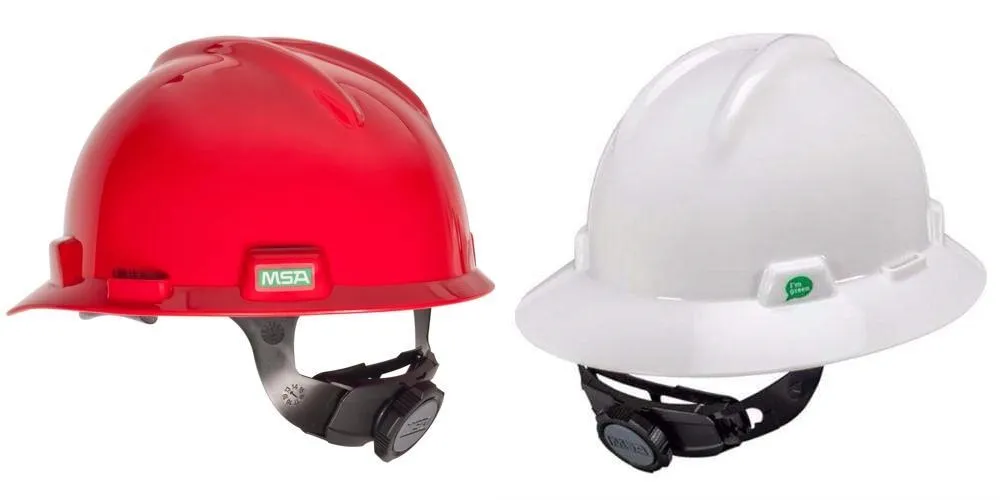
The V-Gard has been on job sites longer than most of the workers wearing it. That iconic V-crown shell isn’t just cosmetic. It stiffens the high-density polyethylene structure and pushes impact energy away from your skull. After more than six decades on the market, this MSA safety helmet still scores 91 out of 100 in independent performance testing. Protection alone pulls 29 out of 30. Accessories max out at a perfect 10.
Here’s what that looks like in real numbers.
Shell, Brim, and the Choice That Matters
You’ll pick between two shell setups — standard brim or full-brim. Most buyers don’t think hard enough about this decision, but it makes a real difference.
The standard V-Gard keeps the profile low and snag-free. It’s the go-to for overhead work where a wide brim catches on forms and framing. The full-brim version adds 360° coverage. It shades your neck and face and delivers 12% greater total sun protection. For outdoor crews doing August concrete pours or exposed steel work, that extra coverage adds up over a full season.
Vented vs. Non-Vented: Don’t Get This Wrong
This is where a lot of buyers make a costly mistake.
The vented V-Gard runs 7 to 11°C cooler inside the shell than a standard white or black hard hat under peak sun. Working a hot-climate site with no electrical exposure? Vented is the clear choice.
But ANSI and CSA guidelines are firm: vented shells cannot be used in Class E electrical environments. The openings break the dielectric seal. Non-vented V-Gard models handle up to 20,000 volts — the vented version does not. Get this wrong, and your hard hat certification means nothing.
Suspension System and All-Day Comfort
The Fas-Trac III 4-point ratchet suspension does the heavy lifting under the shell. It spreads the load across four contact points. That cuts pressure fatigue during long shifts.
The V-Gard C1 Full-Brim takes it further. It adds a moisture-wicking sweatband and MSA’s ReflectIR™ barrier — an infrared-reflective liner that keeps the interior 11°C cooler than a comparable black hard hat. For ironworkers and outdoor crews, that temperature difference builds up over an eight-hour day.
The system also arrives accessory-ready. You get built-in slots for face shields and earmuffs, plus integrated chinstrap anchors. That last detail matters in elevated work.
Bottom line on the V-Gard: it’s not the lightest hard hat out there, and it won’t beat a dedicated Type II hard hat on lateral impact protection. What you get is a proven, flexible platform. It covers multiple work environments, handles a wide range of certifications, and earns its 18 out of 20 comfort score on real jobsites — not just in a lab.
MSA Skullgard Hard Hat Review: Built for Extreme Heat
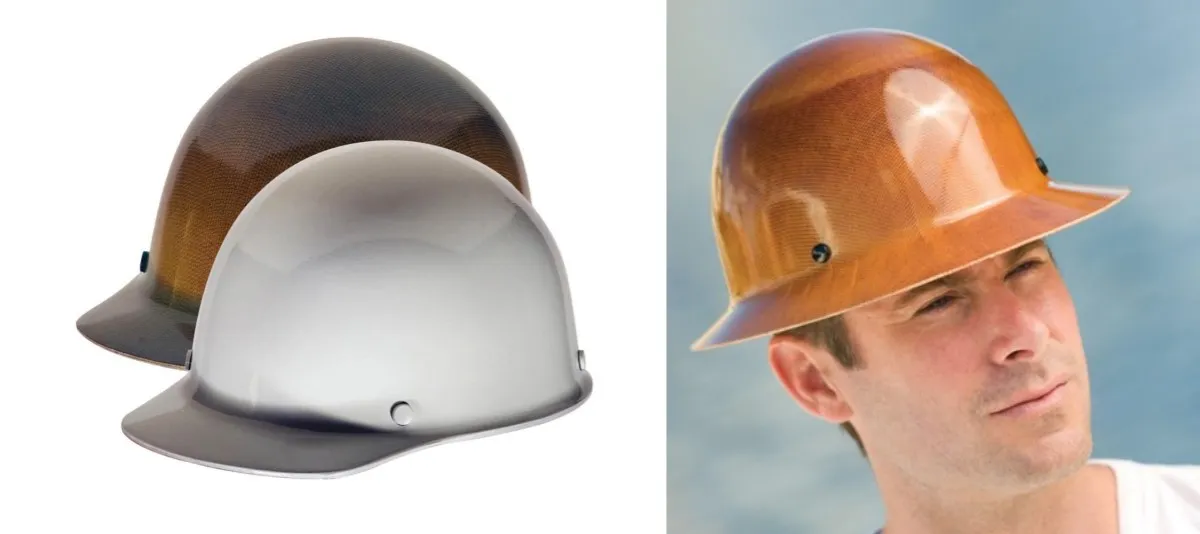
Steel mills don’t forgive mistakes. Neither does a furnace floor, a casting bay, or a shipyard where sparks fall like rain. MSA built the Skullgard for those environments — places where a standard HDPE shell would soften, warp, or fail long before the shift ends.
The shell is phenolic resin or fiberglass. That material choice matters. It lets the Skullgard handle radiant heat up to 350°F (177°C) — a threshold most competitors can’t touch. Welders, foundry workers, and smelting crews aren’t buying this hard hat for comfort features. They’re buying it because their environment demands it.
Certifications and Electrical Protection
The Skullgard carries ANSI Z89.1 Type I, Class G certification. That covers top-impact protection and low-voltage electrical protection up to 2,200 volts. It’s not Class E territory. Working on high-voltage lines? Look at the V-Gard instead. For heat-intensive jobs where the Skullgard belongs, Class G coverage does the job.
Suspension Options and Real-World Fit
Two suspension setups are available:
-
FasTrac III 4-point ratchet — single-hand adjustable, built to cut pressure points across long shifts
-
Staz-On 4-point ratchet — solid and stable, built for extended wear
The smooth crown design is one thing most reviewers miss. It stops the hat from snagging as you move through tight spaces around equipment. The full brim adds 360° protection — it blocks sun, rain, sparks, and debris from hitting your neck and face at the same time.
Workers describe the fit as tight and secure. The sweatband is non-absorbent, but it washes clean with no trouble. Shipbuilding and foundry crews call it “trusty” and “tremendously impact-resistant.” Those aren’t marketing words — that’s real feedback from people putting in full shifts.
Where It Falls Short
The Skullgard is purpose-built, and that focus cuts both ways. The LIFT DAX carbon fiber helmet offers better suspension adjustability and a more absorbent sweatband. For general construction or light-duty sites, the Skullgard is overkill — heavier, stiffer, and priced to match.
Buy the Skullgard if your jobsite involves extreme heat. No extreme heat? The V-Gard handles most other scenarios better.
MSA V-Gard 500 Vented Cap Review: Comfort-Focused Option
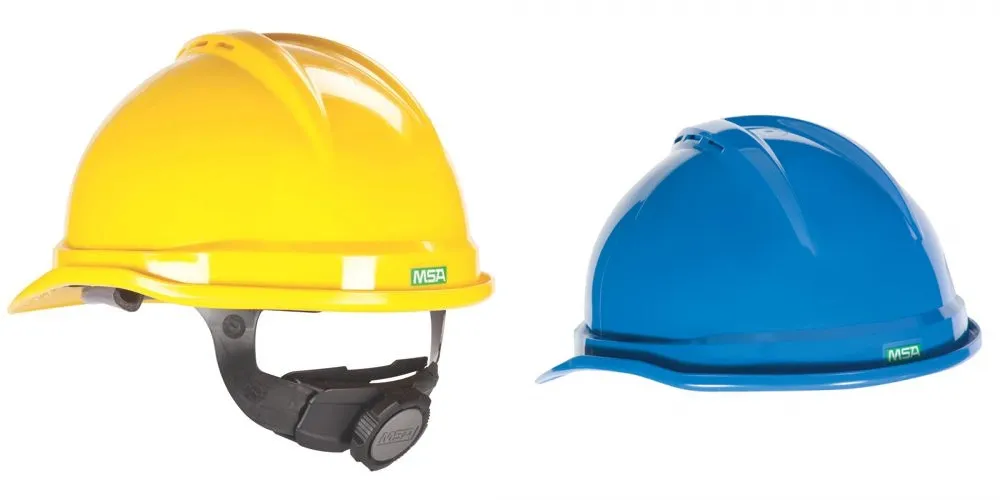
Roofing crews and plant maintenance workers know this feeling — slow, grinding heat building up inside a shell that never breathes. The V-Gard 500 Vented Cap was built to fix that.
Crown vents sit at the top of the shell. They pull heat out as you move. Add the optional large vents, and airflow increases even more. Pair those with the extended rain trough that wraps the full brim perimeter. You get a helmet that handles a July pour and a sudden afternoon downpour — without making the working space underneath miserable.
Comfort Features That Hold Up on the Job
The V-Gard 500 earns its comfort-focused label through real details. Not marketing copy.
-
Lateral contours above the ears — hearing protection clips are tight and clean. No pressure points building into headaches by noon
-
Glaregard™ underbrim surface — cuts reflected glare from concrete and standing water. A small thing until the sun hits at the wrong angle
-
Absorbent moisture-wicking sweatband — pulls sweat away fast instead of just soaking it up
-
Lightweight HDPE or ABS shell — keeps fatigue low across a full shift
The 4-point or 6-point ratchet suspension adjusts from 6½ to 8 inches in diameter. Pinlocks at the back set the height. The neck ratchet controls tension. One person, thirty seconds — locked and personalized fit done.
The Certification Trade-Off You Cannot Ignore
The V-Gard 500 hard hat meets ANSI Z89.1-2014, CSA Z94.1-15 , and AS/NZS standards. It carries Type I classification — solid top-impact protection.
But those ventilation slots come at a cost. The V-Gard 500 is Class C rated. That means zero electrical protection. Keep it off any site with live electrical hazard exposure. This isn’t a design flaw — it’s an honest engineering trade-off. Does your work involve electrical risk? The non-vented V-Gard handles up to 20,000 volts. Pick the right tool for the job.
Construction, oil and gas, confined space work, plant turnarounds — anywhere electrical exposure isn’t a factor? The V-Gard 500 is the most livable hard hat in the MSA lineup. That’s saying something for a brand that has put over 100 million V-Gard helmets on workers worldwide.
MSA Hard Hat vs Pyramex vs 3M: Head-to-Head Comparison
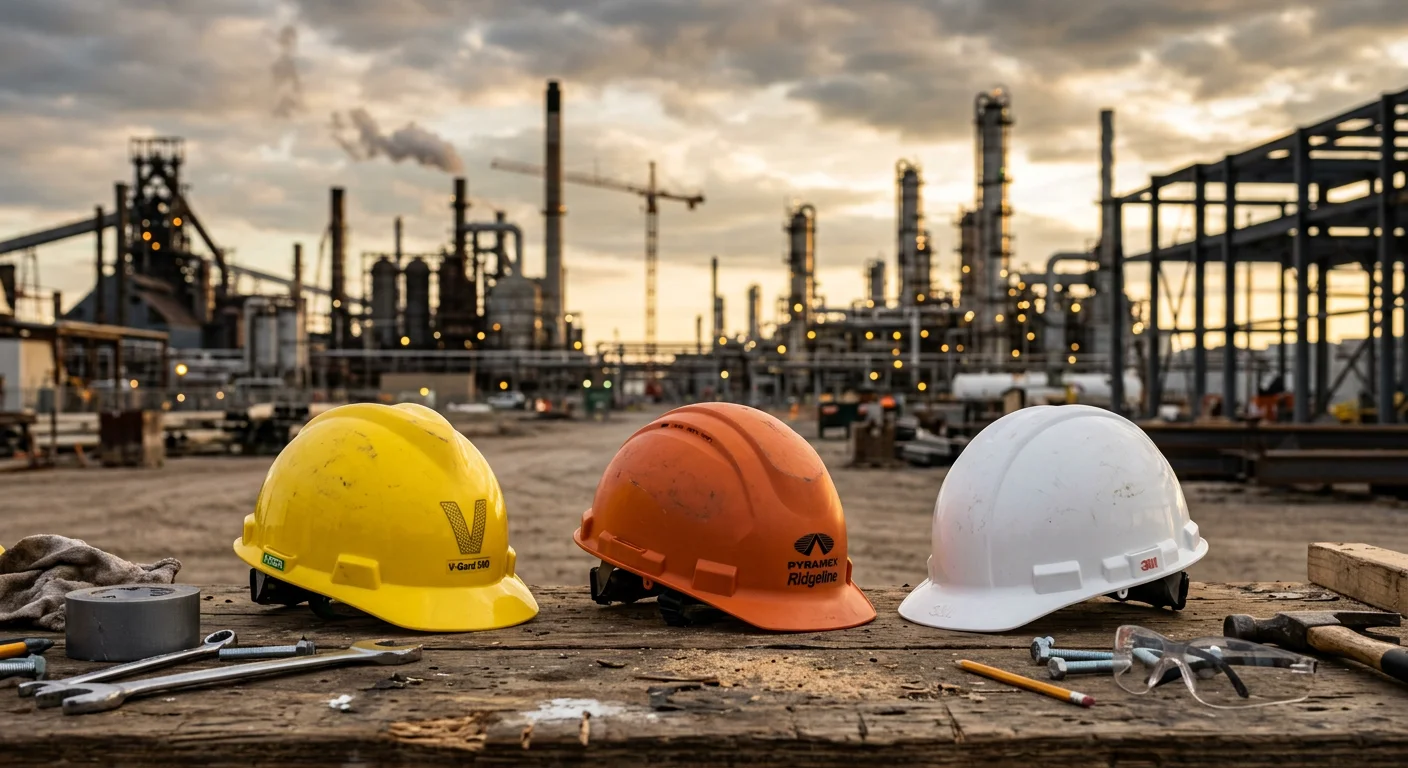
Three brands dominate every safety manager’s purchase order. MSA holds the legacy position. Pyramex has been eating into that market share with aggressive pricing. And 3M sits in the background — well-known for PPE, but thin on hard hat data when you go looking.
Here’s what the numbers say.
Weight and Airflow: Where Pyramex Wins
The Pyramex Ridgeline full brim comes in at 12.6 oz. The MSA V-Gard sits at 14.4 oz. That 1.8 oz gap sounds trivial. Get six hours into a summer pour with your neck carrying the full load, and it stops sounding trivial fast.
Pyramex runs its suspension higher off the skull. That extra clearance pushes more air between the shell and the scalp. On hot-weather sites, the V-Gard’s tighter fit works against you. Pyramex’s open design doesn’t.
MSA hits back on feel. Most workers and site managers rank the Fas-Trac III ratchet suspension as the smoothest in this category. It’s single-handedly adjustable. Secure, but not punishing. Pyramex’s 6-point system is solid — it just doesn’t match that ratchet action.
Safety Certifications: A Dead Heat
Both hard hat brands carry full ANSI/ISEA Z89.1 compliance. Both offer Type I and Type II shells. Both cover Class C, G, and E electrical ratings. On paper, there’s no real certified safety gap between them in standard testing.
MSA does pull ahead in one specific area: extreme heat. The Skullgard carries a 350°F radiant heat rating. Pyramex has nothing that matches it. That’s not a V-Gard feature either — the Skullgard is a separate product built for steel mills and foundries.
One benchmark worth noting: Virginia Tech’s STAR Rating System tests oblique fall scenarios across 12 laboratory impacts per helmet. Type II helmets outperform Type I on rotational acceleration — not by a small margin. Do your workers face fall hazards? That rating matters more than brand loyalty.
Accessories and Long-Term Value
This is where MSA pulls clear. The V-Gard platform supports a full PPE ecosystem — integrated face shields, hearing protection mounts, winter liners, and more. Everything fits together. No workarounds needed.
Pyramex has expanded its accessory lineup in recent years. It still trails. Building a complete kit from a single supplier? MSA’s infrastructure wins that argument.
What about a 3M Hard Hat?
Honest answer: the comparative data isn’t there. The 3M’s hard hat catalog is too thin for reliable head-to-head testing against MSA or Pyramex. The Kask Superplasma HD comes up in premium segments, but that’s a different product category at a different price point.
Cross-shopping MSA against 3M? MSA wins by default. Not because 3M makes an inferior product, but because 3M doesn’t compete in this space at the same scale. The product range just isn’t there.
The Decision Framework
|
Pyramex Ridgeline |
MSA V-Gard |
|
|---|---|---|
|
Weight |
✅ Lighter |
— |
|
Airflow |
✅ Better clearance |
— |
|
Suspension feel |
— |
✅ Fas-Trac III |
|
Accessory ecosystem |
— |
✅ Full PPE platform |
|
Extreme heat |
— |
✅ Skullgard variant |
|
Price |
✅ Lower |
— |
|
ANSI certification |
Equal |
Equal |
Pick Pyramex if weight and budget are driving the decision. Long summer shifts are brutal. Pyramex’s lighter shell and higher suspension clearance will feel noticeably better by the end of the day. Your crew’s neck fatigue drops. That matters on a 10-hour pour.
Pick MSA if you’re standardizing a full crew kit, need Fas-Trac suspension, or your site deals with extreme heat or high-voltage exposure. The MSA hard hat accessories ecosystem alone justifies the price premium. One platform, one supplier, everything fits. For anyone building a complete PPE setup, that’s a real operational advantage.
MSA Hard Hat Suspension System & Accessories: What You Can Customize
The suspension system is the part most buyers ignore — until it fails them at hour seven of a ten-hour shift.
MSA gives you two main options. They are not interchangeable.
Fas-Trac III is the flagship. Hundreds of workers gave direct input during its design. You get 4-point and 6-point configurations. The ratchet turns with one hand — no fumbling. Flush rear lug attachments cut out the pressure points that make a long shift miserable. Three nape strap adjustments let you lock in the fit with real control, not guesswork. The comfort pad at the back shapes to your skull, boosts airflow, and stops hair-pulling. That last detail sounds small. By midday, it isn’t.
Staz-On is the simpler system. It snaps in without tools, fits head sizes 6½ to 8 inches, and comes with a built-in sweatband. Swapping it out takes minutes. No downtime, no specialist needed. One hard limit to know: Staz-On works only with its designated Staz-On models. It does not cross over to other MSA lines or third-party shells.
Accessories Worth Knowing About
MSA also covers a solid range of practical accessories:
-
Hard hat liners for cold-weather work
-
Chin straps for elevated environments
-
Reflective striping for low-visibility sites
-
Lamp attachments, sunshades, and headbands
One key point — a new suspension restores fit and comfort, not impact certification. The shell’s safety rating is tied to the shell itself, not what’s inside it. Check accessory compatibility with MSA before buying anything outside the standard lineup. Your certification depends on getting this right.
MSA offers custom logo and artwork services through its authorized channels. Keep in mind that customized units lose free shipping eligibility.
Who Should Buy an MSA Hard Hat (And Who Shouldn’t)
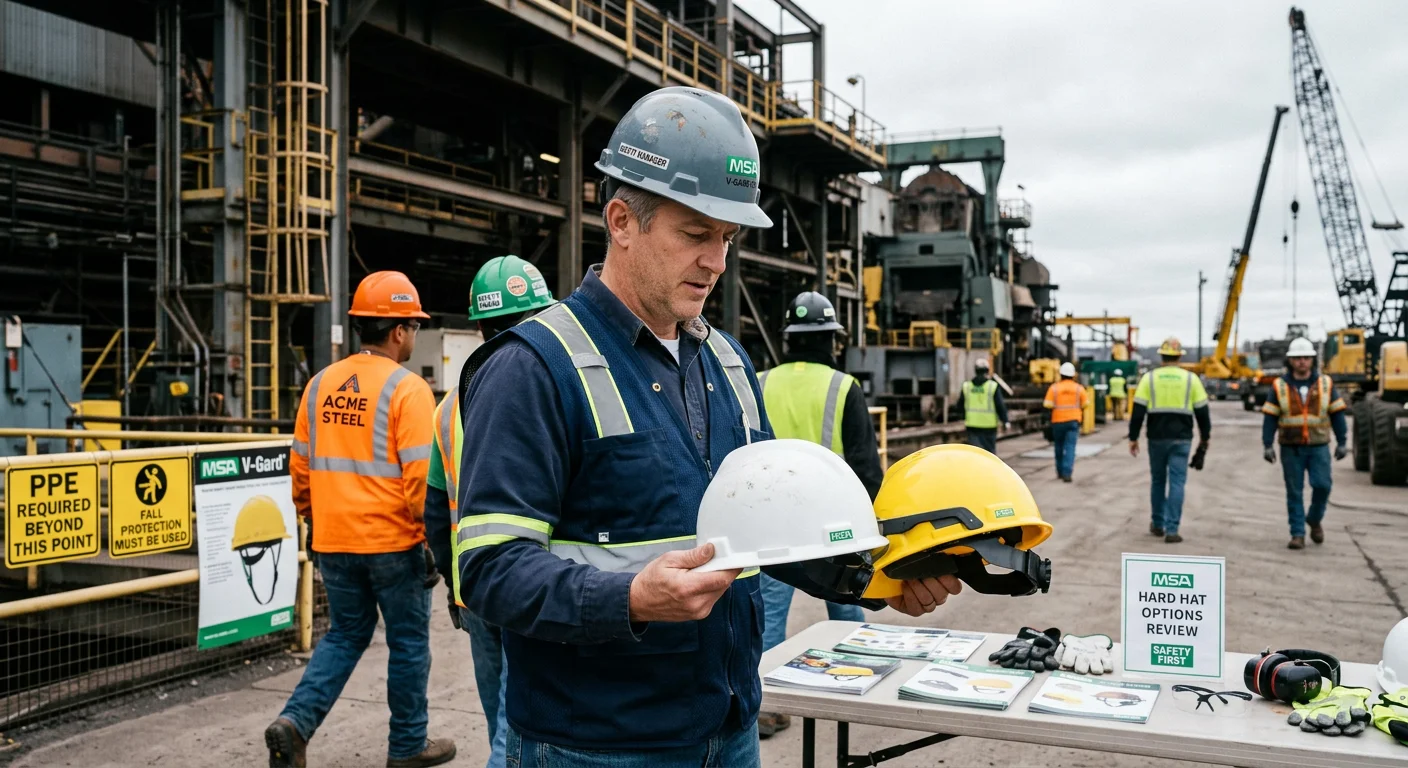
The job site tells you what you need. MSA is the right answer for some workers and a waste of money for others. Here’s how to sort it out fast.
Buy MSA If You’re In These Situations
Electricians working live circuits — Class E protection handles up to 20,000V AC phase-to-ground. That’s not a feature you skip on. Get the Non-vented V-Gard for this job. The vented version breaks the dielectric seal. Don’t mix them up.
Foundry and steel mill workers — The Skullgard is built for you. It uses a fiberglass phenolic resin shell. It holds up to 350°F of radiant heat. The design has taken 12+ years of heavy industrial punishment. Nothing in the generic market comes close.
Safety managers outfitting large crews — Run the numbers straight. MSA units run $50+ each. Generic Type I Class G runs under $20. But MSA shells last 3–5 years. Fiberglass models last for over 10 years. Over a 5-year period on 100 units, the MSA total cost lands around $15,000. Generic alternatives climb past $20,000 through constant replacement cycles. The premium pays for itself.
Skip MSA If This Describes Your Work
Light renovation and low-risk indoor jobs — Class C polycarbonate options cover impact and puncture. No electrical hazard means no reason to pay the MSA premium. You’d be buying certification you’ll never need.
Short-term contractors replacing gear every six months — The helmet won’t last long enough to close the price gap. A basic Type I Class G under $20 does the job. Replace it on schedule and move on.
The Quick Decision Framework
Before buying, work through three questions in order:
-
Where is the impact risk? Crown only = Type I. Lateral exposure near moving equipment = Type II.
-
What’s the voltage exposure? High voltage = Class E. Low voltage = Class G. None = Class C.
-
How long will it stay in service? Under a year, go budget. Multi-year use, MSA’s lifecycle cost beats the rest.
Match those answers to the right model. The certification means nothing if the product doesn’t fit the hazard.
MSA Hard Hat Price & Where to Buy in 2026
MSA pricing in 2026 covers a wide range — and that range tells you something useful.
The entry-level V-Gard starts at $24.69 per unit through industrial suppliers like FullSource.com. The V-Gard 930 series moves into the $60–$100 range. Skullgard and thermal variants fall between $50–$90, based on configuration.
Where you buy matters as much as what you pay:
-
MSASafetyShop.com — Official channel. Bulk pricing runs €17.90–€73.50 per unit. Certification is guaranteed.
-
FullSource.com — Industrial specialist. Fast shipping. Solid choice for bulk orders.
-
Amazon — Convenient, but check the seller first. Counterfeit MSA helmets exist. They fail impact tests by up to 50%.
One hard rule: skip steep discounts from unverified sellers. Pre-2023 shells stored in unauthorized warehouses may already be outside the 3-year shelf certification window. Every genuine MSA unit carries a hologram and batch code. Those aren’t decorations — they’re how you confirm the helmet is real and not a liability.
Buy direct or through an authorized distributor. Everything else is a gamble.
FAQ: MSA Hard Hat Common Questions Answered
Most of the confusion around MSA hard hats comes down to the same handful of questions. Here are the ones that matter most.
How long do MSA hard hats last?
The shell of MSA hard hats gets five years from the date of first use. The suspension gets twelve months, not five years. Your helmet sat in a warehouse for two years before anyone put it on? Those two years count against the clock. A shell that’s three years old with 36 months of storage time behind it has already expired. It never made it to the jobsite with valid protection.
When do I replace it right away?
The moment it takes an impact. Also: visible dents, surface scores that thin the shell, or suspension straps that are frayed, ripped, or show damaged stitching. A hairline crack is enough. Don’t talk yourself out of it.
Class E vs. Class G — what’s the actual difference?
-
Class G : holds 2,200 volts for one minute
-
Class E : holds 12,000 volts for three minutes
-
Class C : no electrical protection, full stop
NFPA 70E is clear — arc flash environments require Class E. That’s not a suggestion.
Type I vs. Type II — the short version?
Type I covers top impact. That’s it. Type II covers top and lateral impact. Are you working near moving equipment or machinery at shoulder height? Type II is the right call.
Can I wear a baseball cap underneath?
No. The gap between shell and skull is part of what makes the protection work. A cap compresses that gap. A metal button on the cap wipes out dielectric protection.
Can I reverse my V-Gard and wear it backwards?
Yes — on standard V-Gard models. The suspension attachment points match front to back. Flip the suspension so the nape strap sits at the rear. UniPro suspension models don’t work the same way. Check your specific model before doing this.
Can I swap in a suspension from another hard hat brand?
No. The helmet earned its certification as a complete system. Put a third-party suspension inside an MSA shell, and the ANSI certification is void. Impact protection drops — or disappears. Use the suspension built for your specific model and size. Nothing else.
How often should I inspect MSA hard hats?
Before every shift. A crack too small to spot clearly still weakens the shell. UV exposure, temperature swings, and chemical contact all eat away at protective properties over time — and you won’t see it happening. Daily checks are the way to catch problems before they cost you.
Conclusion
MSA has spent decades on the world’s toughest job sites. The track record speaks for itself.
The MSA V-Gard hard hat is one of the best buys in personal protective equipment. It’s ANSI Z89.1-certified. The suspension systems hold up through a full shift — not just the first hour. The model lineup covers high-voltage electrical work, radiant heat environments, and everything in between. You’re not paying for a logo. You’re paying to stop worrying about your head protection.
One thing to take from this review: cheap hard hats exist. The consequences don’t.
-
Most workers — the standard V-Gard is the right call
-
Electricians — step up to Class E, no shortcuts
-
Hot environments — go with the Skullgard, full stop
Ready to buy? Check current pricing on Amazon or Grainger. Filter by the ANSI class your job site requires. That one step cuts through all the options fast.