

Tucking a full head of long, thick hair into a bouffant cap can feel impossible. But it’s not. The right cap fits — and fits well. Before you buy, it helps to know why.
A good bouffant hair net cap doesn’t just sit on your head. It works with your hair volume, not against it. That matters whether you’re heading into a hospital shift, a food production line, or a salon backroom.
This guide covers everything you need:
- How to find the right fit and size
- How to wear it correctly
- What to look for before buying
Use it to pick a bouffant cap that handles thick, long hair with ease — no guesswork needed.
Do Bouffant Caps Fit Long or Thick Hair?
 Yes — and not just barely. Bouffant caps are purpose-built for this kind of hair.
The dome-shaped design isn’t an accident. That rounded interior holds volume — thick braids, long layers, dense curls — without pressing your hair flat against your scalp. It’s roomier than it looks. That’s the whole point.
Here’s what makes the fit work for long or thick hair:
- Dome-shaped interior creates vertical space so your hair volume has room to grow
- Elastic edge band hugs the hairline without squeezing out bulk
- Loose-fitting construction gives you full coverage without a tight, uncomfortable feel
- Lightweight, breathable materials — spunbond polypropylene or polyester — keep your head cool during long shifts
Compare that to a standard hair net. It works for short-to-medium hair and not much else. A bouffant cap is a different tool for a different job.
One practical tip for long hair: tie your hair first. A low bun or loose knot works well. Then pull the cap over and place the elastic band along your hairline. The closure ends should sit just behind each ear. That one step gives you cleaner, more secure coverage.
Most bouffant caps come in S through XL, so sizing isn’t a guessing game. The right size is out there. You just need to know what to look for.
Bouffant Cap Size Guide for Long and Thick Hair (How to Choose the Right Size)
 Size matters here — and getting it wrong is the most common reason a bouffant cap fails for high-volume hair.
The good news: bouffant caps come in a range of sizes built to fit different hair types, from standard cuts to thick, waist-length hair. Know your size before you buy. It saves a lot of frustration.
Start With Your Head Circumference
Grab a soft measuring tape. Wrap it around the widest part of your head — just above your ears and across your forehead. That measurement is your starting point. Everything else — hair volume, length, personal preference — builds on top of it.
Most manufacturers offer sizes spanning 19″, 21″, 24″, and 28″ in diameter, with ranges going from XS to 2XL depending on the brand.
Here’s a simple sizing reference:
| Hair Type | Recommended Size | What to Expect |
|---|---|---|
| Standard / average hair | 21″ | Fits most users well |
| Long or thick hair | 24″ | Extra room for volume and length |
| Very long or very thick hair | 28″ | Maximum interior space, full coverage |
A Few Rules Worth Following
- Not sure? Size up. Your measurement lands at the edge of a size range — go larger. Hair volume adds more bulk than most people expect.
- Head shape varies. Two people with the same measurements can get different fits based on hair density alone. Use sizing charts as a guide, not a guarantee.
- Order a sample box first. Test before you commit to bulk or custom orders. That’s the surest way to see how a specific cap handles your hair.
For bouffant surgical caps and other medical-use styles, sizing runs S through XL — and full hairline coverage is non-negotiable, not optional.
How to Wear a Bouffant Cap with Long or Thick Hair (Step-by-Step Fitting Guide)
Getting the fit right takes two minutes — once you know the sequence.
Most people skip the prep and go straight to pulling the cap on. That’s where things go sideways. A bit of prep before the cap touches your head is what separates a secure fit that lasts a full shift from one that starts sliding by hour two.
Before You Put the Bouffant Cap On
Start with clean, dry hair. Oil and sweat break down the cap’s inner material faster. In medical or food-safe settings, that’s a real problem. Skip the large hair accessories. Bobby pins or small clips are fine for loose strands or bangs. Anything bulky creates an uneven surface that the elastic has to fight against.
Then wash your hands. It’s a small step. Easy to skip. Don’t skip it.
Now choose your hairstyle. This part matters more than most people think:
- High bun at the crown — Twist hair up and secure it at the top of your head. This keeps the bulk away from the nape and sides, where gaps tend to form.
- Braid — French, Dutch, or fishtail all work. Secure the end with a hair tie, then coil it in a flat loop so it sits even under the cap.
- Half-up style — Secure the upper half in a bun or ponytail, leave the lower half loose. The cap holds both layers in place without bunching.
Putting the Cap On — Four Steps
Step 1: Open it wide. Hold the bouffant hair cap with both hands and expand it from the inside — like inflating a bag. Get the full dome shape before it goes anywhere near your head.
Step 2: Lead with the front edge. Tilt your chin down a little. Place the front of the cap right at your natural hairline, just above your brows.
Step 3: Stretch and pull back. Draw the elastic over your head toward the back. Let it settle close around your skull and ears — not tight enough to dig in, but secure enough that it won’t shift.
Step 4: Tuck everything in. Check the nape, the sides, and the area around your ears. Those spots are where stray strands escape. Press them in with your fingers. The two closure ends should land just behind each ear — not on your forehead, not on top.
Run a quick check. Press one hand flat against the cap’s surface. The cap moves more than a half-inch? The elastic isn’t seated right. Re-position and try again.
That’s the whole process. Under two minutes. And the fit holds.
Bouffant Cap vs Hair Net for Long Hair: Which Offers Better Coverage?
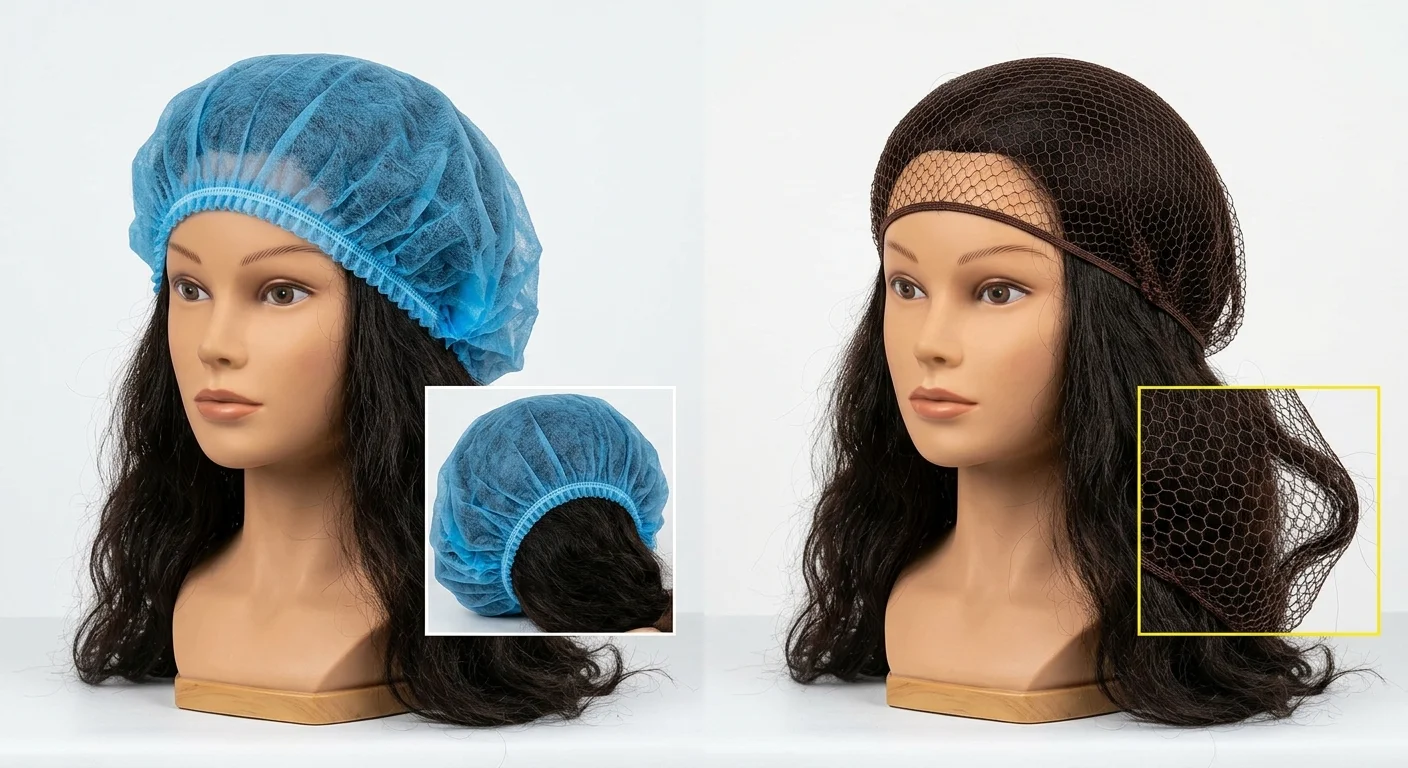 The hair net has been around forever. It’s cheap, lightweight, and breathable — and for short hair in low-stakes settings, it does its job. But put a hair net up against a full head of long, thick hair, and the limitations show up fast.
The mesh is the problem. Those tiny honeycomb openings that make a hair net breathable? They’re also what lets strands escape. For long, high-volume hair, that’s not a minor inconvenience — it’s a failure mode. One escaped strand in a food processing facility or sterile operating room causes real problems. The risk is serious.
A pleated bouffant cap closes that gap — for real. Solid non-woven polypropylene fabric has no openings at all. No openings means no escape routes. Hair stays where it belongs: inside the cap, not drifting onto a sterile field or into a food product.
Here’s how the two options compare for long hair:
| Feature | Bouffant Cap | Hair Net |
|---|---|---|
| Hair coverage | Full — hair, scalp, ears, nape | Partial — mesh gaps allow shedding |
| Volume capacity | Spacious dome fits long hair, buns, braids | Snug fit, struggles with bulk |
| Containment | Solid fabric, no openings | Mesh openings permit stray strands |
| Material | PP nonwoven, fluid-resistant options | Nylon/polyester mesh, no liquid barrier |
| Best for | Long/thick hair, medical, food-safe environments | Short/medium hair, light-duty tasks |
Which One Belongs in Your Setting?
Industry context does a lot of the deciding here:
- Food service — Hair nets work fine for short hair. For long-haired workers, bouffant caps handle the volume that hair nets can’t hold in. There’s no real workaround with mesh.
- Medical and cleanroom environments — Bouffants are the standard. CE and FDA-certified options use lint-free, fluid-resistant fabric. They meet compliance requirements that mesh-based hair nets can’t touch.
- Extended wear (4+ hours) — Bouffant caps with breathable PP fabric hold up well over long shifts. You do get some extra warmth, but choosing the right material keeps that under control.
Hair nets do have a breathability edge — that’s fair. But breathability stops mattering the moment your hair starts falling out of the cap.
For long hair, the bouffant hair net cap isn’t just the better option. It’s the one that does the job right.
Disposable vs Reusable Bouffant Caps for High-Volume Hair: What’s Best for You?
Both options fit high-volume hair well. The real question is what happens around that fit — cost, environment, and how your workplace runs day to day.
Here’s the honest breakdown:
Disposable bouffant caps
(PP nonwoven or SMS fabric) work best in settings where you change caps often, and contamination control is non-negotiable. Lightweight, breathable, CE/FDA-certified options meet the strictest hygiene standards. The tradeoff? Single-use means recurring cost and recurring waste. Over six months, both of those pile up fast.
Reusable cloth bouffant caps flip that equation. The upfront cost is higher, and they need washing. But over six months of regular use, the total cost drops. The carbon footprint shrinks too. And the breathability? Better than most people expect. Cloth fabric lets air through better than nonwoven material — and that gap grows during a full surgical shift.
Here’s a quick side-by-side for high-volume hair:
| Factor | Disposable | Reusable |
|---|---|---|
| Hair volume fit | Excellent | Excellent |
| Breathability | Good | Superior |
| Cost (6 months) | Higher | Lower |
| Eco-impact | High waste | Low footprint |
| Best setting | Food service, high-turnover environments | OR, surgical, long-term daily use |
How to Decide
- Go disposable if your setting requires frequent cap changes, no laundering, or strict single-use protocols. Food processing and high-sterility clinical environments are a clear fit.
- Go reusable if you wear a cap every day, care about sustainability, and have reliable washing protocols in place. Operating rooms and long-term healthcare settings suit this option best.
One thing both options share: neither struggles with thick or long hair the way a hair net does. That battle was already settled in the previous section.
Best Bouffant Cap Recommendations for Long and Thick Hair (Buying Guide)
Not all caps are built equal — and for long or thick hair, that difference matters a lot.
The wrong cap doesn’t just feel uncomfortable. It fails at its actual job: keeping your hair contained, shift after shift. So before you order in bulk or commit to a style, here’s what to look for — and what to avoid.
Match the Cap Type to Your Hair
This is where most people go wrong. They grab whatever’s available rather than what works for their hair type.
| Cap Type | Best For | Works for Thick/Long Hair? |
|---|---|---|
| Bouffant | Long, thick, high-volume hair | ✅ Yes — purpose-built for it |
| Ponytail | Long hair with an opening in the back | ⚠️ Partial coverage only |
| Pixie | Short hair only | ❌ Too snug for thick hair |
| Disposable | High-contamination environments | ✅ Yes — if sized to fit |
Close-fitting caps are a hard no for thick hair. They compress rather than contain. That’s a comfort problem and a coverage failure.
What to Look for in a Quality Bouffant Cap
For long or thick hair, focus on these features:
- Pleated, spacious construction — The gathered dome shape gives your hair real room. Think of it as a well-built container, not just a fabric circle stretched over your head.
- Adjustable closure — A cord-lock or wide elastic sweatband lets you dial in the fit. You keep a snug seal without losing interior volume.
- Cotton or satin-lined interior — Cotton breathes well across long shifts. A satin lining is worth it for curls or braids — it cuts frizz and reduces breakage from daily wear.
- Full-circumference elastic — Not partial. Full. That’s what keeps coverage consistent from hairline to nape.
One Final Note Before You Buy
Purchasing for a team or facility? Order samples in two or three sizes before committing to volume. Hair density varies a lot between people, even at the same head circumference. A sample round cuts out the guesswork — and it’s a much cheaper lesson than a warehouse full of caps that don’t fit.
FAQ: Common Questions About Bouffant Caps and Hair Fit
Real questions from real people with real hair. Here are the ones that come up most often.
Q: Will a bouffant cap actually fit my long, thick hair — or will it just sit on top of it?
It’ll fit. Bouffant caps are built for high-volume hair. The pleated, dome shape stretches out to hold braids, buns, and dense curls. A standard hair net can’t do that — the bouffant’s gathered structure can.
Q: What’s the difference between a pleated bouffant and a flat bouffant?
Good question — and the answer matters depending on your hair.
- Pleated bouffants (mob caps): Machine-made with accordion pleats and single or double elastic. They stretch wide, making them the top pick for full, voluminous hairstyles. Easy to source in bulk.
- Flat bouffants: Handmade, no pleats, pull-on style. More comfortable to wear but less secure — especially if your hair is heavy or thick.
For long or thick hair, pleated wins on containment every time.
Q: My bouffant cap keeps slipping when I’m wearing loupes or a headlamp. What gives?
This is a known issue — worth naming directly. Headgear adds weight. It creates pressure points that push the elastic out of place. A few fixes work well: go one size up, pick a cap with a wider elastic band, or clip the front edge down before putting on your headgear.
Q: Does the cap need to cover my ears?
Yes — in medical and food-safe environments, full coverage of hair, scalp, and ears is the standard. It’s not optional. It’s compliance.
Q: Can I modify a bouffant cap if my hair still doesn’t fit?
Some people do. Sewn changes — like making the back pocket one inch larger or extending the tail to tuck under ties — can add more room for volume. Keep this in mind, though: any change to a certified disposable cap cancels its compliance status. For reusable cloth caps, a skilled seamstress can adjust the fit without losing coverage.
Conclusion
 Long hair, thick hair, a whole lot of hair — none of it has to be a problem. A well-designed bouffant cap isn’t just “big enough.” It’s built for this. The elasticised fit, the generous volume capacity, the breathable material — every detail works to keep your hair covered. No fuss, no fighting with your cap.
Here’s the simple truth: the right bouffant cap doesn’t fight your hair. It works with it.
Surgical suite, commercial kitchen, cleanroom shift — the right fit exists for all of these. You just have to know what to look for. And now you do.
Ready to find yours? Browse our full collection of bouffant hair net caps — sized for real people with real hair. You get coverage that holds up when it matters most.
Your hair deserves better than a cap that hardly tries.