

The Bangkok air that morning was thick and yellowish. Every breath felt like a question mark before I even tied my shoes. AQI was at 178. I still had four kilometers to walk to the old city.
I’d trusted my Vogmask for months. But fast walking in bad air? That was something I kept avoiding. So I stopped avoiding it.
I put the mask on and picked up my pace. I paid close attention to every signal — the tightening in my chest, the seal around my nose, the moment “this is fine” shifted into “this is hard.”
Weighing whether a Vogmask is worth it for outdoor exercise in polluted air? What I found could save you fifty dollars and a lot of unnecessary stress.
I Tested the Fit of My Vogmask Before Walking in Bad Air
 Fit is where most masks fail you — not in the lab, but on the street, mid-stride. Your head turns. The seal shifts. That’s all it takes.
Before I picked up the pace that morning, I ran a quick check. Not paranoia. Just a habit now.
Here’s what I did:
- Pressed both palms flat over the front of the mask and inhaled hard. The fabric should pull inward — a faint, controlled collapse that tells you the seal is holding. Air rushing in from the sides means the protection is already gone. And you haven’t taken a single step yet.
- Exhaled hard. No air escaping at the nose bridge. No puffing at the cheeks. Fog drifting sideways is a fail.
- Then I shook my head. Took three quick steps. Inhaled again. The seal held.
That sequence matters more than most people realize. A 0.1mm gap at the cheek edge can push particle penetration up 1–5% per gap increment. That’s enough to cut Vogmask’s 98%+ filtration rating before you’ve left the block.
Getting the nose clip right is non-negotiable. I bent the aluminum strip down over my nose bridge — not a quick pinch. A deliberate contour press, shaped to my face. Skip this step, and you’re looking at 40% upper face leakage during motion. The cheek edges came next, pressed flush for full contact. Leave them loose, and side leakage jumps 20–50% the moment your stride picks up.
One thing I’d gotten wrong at first: size. I’d been wearing Medium when my face measurement put me in Medium+. That mismatch left gaps at my cheekbones — invisible at rest, exposed the moment I started moving. The wrong size in motion can push unfiltered air intake past 50%. Switching sizes fixed it. The gaps closed.
The whole fit check took under ninety seconds. After that, I knew what I was walking into — and that the mask was ready for it.
What Fast Walking in Bad Air Feels Like with Vogmask On?
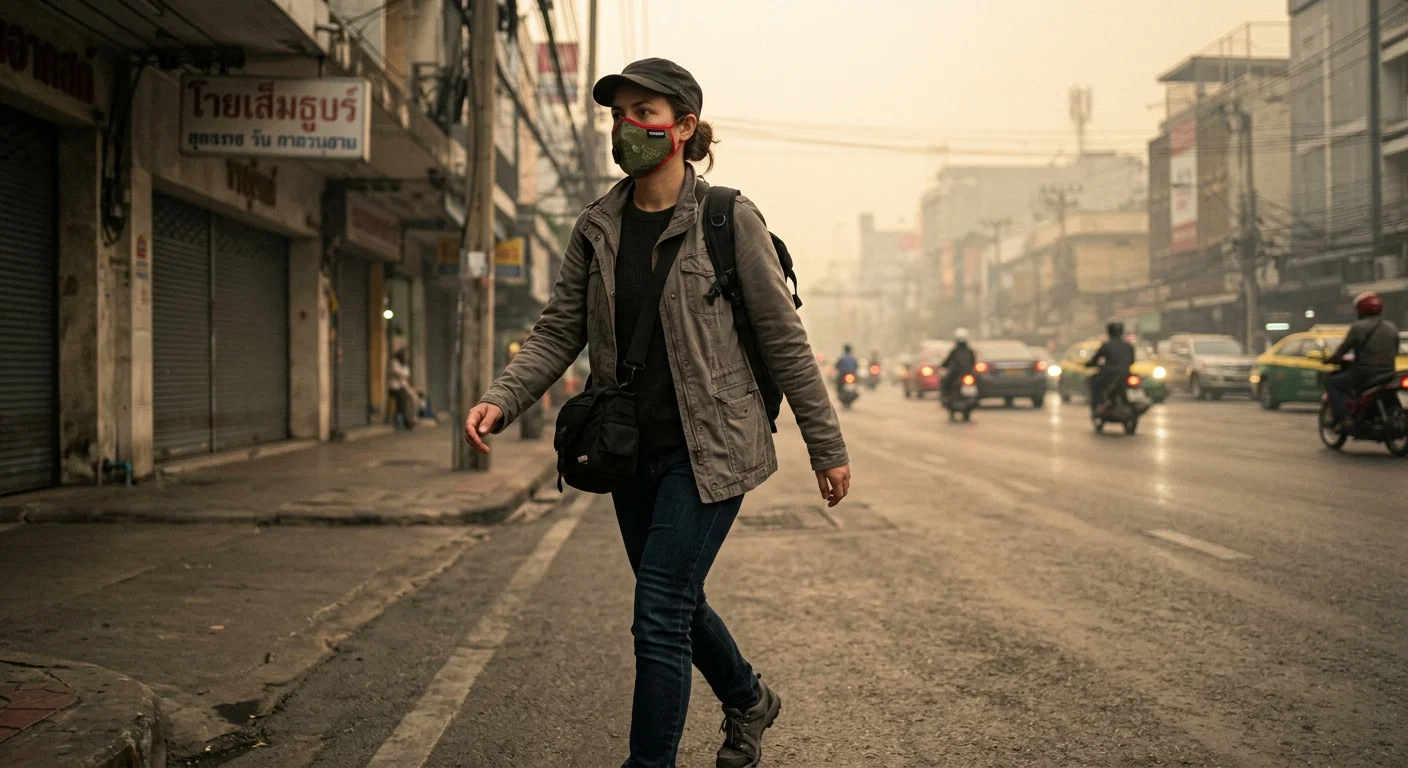 Three minutes in, I stopped waiting for something to go wrong.
That’s the honest version of fast walking with Vogmask. You brace for the wall — the moment breathing gets tight, the chest starts working harder, and your body signals to slow down . With most masks, that wall shows up fast. The Vogmask CV kept not showing up.
Here’s what I noticed, broken into what matters:
The exhaust smell drops fast. Bangkok’s morning traffic hits hard. That thick diesel smell that usually punches straight through? It was cut down to a low hum. Not gone — but filtered to a level your brain stops treating as a threat. That shift matters more than it sounds. A big part of pollution fatigue is sensory. Your nose stops screaming, so your pace holds steady.
The exhale valve is doing real work. Most reviews skip this part. The CV version has a one-way valve — exhaled CO₂ and moisture push out, and outside air doesn’t come back through it. So the trapped, stuffy heat that builds up in sealed masks ? It doesn’t stack up the same way here. At a steady fast-walking pace, that gap grows across 20 to 30 minutes. No stuffiness. No sense of breathing the same stale air on repeat.
There is breathing resistance — that’s worth knowing. Any mask filtering at the N99 standard (99% of PM2.5 particulates, Nelson Lab tested) creates some airflow restriction. Fast walking raises your breathing demand. You’ll feel a slight pull, more in the first week, before the mask shapes to your face. After that break-in period, the ear straps settle in. The aluminum nose clip molds tighter. The whole setup stops feeling like gear and starts feeling like a fitted second skin.
The face stays cleaner. This sounds minor until you’ve walked through bad air without a solid mask. Double-layer disposables leave visible particulate buildup on your face after a commute. With Vogmask, there’s nothing. That’s the N99 filtration doing its job.
One thing worth tracking: the filter degrades over time. In moderate urban air quality conditions, expect six months of reliable filtration before efficiency drops. Fast walking speeds up your breath rate, so the filter works harder each session. Factor that into your cost math before stacking it against cheaper options.
The short version? Fast walking in AQI 178 air with Vogmask on felt manageable — not effortless, but controlled. The protection held up, the stuffiness stayed low, and I didn’t want to stop.
I Tried Fast Walking in AQI 200+ Air — Here’s How Vogmask Held Up
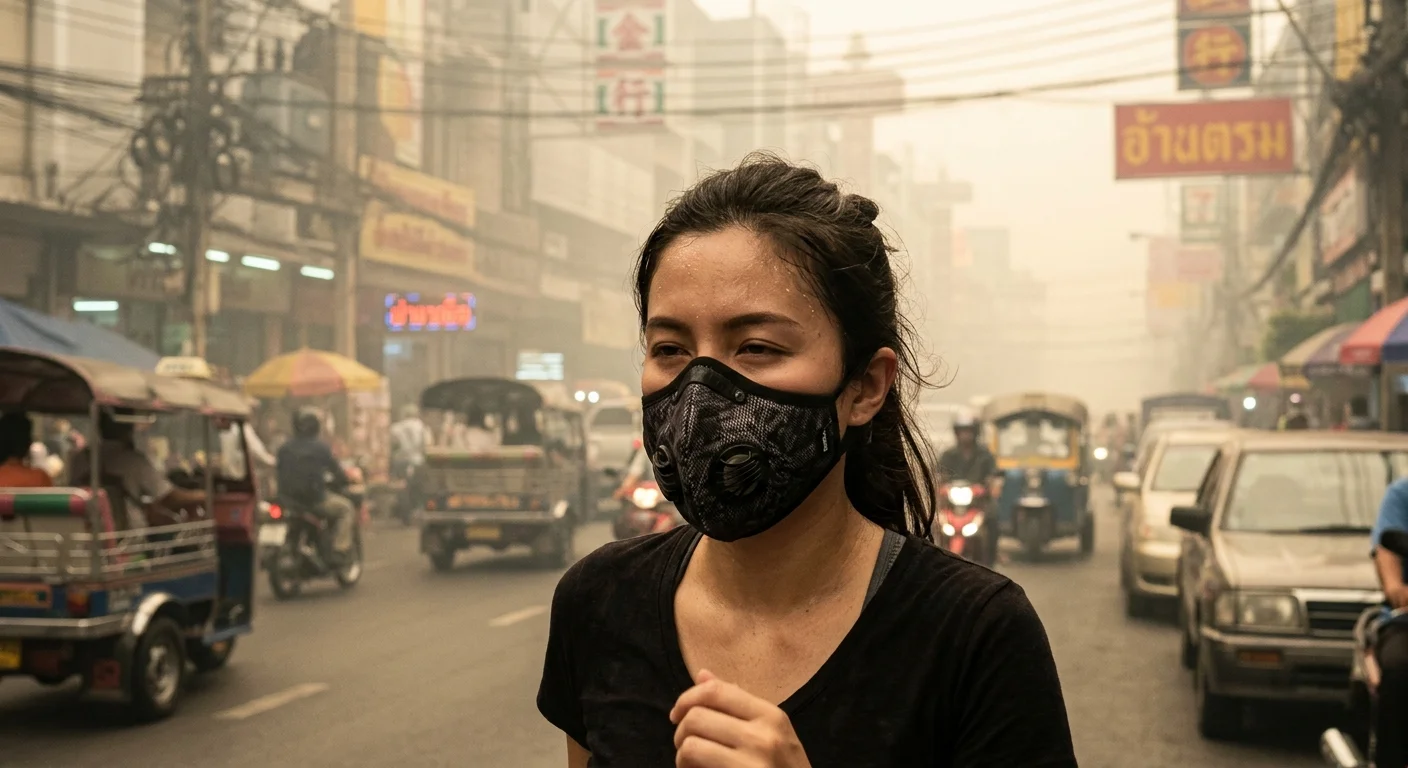 AQI 200 is not a warning you read and forget. PM2.5 at 150 µg/m³ — that’s what was in the air when I clipped on my Vogmask CV and started moving through it.
Thirty minutes. Four kilometers. Brisk pace, not jogging. Here’s the honest breakdown.
The first ten minutes felt surprisingly easy. The CV valve did its job. Exhaled heat and moisture vented outward instead of building up inside. That one-way valve matters more during hard effort than most people think. No stale warmth. No reason to slow down.
Things shifted around minutes twelve to twenty. Not a sudden change. Just a clear one. Breathing took more conscious effort. Each exhale felt a little short — like the valve opening was one size too small for what my lungs needed. That’s the real ceiling of a single small-valve respirator. Not a flaw. Just physics.
Sweat showed up around minute twenty-two. The inner layer — soft, ultrafine fiber — absorbs moisture. It doesn’t make it vanish. After twenty-plus minutes of brisk walking in humid air, that layer feels damp against your skin. Manageable. But you’ll notice it.
The protection numbers still held up. At N99 filtration with a solid seal, your inhaled PM2.5 drops from ~150 µg/m³ to 1.5 µg/m³ equivalent. That seal part carries a lot of weight. Every time I stopped to check a map or take a photo, I pulled the face mask off and put it back on. Each time I skipped re-pressing the nose clip, a gap opened at the bridge. That gap is where the N99 rating stops doing its job.
The practical result for AQI 200+ fast walking:
- Under 20 minutes: Comfortable. Protection holds steady.
- 20–30 minutes: Breathing effort climbs. The inner layer gets damp. The valve starts to feel limiting.
- Frequent mask removal: Press the nose clip back into place every single time. Skip that step, and you’re wearing a filtered decoration, not a respirator.
Steady pace, cooler air, minimal stops — Vogmask handles AQI 200 better than you’d expect. Push past those conditions, and the limits show up fast.
Vogmask vs N95 vs Cambridge Mask: Which One Actually Works for Fast Walking?
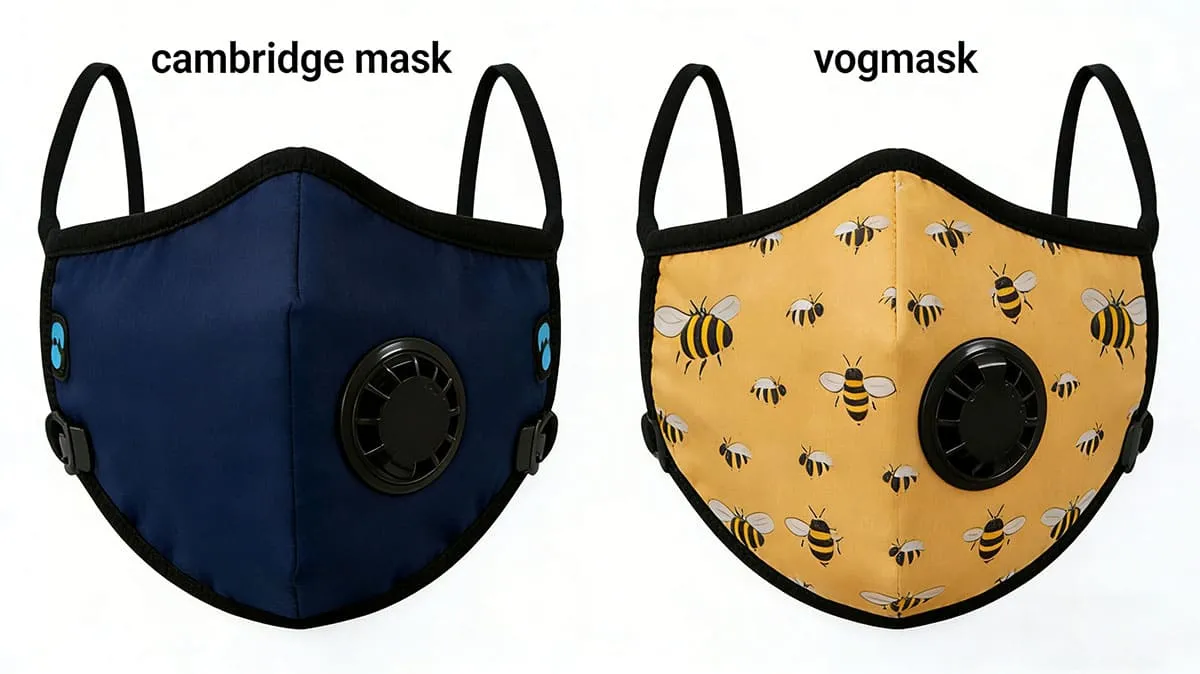 Three masks. One test condition. The question isn’t which one filters best in a lab — it’s which one you can breathe through at pace.
Here’s what the numbers say, and what they don’t.
Filtration on paper looks like this:
– Cambridge Mask: ≥99.47% particulate filtration, meets N99/ FFP2 standards
– Vogmask: ≥95.38% particulate — lower on paper, but >99.9% on bacteria and viruses
– N95 (3M 9501): Rated 95%, but real-world efficiency against fine aerosols drops to 54.1% without a proper elastomeric seal
That last number is the one most buyers miss. A disposable N95 with a poor fit isn’t protecting you at 95%. It’s protecting you at about half that.
For fast walking, the exhale valve is the real differentiator.
Vogmask has one. Cambridge Mask doesn’t. Standard N95 models often skip it, too. No valve means breathing resistance climbs 20–30% at the airflow rates fast walking demands. That’s the gap between a mask you forget you’re wearing and one you’re fighting by minute fifteen.
Seal performance under motion breaks down like this:
The 3M 9501+ uses an elastomeric lining and hits 90.5% real-world efficiency. That’s close to double what a standard N95 without that lining delivers. Vogmask’s adjustable straps stay secure during movement, though it carries no NIOSH certification. Cambridge holds its shape well and meets N99 standards — also without official NIOSH classification.
For travelers putting in high-step-count days through polluted cities, here’s how the three rank:
- N95 (3M 9501+ with valve): Best seal-to-resistance ratio for serious walkers. Certified fit. Disposable, so no maintenance math.
- Vogmask: The valve earns its place at a fast-walking pace. It’s washable and reusable. At $30–50 plus filter replacements, the cost-per-use math holds up across a long trip.
- Cambridge Mask: Highest particulate filtration of the three. No valve, though — heavy breathers will feel that gap.
The honest summary: covering ground fast in AQI 150+ air? Vogmask sits in a solid middle ground. Not the tightest seal. Not the lowest resistance. The exhale valve, reusability, and real-world filtration together make it the most livable choice across a full travel day.
Is Vogmask Worth $50+ Just for Walking in Bad Air? My Honest Verdict
Fifty dollars is a real number. So let’s be honest about what it buys.
I walked four kilometers through Bangkok’s AQI 178 air. I ran fit checks, felt the valve limits, and compared them against N95s and Cambridge Masks. Here’s where I landed.
The math works in Vogmask’s favor. Disposable N95s run $1–2 each. That sounds cheap — until you’re using them every day. At 40 hours of walking per month, disposables cost around $180 over six months. Vogmask with filter replacements runs about $140 for the same period — that’s 20–30% less. Break-even hits at three months if you walk an hour a day.
Who should buy it:
- Walkers or commuters in cities where the AQI is above 150 on most days
- Travelers spending full days on foot in places like Delhi or Bangkok — 77–81% ultrafine particle reduction is real protection, not marketing copy
- Anyone focused enough on fit to work the nose clip the right way — that’s where the 95%+ filtration lives
Who should skip it:
- You walk in bad air once a week or less. A $1 disposable N95 does the job at a fraction of the upfront cost.
- Your “walking” includes sustained hills or running. Filtration drops toward 48–60% under that kind of motion.
The reusable shell, the exhale valve, the N99 filtration when the seal holds — that combination earns the price for a travel walker logging serious mileage through polluted cities. For occasional use, it doesn’t.
Buy it for the long haul. Grab a disposable for everything else.
Conclusion
Months of sweaty, smoggy fast-walking taught me one thing: Vogmask is good — until your lungs push back .
At AQI 150 and below, it handles brisk walking better than any N95 mask for outdoor exercise I’ve tested. The seal holds. The filtration does its job. You stop noticing it’s even there. Push into AQI 200+ at a fast pace, and breathing resistance builds up quickly. That’s not a flaw — that’s physics. No mask feels effortless at high effort.
So pack a Vogmask for Bangkok or Delhi, but be honest about your pace first:
- Casual explorer? It’s a near-perfect travel companion.
- Power-walker chasing steps before a flight? Plan for slower stretches along the way.
My next step for you: Check the AQI forecast for your destination before leaving home. Then match your pace to the air quality — mask on, pace dialed in, lungs thanking you later.