

By the end of a long shift, you know the feeling — that dull, burning ache right where your mask’s ear loops have been pressing all day. It’s not dramatic. It’s just relentless.
Been looking at Tronex disposable masks to fix that behind-ear irritation? You’re not alone. And you deserve a straight answer, not a sales pitch buried under specs.
Here it is: Tronex masks can make a difference for some wearers. But the “why” matters more than the “yes.” Read on to find out what Tronex does — and doesn’t — offer for all-day ear comfort. Plus, a few practical fixes that work no matter which mask you’re wearing.
Do Tronex Masks Help with Ear Pain? (Direct Answer)
 The short answer is no, and knowing why will save you both money and frustration.
Tronex masks are undeniably well-made. Meeting strict FDA 510(K) standards and ASTM filtration levels 1 through 3, they are serious, professional-grade protective gear. However, top-tier filtration doesn’t automatically equal ear comfort.
Across their lineup — whether it’s the 5370B (ASTM Level 3), the 5555W (MR Safe), or the 5040B (Level 1) — Tronex relies on a standard elastic earloop design. While these loops secure the mask effectively, they still rely on continuous tension behind your ears. This constant pull is exactly what leads to that familiar ache halfway through your shift.
Let’s look at what separates a standard medical mask from one specifically built for ear relief:
| Feature | Tronex Masks | Ear Pain Relief Designs |
|---|---|---|
| Fastening Method | Elastic earloops | Headbands, behind-head hooks, or extenders |
| Ear Pressure | Direct, continuous pressure | Partial or full bypass |
| Extended Wear | Breathable fabric; no ear-specific design | Built for 8+ hour shift comfort |
You won’t find headbands, adjustable straps, or extender notches on a Tronex model. Instead of focusing on redirecting pressure away from the ear, their design prioritizes one thing above all else: maximum filtration and safety.
Why Earloop Masks Cause Ear Pain in the First Place?
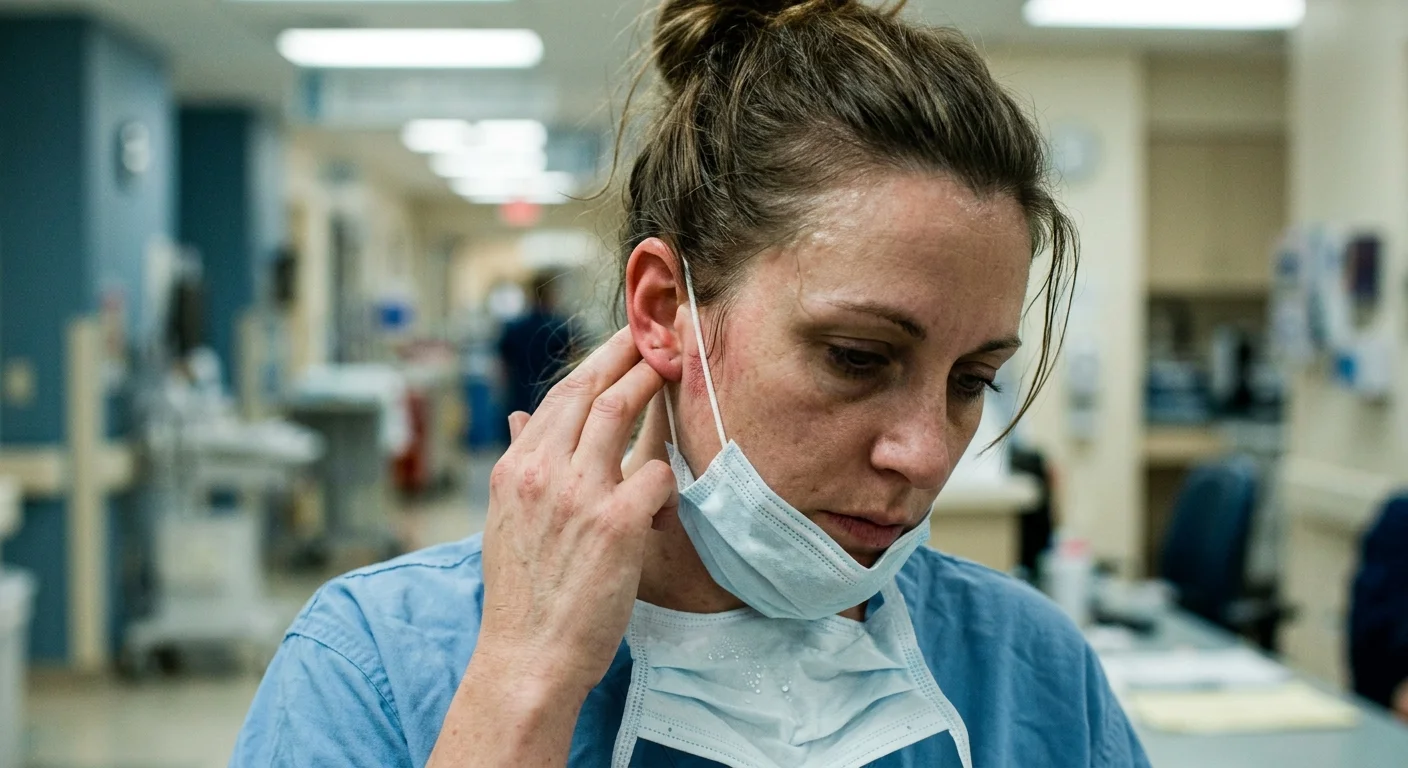 The numbers are hard to ignore: 74.7% of regular mask -wearers experience some form of earache. That’s not a fringe complaint. That’s close to three out of four people suffering through something that deserves a real explanation.
So here’s the explanation.
It’s Not Just Irritation. It’s Mechanical Trauma.
Your ear is not built to hold things. The cartilage, the folds, the thin skin tucked into the crease behind your ear — that whole region exists to receive sound, not bear weight . An elastic earloop pressing against it for hours triggers a predictable response: the tissue fights back.
The main culprit is continuous elastic compression. The loop sits. It pulls. It doesn’t shift or release. Over a six-, eight-, or ten-hour stretch, that sustained pressure causes erythema — redness, tenderness, and real, painful lesions on the skin and cartilage beneath.
Friction makes it worse. That thin rubber band isn’t just pressing down. It’s rubbing. Grinding. Breaking down the skin barrier through constant small movements.
In more serious cases, two specific conditions can develop:
- Granuloma fissuratum — a stubborn sore that forms a split in the crease behind the ear from prolonged mechanical pressure
- Chondrodermatitis nodularis helicis — deep inflammation that reaches the cartilage itself, sometimes causing it to push through the skin
These aren’t rare medical edge cases. They’re documented outcomes of wearing standard earloop masks too long, too often.
Why the Skin Behind Your Ear Is So Vulnerable?
The crease where your ear meets your skull starts at a disadvantage.
The skin there is thin and delicate. It traps moisture and humidity from the mask below. That softens the tissue and speeds up breakdown. Seborrheic dermatitis — a common dormant condition — can flare up from mask pressure right in that fold. For wearers with psoriasis or atopic dermatitis, the risk climbs higher. Prolonged trauma can trigger the Koebner phenomenon, where new psoriatic lesions break out on skin that was previously clear.
Some wearers also discover they have an elastic contact allergy — a reaction not to the mask fabric, but to the chemical compounds in the loop itself.
Time Is the Multiplying Factor
Duration changes everything. Research shows symptoms spike sharply once wear time passes seven hours per day:
- 27.6% of wearers using masks 7–9 hours per day reported ear-area symptoms
- 14.7% wearing masks 10+ hours reported even greater severity
- Wearing multiple masks at the same time increased behind-ear pain at a notably higher rate than single-mask use
Among healthcare workers — the group most exposed — 11% reported visible indentation and pain from regular earloop contact. There’s another cost too: research found that ear pain from rubber bands cuts concentration at work. It’s not just physical discomfort. It chips away at focus and performance across a full shift.
Earache ranked as the third most common mask-related complaint overall (16.2%), behind breathing difficulty and nasal discomfort. That puts it ahead of speech difficulties, hearing problems, and ear itching — combined.
The mechanism, in plain terms: a small elastic band, worn in the wrong spot, for too many hours, against skin that was never built for it. The result is predictable. The solution doesn’t have to be complicated.
What Makes Tronex Masks Comfortable — And What They Don’t Offer
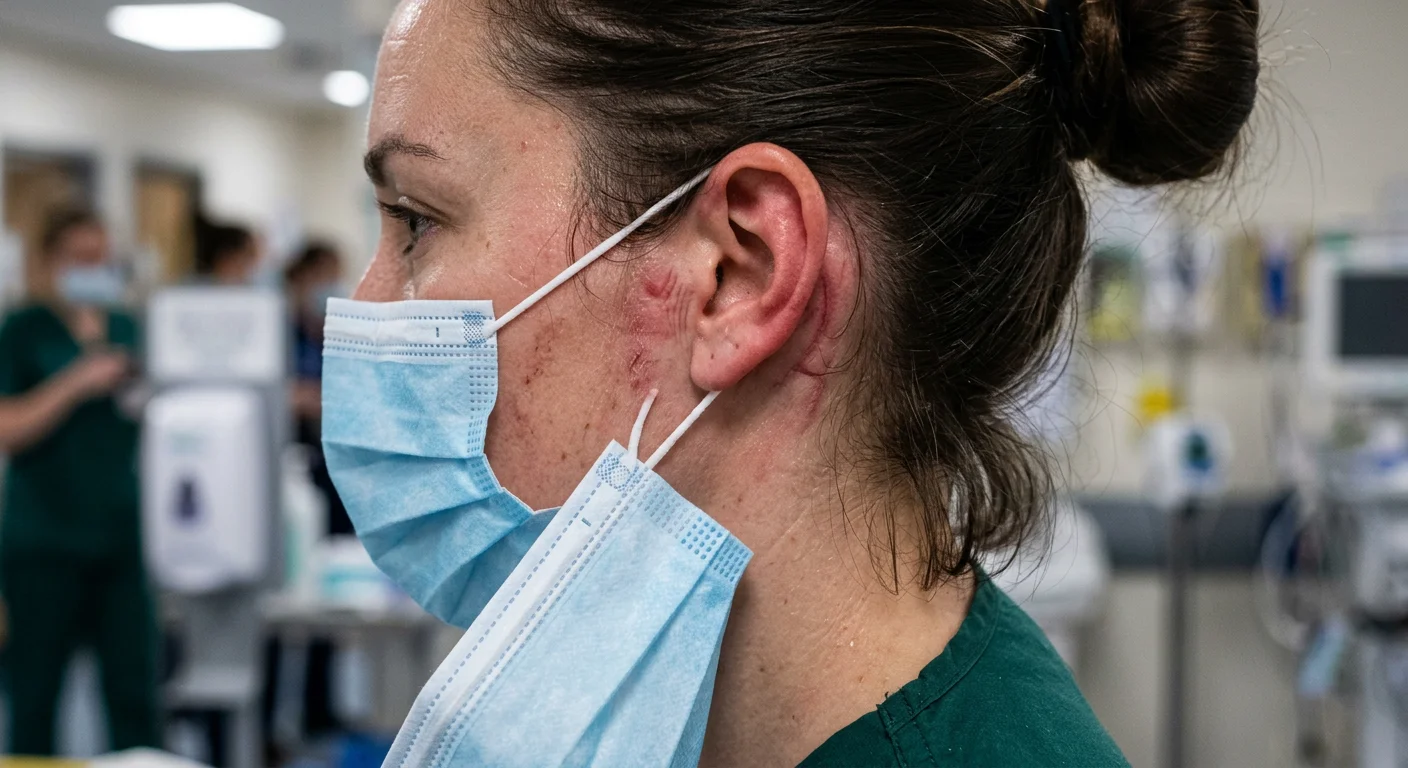 Tronex masks are well-built. That matters. But “well-built” and “ear-friendly” are not the same thing. Mixing them up is how people end up disappointed after a twelve-hour shift.
Here’s a straight breakdown of what Tronex gives you — and where the comfort story stops.
What Tronex Gets Right?
Start with the materials. Every Tronex procedure and surgical mask uses soft, breathable nonwoven fabric in a 3-ply pleated construction. Lightweight. Gentle against the face. Built to move with you, not against you. If heat and stuffiness are your biggest complaints, this design helps. Breathable layers cut down on moisture and humidity buildup inside the mask — the kind of trapped warmth that makes everything feel worse after a few hours.
The malleable nosepiece pulls its weight, too. A well-fitted nose bridge keeps the mask sealed where it needs to be. That means less shifting, less readjusting, and less friction across your face all day. Fewer adjustments mean fewer moments of irritation.
User reviews back this up across the board. Wearers call Tronex masks “super light” — the kind of light you notice most during long stretches when a heavier mask would be wearing you down. For nurses moving between patients or teachers on their feet all morning, that lightness is a real daily win.
The N95 models go a step further. They’re built for extended wear — form-fitted to work with a wider range of face shapes, available in small and unisex options, and designed to hold their seal without constant readjustment. For wearers who put filtration first, that’s a solid combination.
Where the Comfort Story Ends?
None of that changes one key fact: every Tronex model uses a standard fixed elastic earloop.
That loop does its job. It holds the mask in place. It’s soft enough. But soft elastic is still elastic, and elastic pressing against the thin skin behind your ear for hours creates pressure. That happens regardless of how gentle the fabric feels.
Here’s what Tronex doesn’t include, and why each gap matters for all-day wearers:
- No adjustable ear straps — the loop tension is fixed. You can’t loosen it for a more relaxed fit during low-risk moments
- No headband or behind-head strap — a design that moves pressure off your ears completely is not part of the lineup
- No pressure-relief ear pads — thin cushioning inserts that sit between the loop and your skin aren’t offered
- No wide-band earloops — wider loops spread pressure across more surface area. Tronex uses standard narrow bands
That’s not a flaw in the product. It’s a design choice. Tronex focuses on protection — 95–98% bacterial filtration efficiency, fluid resistance up to 160 mmHg at Level 3, and full ASTM F2100 compliance across the range. Their filtration numbers are measurable, certified, and documented to the decimal point.
Ear comfort is not. Tronex specs include no quantified ear pressure reduction. No data on earloop thickness. No clinical wear-time metrics. The comfort claims they make are real — the breathability, the lightness, the fit — but these are side effects of good construction. They’re not purpose-built fixes for behind-ear pain.
| What Tronex Delivers | What Tronex Doesn’t Address |
|---|---|
| Breathable, lightweight nonwoven layers | Adjustable or wide-band earloops |
| Malleable nosepiece for a stable fit | Headband or behind-head strap option |
| Reduced heat and moisture buildup | Pressure-relief padding at the ear contact point |
| Strong ASTM-certified filtration | Quantified ear pressure reduction |
| Soft elastic earloops | Extended wear pain mitigation (>4–8 hours) |
The gap shows up most for anyone wearing a mask for four to eight hours. Under that mark, breathable fabric and soft loops are usually enough. Push past it — a full nursing shift, a double-period teaching day, a long retail floor stretch — and fixed elastic loops build up pressure in all the ways described above.
Tronex gives you an excellent mask. It just doesn’t give you an ear pain solution. Those are two different things, and the next section covers how to close that gap.
How to Reduce Ear Pain Wearing Tronex Masks (Practical Fixes)
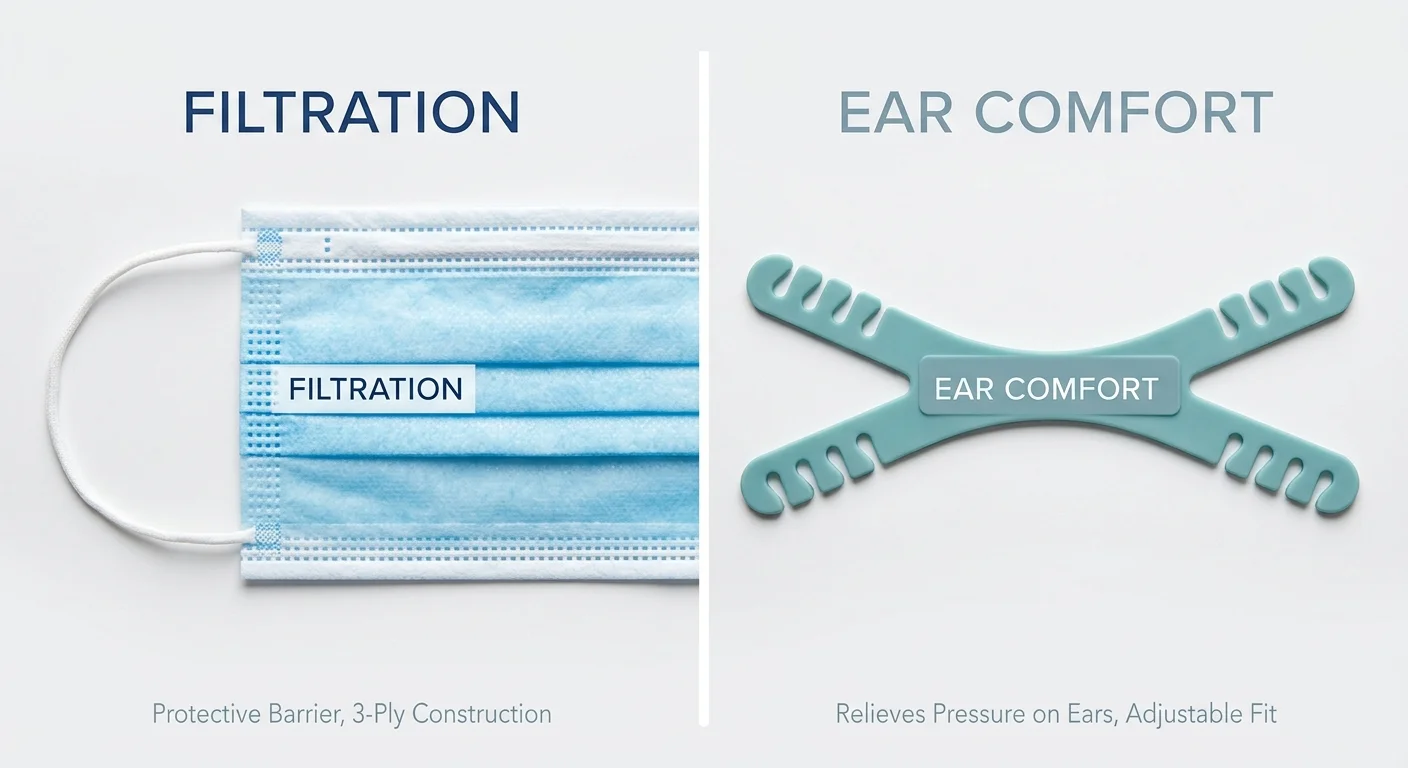 The fix isn’t a better face mask . It’s physics.
Here’s what’s happening when your ears ache after a long shift. Your Tronex earloop pushes 2–5 Newtons of tension into about one square centimeter of skin. That equals 20–50 kilopascals of pressure. Your pain threshold sits at around 10 kilopascals. So you’re doubling it every single shift. Sometimes quadrupling it. No wonder your ears are done by noon.
The math points to one solution: spread that force over a larger area, and the pressure drops below the pain threshold. A mask extender grows the contact area from 1 cm² to 5–20 cm². That can cut pressure by up to 70%. You don’t need a different mask. You need more surface area.
Here are six ways to get it — ranked from easiest to most involved.
Six Practical Fixes, Ranked by Effort
① Ear Saver / Mask Extender Band
(1–2 minutes — start here)
A small plastic or silicone headband — bought or 3D-printed — hooks your Tronex earloops into slots near each end. The force spreads across 15–20 centimeters of the headband instead of one thin point on your ear. That’s ten times the contact area. Pressure drops fast. A four-pack of silicone extenders costs $9–$10 online — less than a decent coffee. Search “adjustable silicone mask ear saver” and check that it fits ear loops 2–4mm in diameter. Every standard Tronex model falls in that range.
② The Eyeglass Trick
(30 seconds, zero cost)
Wear glasses? Loop your Tronex earloops around the temples instead of your ears. Twist once or twice behind the ear. The load moves to a 4–5 centimeter span of glasses arm. Studies of healthcare workers on 8-hour shifts show that this works for 80% of glasses wearers. It costs nothing. You’re set up in under a minute.
③ Buttons on a Hat
(5 minutes, works all day)
Sew four small plastic buttons — about 1 centimeter wide — along the brim of a cap or headband. Space them 2–3 centimeters apart. Hook your ear loops over the buttons instead of your ears. Contact area grows to 3–4 centimeters per side, cutting pressure by an estimated 50–70%. Teachers, retail workers, and anyone in uniform can do this. It looks clean and stays discreet.
④ The Hair Bun Method
(2 minutes, no supplies needed)
Pull your hair into a high bun or braid. Loop the ear loops under or around the base of the bun. Tuck a small foam pad or folded sock between the loop and your scalp for extra cushioning. The force spreads across a 5–6 centimeter hair mass instead of bare skin. Not the most stylish option. Works well, though.
⑤ T-Shirt Strip Extender
(3 minutes, old T-shirt required)
Cut two strips from an old T-shirt: 40 cm long, 3 cm wide. Tie one strip to each earloop. Cross the strips at the back of your neck, then re-hook. Your loop length grows to 25–30 centimeters. Pressure drops to almost nothing. This fix is great mid-shift — your ears are already sore, and you need relief fast with no extra gear.
⑥ 3D-Printed Mask Extension Bracket
(30–60 minutes to print, free STL files)
Have a 3D printer? Search “mask extender STL” — free files are easy to find. Print a 10-centimeter bridge that clips across your ear loops and spans the back of your head. Contact area reaches 10–12 centimeters. This is the most durable fix on the list. Worth making if you wear a mask every day for work.
The One Worth Buying for Long Shifts
Nurses, teachers, long-haul retail staff — anyone in a Tronex face mask for eight hours or more — a silicone adjustable lanyard is the best buy here.
Medical-grade silicone cord, 1–2 mm thick and 30–50 cm in loop length, cuts peak ear pressure by an estimated 60–75%. It’s washable. It holds up through 100+ uses. The adjustable slider lets you set the tension so the mask stays snug without digging into skin. A pack runs $5–$10 and fits all standard Tronex earloop models.
The pressure math is simple. The cost is low. The relief at hour eight is real.
Conclusion
 Your ears have put up with enough.
Here’s the truth: Tronex disposable masks won’t eliminate ear loop discomfort — no standard earloop mask will. But the softer elastic and lightweight breathable design does cut down the pressure. That pressure is what turns a two-hour shift into a full-blown irritation problem.
The real win? No choosing between protection and comfort. Pair a Tronex mask with a simple ear saver. Adjust how you wear it. What once felt like a daily endurance test becomes just… wearing a mask.
That’s the straight answer the title promised.
Are your ears already staging a quiet protest? Don’t wait it out. Browse Tronex masks at morntrips.com and find the right fit for your face — and your day.
The best mask isn’t just the one that protects you. It’s the one you’ll keep wearing, day after day.