

Every year, millions of workers leave job sites with ringing ears. It’s not from a single accident. It’s from years of using the wrong
hearing protection PPE — or skipping it altogether.
Choosing between earplugs and earmuffs isn’t about comfort or personal taste. It’s a decision that shapes whether your hearing holds up after decades of workplace noise.
This guide is for you if you fall into any of these groups:
- A construction worker is blocking out the jackhammer noise at 100+ dB
- A safety manager building a compliant hearing conservation program
- Someone who needs to know what the noise reduction rating (NRR) number means in real-world use
You’ll find clear answers on which protection fits your environment, your workflow, and your compliance needs.
What Is Hearing Protection PPE and Why Does It Matter for Noise-Induced Hearing Loss Prevention
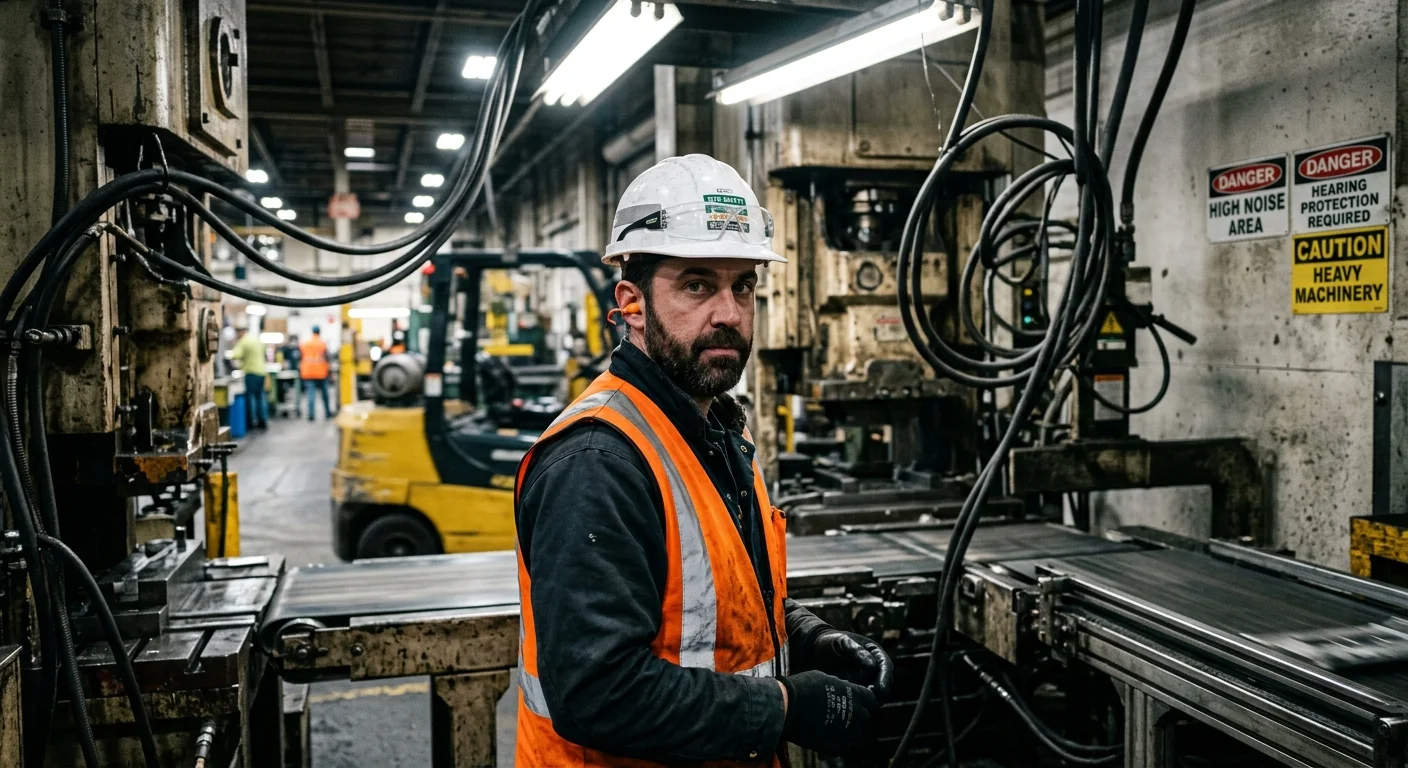 The numbers are hard to ignore. 22 million U.S. workers face hazardous noise levels every year. In 2019 alone, private industry recorded 14,500 occupational hearing loss cases — that’s 11.4% of all workplace illnesses reported to the Bureau of Labor Statistics.
Hearing protection PPE covers devices worn over or inside the ears. Their job is to lower the sound level that reaches your inner ear. The two main types are earplugs and earmuffs. Each one fits your ear in a different way. Each one blocks noise in a different way. The right choice depends on your specific noise environment.
This goes beyond checking a compliance box. The real issue is permanence. Noise-induced hearing loss (NIHL) cannot be reversed. The tiny hair cells inside your inner ear pick up sound. Sustained high-decibel exposure destroys those cells. No medical treatment brings them back.
So the stakes are real. The right ear protection PPE does more than satisfy a regulation. It stands as the only line of defense between a worker and permanent hearing damage. Get it right, and you protect something that cannot be replaced.
Understanding NRR and SNR Ratings: How to Calculate Real-World Hearing Protection Levels
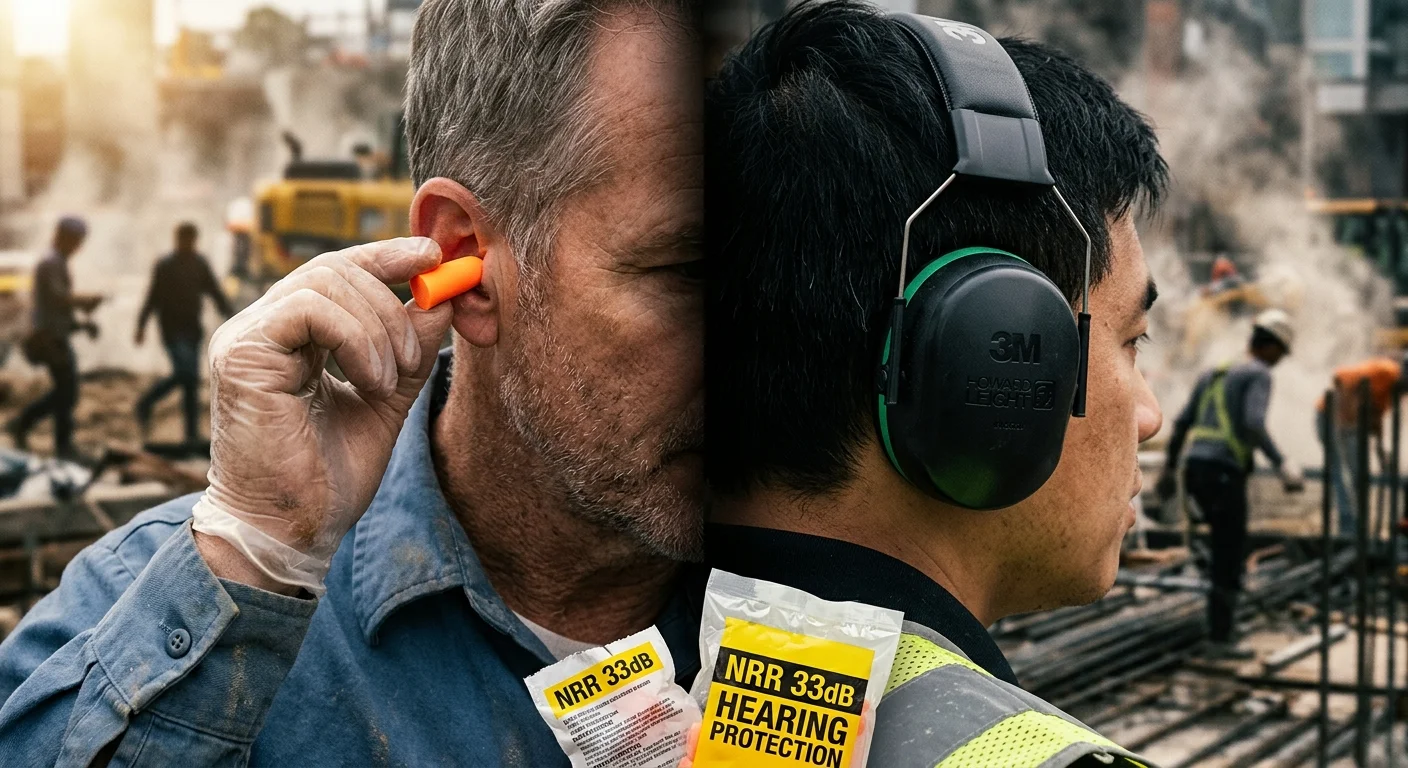 That number printed on the packaging — NRR 33 — is not what your ears receive.
Lab conditions are ideal. Your job site is not. OSHA uses a derating formula to close that gap. It converts the label number into a real-world figure:
Derated NRR = (NRR − 7) ÷ 2
Run it against real numbers and the gap gets hard to ignore:
- NRR 33 in a 100 dB environment → (33−7)÷2 = 13 dB actual reduction → protected level: 87 dB (not the 67 dB the label implies)
- NRR 31 in a 95 dB environment → 12 dB reduction → protected level: 83 dB
Three decibels sounds small. It isn’t. A 3 dB loss means sound intensity doubles. That’s the physics behind why a poor earplug seal cuts real protection by more than half.
NRR vs. SNR: Which Rating System Are You Looking At?
Source hearing protection PPE from European PPE suppliers , and you’ll see SNR instead of NRR. Both measure the same thing, just by different methods:
| Feature | SNR (Europe) | NRR (United States) |
|---|---|---|
| Standard | EN 352 / ISO 4869 | ANSI S3.19 / EPA |
| Typical value | 2–5 dB higher than NRR | Lower after derating |
| Real-world use | Minor adjustment needed | Always derate |
A quick conversion rule: SNR ≈ NRR + 3 dB . So NRR 25 translates to about SNR 28. You can’t swap one number for the other without adjusting first.
Why the Label Number Always Overpromises
Four factors eat into your decibel protection level before your shift even begins:
- Lab fit vs. real fit — Test subjects insert earplugs under supervision. You don’t. This gap alone creates 5–6 dB of overestimation.
- Seal integrity — An earplug seated even slightly off-center can wipe out more than half the rated protection.
- Intermittent wear — Ratings assume continuous use. Pull off your earmuffs for 30 minutes in an 8-hour shift, and your effective protection drops sharply.
- Anatomy variation — Lab testing assumes a standardized ear canal. Yours may differ.
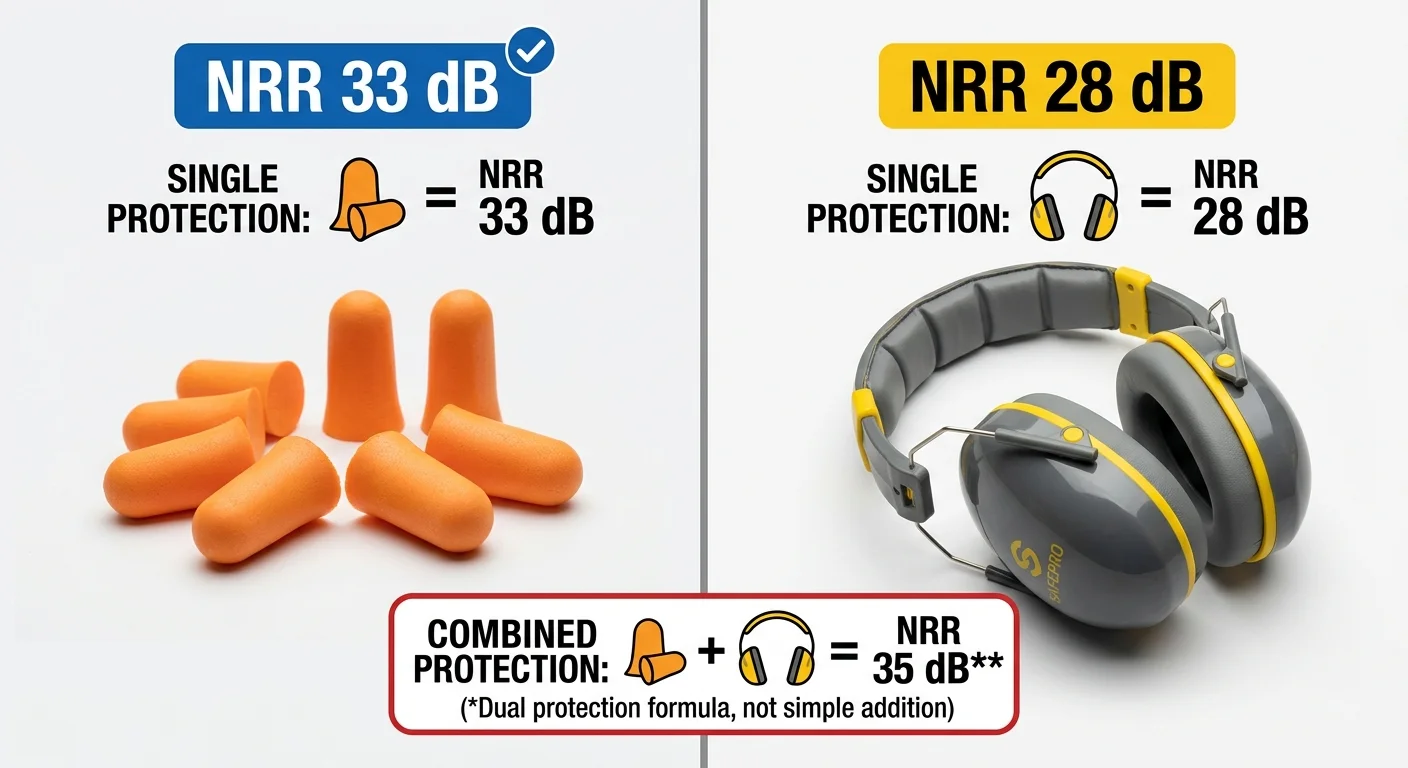
One key point on dual protection: stacking foam earplugs (NRR 29) with industrial earmuffs (NRR 27) does not add up to NRR 56. OSHA’s method gives a combined rating of 34 dB, which derates to 13.5 dB of real-world attenuation. Dual protection does help — but know what the numbers mean before you count on them.
Earplugs for Hearing Protection: Types, NRR Performance, and Best Use Cases
 Four types of earplugs exist. Each one solves a different problem. Picking the wrong type doesn’t just hurt comfort — it slowly destroys the protection you think you have.
The Four Earplug Types (and Where Each One Belongs)
Disposable foam earplugs carry the highest NRR on the market — rated between NRR 25–33 dB. They cost almost nothing: about $0.10–0.20 per pair. That price makes them the go-to choice for loud, non-stop environments like construction sites, foundries, or factory floors running above 100 dB. The catch? The insertion technique determines everything. A shallow fit drops your protection from 33 dB down to under 10 dB — and you won’t feel a thing different.
The Roll-Pull-Hold method closes that gap:
1. Roll the plug into a tight, thin cylinder — full compression
2. Pull your ear up and back to open the canal
3. Insert fully , then hold for 20–30 seconds while the foam expands
Do this right, and you get 80–90% of the lab-rated NRR . Rush it or skip steps, and attenuation drops by half.
Pre-molded reusable earplugs (NRR 22–30 dB, ~$10–30/pair) cut out the insertion technique problem. No foam expansion. No guesswork. They perform better in hot, tight spaces where foam feels suffocating. Plus, they sit under hard hats, respirators , and safety goggles without any fit issues.
Custom-molded earplugs ($100–300/pair) deliver NRR 20–35 dB with a precise fit shaped to your ear canal. Vented versions let sound through for speech — useful for workers who need to talk without pulling out their protection.
Semi-insert canal caps (NRR 14–20 dB) are not built for long stretches in high-noise areas. They suit intermittent environments — quick on, quick off, no hassle between tasks.
Hygiene: The Factor Most Workers Ignore
Reusable earplugs need regular cleaning. Skip that, and your risk of otitis externa (outer ear infection) goes up 2–5 times.
| Earplug Type | Cleaning Routine | Replacement Schedule |
|---|---|---|
| Disposable foam | Single-use only | Replace every shift |
| Pre-molded reusable | Soap/water or alcohol wipe after each use | Every 1–3 months (heavy use) |
| Custom-molded | User wipes daily; professional cleaning every 6–12 months | As your audiologist advises |
Three rules prevent most hygiene problems:
– Dry your ears before inserting
– Never share earplugs with anyone
– Throw out any plug that has absorbed moisture
Earmuffs for Hearing Protection: Types, Fit Systems, and Ideal Scenarios
Earmuffs solve a problem earplugs cannot: speed. A worker moving in and out of noise zones can’t afford to re-insert and re-seal foam plugs a dozen times per shift. Earmuffs go on in one motion and come off just as fast. That’s why they dominate construction sites, assembly lines, and shooting ranges.
Passive Earmuffs: Where Raw Attenuation Wins
Standard over-ear earmuffs deliver NRR 24–31 dB. The numbers make your choice clear:
- 3M Peltor X5A — NRR 31 dB, SNR 37 dB. The performance data stands out: 41.1 dB attenuation at 500 Hz, 43 dB at 1000 Hz, 44 dB at 4000 Hz. No other consumer model matches it across the speech-critical frequency range.
- 3M Peltor Optime 105 — NRR 30 dB, 286g, cup depth 7.2 cm. Deep cups give you better low-frequency coverage.
- Howard Leight Leightning L3 — NRR 30 dB, 300g. Strong at low frequencies (125–250 Hz). This makes it a solid pick for heavy machinery environments.
- 3M Peltor X4A — NRR 27 dB, 230g, cup depth 4.5 cm. The low-profile design fits more easily under hard hats.
- 3M Peltor Optime 98 — NRR 25 dB, 222g. Light enough for children and long shifts.
One key fact to know: earmuffs outperform earplugs at frequencies above 160 Hz by up to 14 dB. Below 80 Hz, earplugs edge ahead by 5–7 dB. Check your noise frequency before you decide.
Electronic Earmuffs: Protection Without Isolation
Passive muffs block everything — including your supervisor telling you to stop. Electronic earmuffs compress dangerous sound peaks while letting safe ambient sounds through. The tradeoff is cost:
| Model | NRR | Price |
|---|---|---|
| Walker Razor Slim | 23 dB | ~$23 |
| Howard Leight Impact Sport | 22 dB | ~$56–67 |
| AXIL TRACKR | SNR 27 dB | ~$49 |
| ShellShock EXO PRO | SNR 28 dB | ~$99 |
| MSA Sordin Supreme Pro X | 22 dB | ~$319 |
| Peltor ComTac V | 23 dB | ~$519 |
At shooting ranges, electronic models are the go-to choice. You can hear commands and conversations at safe levels. Gunshot peaks that spike past 140 dB still get blocked. Passive options like the X5A and Optime 105 work fine where communication is not a concern.
Helmet-Mounted and Specialty Fit Systems
Hard hats are mandatory on many job sites. Standard over-ear headbands create pressure points that wear down the cup seal over time. Helmet-mounted earmuffs — like the Safariland Liberator HP 2.0 (NRR 26 dB) — attach to the helmet shell. The seal stays consistent no matter how your head moves.
Weight adds up fast on long shifts. The Optime 98 (222g) and X4A (230g) both stay light enough that most users report no noticeable neck strain even after four-plus hours of wear.
Earplugs vs Earmuffs: How to Choose Hearing Protection PPE
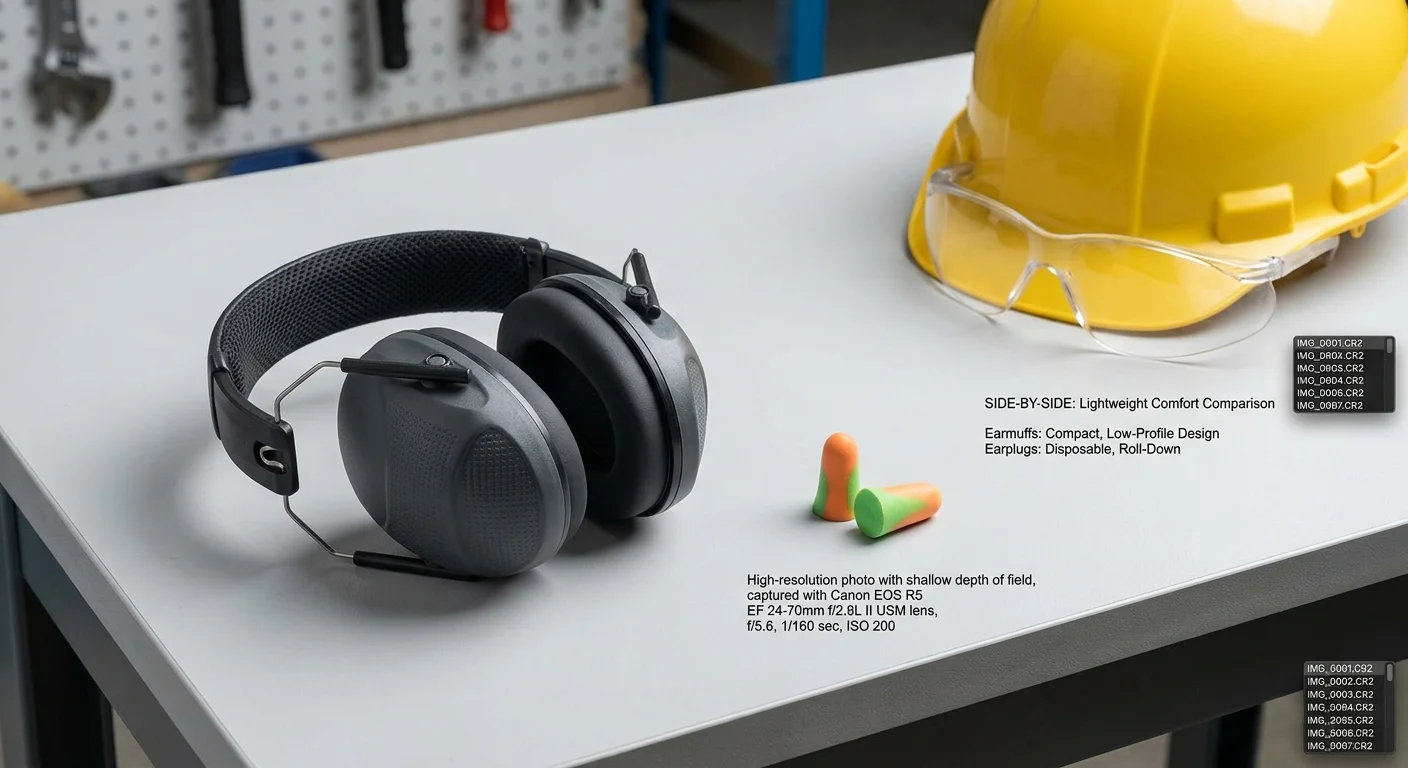 Pick the wrong one, and the NRR number on the box means nothing. Here is how these two types of hearing protection PPE compare — across seven factors that decide whether your ears are truly protected or just covered.
| Factor | Earplugs | Earmuffs | Real-World Winner |
|---|---|---|---|
| NRR Protection Level | Up to NRR 33 (lab); ~16.5 dB after NIOSH 50% derating | Up to NRR 31; ~23.25 dB after 25% derating | Earmuffs for most workers; earplugs require perfect deep insertion |
| Long-Shift Comfort | Lighter, cooler, better for 8+ hour wear | Heavier, warmer, better for short, stationary tasks | Earplugs for extended active work; earmuffs for brief stints |
| PPE Compatibility | Works well with hard hats, respirators, and safety glasses | Creates seal gaps under helmets; slippage risk with headgear | Earplugs wherever other PPE is mandatory |
| Ease of Use | Requires correct Roll-Pull-Hold technique; high user error rate | On-off in one motion; a consistent seal every time | Earmuffs for reliability; earplugs need proper training first |
| Maintenance & Hygiene | Disposable: replace each shift. Reusable: wash after each use | Wipe cups after use; replace worn cushions | Earplugs (disposable) for simplicity; earmuffs for long-term durability |
| Cost | Bulk foam: $0.20–0.50/pair. Reusable: $5–15/pair | Passive: $20–50. Electronic: $100–300+ | Earplugs for budget and bulk purchasing |
| Compliance Visibility | Hidden under a hard hat — supervisors cannot confirm wear | Visible from across the floor in seconds | Earmuffs for OSHA hearing conservation program enforcement |
Where Each One Wins
The table gives you the structure. These benchmarks give you the details.
Frequency matters more than most buyers expect. Earplugs outperform earmuffs at frequencies below 500 Hz. At 60 Hz, earplugs deliver 5 dB more attenuation. At 80 Hz, that jumps to 7 dB. At 315 Hz, it is 4 dB better. Flip the frequency range, and the result flips too. Above 1,000 Hz, earmuffs lead by up to 14 dB. That gap is significant in workplaces filled with machinery whine, power tools, and high-pitched industrial equipment.
Real-world derating is not the same for both types. The NIOSH derating model cuts earplug NRR by 50–70% to account for poor user insertion. Earmuffs lose 25%. So a foam earplug rated NRR 33 often delivers less real-world protection than a well-fitted earmuff rated NRR 27.
Situational awareness is an overlooked factor. Research shows earmuffs reduce sound localization sharply. Users wearing passive earmuffs identified a sound source correctly just 21% of the time, with an average response delay of 2.9 seconds. Earplug users performed much better. In workplaces where spatial awareness affects safety — warehouse forklifts, active construction zones — that difference goes well beyond decibels.
The One Combination Worth Knowing
Pairing foam earplugs with industrial earmuffs pushes combined attenuation to 36–40 dB, peaking at 42 dB at 2,500 Hz. That ceiling matters in environments exceeding 105 dB. Neither product alone provides enough hearing protection at those levels. For foundry workers, grinders, and demolition crews, dual protection is not overkill. It is the one setup that keeps noise exposure inside safe limits.
The bottom line across all seven factors:
- Choose earmuffs for noise above 90 dB in the mid-to-high frequency range. Also, pick earmuffs when compliance visibility matters, or workers need fast on-off access between noise zones.
- Choose earplugs for hot environments, long shifts, or any job requiring a hard hat, respirator, or safety goggles.
- Use both when a single device — no matter what its NRR label says — cannot close the gap between ambient noise and the 85 dB OSHA action threshold.
Choosing the Right Hearing Protection by Work Environment: Scenario-Based Recommendations
The noise level on your job site doesn’t care which earplug brand you bought.
What matters is whether your protection matches the environment you work in. A foam earplug rated NRR 33 that belongs in a foundry does nothing useful at a concert. An electronic earmuff built for shooting ranges won’t help a construction worker hauling materials under a hard hat.
Here’s a quick breakdown by environment.
Construction and Manufacturing (85–105 dBA, Continuous)
Foam earplugs are the right tool here. Hard hats, respirators, and constant movement make earmuffs awkward and impractical. Earplugs stay out of the way, handle heat better, and still deliver the NRR you need.
Target NRR 25–33 dB after derating. Ambient noise above 100 dBA? A single device won’t bring your exposure below OSHA’s 85 dBA action level. Switch to dual protection at that point.
96% of heavy manufacturing companies have at least one worker exposed above 85 dBA on a regular basis. That stat alone makes earplug compliance non-negotiable in this space.
Shooting Ranges (Impulse Peaks of 140–165 dB)
A single gunshot peaks at over 140 dB. No passive earplug handles that on their own.
Electronic earmuffs are the go-to first choice. They amplify safe ambient sounds so you can communicate — then shut off the moment a shot fires. At indoor ranges where peaks push past 140 dB, pair them with foam earplugs (NRR 25–33). That combination adds 5–10 dB of effective attenuation beyond what either device delivers on its own.
Airport Ground Crew and Intermittent High-Noise Zones
Speed is the deciding factor here. Ground crew moves in and out of aircraft engine blast zones fast. Protection needs to go on in seconds — not require the Roll-Pull-Hold technique between every task.
Earmuffs rated NRR 25–28 dB handle intermittent peaks well. They keep derated exposure below 85 dBA across an 8-hour TWA without slowing workers down.
Concerts, Lawnmowing, and Home Power Tools (85–100 dBA, Intermittent)
Max NRR isn’t the priority here. Comfort and consistency are.
Slim earmuffs or foam earplugs in the NRR 15–25 dB range give enough protection for lower, intermittent exposures. Go with reusable options. They cut the per-use cost and — more to the point — people tend to wear protection they find comfortable. Disposable earplugs too often end up in a drawer.
Common Mistakes When Using Hearing Protection PPE and How to Avoid Them
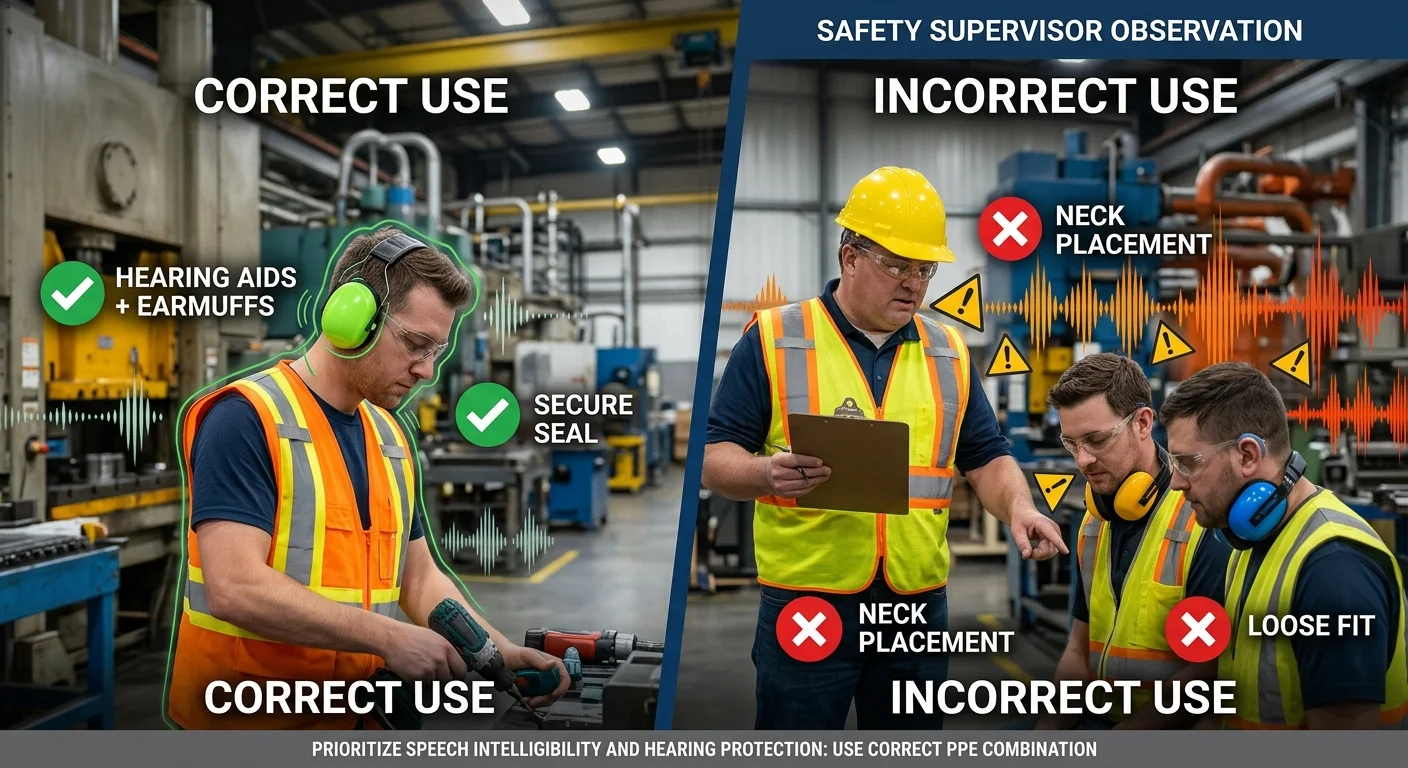 The right product in the wrong hands still fails. A CDC/NIOSH 2023 report found that 40% of workers in high-noise industries use hearing protection the wrong way — and that mistake drives 15% of all noise-induced hearing loss cases. That’s not a product problem. That’s a behavior problem.
Here are the mistakes that silently erase your NRR:
1. Wrong Earplug Insertion Technique
Shallow insertion is the single biggest performance killer. Workers get half — sometimes less — of the rated noise reduction because the foam didn’t go in deep enough. The Roll-Pull-Hold method fixes this every time. WorkSafeBC traced 20% of occupational NIHL claims back to insertion errors alone. Hands-on training per CSA Z94.2 cuts improper use by 22%.
2. Broken Earmuff Seal
Eyeglasses, thick sideburns, and hard hat edges all create gaps in the cushion seal. That gap lets noise pass through the muff — even during full-shift wear. Check your seal often. Go with helmet-mounted designs where headgear is required.
3. Mismatched NRR for the Environment
30% of construction workers pick the wrong protection level. Always cut your NRR by 25–50% before trusting the label. Above 105 dB, no single device is enough — you need double protection.
4. Reusing Disposable Earplugs
OSHA audits in 2022 found 25% of workers using damaged or poor-fitting devices. Foam earplugs are single-shift tools. Use them once, then replace. Reusable earplugs need soap, water, and dry storage after each use.
5. Removing Protection — Even for a Moment
A Kimberly-Clark survey found 89% of safety professionals had seen PPE noncompliance on the job. Hearing protection ranked second at 18%. The most common reason? Workers felt it “wasn’t needed.” Short removals in loud zones build up hearing damage just as surely as never wearing protection at all. Five minutes without protection in a 100 dB zone can undo hours of safe exposure.
6. Skipping Training
OSHA’s 2022 data tied 10% of noise violations to poor training. Workers who don’t know the right technique can’t fix their own mistakes. Field attenuation testing paired with hands-on instruction closes that gap faster than any written policy. Give your team a chance to practice — not just a pamphlet.
| Mistake | How Common | Protection Loss |
|---|---|---|
| Incorrect use | 40% of workers | 15% of NIHL cases |
| Wrong NRR selection | 30% of construction workers | Up to 50% |
| Hearing PPE noncompliance | 89% observed by safety pros | 100% preventable |
| Improper earplug insertion | 20% of NIHL claims | 50% or less of the rated NRR |
The pattern is the same across every mistake: the device was there, but the behavior wasn’t. Fix the behavior, and the NRR number on the box starts to mean something.
Hearing Protection PPE FAQ: Expert Answers to the Most Common Questions
These questions come up all the time — on job sites, in safety meetings, and from HR managers who need straight answers before an OSHA audit.
When does OSHA require hearing protection?
The trigger is an 8-hour TWA of 85 dBA or higher. At that point, employers must provide hearing protection at no cost. They also need to train workers on proper use and confirm the correct fit. No exceptions.
What’s the real difference between NRR 33 and NRR 25?
Less than you’d expect. Real-world fit issues push actual attenuation well below 50% of the label rating. NRR 33 delivers around 15–20 dB in practice. NRR 25 lands closer to 10–15 dB. The one number worth trusting? Your Personal Attenuation Rating (PAR) — and you only get that through fit-testing.
Do earplugs damage your ear canal over time?
No. Clean reusables after each use and swap out disposables every shift. The real risk isn’t physical damage. It’s an infection from poor hygiene.
Can earmuffs be worn with glasses?
Yes, but there’s a catch. Temple arms pressing against the cushion cut attenuation by 5–10 dB. Low-profile frames close that gap.
Is fit-testing mandatory?
Not yet. That said, OSHA’s 2026 Bulletin and NIOSH’s updated QNFT policy have made it the clear best practice. Quantitative fit-testing gives you your actual PAR — not a lab average that may have nothing to do with your real-world protection.
How do you confirm protection is adequate above 90 dBA?
Start by measuring your TWA. Then derate the NRR — subtract 25% for foam plugs, 50% for all other types, then take off another 7 dB for A-scale conversion. Run a fit-test to get your PAR. Your target is protected exposure at or below 85 dBA. Schedule retraining each year. Also, reassess any time noise levels shift.
Conclusion
Your hearing doesn’t come back once it’s gone. The right earplugs or earmuffs are all that stand between you and permanent damage.
Here’s what matters most: match your hearing protection PPE to three things — your noise level, your environment, and how long you’ll wear it. NRR ratings aren’t just compliance numbers. They’re the line between protected and exposed.
Foam earplugs work well for all-day comfort. Industrial earmuffs are better for high-decibel work sites. Either way, the worst choice is no choice at all.
Don’t overthink it. Follow these steps:
- Use the scenario-based recommendations in this guide
- Check your workplace’s OSHA hearing protection requirements
- Pick the option that fits your situation
Next step: Get a sound level meter reading for your environment. Then check the comparison table above. Five minutes of smart selection today could protect the next fifty years of your hearing.