

Finding a reliable KF94 mask shouldn’t feel like a research project. Yet here you are — tabs piling up, still unsure whether Good Day is worth your money or just another name in a crowded market. That doubt makes sense. Not every mask stamped with “KF94” delivers equal protection. The differences between brands matter far more than most product listings show.
This review takes a hands-on look at Good Day KF94 mask filtration performance, its boat-shaped fit, all-day breathability, and how it stacks up against strong competitors like Bluna and BOTN — so you can stop researching and start breathing easier.
What is a Good Day KF94 Mask? (Brand & Certification Background)
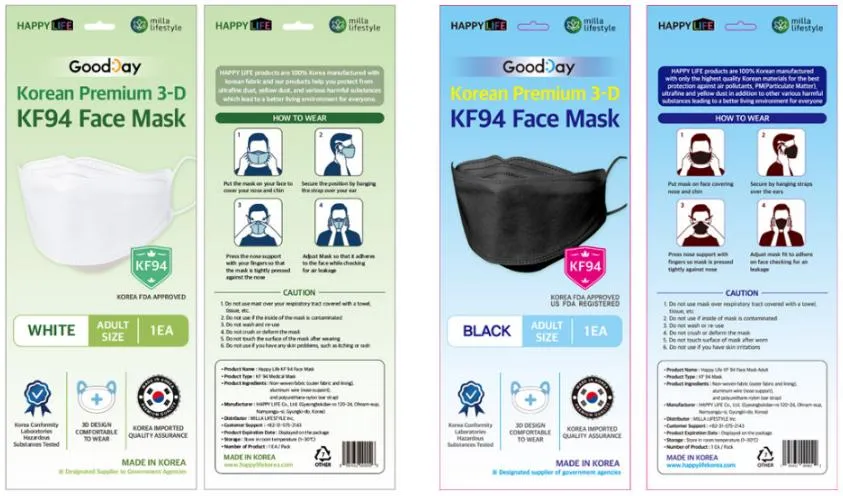
Good Day is a KF94 mask made by Happy Life Co., Ltd., a South Korean company. Supply chain reviews confirm it as a legitimate Korean producer. You’ll find it listed alongside other verified KF94 brands — and that distinction matters more than it looks.
The “Made in Korea” Requirement Isn’t Just a Label
KF94 certification requires Korean manufacturing by law. Not as a marketing claim. As a hard condition. The Korean Ministry of Food and Drug Safety — the MFDS (also called KFDA) — certifies each KF94 mask through a strict process. That includes lab testing, product safety data, and ongoing inspections of thousands of masks each month. Good Day masks print “Made in Korea” on both packaging and their website. Happy Life also appears on MFDS verified manufacturer lists.
Korea treats counterfeiting as a serious crime. Penalties include heavy fines, sales suspension, and up to five years in prison. In April 2021 alone, authorities prosecuted 11.4 million fake masks. That strict enforcement is why KF94 holds stronger credibility than KN95 — KN95 depends on self-attestation, with no equivalent government oversight.
What does the KF94 Standard require?
The KF94 standard isn’t a rough guideline. It’s specific:
- ≥94% filtration efficiency for particles as small as 0.4 microns
- Mean total inward leakage under 11% across real human test subjects
- Mandatory fit-testing on actual people — not just mannequins
- CO₂ clearance testing to confirm safe breathability during extended wear
Independent lab results often show KF94 masks hitting above 98% filtration efficiency — well above the certified minimum. To put that in perspective, surgical masks sit at 50–70% filtration. KF94 matches N95 and FFP2 standards, even though it’s built for public use, not occupational settings.
One thing worth noting: a correctly worn Good Day KF94 mask is rated for 40 hours of total wear. So don’t treat it as single-use — it’s built to last through multiple sessions.
Good Day KF94 Mask Filtration Performance: Does It Hit 94%?
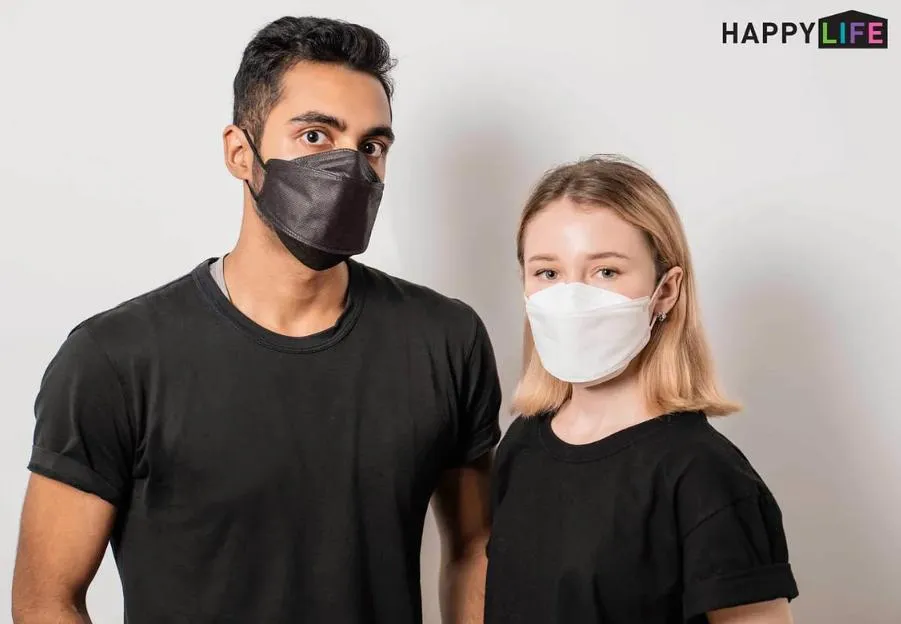
94% sounds like a clean, confident number. But what it means on your face, in a crowded subway car, on a regular Tuesday — that’s a more complicated story.
Start with what the certification guarantees. KF94 masks must filter at least 94% of particles as small as 0.4 microns, tested at a flow rate of 160 liters per minute. That flow rate matters. N95s are tested at 85 L/min. The KF94’s higher flow rate means the filter material faces greater air pressure during testing — and still has to pass. Good Day’s mask, like other certified KF94s, claims 99.9% Bacterial Filtration Efficiency (BFE).
Independent lab results back this up. Across comparable KF94 models tested using PFE machines:
- Nepure KF94 : 99.91% filtration / 94.2 Pa resistance
- Flexmon Kids KF94 : 99.60% / 113 Pa resistance
- Wellkeeps Premium KF94 : 99.85% / 60.3 Pa resistance
These results aren’t outliers. They show up consistently. The 4-layer meltblown construction standard in KF94 masks drives this performance — well above the 2–3 layer surgical mask, which tops out at 50–77% filtration.
The Part No One Talks About: Fit Changes Everything
Here’s where the number gets humbling. Flat-plate lab tests measure the filter material itself. Real-world wear is a different situation.
Researchers tested KF94 masks on real people — real faces, real movement, real gaps. Total filtration efficiency dropped to 57–77%, with leakage reaching up to 43%. Compare that to a well-fitted N95, which leaks just 3%.
Seal quality alone swings performance by 9%. A near-perfect fit scores 86% fitted filtration efficiency. Major leaks pull that down to 60%.
This isn’t a flaw unique to Good Day. It’s the reality of any mask that isn’t custom-sealed. The KF94 boat shape works to close this gap. It keeps the filter material away from your mouth and nose, which improves airflow and widens the contact perimeter around your face. But the seal still comes down to your face shape and how carefully you put it on.
So — does it hit 94%? The filter material does. It clears that bar with room to spare. Whether you get 94% depends on whether you nail the seal.
3D Boat-Shape Design & Fit Test: How Well Does It Seal?
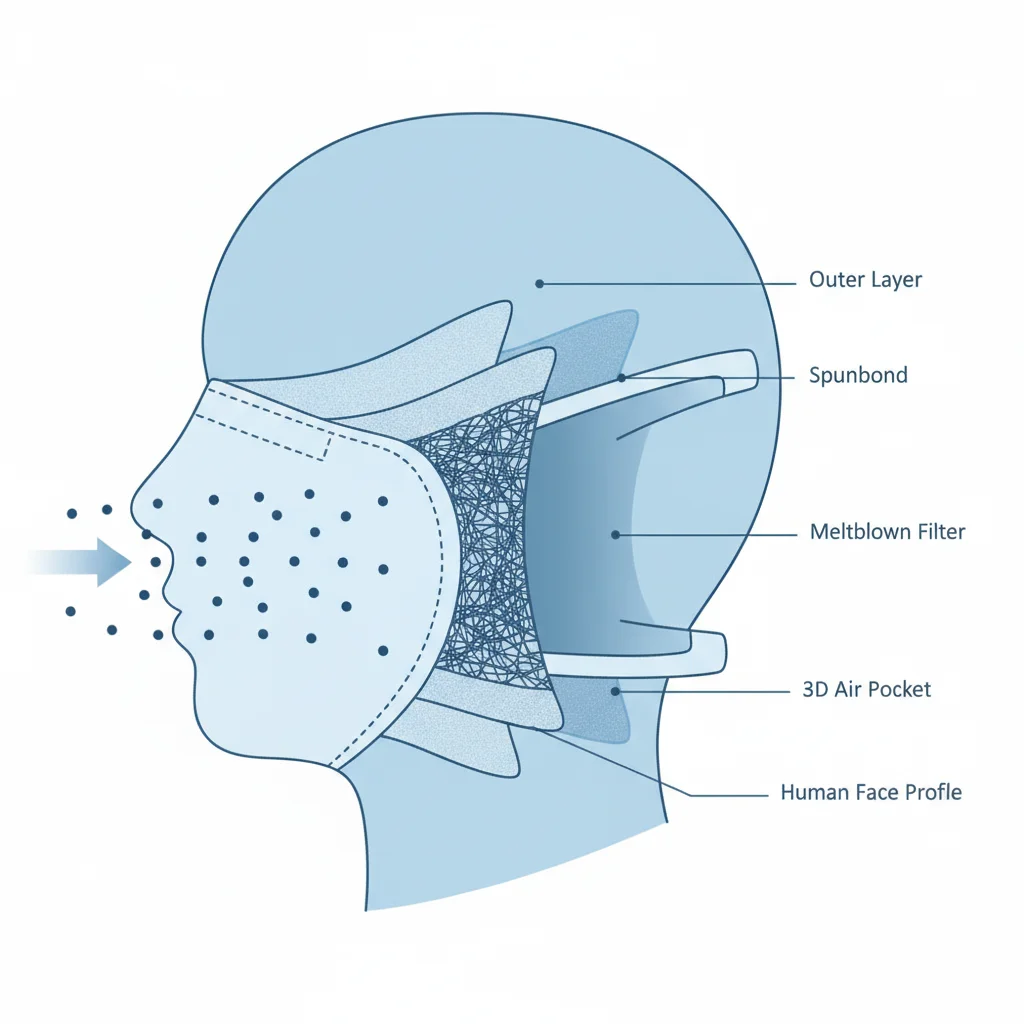
The shape of a mask is not decorative. It is functional — and for the Good Day KF94 , the boat shape is the whole argument.
Flat-fold masks press straight against your lips and nose. The KF94’s 3D boat-shaped structure works differently. It creates a tent-like air pocket between the filter material and your face. That space matters. The filter stays on your mouth as you breathe in. You also get more interior volume to draw air from. The result is a roomier feel — less like wearing a mask, more like wearing a shield that happens to sit on your face.
How the Seal Actually Works?
The Good Day KF94 uses a dual ear-loop and nose wire system to hold its seal. The nose wire bends with light pressure across the bridge of your nose. No aggressive shaping needed. Press from the center outward with two fingers, and it conforms to your face with a clean fit.
The boat shape’s wider perimeter reaches lower toward the chin and wider toward the cheeks. That extra coverage gives the seal more surface area to work with. More contact points mean fewer gaps — which is why KF94s tend to outperform surgical masks on fit.
For most adult faces, the standard size holds in place. The chin cup stays put without riding forward. The cheek edges don’t gap or lift during normal jaw movement, even while talking. Glasses wearers will notice minimal fogging with the nose wire fitted well — a small but meaningful everyday win.
One Honest Caveat
Very narrow faces or shorter chin-to-nose distances can cause the boat structure to sit proud rather than flush against the skin. The mask still works — but getting a solid seal takes more careful adjustment.
The Good Day KF94 doesn’t reinvent the boat-shape category. It just does it well. For most wearers, that consistent, structured fit is what makes it worth grabbing.
Breathability & All-Day Comfort: Can You Wear This for Hours?
Eight hours is a long time to have anything pressed against your face. Breathability isn’t a comfort bonus — it’s the deciding factor between a mask you’ll wear all day and one you’ll peel off by noon.
The Good Day KF94’s boat-shaped structure earns its keep here. That interior air pocket keeps the filter material off your lips and nose. Your exhaled breath has room to move. Less heat builds up. Less of that suffocating, fogged-in feeling that makes people ditch their face masks halfway through a commute.
What the Numbers Tell You?
Breathability comes down to moisture vapor transmission rate ( MVTR ) — how fast humidity escapes the interior. Here’s what the numbers mean in practice:
- Low-intensity wear (office work, quiet commute): an MVTR around 5,000 g/m²/24h keeps things dry and comfortable across an 8-hour stretch
- Moderate outdoor activity : you want 10,000+ g/m²/24h — below that, internal temperature climbs to 95–98°F within 45 minutes
That’s not protection. That’s punishment.
Most wearers report an adjustment window of 15–30 minutes with a fresh KF94. After that, the air inside the mask settles into a stable microclimate. Masks with higher air permeability — tested under ASTM D737-18 — drop interior humidity by around 10% after moderate activity. Small margin, but a real difference by hour three.
One Thing Worth Knowing Before Your First Wear
You may notice a faint chemical smell on first use. It comes from polypropylene off-gassing in the meltblown filter layer. This is common across KF94 masks — not something specific to Good Day. The smell fades after 24–48 hours of open-air exposure. A light spray of alcohol cuts the intensity by 50–70% within 10 minutes if you’d rather not wait.
KN95s use harder, less flexible structures. Beyond two hours of active wear, they get uncomfortable fast. The Good Day KF94 wears lighter and stays that way across a full day.
Good Day KF94 vs. Bluna vs. BOTN: Which Korean Mask Wins?
Three certified KF94 masks. One comparison. The right mask for you depends on more than any single spec on the label.
Good Day holds its place here as a certified, properly manufactured KF94 face mask at a price most people are fine with — around $1–2 per mask. That’s a fair price for a Korean air filtration mask with real MFDS backing. Bluna and BOTN, though, have spent years building reputations with data to back them up. So here’s an honest look at where each brand stands.
The Numbers Side of Things
Filtration efficiency is where the gap shows up.
Bluna posts tested results of 99.6–99.9% filtration across its 4-layer construction. BOTN lands at 98.9–99.8%, depending on size. Good Day, as a certified KF94, meets the legal minimum of ≥94% — but independent test data on the same level as Bluna and BOTN isn’t as easy to find.
That’s not a dealbreaker. It’s a transparency gap worth knowing before you buy.
On breathability, BOTN reports a pressure drop of 0.26 inH2O. That’s a real number. It tells you breathing stays easy during extended wear. Bluna performs at a similar level, though the black colorway feels a bit stiffer than the white version. Good Day passes the standard KF94 flow-rate test at 160 L/min. That confirms basic compliance — but it won’t tell you how the mask feels six hours into a workday.
Fit Is Where the Brands Diverge Most
This part is what shapes your daily experience.
Bluna comes with adjustable earloops, a sculpted 3D structure, and a nose bridge that fits well on smaller or narrower faces. It earned an “Excellent” rating from Dermatest Germany — no skin irritation, no fogging, no slipping. Long wear sessions are where Bluna stands out.
BOTN takes things further with a double nose wire and a hard-shell structure that holds its shape under pressure. It comes in three sizes — Large (230×150mm), Medium (210×140mm), and Small (180×120mm). That makes it the most flexible option for people who’ve had trouble getting a KF94 mask to seal well. In high-risk environments where a secure fit is non-negotiable, BOTN’s adjustable system is the strongest choice in this group.
Good Day has the boat-shaped structure and nose wire covered earlier in this review. For most average adult faces, that’s enough. It doesn’t reach Bluna’s skin-comfort level or BOTN’s sizing flexibility, but it covers the basics well.
The Honest Breakdown
| Feature | Good Day KF94 | Bluna KF94 | BOTN KF94 |
|---|---|---|---|
| Filtration | ≥94% (certified) | 99.6–99.9% tested | 98.9–99.8% tested |
| Breathability | KF94 standard-compliant | Excellent; black version slightly stiffer | 0.26 inH2O (strong performer) |
| Fit System | Nose wire, standard boat shape | Adjustable loops are great for smaller faces | Double nose wire, 3 sizes, hard shell |
| Skin Comfort | No third-party certification | Dermatest “Excellent” | Dermatest “Excellent” |
| Price | ~$1–2/mask | Not listed publicly | Not listed publicly |
So — Which One Wins?
It comes down to what matters most to you.
Pick Bluna for all-day comfort. Office days, long commutes, situations where you want a mask, you stop noticing — Bluna handles that well.
Pick BOTN for high-risk settings, an unusual face shape, or the tightest possible fit in this group. The three size options alone make it worth a closer look.
Pick Good Day for everyday use on a budget. No premium markup. It does what a KF94 should do. It just doesn’t have the depth of documented performance that Bluna and BOTN have built up over the years — at least not yet.
None of these are bad mask. They’re just built for different people.
Who Should Buy Good Day KF94 — And Who Should Skip It?
Most disposable KF94 masks don’t fail because of bad materials. They fail because they end up in the wrong hands — wrong context, wrong person, wrong expectations.
So let’s be direct about who Good Day works well for.
Buy It If This Sounds Like You
You commute. You run errands. You live a normal life in public spaces. Good Day’s KF94 certification filters over 94% of particles down to 0.4 microns — and real-world BFE testing hits 99.9%. For daily transit, crowded markets, and general outdoor exposure, that’s not just adequate. That’s strong protection.
You’re watching your budget without cutting corners. A 10-pack of wrapped masks runs $7.99–$10.90. That’s about $1 per mask for Korean MFDS-certified, FDA-listed filtration. The math works.
You’ve struggled with mask discomfort. The KF94 flow rate is tested at 160 L/min. Compare that to N95’s 85 L/min. You get easier breathing, less resistance, less heat buildup, and none of that pressed-against-your-face feeling by hour four.
You need options for the whole family. Good Day covers kids as young as two with Extra Small sizing (167×72mm), youth with Small (184×72mm), and standard adult sizing. All meet the same certified standard.
Skip It If This Is Your Situation
You work in healthcare or high-exposure clinical settings. KF94’s airflow is a daily advantage — but in prolonged, high-risk medical environments, N95’s tighter seal is the safer call. Some regulatory requirements also mandate N95 by name. Good Day isn’t built for that context.
You have sensitive skin or strong reactions to new materials. The initial polypropylene off-gassing noted earlier in this review is mild and short-lived. Still, sensitive skin or chemical odor reactions could make the break-in period harder for you than for most users.
You need Bluna- or BOTN-level documented performance data. Good Day does what a certified KF94 should do. It just doesn’t carry the same volume of third-party testing transparency that those brands have built up. Published filtration data matters more to you than price? Start there.
The honest summary: Good Day KF94 is a solid everyday mask for most people. It’s not built for operating rooms. It’s built to get you through your Tuesday — and at that, it delivers.
Where to Buy Good Day KF94 Mask & How to Spot Fakes
.jpg)
Good masks are useless if you can’t get them — or if they’re fake.
KollecteUSA is the main source for the adult black version. Stock runs thin, and the current listing shows sold out. Restocking is expected, so bookmark it and check back. For kids and youth sizing, PlanetHaloHealth, KN FLAX, and VitalSupply carry 10–20 piece packs at around $1.45 per mask.
Bulk orders cut the cost fast. A 50-piece kids pack drops to $0.30 per mask. Go bigger — 100-piece adult or youth orders through FlexmonUSA — and the price lands in the $0.20–$0.30 range. The sweet spot for bulk savings starts at 50 pieces.
Walmart carries generic KF94 masks. You won’t find the Good Day brand there — just alternatives.
How to Tell a Real One From a Fake?
Counterfeit KF94s are common. They don’t come with a warning label.
Check these four things before you open the box:
- KFDA/MFDS mark on packaging — no mark, no deal
- “Made in Korea” label — Good Day masks come from Happy Life Co., Ltd. That’s the manufacturer. Full stop.
- No “USFDA Certification” claim — KF94 is a Korean standard. The FDA registers products but does not certify KF94 masks. That phrase on packaging is a red flag, not a credential.
- 4-layer construction + BFE 99.9% notation — real masks print this on the box. No fine print, no vague claims.
A listing that skips these details or hides them? Trust your gut. Something’s off.
Final Verdict: Is the Good Day KF94 Mask Worth Buying?
Here’s the honest answer: it depends — but the details matter more than the headline.
Good Day, KF94 gets some things right. It’s MFDS-certified, made in Korea, and each mask comes in its own package. One tested unit hit 95.22% filtration — clearing the KF94 bar and going past N95 standards. That’s real protection.
But quality control is where things fall apart. A second unit tested at 85.779% — below the certified minimum. That gap, in a product marketed as “Premium,” isn’t a small detail. It’s the whole problem.
Then there’s breathability. The mask measures 290 pascals of airflow resistance. That’s close to double the recommended 150-pascal limit. Wearing it for long periods becomes a real issue. Users put it plainly: “super hard to breathe.”
The comfort problems don’t stop there:
– Loose fibers inside the mask shed against facial hair
– A plastic odor that’s stronger than most competing masks
– These issues stack up fast during extended wear
Buy it if:
– You only need short-duration protection
– Filtration efficiency is your top priority above all else
Skip it if:
– You mask for hours at a time
– You’re buying for children
– Batch-to-batch consistency matters to you
Worth noting — Bluna and BOTN both deliver stronger, better-documented filtration results at similar price points. They’re worth a look before you commit.
Good Day isn’t a scam. It’s just an inconsistent product in a category where consistency is the whole point.