

Selecting a reliable disposable coverall manufacturer in India should be straightforward. India is now a major global sourcing hub, but supplier quality varies widely. From chemical-resistant and cleanroom garments to Type 5/6 certified PPE, the wrong choice risks safety and compliance. Based on capacity, certifications, and market feedback, this guide highlights the top 8 disposable coverall manufacturers in India to support confident, efficient sourcing decisions.
1. Welcome Enterprises
Welcome Enterprises built its name on one thing: steady quality across huge production runs. They hold a solid spot in India’s disposable protective clothing manufacturers market.
Their factory handles industrial safety coveralls in India for chemical and pharma uses. The company holds ISO 13485 certification for medical device making. This counts when you supply sterile spaces.
They make SMS fabric coveralls using three-layer protection tech. The spunbond-meltblown-spunbond build gives you fluid resistance. Plus, it breathes well. Their Type 5/6 coverall manufacturer’s rating means protection from solid particles and some liquid splashes.
Welcome Enterprises runs clean room facilities for pharma-grade production. These controlled spaces keep contamination under 0.1%. That’s vital for medical and lab use. Their sterile coverall suppliers division ships pre-sterilized units in sealed packs.
The company focuses on mid-to-large volume orders. MOQ starts at 5,000 units for standard designs. Custom specs require 10,000 pieces. Lead times run 25-30 days for regular stock items.
They’ve landed contracts with Indian pharma makers and chemical plants. Their clients include domestic industrial users and export partners in Southeast Asia.
Antistatic coverall production is another specialty line. These ESD-safe garments use carbon fiber threading. Surface resistivity tests at 10^6 to 10^9 ohms. Great for electronics making and explosive spaces.
2. Morntrip
Morntrip is an experienced disposable coverall manufacturer with a strong focus on large-scale, standardized PPE production. The company is known for its highly integrated manufacturing model, which helps reduce lead times and maintain stable quality across bulk orders.
Morntrip operates automated production lines for disposable coveralls and other non-woven PPE products. In-house control over key production stages allows better consistency compared with suppliers that rely heavily on outsourced materials or processing.
Beyond disposable coveralls, Morntrip manufactures a wide range of PPE items, including flat masks, dust masks, and isolation gowns. This multi-category capability demonstrates solid production management and the ability to support diversified procurement needs.
The PPE supplier follows internationally recognized quality and safety standards, including ISO management systems and relevant ANSI, EN, and ASTM testing requirements. Its products are supplied to industrial users, healthcare distributors, and institutional buyers in multiple export markets.
For buyers seeking reliable, high-volume disposable coverall supply with controlled production processes and predictable lead times, Morntrip represents a stable sourcing option.

3. Shilpee Surgicals
Shilpee Surgicals runs from India’s medical manufacturing belt. They focus sharply on surgical disposables. Their product line goes beyond coveralls. You’ll find surgical drapes, gowns, and patient exam kits.
The company works as a disposable protective clothing manufacturer’s choice for healthcare sites. They serve small nursing homes. Mid-sized hospitals across India use their products too. Their non-woven coverall production relies on polypropylene materials. These garments work well in medical exam rooms and general wards.
Their factory makes basic industrial safety coveralls, India specs. Advanced chemical resistance ratings? Not here. They make standard visitor suits and light-duty protection gear. Prices stay low for routine use.
Shilpee Surgicals has standard medical device-making licenses. You won’t find many public certification details on verification sites. Most buyers reach them through Indian medical distributors. Direct factory contact happens less often.
MOQ starts around 2,000-3,000 pieces. Lead times run 30-40 days based on order details. Their disposable workwear manufacturer’s line fits domestic buyers well. These buyers want cheap protection for non-hazard areas.
Contact info goes through regional sales reps in major Indian cities. Want to visit the factory? Arrange it ahead through their Mumbai sales office.
4. Dispowear
Dispowear runs factories across India and Sri Lanka. They focus on two markets that most competitors overlook. You get disposable protective clothing for medical centers. Plus, they supply hospitality, spa, and salon businesses with specialty non-woven products.
Their non-woven coveralls use SMS fabric technology. That’s a three-layer build: spunbond-meltblown-spunbond. This material stops fluids but lets air pass through. Their surgical gowns give strong protection for operating rooms. Drape sets come ready to use for different medical procedures.
Their certifications check out: ISO 13485 for medical device making, ISO 9001 for quality management. They have CE and FDA approvals, too. ISO 11607 covers their packaging for sterile medical devices. Ethylene oxide sterilization? They handle it in-house. Every product comes with a two-year quality guarantee.
The product range goes way beyond basic industrial safety coveralls in India. You’ll find three-ply face masks, bouffant caps, and shoe covers with anti-slip bottoms. Disposable lab coats are in there, too. Their spa line includes massage gowns, facial masks, and terry towel slippers with EVA soles.
What makes them different? They care about the environment. They use recyclable or biodegradable non-woven fabrics. OXO degradable options come in 45 GSM weight. You don’t see that much among India’s disposable workwear manufacturers.
MOQ changes by product – 50 to 500 pieces. Standard delivery takes 4 days. Pack sizes reach 100 pieces for salon aprons. Everything is 100% Made in India under the MII initiative.
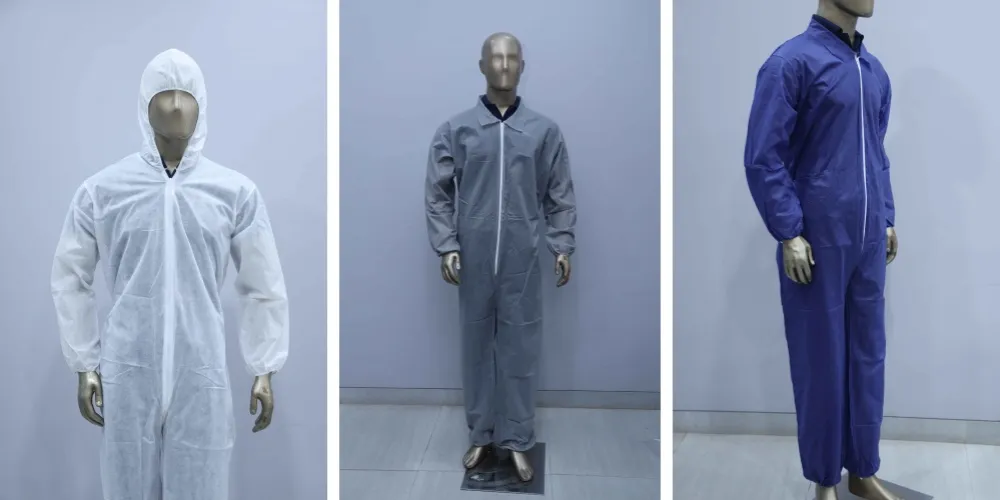
5. Cortex Products Solution Private Limited
Cortex Products Solution Private Limited started in September 2019 in Ahmedabad, Gujarat. The ₹1 lakh paid-up capital looks small. But they’ve built a strong spot in the medical disposable protective clothing market. This happened in just six years.
The Body Coverall is their main product. It’s a quality non-woven coverall production made for healthcare. Materials follow medical rules. The gear lasts through long shifts. Fabric lets air pass but stops viruses.
They sell many products: Full Gown Sets (HIV kits), isolation gowns, and breathable viral barrier gowns. You’ll find PPE kits, face shields (300 micron and PET), surgical drapes, and strong surgical gowns . These aren’t simple disposable workwear manufacturers’ products. Operating rooms use them. Infection control zones need them.
Hospitals, clinics, and nursing homes across India buy from Cortex. Bulk orders? They handle those. Rush jobs? They ship fast. The distributor network covers the North, South, and Central regions. Union Territories too. Partners need 500 sq.ft. space. City-level delivery chains help. Good profits and clear terms close deals.
Medical-grade protection with quick delivery? Cortex gives you that.
6. Surya Textech – Medical & Industrial PPE Manufacturer
Surya Textech leads non-woven coverall production with serious manufacturing power. Their Kala Amb facility processes 1,000 metric tons of fabric each month. That’s 7,200 MT per year. Most competitors can’t match these numbers.
Anuj Gupta runs a 26-50-person team. They’ve been making technical textiles for over 15 years. The company has served 500+ happy customers. Revenue hits ₹25-100 crore each year. They registered for GST in 2017.
The fabric uses three layers with bi-component spunbound material. It meets AAMI Level 4 standards for body coveralls. Surgical gown fabrics weigh 50-62 GSM at 160 cm width. Single-use applications? They handle it perfectly.
Look at their certifications: AAMI PB70, EN 13795, EN 1149-5, EN 14325, and EN 14126. These aren’t just badges. The fabric blocks fluids. It resists chemicals. It protects against biological threats.
You get more than coveralls. Spunmelt fabrics, laminated materials, and SureTx wipes are all available. Their PPE line serves the medical and industrial sectors. Products range from chemical-resistant coveralls to sterile surgical fabrics.
Import Export Code 2206001543 proves they work in global markets. HSN codes include polypropylene and polyethylene materials. Manufacturing, warehousing, and depot operations all happen in one place.
Need bulk orders with AAMI Level 4 protection? Surya Textech has the capacity.
.jpg)
7. S.K. Enterprises
S.K. Enterprises runs a small factory in India’s protective clothing business. Their money forecasts show slow, steady growth through 2030.
Revenue climbs from ₹175 lakhs in 2026 to ₹256 lakhs by 2030. That’s about $210,000 to $307,000 USD. Net profit margins stay around 3%. They made ₹5.25 lakhs profit in 2026. This grows to ₹7.68 lakhs by 2030.
Their trading account shows how they operate. Raw material purchases eat up most costs – ₹171 lakhs in 2026 alone. Power and fuel cost ₹5.25 lakhs each year. Direct labor costs ₹14 lakhs in 2026. This number rises to ₹20.48 lakhs by 2030.
Here’s the big problem: ongoing cash flow issues. Their quick ratio stays low. Quick assets just barely cover short-term debts. This money strain stops them from handling large orders. It also blocks them from upgrading capacity.
Plant and machinery lose 15% of their value each year. Fixed assets fell from ₹39.7 lakhs in 2026 to ₹24.4 lakhs by 2029. The company needs ₹75 lakhs in financing to keep running.
8. Mallcom India – Infectious Disease Control Focus
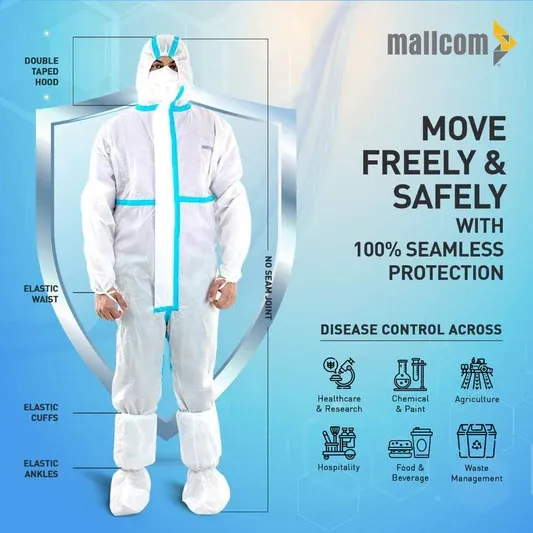
Mallcom India Limited focuses on one part of PPE making: infectious disease management and hazmat applications. The numbers prove their timing is right. India’s infection control market hit USD 1.2 billion in 2024. Forecasts push it to USD 2.1 billion by 2033. That’s a 6.27% CAGR over nine years.
Healthcare infections drive this growth. Hospitals and clinics need constant PPE supplies. Mallcom jumped right into this demand wave.
The Asia Pacific hazmat suits market grows at 6.82% CAGR. Mallcom shows up as a key player in regional reports. India? The fastest growth rate at 9.9% CAGR. Government safety rules push this. So do growing sectors like chemicals and mining.
Global market data shows where the money goes. Biohazard and infection control applications grabbed 43.38% revenue share in 2024. Level C suits took 36.59% of the total market share. Healthcare buyers made up 26.76% of demand.
Mallcom’s product range goes beyond coveralls. You get nitrile gloves, high-ankle safety shoes, and safety helmets. This range helps infection control teams that need full PPE kits. They make hazmat suits across all protection levels. Each one matches different contamination risks in hospitals, labs, and drug plants.
Hospital buying teams and emergency response units are their main customers. The infectious disease control focus sets them apart from general industrial safety coveralls in India .
Quality Standards & Certifications for Indian Disposable Coverall Manufacturers
Three core test standards separate real disposable coverall manufacturers from questionable suppliers. Your factory visit checklist needs ASTM F1670/F1671:17 for synthetic blood penetration resistance. Look for ISO 16603:2004 certifications. This proves microbial barrier effectiveness. Confirm IS 16546:2016 compliance – India’s national standard for protective clothing.
Raw material quality matters as much as the finished product. Top manufacturers test fabrics against ISO 16604, EN 14126 Annex A, ISO 22611, ISO 22612, EN 16604 , and ASTM D1238. These standards cover chemical permeation and seam integrity under stress.
Testing Infrastructure That Works
9 laboratories across India can conduct Synthetic Blood Penetration Resistance Tests. All have NABL accreditation (National Accreditation Board for Testing & Calibration Laboratories). Here’s where you’ll find them:
- Defence Research and Development Establishment (DRDO), Gwalior
- South India Textiles Research Association (SITRA), Coimbatore
- Six Ordnance Factory Board facilities: Heavy Vehicle Factory in Chennai, Small Arms Factory in Kanpur, two Ordnance Factories in Uttar Pradesh, one in Ambernath (Maharashtra), and Metal & Steel Factory in West Bengal
- Textiles Committee, Mumbai
The Textiles Committee built its lab setup and earned NABL accreditation in 45 days flat during COVID-19. Regulatory bodies can move fast.
The UCC Certificate System You Can’t Fake
Every real disposable coverall manufacturer uses a Unique Certification Code (UCC) embossed on each coverall. This code links to a prototype sample that passed testing. You’ll see the manufacturer name, production date, and client name stamped right there.
Smart buyers verify UCC Certificates on official DRDO, OFB, and SITRA websites before signing orders. The affidavit behind each UCC includes manufacturing unit details, GSTIN number, company registration, and Udyog Aadhar number. Plus a sworn statement that the applicant makes textiles, not just trades them.
The 8-Out-Of-319 Reality Check
By March 28, 2020, 8 suppliers from 319 Indian firms had samples cleared for SITRA-specification coveralls. SITRA reviewed 50 samples over two months. They approved just 8. Three from South India, five from North India. That’s a 16% approval rate.
This tough filtering protects you from factories that claim skills they don’t have. AAMI 4-level compliance sets the baseline for medical-grade coveralls . The American National Standards Institute (ANSI) and the Association of the Advancement of Medical Instrumentation (AAMI) created these benchmarks for fluid barrier performance.
Quality Oversight That Follows Your Order
The Indian government requires certified players across the full chain for body coveralls. Random sampling happens at manufacturing sites. Visual inspection checks size and spec conformity. Technical inspection teams visit during production runs. Disposable coverall manufacturers own quality outcomes – not distributors or middlemen.
Pandemic challenges exposed gaps. At first, 2 authorized testing labs operated nationwide. West Bengal had zero facilities. Lockdowns delayed testing timelines. These problems forced rapid infrastructure growth. Now you have 9 accredited labs and stricter tracking protocols protecting your procurement process.
Cost Analysis: Pricing Factors for Indian Disposable Coveralls
Indian disposable coverall manufacturers face a complex pricing challenge. This challenge affects their entire cost structure. Material choices drive 60-70% of your final invoice. Regulatory compliance testing adds another 12-18%. Shipping issues multiply these costs further.
Material Grades Define Your Price Floor
Polyethylene dominates India’s protective clothing market as the most profitable segment. Chemical plants pay premium rates for polyethylene-based coveralls. The material blocks harsh industrial chemicals. Tyvek spun-bonded nonwoven olefin fabric sets the gold standard for chemical-resistant coveralls. You’ll pay 40-60% more than standard SMS fabric options.
Non-woven fabric prices change often. Polymer costs shift with global oil markets. One quarter polypropylene trades at ₹120/kg. Next quarter it hits ₹185/kg. Your disposable protective clothing manufacturers can’t lock prices beyond 90 days. Markets change too fast.
Standards Compliance Raises Production Costs
Premium Type 5/6 coverall manufacturers invest in multi-stage testing protocols. AAMI Level 4 certification requires synthetic blood penetration tests. EN 14126 biological hazard testing costs ₹45,000-₹65,000 per product line. Add ISO 16603 microbial barrier verification. These expenses push certified products 25-35% above basic protective wear.
The government relaxed BIS certification rules in June 2020. This helped smaller producers enter the market. But quality-conscious buyers still want international certifications. So we now have a two-tier pricing system.
Shipping Disruptions Hit Your Bottom Line
India imports critical raw materials for sterile coveralls. Global shipping delays push shipments back 3-6 weeks. Port congestion doubles container costs from $2,200 to $4,800. Recent U.S. tariff changes add 15-25% to exported protective apparel costs.
Smart buyers now group orders with disposable workwear manufacturers in Gujarat and Tamil Nadu. These local production centers cut logistics costs by 18-22%. You skip international freight problems. Plus, delivery times drop from 45 days to 12-15 days.
Market data shows the pricing trend: India’s disposable protective clothing market jumped from $448.2 million in 2019 to a projected $1,426.2 million by 2027. That’s 15.5% CAGR growth. Demand grows faster than production capacity. Prices show this gap clearly.
Small businesses face high costs for advanced products. A certified hazmat coverall runs ₹450-₹850 per unit. Buyers on tight budgets choose basic ₹180-₹280 options. These lack premium certifications. You get less protection to stay within budget limits.
Conclusion
India’s disposable coverall market offers scale, innovation, and wide certification depth, but supplier quality varies sharply. This guide breaks down leading disposable coverall manufacturers, compliance standards, pricing drivers, and sourcing risks to help you choose with confidence. If you need customized disposable coveralls or tailored PPE solutions, contact us for a fast, competitive quotation.