

Wearing a mask feels confusing with so many choices on the market. Some feel tight and uncomfortable, while others leave gaps that let particles in. KF94 vs N95 masks have different designs and filtration standards. This guide explains the differences and helps you decide which one gives better protection for your needs.
KF94 vs N95: Key Technical Specifications Breakdown
Both masks filter over 94% of airborne particles. But their testing protocols differ. The numbers on the certification label matter less than how those numbers get measured. Here’s what separates these two respiratory protection standards.
Filtration Efficiency: More Than Just Percentages
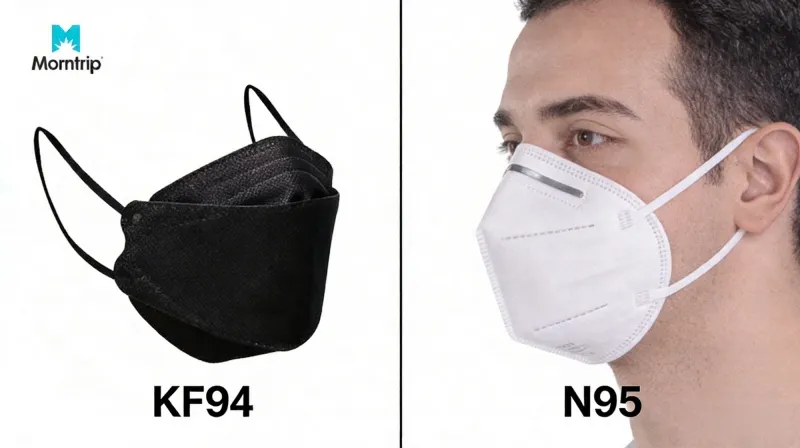
N95 masks filter at least 95% of particles sized 0.3 micrometers or larger. Testing uses a sodium chloride (NaCl) aerosol at 85 liters per minute. No oil resistance here—the “N” designation means non-oil particles alone.
KF94 masks hit 94% filtration for particles 0.4 micrometers and up. Testing uses both NaCl and paraffin oil aerosols at a higher flow rate of 95 liters per minute. This dual-agent approach covers fine dust, bacteria, and viruses more fully.
A 2024 Korean study found that both masks block aerosols just as well with a proper fit. That 1% filtration difference? It disappears in real-world conditions. The seal against your face matters more.
Breathing Resistance: Where Comfort Diverges
Inhalation resistance shows the biggest gap. N95 masks max out at 343 Pascals. KF94 masks stay under 70 Pascals. Lower pressure means easier breathing. You’ll notice this during a long flight or busy day.
Exhalation resistance tells a different story. N95 caps at 245 Pascals, while KF94 allows up to 300 Pascals. The N95 makes exhaling a bit easier. Most users won’t feel this 55-Pascal difference, though.
KF94 standards include a CO2 clearance requirement. N95 testing skips this step. This prevents carbon dioxide buildup inside the mask during extended wear. Travelers spending hours in airports get less of that stuffy, breathless feeling.
Certification Requirements: Philosophy Clash
NIOSH certification for N95 masks demands headstraps, not ear loops. Ear-loop designs fail approval right away. The agency requires strict lab testing for filtration and breathing resistance. Healthcare settings and dusty industrial sites trust this standard.
Korean FDA (MFDS) certification under KMOEL-2017-64 takes a different approach. It allows ear loops while mandating Total Inward Leakage (TIL) stay below 8%. Testing covers filtration, leakage, breathing resistance, and CO2 clearance. The standard serves both public and healthcare contexts.

Fit Testing: Industrial Seal vs Adaptive Design
N95 masks need a tight industrial seal to work properly. Clean-shaven faces are a must—facial hair breaks the seal and ruins protection. OSHA requires workplace fit testing to verify the mask performs as expected. Any gap between the mask and the skin defeats the 95% filtration promise.
KF94 masks use a 3D boat-shape design that molds to different face structures. Multiple sizes fit various facial shapes. Studies show KF94 masks keep their filtration power even with facial hair—something N95 masks cannot claim. Adding ear-loop clips boosts the protection factor to 12.8 times baseline.
This fit approach separates healthcare-grade industrial protection from everyday use. N95 demands precise donning and constant refitting. KF94 focuses on real-world wear without losing particle blocking power. For travelers facing changing situations, that flexibility matters.
Pros and Cons: N95 Masks
N95 masks deliver serious protection numbers. Healthcare workers wearing them face 97% lower COVID-19 odds compared to no mask (OR=0.03, 95% CI: 0.01–0.15). This comes from medical research, not marketing hype. The data shows real risk reduction in hospitals where virus exposure runs highest.
The Protection Advantages
Filtration power reaches 95% for particles at 0.3 micrometers. A 2022 study tracked 1,004 healthcare workers. It found infection rates of 9.27% with N95s versus 10.46% with surgical masks. The numbers look close. But look at a Canadian hospital subgroup. Surgical masks showed 2.83 times higher infection risk (6.11% vs 2.22%).
Source control beats standard masks. This happens when an infected person wears the N95. The mask blocks infectious particles before they spread. Dual masking— N95 under a cloth mask—creates stronger protection. Surgical or cotton combinations can’t match this.
High-aerosol procedures show where N95s shine. Intubating a patient generates massive viral clouds. That 95% filtration becomes critical. An industrial-grade seal blocks about 99% of particles with a proper fit. Medical staff performing risky procedures need this level of protection.
The Real-World Drawbacks
Comfort suffers during long wear. Heat builds up inside. Breathing takes effort. Pressure marks dig into your face. A hospital compliance study found just 81% of staff kept N95s on during full shifts. Remove the mask once, and the protection drops.
Fit testing creates a major barrier. You need professional verification that the mask seals properly. Without it, protection fails. One trial showed almost identical infection rates between medical masks and bad-fitting N95s (HR 1.14). Facial hair breaks the seal. Beards and N95s don’t work together.
Practical headaches stack up. Head straps cause more discomfort than ear loops during 8-hour days. You need the right size—small, medium, or large models—or the fit fails. Extended wear leaves you adjusting again and again.
Cost runs $1-3 per certified NIOSH mask. Bulk healthcare suppliers offer better rates. But you’re still replacing these often. Six trials show wide confidence intervals. These intervals hide potential benefits. This makes the protection-versus-discomfort tradeoff harder to judge for everyday situations.
Pros and Cons: KF94 Masks
KF94 masks filter 94% of particles at 0.4 micrometers and larger. Lab tests push this number to 99.9% under optimal conditions. That’s the certified minimum. Real performance often beats it.
The Filtration and Protection Edge
Healthcare data backs up the numbers. A Journal of Hospital Infection study tracked infection rates among medical staff wearing KF94s. The masks cut COVID-19 risk by a large margin. Duke University researchers found KF94s blocked breathing droplets better than cloth masks, surgical masks, and several other options.
Statistical analysis shows an adjusted odds ratio of 0.17 for testing positive versus wearing no mask. This matches N95 and KN95 performance. You get similar virus protection. No industrial-grade fit needed.
Fit improvements happen with simple changes. Loose KF94 wear shows just 13% of users achieving a fit factor of 100 or higher. Use a tight horizontal 3-fold technique, and that number jumps to 60%. The nose bridge adjusts to create a seal like N95 masks. This barrier stops droplets from sneaking in around the edges.
The Performance Limitations
Protection rates reveal a major gap. Just 1.1% of KF94 wearers hit the fit factor standard. Compare that to 48.7% for N95s (P<0.001). Leakage rates tell the same story—2.8% versus 42.0% (P<0.001). Healthcare settings with spray-making procedures need N95 reliability. KF94s fall short here without changes.
Exercise performance drops with KF94s on. Research subjects completed fewer repetitions (P=0.004) and lower total exercise volume (P=0.002). Breathing volume, oxygen use, and breathing efficiency all dropped (P<0.05). Users reported higher felt effort (P<0.01) and more shortness of breath (P<0.001). Energy use climbed (P=0.002). After a workout, artery stiffness increased. The rise index went up (P=0.0055) and pulse wave speed increased (P=0.0044).
Heart and breathing effects show up even during light activity. Oxygen use drops (P<0.05). The breathing exchange ratio rises at rest and during 10-minute exercise (P<0.05). Blood cell stretch index increases at rest, 10 minutes, and 30 minutes into activity (P<0.05).
Seal challenges stick around. Those low protection percentages point to fit and leak problems. Skip tight-fitting techniques, and you’ll have issues. No studies measure how facial hair or different face shapes affect KF94 performance. This leaves travelers guessing about real-world protection.
Best Use Cases: KF94 vs N95
Pick your mask based on where you go and what risks you face. N95 masks work best in medical settings—48.7% of users get proper protection by fit factor compared to just 1.1% with KF94 (P<0.001). This gap matters for aerosol procedures or work near infected patients. Healthcare workers facing COVID exposure need the industrial seal N95s provide.
KF94 masks work great for everyday life. The 3D boat-shape fits well during long commutes, errands, and office hours. A 2024 study found KF94s block aerosols just as well as N95s under normal breathing. Add an ear-loop clip and protection jumps 12.8 times above baseline. You get N95-level filtration without a rigid seal digging into your face.
Medical and High-Risk Environments
Hospitals need N95 reliability. Testing shows 42.0% protection by leakage rate versus KF94’s 2.8% (P<0.001). Both masks blocked SARS-CoV-2 from coughing patients in controlled tests—0 out of 7 cases detected versus 3 out of 7 with surgical masks . But viral particles stuck to inner surfaces. The big difference shows up during aerosol procedures like intubations. Spray exposure runs highest there.
N95 fit pass rates vary by model. Product B hit 50.0% while Product A reached 33.3%. Product C made just 2.3%. Overall fit factors ranged from 104.64 to 17.64. Got a weak immune system or caring for COVID patients? N95 protection cuts through uncertainty.
Air Travel and Airports
TSA accepts both masks as respirators. Crowded airplane cabins create ideal virus spread. KF94 masks weigh less and pack flat—better for carry-on bags. The 3D structure keeps fabric off your lips during 10-hour flights. You’ll breathe easier than with rigid N95 cups pressing against your face.
N95 masks create a tighter seal once cabin air quality drops. Exhalation resistance runs higher. Travelers notice this during boarding rushes and layover sprints. Pick based on flight length. Short domestic trips favor KF94 comfort. International flights with poor ventilation systems lean toward N95 protection.
Public Use
KF94 masks handle commutes, grocery runs, and public transit without discomfort. CO2 clearance testing stops that stuffy, breathless feeling during long wear. The fit works all day at the office. KF94s keep filtering even with facial hair—no clean shave needed.
Filtration numbers tell part of the story. N95 blocks ≥95% of 0.3-micrometer particles. KF94 stops ≥94%. That 1% gap disappears with a proper fit. Studies show KF94s perform 48% better than surgical or cloth masks overall. Regular errands where you’re not exposed to infected people? KF94 protection covers your needs.
Environmental Protection
Wildfire smoke and construction dust need serious particle blocking. N95 masks deliver industrial-grade seals that stop non-oil particles. NIOSH certification backs performance in harsh conditions. Fit factors peak during deep breathing and back-bending tests—151.97 and 134.57.
KF94 masks handle urban pollution and moderate air quality drops. The 94% filtration rate covers fine dust and exhaust particles. Testing shows KF94s beat KN95 masks with facial hair that breaks the seal. You get reliable public exposure protection without industrial discomfort.
Quick decision guide : Pick an N95 for aerosol procedures, healthcare work, or heavy dust exposure. Choose KF94 for flights, commutes, offices, and times when comfort matters. Fit test both options if possible. A KF94 with ear-loop clips boosts protection 12.8 times—simple upgrade, major impact.
Reusability, Lifespan, and Cost Efficiency
Most N95 and KF94 masks are designed for single-use disposal. Real-world budgets and supply shortages pushed people to reuse them. The cost difference goes beyond sticker price. It’s about how many times you can wear each one safely. That adds up over months of use.
Single-Use Design vs. Extended Wear Reality
NIOSH labels N95 masks as disposable respirators. You’re supposed to toss them after one contaminated exposure. Breathing gets difficult? Time to replace it. Healthcare facilities followed this rule before COVID-19. One patient encounter meant one fresh mask.
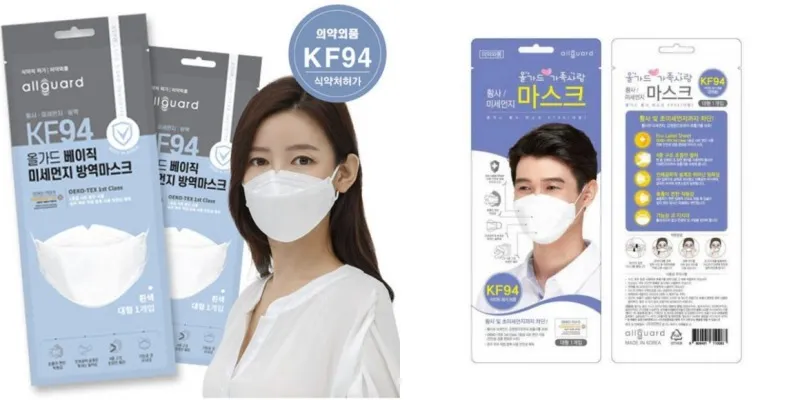
KF94 masks carry the same single-use label from Korea’s Ministry of Food and Drug Safety. The official guidance says discard after each use. Both masks handle extended wear better than their labels suggest.
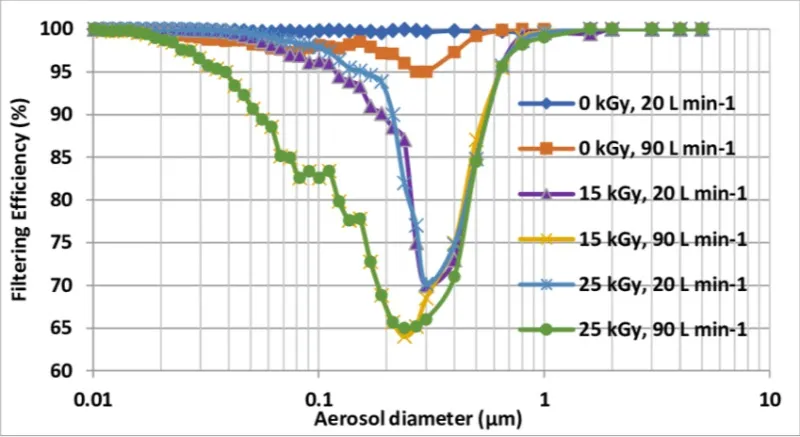
A 2020 CDC study found N95 masks maintained filtration above 95% for up to five donning cycles. Vaporized hydrogen peroxide kept the masks effective. The elastic bands and nose foam stayed intact. Stanford researchers tested UV light sterilization. Masks worked through multiple uses without losing protection.
KF94 masks show similar durability. The 3D boat-shaped structure holds up during repeated wear. Users report 3-5 wears before the ear loops loosen. The nose wire loses shape after that. Store the mask in a paper bag between uses. Let it air dry for 3-4 days. This rotation system extends one mask across several weeks of use.
Real Cost Breakdown: Per-Use Economics
N95 pricing ranges from $1.00 to $3.00 per certified NIOSH mask . Healthcare bulk suppliers offer boxes of 20 for $25-$40. That’s $1.25-$2.00 each. Retail pharmacies charge $2.50-$3.00 for individual masks.
KF94 pricing runs $1.50 to $2.50 per mask from Korean mask manufacturers. Boxes of 50 sell for $60-$80 online—about $1.20-$1.60 each. Retail prices hit $2.00-$3.00 for convenience store purchases.
Single-use disposal at these prices adds up fast. Mask use each day costs $365-$1,095 per year with N95s at $1-$3 each. KF94s run $547.50-$912.50 per year at $1.50-$2.50 per mask.
Extended wear changes everything. Rotate three N95 masks over five uses each. Your cost drops to $73-$219 per year (15 total masks at $1-$3 each, covering 75 use days per quarter). Three KF94 masks at five uses each cost $90-$150 per year (15 masks at $1.50-$2.50).
That’s a 61-83% cost reduction through simple rotation. Reusable packaging studies show similar results. Multi-trip use achieved 61% total cost cuts versus disposables. Your mask rotation delivers the same savings.
Lifespan Factors That Kill Protection Fast
Physical breakdown limits reuse more than filtration failure. N95 head straps stretch out after 8-10 full-day wears. The nose foam compresses and stops sealing. Moisture from breathing breaks down the inner layers. You’ll notice breathing gets easier—that’s bad news. The filter material is breaking down.
KF94 ear loops give out first. Cheap models snap after 2-3 uses. Quality Korean-made versions last 5-7 wears before the elastic weakens. The nose wire loses memory after wearing for around six hours. Can’t pinch it tight to your nose bridge? Protection drops. Contamination shows up as visible dirt, makeup stains, or a musty smell. Toss the mask then.
Storage method extends the lifespan a lot. Stuffing a damp mask in your pocket breeds bacteria. It crushes the filter layers. Hang it in the open air instead. Sunlight provides UV decontamination. Paper bag storage in a dry space works for rotation systems.
Risky Reuse Situations
High-viral-load environments change the rules. Direct exposure to coughing COVID patients means single-use disposal. The mask exterior gets contaminated. Touching it during removal spreads the virus to your hands. Healthcare workers treating confirmed cases shouldn’t reuse masks.
Visible contamination ends the mask ‘s life right away. Blood, body fluids, or heavy dirt mean throw it away. The filter can’t be cleaned without destroying its structure. Soap and water collapse the charge that traps particles.
Structural damage kills effectiveness. Tears, holes, or crushed nose pieces create gaps. Unfiltered air rushes in. A stretched-out head strap won’t maintain the seal. Check the mask before each wear. Pull the straps—if they don’t snap back tight, the mask is done.
Cost-Per-Protection Calculation for Travelers
A two-week international trip needs different math. Pack seven N95 masks at $1.50 each ($10.50 total). Wear each mask for two days using the rotation method. You get 14 days of protection for $10.50—that’s $0.75 per day.
Pack seven KF94 face masks at $2.00 each ($14.00 total). Same two-day rotation. Your cost runs $1.00 per day for identical trip coverage.
Compare this to surgical masks at $0.25 each, with single use per day. That’s $3.50 for 14 days. Surgical masks provide about 48% less protection based on filtration studies. You’re trading $7 in savings for much weaker virus blocking. The cost-per-protection ratio favors reusable respirator-grade masks.
Environmental Impact of Extended Wear
Disposable culture creates massive waste. Americans threw away an estimated 7,200 tons of mask waste per month during peak COVID. Most masks contain polypropylene plastic that takes 450 years to decompose.
Extending mask lifespan from one use to five uses cuts waste by 80%. Research shows 50% lifespan increases reduce environmental impact by 33%. Double the lifespan and impact drops 50%. Your rotation system prevents four masks per five-use cycle from hitting landfills.
The economics work like reusable packaging systems. Initial costs run higher—$1.50 for a quality N95 versus $0.50 for a surgical mask. Per-use costs drop a lot. Manufacturing resource costs get spread across multiple wears instead of one. Studies show reusable systems decrease total costs as circulation increases. The same principle applies to your mask rotation.
This cost efficiency matters most during long-term use. Travelers wearing masks each week across a year face different economics than someone needing a mask once. Five uses per mask transforms costs from $912 down to $182—a difference of $730 in savings that justifies buying higher-quality certified respirators over cheap alternatives.
Conclusion
Both KF94 and N95 masks offer top-tier respiratory protection. For maximum safety in high-risk areas, choose N95s with their superior filtration efficiency. However, for long flights where mask comfort level counts, the breathable KF94 shines.
Ideally, pack both: N95s for crowded transit and KF94s for daily exploring. Ready to upgrade your kit? Check out our top-rated, certified disposable masks . The best protection is the one you’ll actually wear. Safe travels, and breathe easy!