

Wrong coveralls cause leaks, heat stress, and wasted money. Different jobs face very different risks, yet buyers often guess. This article explains how Lakeland disposable coveralls fit specific industries, so you can choose the right protection level based on real hazards, not assumptions.
Quick Industry-Based Lakeland Coveralls Selection Guide
Match your industry’s hazards to Lakeland coveralls. This selector helps you find the right fit fast. We’ve mapped common workplace environments to specific coverall series. Protection level, material strength, and compliance standards all factor in.
Chemical Processing & Hazmat Response
ChemMax series works best here. ChemMax 2 handles moderate chemical splash (Type 4/5/6). ChemMax 3 tackles aggressive acids and bases (Type 3). Chemical plants using corrosive liquids need Type 3 certification at a minimum. Emergency spill teams should stock both types. Use ChemMax 2 for routine cleanup. Use ChemMax 3 for unknown substance incidents. These hazmat suit selection standards stop dangerous exposure.
Pharmaceutical & Cleanroom Manufacturing
MicroMax NS and MicroMax TS handle sterile environments. MicroMax NS (non-sterile) fits ISO Class 7-8 cleanrooms in generic drug making. MicroMax TS (sterilized) is required for ISO Class 5-6 areas, like aseptic filling lines. Both offer contamination control apparel with tested particle shedding data. FDA audits demand this proof.
Construction & Asbestos Abatement
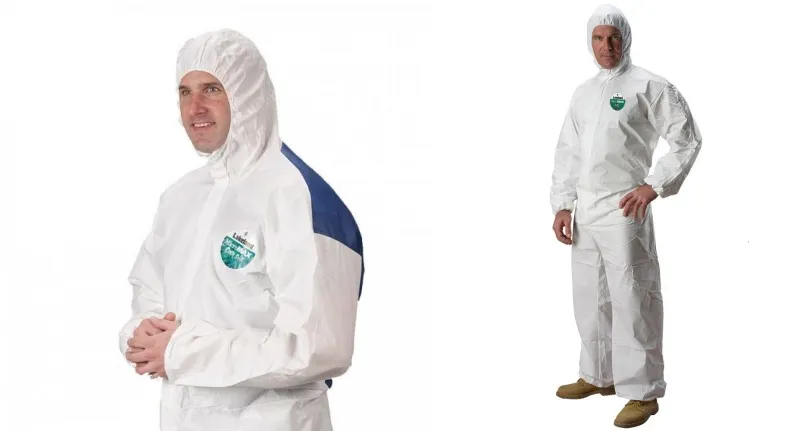
Pyrolon CRFR (flame-resistant) protects welders and demolition crews. Asbestos removal calls for SafeGard SMS Type 5/6. It breathes well but blocks fiber entry. These industrial safety wear options meet OSHA 1926.1101 rules. Plus, they prevent heat stress during 8-hour shifts.
Automotive Spray Painting
Pyrolon Plus 2 gives you paint overspray protection with comfort. The microporous film blocks liquid paint particles. It also lets moisture vapor escape. This prevents the sweat buildup you get with cheaper spray paint coveralls. Body shops report 30% longer wear times versus standard polypropylene suits.
Agriculture & Pesticide Application
SafeGard GP provides budget-friendly Type 5/6 protection for mixing and spraying. The PP+PE laminate resists common herbicides and insecticides. For concentrated pesticide handling, upgrade to ChemMax 1 with taped seams. It costs $8 more per suit. But it prevents the skin exposure incidents that trigger EPA violations.
Food Processing & Sanitation
Standard polypropylene coveralls work for dry goods packaging. Wet processing (meat, dairy) needs MicroMax NS for a liquid barrier plus a lint-free build. The $2.50 price difference pays off. It stops product contamination complaints and failed health inspections.
Decision Shortcut: Unknown chemical? Start with ChemMax 2. Tight budget with low hazard? SafeGard SMS. Cleanroom? MicroMax is your choice. This tiered system covers 80% of industrial uses and keeps safety margins intact.
Understanding Lakeland Coveralls’ Protection Levels: CE Type Classification
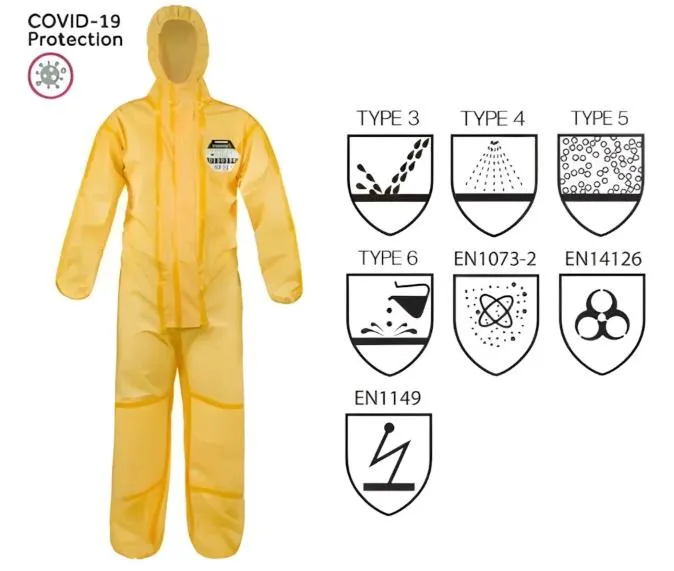
European CE Type ratings show which hazards your Lakeland coveralls can handle. Lakeland certifies its disposable coveralls under four main categories. EN standards define each one. Each Type tackles a specific threat. Know these differences. You avoid wrong protection choices that expose workers or waste money.
Type 3 gives liquid-tight protection per EN 14605. High-pressure chemical jets need this level. So do immersion scenarios. Chemical plant maintenance teams use Type 3 suits. Emergency response crews handling unknown liquids depend on them. These suits block strong acids and caustic bases under high pressure.
Type 4 stops chemical spray per the same EN 14605 standard. Spray-tight construction protects against liquid splashes. This matters during chemical transfer operations. Refinery workers filling tanker trucks need Type 4 coverage. Technicians cleaning industrial reactors need it too. The barrier stops corrosive mists from getting through fabric and seams.
Type 5 defends against dangerous dry particles. It follows EN 13982-1. Asbestos removal crews depend on this protection. Workers handling drug powders need it. The suit blocks tiny solid particles. These particles cause lung damage and contamination. Nuclear facility teardown needs Type 5 certification. Dry chemical handling does too.
Type 6 handles light aerosol and reduced liquid spray per EN 13034. Pesticide application falls into this category. So does general industrial cleaning. The protection stops fine mist from getting through. It still lets you breathe. Agricultural workers mixing herbicides use Type 6 Lakeland coverall suits. Automotive painters use them often.
Material Strength & Performance Standards (EN 14325)
CE certifications follow strict material testing under EN 14325. Durability sets the options apart. Lakeland targets Class 6 tear resistance (>150N). Budget options often just hit Class 2 (20N). This gap matters. A Class 6 suit handles sharp equipment and active movement. Weaker fabrics rip, and you lose safety protection fast.
Chemical & Biohazard Reality
A basic “Type” check falls short. Look at the specific performance classes:
- Type 6 Chemical Defense: Lakeland’s MicroMax gets the top rating (Class 3) for liquid repellency. Many generic FSPE fabrics fail Class 1 tests. That $3 saving creates a contamination risk.
- Infectious Agent Protection (EN ISO 14126): For biohazards, MicroMax hits the maximum Class 6 for blood and viral penetration (ISO 16604). Standard SafeGard SMS often scores just Class 1. This difference keeps hospital and hazmat teams safe from pathogens like Ebola or blood-borne viruses.
Lakeland Coveralls Series Breakdown
Lakeland groups its disposable coveralls by hazard type. Each product line tackles specific workplace dangers. The company’s 2026 product lineup shows what the market wants. Fire Services products brought in 53% of total revenue by Q3 FY2026. Sales reached $25.3M, up 31% year-over-year from $19.3M. Acquisitions like Veridian and LHD drove this growth. These deals brought $9.9M in Fire Services sales during Q1 alone. To find the right series, match the material performance to your hazard risks.
ChemMax: Multi-Layer Chemical Barrier Systems
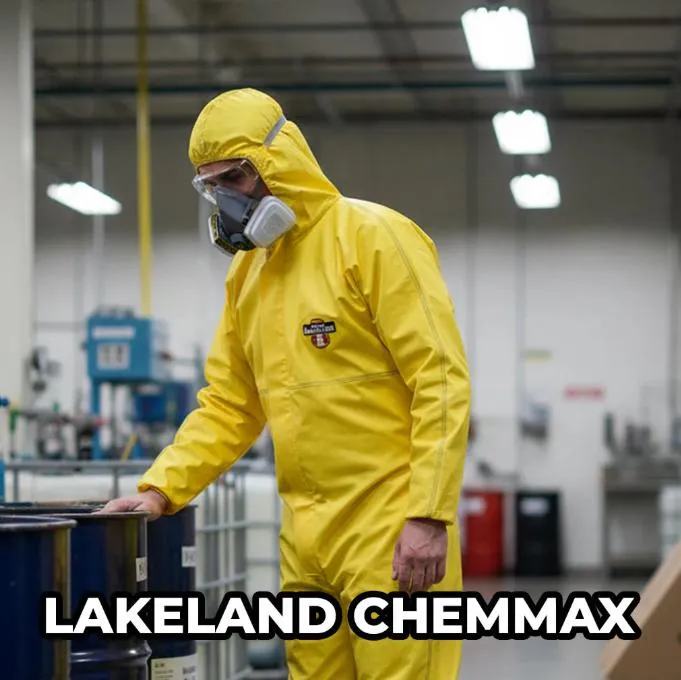
ChemMax is Lakeland’s top chemical defense line . The series uses a multi-layer build. This design blocks harsh chemicals that eat through single-layer fabrics. ChemMax 1 gives basic Type 5/6 protection for dry particles and light spray. Agricultural workers mixing strong pesticides rely on this level. The suits cost $15-22 per unit based on order size.
ChemMax 2 stops moderate chemical splash under Type 4/5/6 certification. The fabric layers a polyethylene coating over spunbond polypropylene. Chemical plant workers move corrosive liquids every day. They need this spray-tight build. Seams get taped with heat-seal technology. This removes the needle holes in sewn garments. Pricing runs $22-35 per suit. This cost stops skin exposure incidents that cause OSHA violations and workers’ comp claims.
ChemMax 3 gives liquid-tight Type 3 protection . Emergency crews dealing with unknown chemical spills stock this level. The suit stops high-pressure jets and full dips. Tests show it resists over 230 chemical attacks. Sulfuric acid, sodium hydroxide, and chlorinated solvents can’t get through. Safety managers pay $45-65 per suit. This premium prevents major exposure events that close facilities for weeks.
ChemMax 4 Plus adds flame resistance to Type 3 chemical protection . Refineries and petrochemical plants face two hazards at once. Workers handle flammable liquids near spark sources. The fabric meets EN 14605 chemical standards and EN ISO 14116 flame spread limits. This combo prevents burn injuries from standard chemical suits catching fire during flash events.
MicroMax: Breathable Microporous Film Technology
MicroMax suits industries that need particle barriers plus comfort . The microporous film lets water vapor pass through. Sweat gets out while liquid chemicals stay blocked. This breathing feature cuts heat stress during long wear. Pharmaceutical techs working 8-hour cleanroom shifts report 30% less fatigue versus sealed alternatives.
MicroMax NS (non-sterile) fits ISO Class 7-8 cleanroom spaces . Generic drug plants use this spec. The Lakeland coveralls suits hit Class 6 maximum rating on EN ISO 16604 blood pathogen tests. Hospital cleaning teams need this proof. Pricing sits at $8-12 per garment. The clean-processed fabric sheds minimal particles. Outside testing confirms <400,000 particles/m² release rates.
MicroMax TS comes double-bagged and gamma-ray sterilized . Aseptic pharmaceutical filling lines require this status. The suits meet ISO Class 5-6 rules for sterile mixing. FDA inspectors check documents during facility reviews. Each case includes Ca ertificate of Irradiation proving sterility. This proof prevents audit issues that delay product releases. Units cost $15-20 each, but the stop contamination risks are worth millions in thrown-out batches.
SafeGard and Pyrolon: Budget-Conscious Protection
SafeGard SMS layers spunbond-meltblown-spunbond polypropylene . Construction and general industrial users get Type 5/6 coverage at $4-7 per suit. Asbestos removal crews taking down ceiling tiles pick SafeGard. The material breathes on its own. Workers skip the heat exhaustion from film-coated suits. But blood pathogen tests show just Class 1 performance. Healthcare jobs need MicroMax.
Pyrolon series adds flame resistance for spark work . Pyrolon CRFR protects welders and metal workers. The fabric puts itself out after ignition sources vanish. Pyrolon Plus 2 works for automotive painting jobs. Microporous film blocks liquid paint drops. Moisture vapor still gets out. Body shops say the suits last through several paint sessions. Standard polypropylene spray paint coveralls quit after one use.
This product setup lets you match industrial safety wear specs to real workplace chemicals. Unknown hazards? Go with ChemMax 2. Tight budgets with confirmed low risks? Use SafeGard. Cleanroom work? You need MicroMax certification proof. Each Lakeland coveralls series covers different safety needs without overlap.
Lakeland Coveralls Material Selection: Balancing Protection, Comfort, and Cost
Raw materials take up 70% of manufacturing budgets in protective textile production. This directly affects what you pay. Lakeland builds coveralls from five core material types. Each one balances protection, comfort, and price in different ways. Know these material costs. You’ll avoid paying too much for features you don’t need or buying too little protection.
Core Material Categories and Cost Positioning
Polypropylene (PP) fabrics are the budget option. SafeGard SMS coverall suits use spunbond-meltblown-spunbond PP. They cost $4-7 per unit. The three-layer build blocks particles through mechanical filtering. The nonwoven structure breathes well. But it doesn’t resist liquid chemicals well. PP absorbs very little moisture. Workers stay cooler than in film-coated suits. Construction teams pick PP for 8-hour asbestos removal shifts. The material can’t handle strong solvents and acids, though.
Polyethylene-coated fabrics give you better chemical barriers. ChemMax 1 puts PE film over a PP substrate. Price runs $15-22 per suit. The coating blocks pesticide sprays and mild acids. Air flow drops compared to plain PP. Workers sweat more during summer outdoor jobs. The $8-15 price jump gets you Type 5/6 certification. EPA pesticide handler rules and OSHA chemical standards require this.
Microporous film technology fixes the air flow issue. MicroMax has tiny pores. These block liquid drops but let water vapor through. Tests show 30% less heat stress than solid PE films in pharmaceutical cleanrooms. The material reaches Class 6 pathogen resistance —the highest rating. Units cost $8-12 for non-sterile versions. Sterile gamma-irradiated MicroMax TS costs $15-20. Compare this to flame-retardant cotton at $2.50-4.00/m². Or basic waterproof Oxford at $0.65-1.50/m². You pay more for both barrier and breathability.
Multi-layer laminates give top protection. ChemMax 3 has a liquid-tight build. It combines a PE outer layer, support fabric, and sealed seams. The system blocks over 230 chemicals. This includes concentrated sulfuric acid. Price hits $45-65 per suit. Emergency response teams pay for unknown chemical events. One prevented exposure saves $50,000+ in medical costs and OSHA fines.
Certifications and Compliance Requirements of Lakeland Coveralls
Regulatory bodies don’t accept “protective clothing” as a category. They want documented proof that specific garments meet defined standards. OSHA, EPA, FDA, and international agencies require certification marks on every coverall before it enters regulated workspaces. Missing these credentials triggers compliance failures during audits. Material quality doesn’t matter if you lack proper certification. Lakeland builds its product lines around core certification frameworks that cross multiple industries.
- CE Marking (EU Regulation 2016/425)
Disposable coveralls fall under Category III PPE, requiring third-party certification and ongoing audits. - ANSI/ISEA 101 (United States)
Defines minimum performance requirements for disposable and limited-use coveralls used across U.S. industries. - NFPA 1992 / NFPA 1994
Required for fire service and hazmat response involving liquid splash or CBRN threats. - EPA Worker Protection Standard (40 CFR Part 170)
Governs chemical-resistant clothing for pesticide handling in agriculture.
Certification marks must be supported by test reports and conformity documentation during audits. Lakeland maintains ISO 9001-certified manufacturing systems to support consistent compliance.
How to Decide and Budget for Lakeland Coveralls?
Smart buying balances safety, volume, and total cost. Picking the cheapest Lakeland coverall often hurts you. You might save $6 on a unit, but you risk $700,000 in contamination losses. Follow this simple plan to protect your profits.
Steps Before Buying
Assign roles first. Safety names the hazards. Procurement works on the price. Operations track the waste. Set your criteria before you call vendors:
- Chemical Match: List every substance. Note how long the exposure lasts.
- Standards: Pick the CE, ANSI, or NFPA rules you need.
- Price Limit: Set a max price per unit. Base this on your yearly needs.
Gear failure happens? Upgrade it right away. An $850 upgrade costs way less than a $180,000 facility shutdown.
Budget and Control
Skip static budgets. Plan for low, baseline, and high use scenarios. See a spike? Check it fast. Better training on suit reuse saves thousands. Lock approved specs in your system. This stops generic substitutes that fail inspection. Check your spending every month. You catch fit issues fast this way. Have surplus funds? Build emergency stockpiles instead of losing that budget.
Common Lakeland Coveralls Selection Mistakes and How to Avoid Them
Purchasing teams waste 15-25% of PPE budgets on wrong Lakeland coverall choices every year. These errors burn money. They also create exposure incidents, compliance failures, and production shutdowns. Five patterns show up across industries. Spot them before your next order.
Mistake #1: Prioritizing Price Over Hazard Match
Buyers see $4 SafeGard SMS coverall suits versus $28 ChemMax 2 options. The $24 savings look good on spreadsheets. Then, the chemical splash breaks through the serged seams during pesticide mixing. EPA violations cost $37,500 in fines. Plus $8,200 in medical monitoring for the exposed worker.
Fix this: Start with chemical compatibility data, not price comparisons. Match your substance list to permeation test results. Budget the minimum protection level that stops your specific hazards. A Georgia agricultural operation saved $6,400 each year by switching from over-spec ChemMax 3 to properly-matched ChemMax 1 for their herbicide work. Right protection. Lower cost.
Mistake #2: Ignoring Certification Requirements Until Audit Time
Safety managers assume ” chemical-resistant coveralls ” meet regulatory language. OSHA inspectors ask for ANSI/ISEA 101 documentation during facility reviews. Your vendor can’t provide test reports. The citation adds $13,653 per violation under current penalty structures.
Fix this : Download the regulation text before specifying products. Circle every certification term: Type 3/4/5/6, NFPA 1992, EN 14126, ANSI/ISEA 101. Request notified body certificates from vendors. File these with purchase orders. One Texas refinery avoided a $68,000 multi-violation penalty by keeping cert files. These files proved compliant with hazmat suit selection during their 2024 Process Safety Management audit.
Mistake #3: Single-Size Inventory for Diverse Workforce
Facilities stock Medium and Large coveralls. That’s it. 68% of workers get acceptable fits. The other 32%—mostly women and smaller-framed men—wear oversized suits. Excess fabric snags on equipment. Chemical pooling happens in fabric folds. Or workers skip wearing protection because movement restriction makes tasks impossible.
Fix this : Survey actual worker measurements before bulk ordering. Stock Small through 3XL based on your crew distribution. A pharmaceutical plant added Small and XS MicroMax coveralls after gowning validation showed 22% of technicians couldn’t maintain clean technique in Medium suits. Sleeve pull-back exposed wrists during vial transfers. The $840 inventory expansion prevented contamination risks worth millions in batch losses.
Mistake #4: Mixing Protection Levels Across Similar Tasks
Different supervisors order Lakeland coveralls on their own. Reactor cleaning crews use ChemMax 3 Type 3 suits. Tank farm workers doing the same chemical exposure work get ChemMax 2 Type 4. Both teams face the same substance list. This mix-up signals confused hazard assessment during regulatory reviews.
Fix this : Create task-based protection matrices. List every chemical operation. Assign one minimum suit spec per task type. Lock this into your procurement system. A specialty chemical manufacturer standardized on ChemMax 2 for all routine maintenance across three facilities. Their consolidated 1,200-unit order each year dropped per-suit cost from $32 to $24. Consistent protection. Volume savings.
Mistake #5: Skipping Field Testing Before Large Orders
Purchasing commits to 500-unit minimums based on spec sheets and vendor samples. Workers discover fit problems, mobility restrictions, or heat stress issues after the pallets arrive. You’re stuck with unusable inventory. Return policies don’t cover opened cases.
Fix this : Order 25-50 trial units in your size range. Have workers perform actual job tasks—not just standing around. Check arm reach during overhead valve work. Test squat mobility for drum handling. Verify hood visibility during confined space entry. One construction firm found that their selected Pyrolon CRFR suits restricted ladder climbing. The 50-suit trial cost $850. It prevented a $12,500 waste on 500 unusable units they would have ordered.
Conclusion
Choosing the right protection is about matching real hazards, not guessing. This guide shows how Lakeland Disposable Coveralls align with industry risks, materials, and certifications, helping you protect workers while controlling cost. If you need customized disposable coveralls —size, material, or compliance specific—contact us for a tailored quote and expert support.