

Many people wear surgical masks every day, but not all masks offer real protection. You might wonder why some masks feel safer or last longer than others. Understanding ASTM standards for medical & surgical face masks can clear up the confusion. In this article, I’ll explain what these standards mean, how to read mask labels, and which masks are best for everyday or medical use.
What Are ASTM Standards For Medical & Surgical Face Masks?
ASTM F2100 sets standards for surgical and medical face masks. It uses five key material tests. Each test has strict lab standards and labeling rules. I believe these criteria make medical masks reliable. They block bacteria, particles, and fluids. They also resist flames. This makes them dependable in healthcare settings.
What Does ASTM F2100 Cover?
Scope: This applies to face masks with ties (surgical masks) and ear loops (procedure or isolation masks).
Focus: It tests how the material performs. It does not test overall fit or respirator approval.
Distinct from Respirators: ASTM medical masks block large droplets and splashes. N95 and similar respirators provide airborne protection and tight-fit coverage. They are certified under different standards.
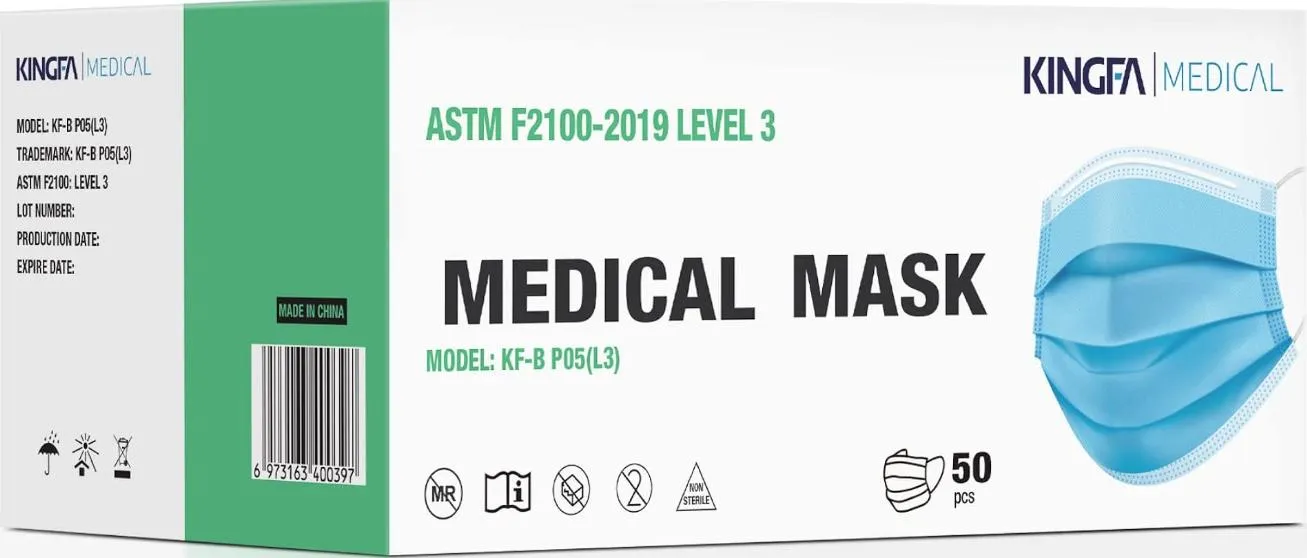
The Five Critical ASTM F2100 Performance Tests
Bacterial Filtration Efficiency (BFE)
This test checks how well disposable face masks block Staphylococcus aureus aerosols (~3 microns).
Level 1: ≥95%, Levels 2 & 3: ≥98%.
I recommend masks with higher BFE. They protect better against bacteria.
Particulate Filtration Efficiency (PFE)
This test uses 0.1-micron sodium chloride particles. It measures how well disposable face masks filter tiny particles.
Level 1: ≥95%, Levels 2 & 3: ≥98%.
Masks filter out small particles and virus-sized threats. Based on my experience, this is critical for safety.
Differential Pressure (ΔP – Breathability)
This measures how hard it is for air to flow through the mask material.
≤5.0 mm H₂O/cm² for Level 1; ≤6.0 mm H₂O/cm² for Levels 2 & 3.
Masks with lower ΔP are easier to breathe through. I suggest choosing these for long-term wear. Comfort matters.
Fluid Resistance (Synthetic Blood Penetration)
This test checks resistance to synthetic blood at set pressures.
80 mmHg for Level 1; 120 mmHg for Level 2; 160 mmHg for Level 3.
This test keeps blood and body fluids from reaching the wearer. A visual check decides if the mask passes or fails.
Flame Spread (Flammability)
This uses 16 CFR Part 1610. It checks if the mask burns at a safe rate for clinical use.
Class 1: Burn time ≥3.5 seconds. This is the safest hospital rating.
Testing Protocols, Data, and Compliance
Required test samples: 32 masks for fluid resistance, 14 for flammability.
Acceptable Quality Level (AQL) of 4% applies for BFE, PFE, and ΔP. This ensures consistent results.
PFE and BFE tests consider face velocity, particle charge, and size. Higher velocities or charges may reduce how well the mask works. I think this is key to understanding real-world performance.
Lab-certified face masks can display ASTM levels (1, 2, or 3) on packaging.
ASTM F2100 does not test mask fit or face seal. It tests material properties.
ASTM Barrier Performance Summary Table
| Test | Measured Factor | ASTM Level 1 | ASTM Level 2 | ASTM Level 3 |
|---|---|---|---|---|
| Bacterial Filtration (BFE) | Bacteria blocking | ≥95% | ≥98% | ≥98% |
| Particulate Filtration (PFE) | Particle blocking | ≥95% | ≥98% | ≥98% |
| Differential Pressure (ΔP) | Breathability | <5.0 mm H₂O/cm² | <6.0 mm H₂O/cm² | <6.0 mm H₂O/cm² |
| Fluid Resistance | Blood/fluids splash | 80 mmHg | 120 mmHg | 160 mmHg |
| Flame Spread | Flammability | Class 1 (>3.5s) | Class 1 (>3.5s) | Class 1 (>3.5s) |
Masks must pass all five certified tests to claim ASTM compliance. They must display the correct level on the packaging. I like this system. It helps healthcare professionals choose the right product for each clinical risk.
ASTM Mask Protection Levels: Level 1, Level 2, and Level 3 Explained
ASTM medical mask standards sort masks into three protection levels. These are Level 1, Level 2, and Level 3. Each level fits different risk settings and fluid exposure types.
Level 1 Face Mask: Basic Protection for Low-Risk Environments
Barrier: Low
Bacterial Filtration Efficiency (BFE): ≥95%
Particulate Filtration Efficiency (PFE): ≥80% (at 0.3 micron)
Fluid Resistance: 80 mmHg
Breathability (Delta P): <24.5 mm H₂O
Use Cases: I recommend this level for routine exams, basic patient care, minor procedures, and ophthalmology work
Comfort: High. Best for long wear where splash risk is low
Level 2 Face Mask: Moderate Protection for Medical Procedures
Barrier: Moderate
BFE: ≥98%
PFE: ≥85% (at 0.3 micron)
Fluid Resistance: 120 mmHg
Breathability: <29.4 mm H₂O
Use Cases: Dental work, general surgery, endoscopy. Good for procedures with light to moderate fluid risk
Balance: This level gives you protection with comfort. It works well for longer procedures or more involved work
Level 3 Face Mask: Maximum Protection for High-Risk Procedures
Barrier: High
BFE: ≥98%
PFE: ≥85% (at 0.3 micron)
Fluid Resistance: 160 mmHg
Breathability: <29.4 mm H₂O
Use Cases: I suggest Level 3 for surgery, trauma care, and orthopedic operations. Also, use it for cardiovascular work and any situation with heavy blood or fluid splatter
Recommendation: Best choice for procedures with the highest fluid exposure
.jpg)
Practical Examples by Level
Level 1: Use during patient visits, minor care, and general check-ups
Level 2: Good for dental procedures, endoscopies, and low-to-moderate fluid risk
Level 3: Use for surgery, trauma cases, ortho cases, and situations with high splatter
Note: Even Level 3 ASTM masks do not replace N95 respirators. They lack a tight seal. They do not filter small aerosols or vapors.
ASTM Mask Levels at a Glance
| ASTM Level | BFE | PFE | Fluid Resistance | Example Use Case | Breathability Standard |
|---|---|---|---|---|---|
| 1 | ≥95% | ≥80% | 80 mmHg | Routine check-ups, minor care | <24.5 mm H₂O |
| 2 | ≥98% | ≥85% | 120 mmHg | Dental work, general surgery | <29.4 mm H₂O |
| 3 | ≥98% | ≥85% | 160 mmHg | Surgery, trauma, high fluid risk | <29.4 mm H₂O |
Summary: Each higher ASTM mask level gives you at least as much protection as lower levels in every metric. But it may offer a bit less breathability. This happens because of increased filtration and barrier features.
The Importance of ASTM Standards During the COVID-19 Pandemic
During the COVID-19 pandemic, ASTM face mask standards played a vital role. ASTM F2100 was key in maintaining mask quality and public health safety worldwide. Demand for surgical and medical masks soared. Some hospitals used 17 times more masks per day than before. The risk of counterfeit and low-quality products increased rapidly.
ASTM F2100 has three standardized levels: Level 1, Level 2, and Level 3. Each level became crucial. They set clear, testable benchmarks for Bacterial Filtration Efficiency (BFE), Particulate Filtration Efficiency (PFE), fluid resistance, and breathability.
Counterfeit Protection and Public Health
Clear labeling and certification protected hospitals and buyers. Tens of millions of counterfeit masks entered the global market. I believe proper standards saved lives. Model data confirmed this: if over 80% of people wore ASTM-compliant masks, COVID-19 deaths could be halved compared to unmasked scenarios. This held true even in hard-hit regions.
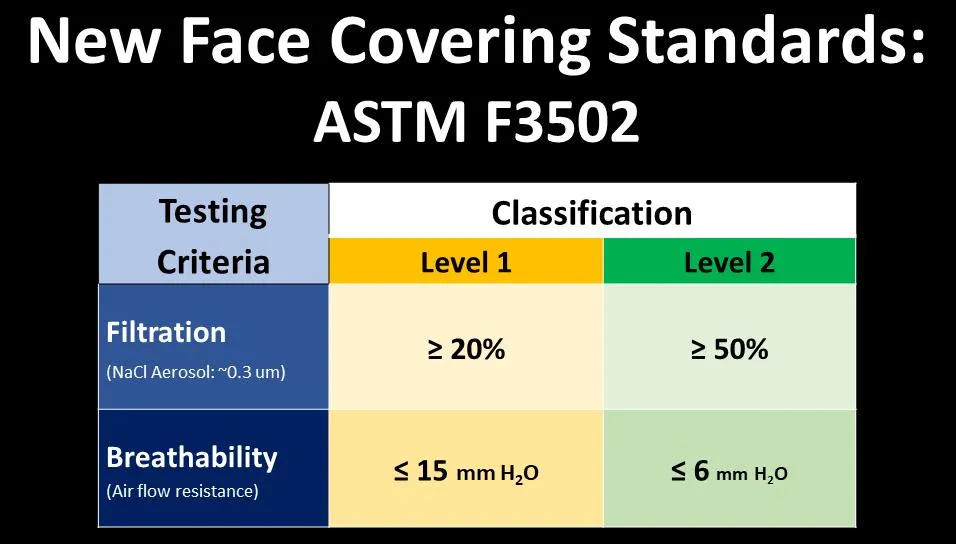
Expanding Standards: ASTM F3502-21
Reusable and non-medical face masks caused confusion. ASTM released ASTM F3502-21 to address this issue. The standard sets requirements for barrier face coverings. These include filtration, breathability, and comfort. This helps control misinformation and supports infection prevention.
Based on my experience, these standards remain critical. They ensure ongoing infection control, healthcare worker safety, and pandemic preparedness. I recommend following the ASTM standards for any mask selection.
How to Choose ASTM-Approved Face Masks?
Choosing the right face mask is important for safety and comfort. ASTM-approved face masks follow ASTM F2100 standards, which check protection against fluids, particles, and bacteria. Knowing how to identify these masks can help you stay safe.
Check Labels and Certifications of Surgical Face Masks
Before choosing face masks, always look at the packaging. Genuine ASTM masks usually show the ASTM level, FDA 510(k) clearance, and ISO 10993 seals. These marks confirm the mask has been tested and meets safety standards. Avoid masks without clear labeling, as they may not offer proper protection.
Select the Right ASTM Level of Surgical Face Masks
Different levels provide different protection:
- Level 1 or 2 masks – Good for public use, like offices, schools, or shopping.
- Level 3 masks – Best for medical professionals or high-risk areas.
Choose the level based on your situation to get the right protection.
Avoid Counterfeit Surgical Face Masks
Counterfeit masks are common. Always check for FDA and ISO marks and buy from trusted vendors. Avoid unknown online sellers or packages that look unofficial. Real ASTM masks are tested and safe, while fakes may look real but fail to protect you.
Prioritize Fit of Surgical Face Masks
Fit is as important as mask quality. Masks with ties can be adjusted for a snug fit. Ear loops are easier to wear but may leave gaps. Make sure the mask covers your nose and mouth fully without gaps on the sides.
By following these tips, you can safely choose ASTM-compliant face masks. Check certifications, pick the correct level, buy from trusted vendors, and ensure a good fit. Doing all this will keep you and others protected.
ASTM Face Mask FAQs: What ASTM Level 3 Means, Reuse Limits, and Mask Comparison
Does ASTM Level 3 mean full protection?
ASTM Level 3 masks offer high filtration efficiency (≥98% bacterial and particulate) and maximum fluid resistance (160 mm Hg to synthetic blood). But proper fit and usage are critical. Any gaps or improper wearing will lower effectiveness. I want to clarify: these are not respirators. They do not filter airborne particles like N95s.
Can ASTM masks be reused?
These masks are single-use disposables. Reuse may harm their filtration, fluid resistance, and fit. There is no ASTM standard for mask reuse. I recommend following the manufacturer’s instructions and institutional guidelines. For best protection, dispose of the mask after each use. This is vital after exposure to aerosols or fluids.
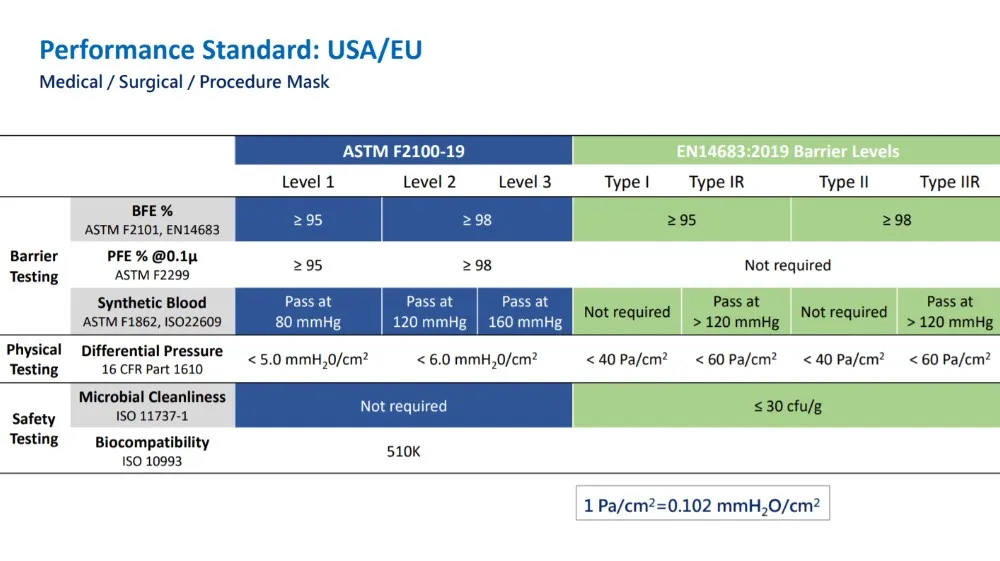
Is ASTM the same as EN 14683?
ASTM F2100/F3502 (US) and EN 14683:2019 (EU) are both medical mask standards. But they differ:
– ASTM Level 2/3 requires≥98% BFE and PFE. EN 14683 Type IIR has similar filtration. But it uses a different fluid resistance testing.
– ASTM Level 3: 160 mm Hg fluid resistance
– EN 14683 Type IIR: 120 mm Hg fluid resistance
Example: An ASTM Level 3 mask offers higher synthetic blood splash resistance than Type IIR.
Are surgical masks better than cloth masks?
Yes, ASTM-certified surgical masks outperform cloth masks. Based on my experience, here’s why:
– Surgical masks: BFE and PFE of ≥98% for Level 2/3
– Typical cloth masks: 20–60% filtration efficiency. Wide variability by fabric and fit.
– ASTM masks provide proven fluid resistance. Cloth masks do not.
– ASTM masks are third-party tested. Cloth mask outcomes depend on material and construction.
Key Data & Real-World Examples
Filtration
- ASTM Level 1: BFE ≥95% @ 3.0 micron, PFE ≥80% @ 0.3 micron
- ASTM Levels 2 & 3: BFE ≥98% @ 3.0 micron, PFE ≥85% @ 0.3 micron (2025 standard), ≥98% @ 0.1 micron in some lab tests
Fluid Resistance
- Level 1: 80 mm Hg
- Level 2: 120 mm Hg
- Level 3: 160 mm Hg
Breathability
- Delta P <24.5 mm H₂O (Level 1)
- Delta P <29.4 mm H₂O (Level 2/3)
Usage Guidance
- CDC/WHO recommends disposing after each use. This is crucial after aerosol-generating procedures or visible soiling.
Common Misconceptions—Expert Clarification
ASTM Level 3 ≠ complete viral protection : Mask fit, handling, and environment matter as much as mask rating. I suggest paying attention to all these factors.
Reusing ASTM masks is not cleared by standards : This results in reduced protection.
Surgical (ASTM Level 2/3) masks give both source control and wearer protection far above cloth masks . This is thanks to stricter regulation and testing. I recommend choosing ASTM-certified masks for medical settings.
Conclusion
ASTM standards ensure medical and surgical masks reliably block bacteria, particles, and fluids while remaining breathable and safe. Level 1, 2, and 3 masks suit different risk settings—from routine care to high-exposure procedures. Proper fit, certified labeling, and correct usage are key to real protection. Compared to cloth masks, ASTM-certified masks offer proven safety. For custom surgical face mask solutions, feel free to contact us for a quote.