

Finding a reliable disposable coverall manufacturer in South Africa is challenging. Whether for Type 5/6 chemical protection, medical use, or SMS coveralls for industrial teams, mistakes are costly. We evaluated 9 disposable coverall manufacturers on quality, certifications, product range, and pricing. This guide provides all the details necessary to make informed, safe purchasing decisions.
#1 Retter Workwear – Industrial Disposable Coverall Manufacturer
Retter Workwear makes flame-resistant coveralls and chemical-resistant coveralls for high-risk industrial work. We focus on fire-retardant boiler suits, standard coveralls, and custom workwear that hits strict safety marks.
Our products serve South Africa’s construction, mining, lab, and chemical processing sectors. Each piece goes through heat resistance tests, durability checks, and fire resistance trials. They meet SABS standards and global safety certifications for hazardous jobs.
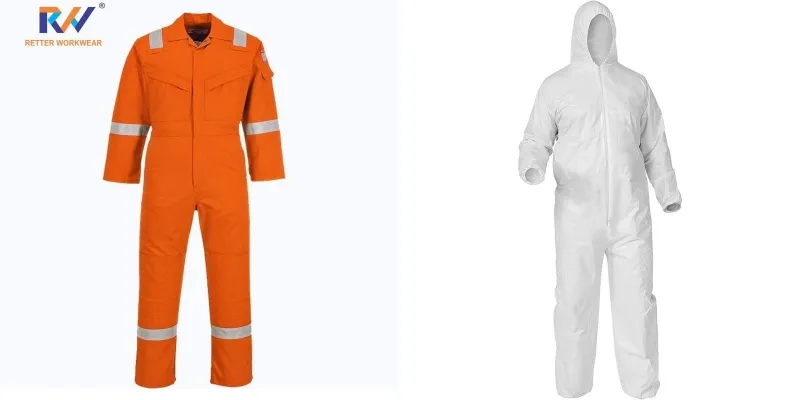
Product Features & Custom Options
You get several protective features:
- Flame-resistant materials certified for high heat
- High-visibility reflective strips for dark work areas
- Breathable fabrics that pull moisture away and cut heat stress
- Chemical-resistant options for handling harsh substances
- Custom sizing and fit changes for different body types
We use recycled and green materials where we can. This meets sustainability goals without losing protective strength.
Pricing & Market Spot
Retter sits in the budget-friendly range. Our pricing makes safety clothing accessible. Small contractors can afford it. Big industrial companies trust it. Volume buyers can work out tiered pricing for regular orders.
We sell beyond South Africa – to India, Denmark, and Ukraine. This demonstrates that our manufacturing remains stable across various safety regulations.
#2 Morntrip – OEM & Bulk Disposable Coveralls Manufacturer for Global Markets
Wuhan Morntrip Trading Co., Ltd. is a China-based OEM manufacturer. They have a strong presence in South Africa’s bulk buying market. Their 500,000-piece production runs each month. This serves buyers who want competitive prices on certified protective clothing. Over 120+ countries buy from Morntrip. This includes European governments and hospital systems in Peru and Spain.
ISO 13485, CE, and FDA certifications back their medical-grade production. The company has 20+ years of experience in the non-woven industry. They make disposable coveralls , isolation gowns , surgical gowns , and full PPE lines. Big buyers who need 250+ SKU orders find their capacity helpful.
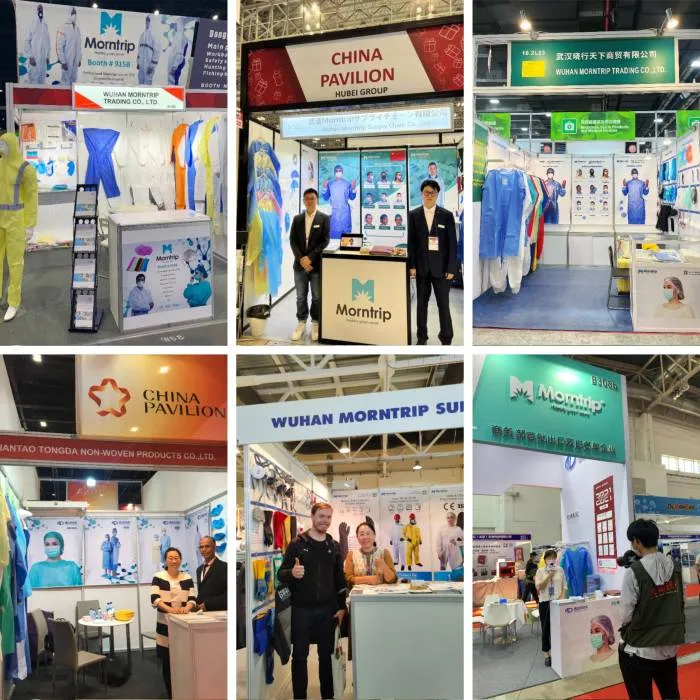
Volume Pricing Structure
Order more and the price drops:
- 3,000-4,999 pieces : US$0.944/piece
- 5,000-9,999 pieces : US$0.912/piece
- 10,000+ pieces : US$0.89/piece
Morntrip’s rates sit below most South African local disposable coverall manufacturers . But you deal with Shanghai port logistics, import duties, and 4-6 week lead times. Currency shifts happen. Plus, you need to order at least 3,000 pieces to start.
European clients like ARCO (UK) and Cofra (Italy) keep working with Morntrip. This shows they deliver quality to strict markets. You can pay with L/C, T/T, D/P, Western Union, PayPal, and MoneyGram. This fits different buying processes.
South African buyers need to weigh local versus import choices. Calculate your total landed costs. Add customs clearance, freight forwarding, and buffer stock needs. Then compare against Morntrip’s per-unit savings.
#3 UVEX South Africa – German-Engineered Multi-Technology Range
UVEX South Africa brings German precision engineering to protective workwear and safety equipment. They serve multiple industries with top-grade solutions. The company operates with ISO 9001 manufacturing standards and ISO 14001 environmental certification. You get complete protection solutions that go far beyond basic disposable coveralls.
Their product range covers eye protection, respiratory equipment, safety helmets, hearing protection, and specialized gloves . Manufacturing sites use these products. So do mining operations, construction zones, healthcare facilities, and food processing plants. This multi-category approach helps companies meet full worker safety standards.
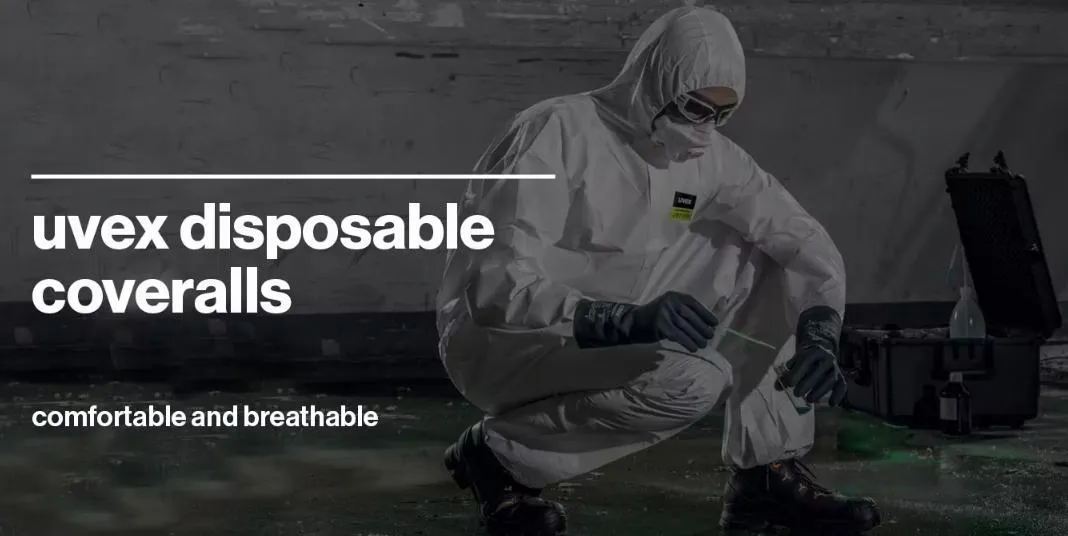
Advanced Eye Protection Technology
UVEX puts serious money into R&D for vision protection. The UVEX Megasonic has a panoramic lens 20% larger than standard goggles. You get optical class 1 clarity—the highest grade you can buy. A 30mm wide adjustable headband fits over prescription glasses. Their supravision coating stops fogging on the inside for good. Plus, it resists scratches on the outside.
The UVEX i-lite (9143265) gives you 91% light transmission with UV400 protection. This blocks 100% of UVA/UVB rays up to 400nm. It meets EN 166/EN 170 certifications with marking W 166 F CE – 2C-1.2 W1 FKN CE.
Blue light filtering comes in two strengths. UVEX CBR65 offers 65% transmission. It filters harmful 380-450nm wavelengths by up to 50%. This works great for indoor/outdoor LED environments. UVex CBR23 has 23% transmission and filters HEV by up to 95%. Use this for high-glare outdoor conditions.
Compliance & Market Position
All products carry EN/ISO/SANS compliance marks. These cover vision, hearing, head, and respiratory categories. UVEX’s RX CD frames meet EN 166 field-of-vision requirements. They include integrated side shields, adjustable earpieces, and nose pads. The design fits Asian headforms (ISO 18526-4:2018).
This German-engineered range sets UVEX apart as a premium multi-technology safety provider. They’re not just another disposable coverall specialist. Procurement teams can get complete PPE solutions from one certified source.
#4 Dromex – Specialized Type 5/6 Protection with HDPE Zipper Technology
Dromex makes dual-certified Type 5/6 coveralls for chemical handling and particle exposure. The microporous spunbond polyethylene laminate gets both EN ISO 13982-1:2004 + A1:2010 (Type 5B) certification for solid particles and EN 13034:2005 + A1:2009 (Type 6) for limited liquid chemical splashes.
Advanced Material Construction
The 65 GSM microporous laminate gives you three key features. First, it breathes well for all-day comfort. Second, bound seams stop particles from getting through. Third, it won’t lint in clean environments.
A hidden HDPE zipper with a storm flap closes the front. This stops chemicals from leaking through the zipper—a weak spot in standard designs.
Elastic at wrists, legs, and waist seal tight against your skin. The hood covers your neck completely. All parts meet EN 1149-5:2018 electrostatic dissipation standards. This matters for work in explosive areas.
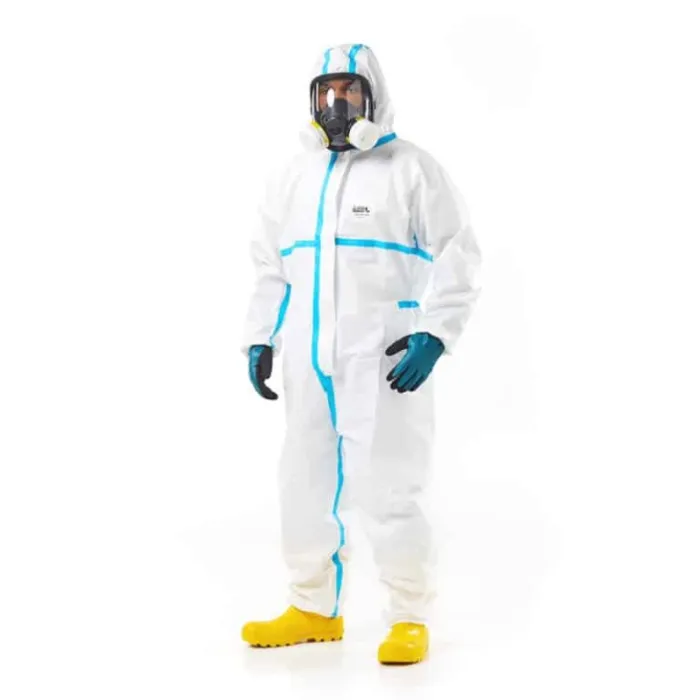
Performance Testing Results
EN 14325 testing shows exact protection levels. Liquid penetration resistance reaches Class 3 against H₂SO₄ 30%, NaOH 10%, o-Xylene, and Butan-1-ol. Tear resistance hits Class 2. Seam strength reaches Class 2. These ratings show how the suit holds up during chemical mixing, spraying, and hazmat cleanup.
Abrasion and puncture resistance both score Class 1. This works for light industrial contact. Heavy-duty abrasion zones need stronger protection. Flex cracking scores Class 6. The material stays intact through repeated bending.
Sizing & Application Fit
Six sizes (S through 3XL) fit body types from 164cm x 124cm chest/inseam up to 190cm x 146cm. Measurements have ±2cm tolerance. This Category III PPE protects your torso, arms, legs, and head from light chemical sprays and fine particles. Use it for pharmaceutical manufacturing, agricultural spraying, asbestos removal, and industrial cleaning.
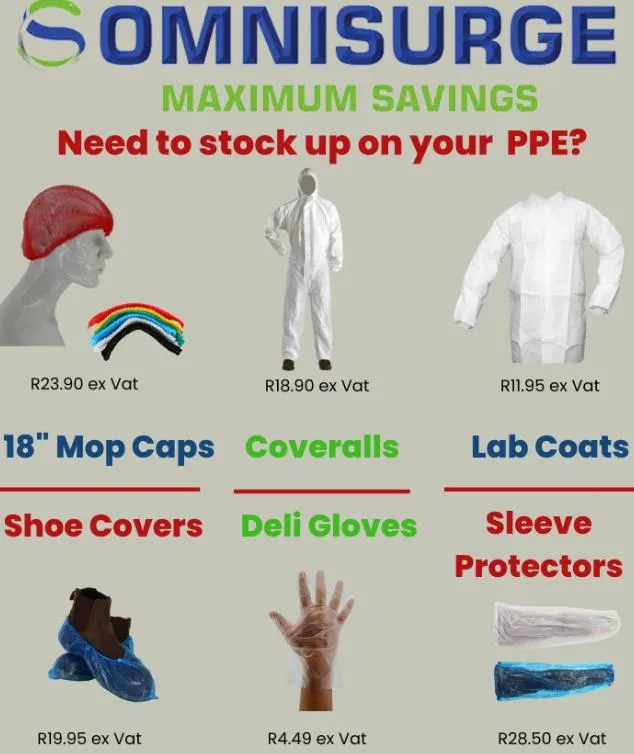
#5 Omnisurge PPE Supplies – Entry-Level Hazmat Protection Specialist
Omnisurge PPE Supplies makes Level D hazmat protection kits for controlled industrial settings. Their PPE Gold brand handles basic contamination scenarios. Think warehouse operations, factory support areas, and non-emergency cleanup tasks. You won’t find advanced chemical emergency gear here. They focus on entry-level protection for atmospheres with ≥19.5% oxygen and minimal hazardous exposure.
Complete Entry-Level Kit Components
A standard Omnisurge hazmat kit includes:
- Laminated multi-layer hooded coveralls with sealed seams and storm flap closure
- Dual-layer
nitrile gloves
(outer gloves + inner exam gloves in two sizes) - HazMat boot liners plus vinyl overboots for liquid splash resistance
- Non-vented safety goggles meeting ANSI Z87.1 + eye protection standards
- N95 respirator masks for particle filtration (not vapor protection)
- Pre-measured ChemTape strips for quick chemical identification
This setup protects against nuisance contamination. Dirt, dust, minor scrapes, and light liquid splashes get blocked. It’s not designed for chemical emergency response. Don’t use it in environments below OSHA limits.
Application Range & Limitations
Use Omnisurge kits in controlled settings where skin contact risks come from non-hazardous liquids or particles. General maintenance, light industrial cleaning, or warehouse material handling all fit. The coveralls block contamination transfer, not chemical vapor penetration. Respiratory protection stops at N95 -level particles—no organic vapors or toxic gases.
Budget-conscious operations find value here. You get complete basic coverage. No paying for certifications or advanced materials your site doesn’t need.
#6 Sutures Suppliers South Africa – Healthcare-Oriented Disposable PPE Provider
South Africa’s surgical sutures market hit USD 95.8M in 2023. The market should reach USD 144.5M by 2030 at a 6% annual growth rate. This medical device sector impacts PPE supply chains. Hospitals buy sutures from the same distributors who sell medical-grade coveralls, sterile gowns, and cleanroom protective clothing.
Absorbable sutures dominate the market with 58.87% revenue share. These materials reached USD 42.2M in 2024. They will hit USD 59.6M by 2030. Needled absorbable sterilized sutures hold 85.78% of this segment. This is the fastest-growing category. Healthcare facilities need matching sterile PPE for surgical rooms.
Ethicon leads South Africa’s 2022 market rankings. Covidien, Arthrex, Smith & Nephew, and B. Braun Melsungen follow. These medical suppliers run distribution networks. You can get Type 5/6 medical coveralls, SMS isolation gowns, and fluid-resistant protective wear from them. Procurement teams bundle surgical supplies with PPE orders. This gets you better pricing.
Direct tender channels control 44.51% of distribution. Government hospital procurement and group purchasing groups lead here. Online marketplaces grow at 6.54% CAGR. This is the fastest digital channel. ORION SUTURES INDIA showed braided dissolvable stitches at the Africa Health shows in South Africa. These medical trade events link PPE buyers with certified suppliers.
South Africa holds 2.1% of the global surgical sutures market. Regional competitors like Saudi Arabia will reach USD 162.9M by 2030. Local healthcare buyers can use suture supplier ties to get ISO 13485-certified disposable coveralls and sterile workwear. Contract rates stay competitive this way.
South Africa’s Disposable Coveralls Manufacturing Landscape
South Africa’s PPE market keeps growing. Revenue hit USD 103.7M in 2024. It’s set to reach USD 149.5M by 2030. That’s a 6.7% compound annual growth rate. Mining expansion drives this. So does automotive manufacturing. Plus, workplace safety rules keep getting stricter.
Protective clothing leads the market . It holds 25.36% of the total market share—the largest piece in 2024. Disposable protective coveralls form the core of this category. Industrial sites need Type 5/6 chemical protection. Hospitals need medical-grade barriers. Mining operations need dust-resistant coveralls in large volumes.
Manufacturing shows a big investment . Dromex Globale runs Africa’s largest PPE facility—an 8,000m² SABS-approved plant in KwaZulu-Natal. They operate 26+ production lines. These produce 500,000 garments monthly. This setup came together in 2019. Back then, competitors moved to cheaper overseas options. Local makers stayed and expanded.
Compliance standards matter here . South African makers must meet SABS requirements. They also need international benchmarks—ISO 13688, SANS 1387, NFPA 70E. Government contracts spell out exact needs: liquid resistance, reflective strips for visibility, and ISO 13982-1 certification for chemical settings. Every batch goes through strict testing before it ships.
What about competition? Saudi Arabia leads the MEA region. UAE’s market heads toward USD 252.8M by 2030. South Africa holds just 1.0% of the global PPE market share. But local makers focus on quality, not price wars. They compete on certifications. They compete on fast delivery (that 500K capacity per month counts). They compete on proven compliance—not cheap quotes from faraway suppliers.
Certification Requirements and Quality Standards in South Africa
South African disposable coverall manufacturers work under strict rules. These rules affect product quality and buyer confidence. The country’s Testing, Inspection, and Certification (TIC) market hit USD 1,622M in revenue during 2024. It’s projected to reach USD 1,935.1M by 2030. Testing services dominate with 79.31% market share. But certification grows fastest as companies chase compliance across multiple standards.
Mandatory SABS and NRCS Compliance
The South African Bureau of Standards (SABS) sets quality benchmarks for protective clothing. The National Regulator for Compulsory Specifications (NRCS) enforces compliance. They require product approvals before sale. Disposable coveralls fall under compulsory specifications in three cases: electrical components (integrated heating elements), chemical-resistant treatments (plastics/polymers), or pressure equipment features (respiratory protection).
NRCS requires disposable coverall manufacturers to submit products for third-party testing at accredited laboratories. SABS-approved facilities issue certificates. No other facilities can do this. Testing covers material strength, seam integrity, chemical penetration resistance, and flame spread rates. Products that fail these tests cannot enter the South African market.
International Certification Requirements
Export markets or multinational chains need ISO 13688:2013 certification as the foundation. This covers general requirements for protective clothing. You get sizing, ergonomics, aging, and labeling standards. Chemical-resistant coveralls add EN ISO 13982-1:2004 (Type 5) for solid particle protection. They also need EN 13034:2005 (Type 6) for liquid splash resistance.
Medical-grade disposable coveralls require ISO 13485 certification. This is the medical device quality management standard. South Africa’s ISO certification market grows at 15.7% each year. It’s reaching USD 32.4M during the current forecast period. Healthcare facilities won’t accept bids without this credential.
Quality Assurance Testing Protocols
Disposable coverall manufacturers run batch testing on every production lot. EN 14325 testing measures six performance parameters. These include abrasion resistance (0-6 scale), tear resistance (0-6), puncture resistance (0-6), liquid penetration (1-6), and seam strength (0-6). Higher numbers mean better protection. Type 5/6 coveralls score Class 2-3 across these metrics.
Electrostatic dissipation testing follows EN 1149-5:2018 standards. Coveralls for explosive environments must discharge static electricity. Test labs measure surface resistivity and charge decay times. Results below specified thresholds earn antistatic certification. This is critical for petrochemical plants and mining operations.
Common Questions B2B Buyers Ask
Procurement teams face challenges when sourcing disposable coveralls in South Africa . These seven questions tackle the key decision points. They’re based on real buyer behavior and supply chain facts.
What’s the lead time for bulk disposable coverall orders in South Africa?
Local manufacturers deliver in 7-14 days for standard orders of 1,000-5,000 units. Dromex produces 500,000 pieces each month. This means a 5-7 day turnaround for rush orders. Custom specs add 2-3 weeks for tooling and testing.
Import orders from China take 4-6 weeks. This includes shipping and customs clearance. Add 10-15 days for NRCS compliance checks if products don’t have pre-approved certifications.
How do I verify that a disposable coverall manufacturer’s certifications are real?
Request certificate numbers. Verify them with the issuing bodies. Check SABS certification through their online database at sabs.co.za. ISO certificates should link to accredited registrars like SANAS-approved auditors.
Get test reports from SANAS-accredited labs for EN/ISO performance claims. Generic “CE marked” statements without notified body numbers mean non-compliance. The NRCS LOA (Letter of Authority) database confirms spec approvals.
Can I get samples before placing bulk orders?
Most South African disposable coverall manufacturers provide 5-10 sample units at cost price. That’s R50-150 per piece, including shipping. Dromex and UVEX offer free samples for verified corporate buyers. You’ll need tax clearance certificates.
Request samples in your sizes. Test seam strength, material breathability, and fit on your workforce. Medium-sized samples don’t show sizing issues. This matters for 2XL-4XL workers common inthe South African industry.
What payment terms do manufacturers offer?
Standard terms are 30% deposit, 70% on delivery for new clients. Buyers with audited financials can negotiate Net 30 or Net 60 credit terms. This happens after 3-6 months of consistent ordering.
Government tenders require bank guarantees. Payment follows 30-day post-delivery cycles. Export orders need a confirmed L/C or 50% advance payment. Currency fluctuation creates this risk.
How do warranty and defect replacement policies work?
Good disposable coverall manufacturers guarantee batch replacement for defects over 2% of order volume. Dromex’s quality system includes pre-shipment inspection reports. They replace entire batches showing seam failures or material problems.
Report defects within 7 days of delivery. Include photos. Keep original packaging. Disposable coverall manufacturers reject claims for damage from bad storage. This means direct sunlight or moisture with over 80% humidity.
Conclusion
South Africa’s disposable coverall market balances quality, safety, and compliance. From industrial Type 5/6 suits to medical-grade PPE, top manufacturers deliver tested, certified protection with fast turnaround and flexible options. Buyers must weigh local versus import choices carefully. For tailored protective clothing or custom specifications, contact us today for a competitive quote and expert guidance.